Sunday, 20 December 2020

Sunday 20th December - The Birth of Venus

 Well, things have somewhat changed in the last 24 hours here in the UK and I hope everyone is finding a way to deal with the adjustment in our expectation of what Christmas is going to be looking like this year.  As long as everyone stays safe and well, it's all fine in the long run, but the uncertainty and changes are hard to keep up with. Hang in there, my lovelies, we'll get through all this nonsense and have a much better time next year.  Anyway, on with today's offering...

The Birth of Venus (1903) Ettore Tito

Good morning Venus! Even being the Goddess of Love being born from sea foam doesn't keep you safe from being kissed first thing in the morning.  Yes, yes, she's lovely, but she's being born right now so can the kissing wait?  Apparently not. Not only that but the chap next to her has decided this is exactly the moment to blow on his shell-kazoo.  Could you all keep it down a bit until the poor lass has had a cup of tea, at the very least? For heaven sake, some people have no respect...

The Birth of Venus (1875) Alexandre Cabanel

Even if you are not being kissed by someone, there is always the noise.  Look, someone has given two of the putti shell-kazoos.  Venus has the facial expression of every parent on Christmas morning as little Tabitha unwraps yet another noising-making present.  Oh look, Grandma has given both you and your brother recorders for Christmas.  How marvellous.  Where's the gin...?

The Birth of Venus (1846) Eduard Steinbruck

"It is kind of you all to come but I have really only just been born and it's a bit early for all this kerfuffle.  Also, I'm not sure four of us can safely fit on my big shell. And Maureen, your bum is showing again, you attention-seeking hussy..."

Venus Born of the Sea Foam (1887) William Stott

I don't know but is it worse that no-one showed up for this Venus's birth? You don't get all the noise and celebrating, I grant you that, but she looks like she's thinking 'I've shown up, so where is everyone else?! I'm fabulous, dammit, come and be astounded by my beauty and stuff!'

The Birth of Venus (1879) William-Adolphe Bouguereau

Oh no, hang on, that's too many people! There is no happy medium and in William-Electric Boogaloo's pearly rendition of the Venus's birth, there are merfolk and putti everywhere.  No wonder this poor Venus has been born standing up, there is barely room to swing a cat. And two shell-kazoos, the horror... 

Okay, this whole being born thing has to be sorted out.  No kissing, no shell-kazoos, the correct number of people and Venus should be coming into the world like an absolute Boss...

The Birth of Venus (1933) George Spencer Watson

Good Lord, that's awful and I love it! Venus seems to be springing to life in an Instagram-able manner just off the Dorset coast, with two dolphin-riding chums, a chap with a really impressive beard and Cupid, striking a pose behind his mum. And there is a rainbow! Definitely #TooBlessedToBeStressed

So, I think the lesson from today's post is less people first thing in the morning is a good thing, no-one should give children toys that make noise at Christmas, and if you have to spring to life in front of people, remember you are fabulous and don't worry that you haven't done your hair. Also, if you fancy buying yourself a little Christmas pressie, you definitely need this...


God bless Santoro's Masterpieces collection for giving me a good many laughs.  You can find this here...

See you tomorrow...

Saturday, 19 December 2020

Saturday 19th December - In Bed

 I am spending the last few days before Christmas frantically tidying the house up.  You'd think that we were hosting some sort of magnificent event, but obviously we're not in any way, shape or form.  It's just the byproduct of 2020, a year when I have had the time to do stuff.  Therefore, with only a couple weeks of this accursed ratpile of a year left, I am making the most of it and cleaning house.  The chickens are in lockdown because of bird flu, therefore I have great plans for getting the garden shipshape in the near future, but just now, it's the house I'm scrubbing.  All of that meandering leads me to a picture today of domestic comfort...

In Bed (The Kiss) (1892) Henri de Toulouse-Lautrec

In a comfortably rumpled bed, a couple embrace.  In the blue-grey of the sheets, the pair seem to glow with pleasure, lit within in whites, pinks and yellows.  This is just one of a series of four images of the couple, all painted around the bed.  Not only that, but it is suggested that the couple are actually two women, painted at a brothel on the Rue d'Ambroise...

In Bed (1892)

It's unusual for Snogvent that we get a series of pictures, but all four seem to include at least one of the girls, if not both (I think it's the same two lasses, just the girl on the left's long hair is sometimes hidden in the bedding).  There is an informal, relaxed cheekiness to the images that we expect from Toulouse-Lautrec, and despite being sexy, the pictures don't feel sordid or voyeuristic. 

In Bed (1893)

Maybe it's because there are four images that we don't get the normal male-gaze, peep-show aspect of some 'intimate' art.  I remember feeling really creeped out by Edward Linley Sambourne's photograph that he took of his maid sleeping, which was presumably taken without her knowledge (let alone permission). No, we get to know Lautrec's women, if only briefly, and we are included in the rosy glow of their love.  Also, unlike some of the icily perfect images of love we have seen, Lautrec shows us love in a cold climate, buried underneath patchwork quilts and sheets, with rumpled bed-hair and smiling faces.

The Kiss (1892)

I'm not sure in what order you are meant to see the pictures, but I like to read them in reverse - they started kissing on the bed then decided it was much too cold for that and also that bloke with a canvas was stood at the end of the bed again, so they went under the duvet and hid, grinning. Lautrec's interest in the prostitutes of Paris, both on and off duty, brings you to wonder what we are seeing here - is this at work or during leisure hours? Is one of these girls a client or a lover? Are both of these girls in the same business and have found romance with someone who understands the life?

Le Sofa (1895)

This is also a painting from Lautrec's brothel phase, showing two lasses, again possibly both in the same profession, or possibly client and prostitute.  This has a far more professional feel to it, the women in their stockings and barely-there (or not) underwear.  The difference between the kissing couple and these women is that there is no mistaking the profession of the women on the sofa.  In contrast, the couple in the bed  have a cheekiness and an almost prim normality.  There is no fluff-flashing, nor stocking tops, just bedspreads and rumpled hair.  The girls in the bed seem off-duty, the two on the sofa seem professional. There is something about a kiss that seems more intimate and meaningful than all the exposed pubic hair.  As Vivian Ward says in Pretty Woman, no kissing, it's too personal. 

On that note, I'm off to hoover and I'll see you all tomorrow (if you can be bothered to get out of bed)...

Friday, 18 December 2020

Friday 18th December - The Kiss

 I've been trying to avoid today's image.  I love the artist, I love his work and don't actually mind this particular art work but it felt like such an obvious cheat to do it, but here we are.  I can't avoid it any longer...

The Kiss (1907-08) Gustav Klimt

Okay, so the reason I was trying to avoid The Kiss (or Lovers as it's also known) is because it is what we would call in the Walker household, the 'Common People' painting.  To explain, I did not go to university, I did my degrees via distance learning and the superb Open University.  However, Mr Walker did university in the traditional sense.  This was the early to mid 1990s and wherever he went, he could not avoid this...


When I met Mr Walker in 1996 he could not stand Pulp because he had spent the last few years just being inescapably saturated in the music.  I, on the other hand, with my university average age of around 60, was quite delighted with the odd, novel bit of Pulp.  However, that rambling nonsense is sort of how I feel about Klimt.  Despite the Pre-Raphaelites being roundly dismissed by art history courses when I was growing up, you could not spit without hitting some Klimt and usually it was The Kiss.  It was bloody everywhere, on biscuit tins, tea towels and my personal favourite, a 3D resin statuette from the National Gallery. I had become too familiar with it and it lost all its power. I no longer saw it, I saw the mass of marketing and merchandising that had surrounded it.  I think one of the tragedies of loving art from a previous era is that we never experience it new, we're never feeling what the artist and their audience felt when the work was first launched onto the scene.  Even with my very limited art experience before my degree, I knew and was immune to the charms of The Kiss.  However, that has all changed...

Water Serpents (c.1907)

My affair with Klimt began with Gladys.  She was a hefty lass that we bought from Ikea to hang in our front room over our sofa.  Turns out her name wasn't Gladys, despite us christening her that, but she was part of a larger image called Water Serpents and she was obviously by Klimt.  Up until that point I hadn't really given Klimt very much attention but I rather loved Gladys in all her nude-y glory.

From The Beethoven Frieze (1901)

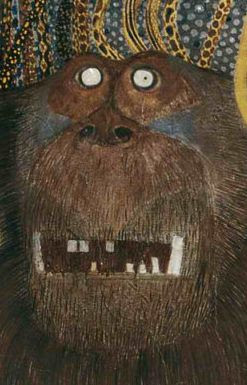
 Then I saw this part of the Beethoven Frieze and I'm sorry, but what in the actual chuff is going on there?!  I wonder if Klimt thought 'I fancy doing something lovely, involving girls, flowers and possibly an animal' and this is what happened.  Here we have Typhoeus, looking like something out of a nightmarish Muppet Show, and his three charming daughters, the Gorgons.  On the right are Lasciviousness, Wantonness and Maureen. On social media, we sometimes play the game of picking which if the nymphs you think you are in Hylas and the Nymphs - it seems deeply inappropriate to do the same here (Bagsy Maureen, as she looks like she knows where the cake is kept)...

Gustav Klimt (and cat)

Oddly, the critics did not take to the glittery hellscape that is the Beethoven Frieze.  It was roundly written off as far too rude and weird, sort of missing the point that maybe that was what he was going for as an interpretation of Wagner's response to the Ninth Symphony.  I think anything that involves both Wagner and the Ninth is going to be a right old palaver, so it's about right, even though the weird giant-y thing will haunt me for a while...

Bernard (35) enjoys gardening, jazz and long walks in the countryside

Swipe left! Left! Damn it, I panicked and swiped right...

Anyway, understandably bruised by the criticism of his enormous artwork, Klimt was filled with self-doubt but determined to do something that people would respond to positively.  In 1908, he revealled Der Kuss (The Kiss), also known as 'The Lovers', a massive canvas almost 6ft square, and decorated with gold leaf, silver and platinum.  The two figures kiss and that's it, but around those two little pink faces are flowers and blocks and all sorts. It has a lot in common with Fulfilment from a couple of years earlier...

Fulfilment (1905-9)

As soon as The Kiss was exhibited (even before he had completely finished it) it was purchased by the Belvedere Museum for a whopping 25,000 crowns overwhelmingly more than the average price paid in Austria for an artwork at the time. Compared with the boobs-and-fluff orgy that is the Beethoven Frieze The Kiss (and Fulfilment) is a modest affair with very little skin showing. So what does it all mean?

Is it just a painting in celebration of a sneaky snog? Obviously art historians are not about to leave it at that and despite Klimt not saying so, have come up with some interesting ideas of what's going on in the picture.  Firstly, they have offered that it might be a celebration of Klimt's love of his artistic collaborator, the designer Emilie Flöge...

Blimey, she rules, look at that outfit! Emilie was a designer and owner of a fashion house, as well as being sister-in-law of Klimt.  The pair of them became long time companions, but the nature of their relationship seems to be up for debate by those who think it's their business to have clarity (such as Germaine Greer, as quoted in Portrait of a Muse, who claims that Klimt never laid a finger on her). Honestly, who cares, because they were obviously devoted to each other. The male figure is meant to be a self-portrait, and it is supposedly a celebration of their love. Well, that's lovely.  Unless, it's another woman entirely and it's all about their love...

Portrait of Adele Bloch-Bauer (1907)

 The extremely famous woman in gold is of course Adele Bloch-Bauer, another woman who definitely had an affair with Klimt unless she didn't.  For a man known for having affairs with lots of Viennese ladies, much like Rossetti he seems to have not slept with many of them. So, maybe that's not what the kiss in The Kiss is about...

Apollo and Daphne (1908) John William Waterhouse

There is a suggestion that the two might be Apollo and Daphne, probably because of the natural patterns that cover the girl.  She seems to be clothed in nature and I suppose it's not a stretch to say that she is being consumed by it as an escape from her lover's attention.  You could read her expression as rather unengaged or unwilling...

Orpheus Leaving Eurydice (1909) Douglas Strachan

 Another explanation is that the couple are Orpheus and Eurydice at the moment that Orpheus turns irresistibly to embrace his lover. The look on the girls face in The Kiss is supposed to be her fate taking hold, pulling her back into the underworld.  The oddly disjointed nature of the flat pattern and the flesh that make up the female figure could be seen as the woman vanishing a piece at a time, fading even as her lover holds her.  She knows she is leaving, so she doesn't return his kiss or even look at him. The man desperately holds her face, but soon even that will vanish.

So, what does this kiss mean? I think it is a comment on love itself.  The gold and precious metals, coupled with the way in which the man holds the girl's face makes me think that love is a precious thing. He holds her like a valuable object and she closes her eyes in appreciation.  Love means being careful with those you value, taking care of them as you would the most valuable thing in the world.  Carelessness and neglect would tarnish them, doubt would damage them.  Those we love need precious care to keep them present. 

Kiss those you love like they are made of gold, and I'll see you tomorrow...


Thursday, 17 December 2020

Thursday 17th December - The Kiss of Peace

 This has been a bit of a peculiar year, to say the least.  One wonderfully sparkly highlight for me has been the publication of my biography of Julia Margaret Cameron and Mary Hillier, Light and Love.  It would be remiss of me to not include one of Cameron's wonderful photographs as part of Snogvent, so let's have this one...

The Kiss of Peace (1869) Julia Margaret Cameron

Here we have little Elizabeth Keown being kissed on the forehead by Mary Hillier. A 'kiss of peace' is a traditional Christian greeting, where a blessing of peace is given to the recipient. These days in church you normally only have to shake someone's hand awkwardly during the Peace, there's no kissing (thank goodness, because it doesn't need to be made more awkward than it already is), unless you belong to the sort of church where you're more relaxed about that sort of thing.  Lawks.  Anyway, it got me thinking about the  the array of meanings of kissing in Cameron's art.

Romeo and Juliet (1867)

It's not that Cameron doesn't do romance - her pride in the match of Mary Ryan, her housemaid, with Henry John Stedman Cotton was expressed through their appearance as Romeo and Juliet on the occasion of their engagement.  It is a bit of a wonder that she didn't go the whole hog and show them as King Cophetua and the Beggar Maid, as Cameron was so proud that her Irish 'beggar maid' would go on to become Lady Cotton.

The Affianced (1867)

It actually came as a surprise when I started thinking and searching for more images of young people in love that I didn't find more than just the Cottons. Heaven knows Cameron was no prude, and had a healthy adoration of handsome men and beautiful girls and all things delicious.  I think The Affianced is one of the sweetest images of love I've seen for ages as they would have had to sit there staring at each other for quite a while while the photograph was taken.  I suppose that is why she didn't do more, as you would have to sit or stand around kissing someone, absolutely still, while the image formed on the plate.  Unless you were very much in love, that would have become weird quickly. Also, it has to be taken into account that photographs of kissing, unlike paintings, had unseemly shades of 'gentlemen's relish' rather than maintaining the pretense of art...

Kissing Couple (early 20th century postcard)

Cameron had loftier artistic intentions than titillation or mere dizzy romance so however pretty that early 20th century postcard is, it is not aiming any higher than a bit of romantic fluff.  Cameron places her real-life lovers in the context of Shakespeare, elevating a civil servant and a housemaid into literary icons personifying love, in all its complexity, triumph and tragedy. For the most part though, the kisses in Cameron's photographs are not those of romance, but of a different type of love...

Iolande and Floss (1864)
 

The two novices, Iolande and Floss, are characters from Henry Taylor's 1862 play St Clement's Eve.  Iolande falls in love with the Duke of Orleans and then gets shot by an arrow at the end (sorry, spoiler alert).  Her fellow novice, Floss gets to witness all the stabby, shooty excitement and say things like 'approach her not' to murderers and the such like. The swirling of developing fluid over the image gives the girls, Mary Hillier and Kate Dore, a ghostly and ethereal presence as they float morally above the murderous awfulness of life.  The kiss between these women is one of solidarity, one of sisterhood, a bit like this one...

The Salutation (1864)
 

Mary Hillier is kissed on the forehead by Mary Kellaway in a presumably Biblical manner.  This vague moment of greeting might refer to the Virgin Mary greeting Elizabeth on the revelation of both of their miraculous babies, however neither Mary looks particularly cheerful or hopeful.  I know these images took a long time and so sometimes the facial expressions are those of quiet impatience and boredom, but these women seem to be greeting each other with sorrow and a shared understanding of their unhappiness.  Being generous, it could be that these two women with their holy babies have a moment of fate and realise that neither son will live long lives.  Motherhood is as terrifying and devastating as it is joyful and I've been in mothers groups where we greet each other in tired resignation and sometimes horror and sorrow. They don't put that on a baby-grow in JoJo Maman Bebe...

The Turtle Doves  (1864)

Children kissing is a different matter.  Cameron is no different from a lot of Victorian artists in portraying the innocence in children kissing each other.  Honestly, it looks a bit weird to us now, but it's still cute.  Again, I am struck by the fact that these images are not moments in time but the girls, Alice and Elizabeth Keown, would have had to sit there pressed together for a good few minutes. Either Cameron was terrifying (so I have read) or she knew how to bribe children. Possibly both.

Grace Thro' Love (1865)

The kisses I'm most familiar with in Cameron's photography are those bestowed by Mary Hillier in the role of the Virgin Mary upon the children she cuddles.  Here she holds little Freddy Gould as a little Holy bundle with his beautiful wavy hair. Her kiss is of quiet peace and comfort, a kiss that expresses all the goodness of the bestower.

Blessing and Blessed (1864)

These are from a series of images of Mary as the Blessed Virgin, often kissing the children she holds.  The kisses she delivers are a blessings, special gifts that pass on a bit of that holiness on to the recipient. The kiss that most frequently happens in Cameron's photographs are those of mother to child, but also from someone with power to those without.  The kiss bestowed by Mary Hillier upon little Freddy Gould is one that says 'It will be okay, hang in there, I'm here.' It seems deeply unfair in a year that would really benefit from some reassurance like that, we are not allowed to kiss each other, so all we can do is offer the same strength to each other in words.

It will be okay, hang in there, we'll all see each other again soon.

I'll see you (virtually) tomorrow...


Wednesday, 16 December 2020

Wednesday 16th December - Dante's Dream

 While looking for pictures for Snogvent, I obviously wanted to have as many Pre-Raphaelite pics here as possible,but it is a bit of a universal truth that, despite being seen as one of histories massive sharky letches, Rossetti did not do many pictures of kissing. Thinking about it, even his most famous picture of kissing has one solitary figure in it...

Bocca Baciata (1859) Dante Gabriel Rossetti

Yes, well, the lovely model, Fanny Cornforth, might well have had a kissable mouth (as referred to in the title) but we'll have to take your word for it as there is no-one around to kiss her. The title refers to the poem by Boccaccio, which says that the mouth that has been kissed does not lose its beauty, but renews itself like the moon. So all that kissing is good for us, which is a relief, however Rossetti mostly tells us this rather than shows us, as on the whole there is very little happy coupling in Rossetti's art. This certainly doesn't count...

How They Met Themselves (1860-4)

No-one in this picture is say 'Give us a kiss!' - more like 'argh!' or general noises of gurgled terrors. None of that is traditionally romantic, so what did he have to offer?

Two Lovers (1853)
You can see that the floppy haired lover-boy is really trying to kiss his Siddal-ish lady.  He's all puckered up but she is having none of it.  I don't know about you, but her expression says 'Your kissing makes me sad,' and that's not a brilliant sentiment.
 
Carlisle Wall (1853)

 This couple look a bit more cuddly, but all you are getting is some hand kissing on a chilly wall.  Still not romantic enough. Come on Rossetti, where is all that romance and passion we have been led to believe you were capable of via Aiden Turner and Oliver Reed? T'uh.  

In the end, the only good kiss is a dead kiss when it comes to Rossetti...

Dante's Dream at the Time of the Death of Beatrice (1856)
 

Here we have a rather deceased Beatrice (played by Margaret Thompson) being kissed by Love while Annie Miller holds the canopy with another young woman.  Rumour has it that Dante was a portrait of William Michael Rossetti, but I'm not sure who played Love.  I must admit, I'm not so fond of Rossetti's watercolours (heresy to say so, I know) and prefer the oil...

Dante's Dream at the Time of the Death of Beatrice (1871)

 Okay, so now we have Jane Morris as the expired Beatrice, canopied by Alexa Wilding and Marie Stillman.  William Stillman, husband of Marie, played Dante and Love is Johnston Forbes-Robertson...

Forbes-Robertson in a suit of Heatherley's property armour (1870) Samuel Butler

 Well, blimey, Father Christmas got my letter. Mr Forbes-Robertson was 18 at the time of the painting and was brought in to replace Edward Hughes as the figure and (more importantly) face of Love.  He had a classically handsome face even as a teenager - he was only 17 at the time of the photograph above -  and that did him no harm when it came to his subsequent acting career.

Johnston Forbes-Robertson (c.1900) Lizzie Caswall Smith

 Lawks, you could ski down the smooth slopes of that face. I wouldn't mind getting a kiss off him but then the very smooth, polished beauty of JFB is beyond passion.  It's all rather holy and harmless, despite him being a very handsome chap, so yet again Rossetti delivers another scene of muted passion.  So what can we take from this?

Don't tell me Desperate Romantics lied!?!

 It suits the narrative of the Pre-Raphaelite Brotherhood (TM) to have Rossetti as the lusty one (as opposed to the mad, religious one and the one who had too much talent).  It makes a good story, keeps us interested and to be honest he wasn't above believing that himself.  However, looking at the evidence, there is very little proof that Rossetti was Lusty Spice, in fact much evidence to the contrary.  Possibly sleeping with three women for the whole of his life (I say 'possibly' because his affair with Jane Morris must have been hampered by his hydrocele, ouch) (also, do not accidentally Google hydrocele while you are checking the spelling. Double ouch) really shouldn't be the stuff of a legendary Casanova.  His paintings, while obviously admiring beautiful women, renders them alone and untouchable, behind tables, windowsills and occasionally up trees. It's almost like he wanted the world to believe he was the great lover but his subconscious betrayed him. Women can be kissed but only after death and then as a posthumous signal that you loved them. Love eludes the people in Rossetti's paintings and death comes before public (or even private) displays of affection. That's rather sad and equally as painful as hydrocele.

I know we can't kiss those we love right now, but we can tell them that we love them.  So, I am sending my love out today to all my dear ones who I miss so much.  I'm thinking of you and look forward to when we are all back together again.  See you (virtually) tomorrow...


Tuesday, 15 December 2020

Tuesday 15th December - Vanity

We are ten sleeps away from Christmas day now and I really have to finish doing all my outdoor things so I can concentrate on hibernating.  It is indeed the season for love, and we really should spare a wodge of that love for ourselves as we all need to be looked after.  With that in mind, I hope today's post provides some inspiration...

Vanity (1890) Auguste Toulmouche

I promised you more Toulmouche and so here we are again, with a young lady who isn't afraid to show a little self-love.  She's a cracking looking girl so I'm not surprised she has no problem kissing her reflection. If anyone deserves your love and attention right now, I bet it's you.  You've had a right pig of a year and yet you've come through it vaguely sane and pretty much intact so well done, you are made of aces and should be rightfully joyous about yourself!

A Kiss in the Glass (c.1885) Antoine Magaud

Of course, sadly, that's not what these paintings are about.  According to Victorian art, we womenfolk are tricksy, narcissistic creatures, too busy falling in love with our own reflections like demented budgies, to have proper thoughts. No wonder they don't let us have a vote.  Who's a pretty girl then?

A Kiss for the Mirror (1920) Pietro Torrini

It's not just our unstoppable vanity that is being spoken of in these images.  Rater more unsettling, the preponderance of mirror-kissing paintings from the turn of the century could be seen as a commentary on the war of the sexes from this time.  Women's attempt to gain the vote was perceived by some as an attack on men - for goodness sake, human rights are not cake, giving some to women does not mean there is less for men - and therefore women chose not to kiss men but to kiss themselves.  The selfish hussies!

Practice Kiss (Woman before a Mirror in her Boudoir) (c.1880) Luma Von Flesch Brunningen

The mirror-snoggers also reveal the secrets of the utter unstoppable carnality of women.  Given half a chance, we whip our bonnets off and are kissing the mirror with our frocks hanging off.  Really, it's a terrible affliction. This was me last Thursday after getting home from Lidls...

Brunette at the Mirror (1906) Henri Caro-Delvaille

 There is a fascinating bit in one of my favourite books, Idols of Perversity by Bram Dijkstra, that quotes Rossetti in his poem The House of Life where he states that the proper mirror for women is the eyes of her husband.  Any other mirror, that of another man's eyes or a glass, would freeze her and kill all desire.  


Lady Lilith (1867) Dante Gabriel Rossetti

A woman with a mirror is engaged in an act of self-destruction, in that case. The removing of men from the equation of evaluating the beauty of women, women are just becoming echo chambers, living for themselves, appreciating their own looks and abilities without competition or depreciation.  My goodness, no wonder, Lilith, the Biblical villainess has two mirrors! What a terrible example she is to us ladies! By their self-appreciation these women are cutting the men out of the equation, but are they?  These paintings are made by men for (presumably) male viewers, so these women, trying to escape male view, are trapped between eyes and glass, with the side they turn to hide, reflected back to their viewer by the traitorous mirror.

All is Vanity (1892) Charles Allen Gilbert

Spend any time as a woman on social media and you will be left in absolutely no doubt who your face is there for.  Even a ruined old baggage like myself, at 47, routinely gets messages on Twitter and Instagram telling me that I should be very, very grateful for their appreciation of my appearance and should I not express the desired amount of delight ('Oh, La! Such flattery! My heart is all a quiver!') then I am told that I am unpleasant and should be thankful that anyone gives me the time of day.  Well, quite, but I'm too busy in front of my mirror in wonderment at how magnificent I am, thank you!


Give yourselves a great big kiss from me today and I'll see you all tomorrow...