I hope you are all coping in the current uncertain situation and keeping well and reasonably sane. I have always been someone who uses the fact I can become absolutely obsessed by a subject to stave off stress. It's distraction, I know, but when the stressful thing is beyond your control then it probably serves me better to research the heck out of a subject than to worry about whether I have enough bread flour or if I will catch the 'Rona by going to get some more. Anyway, all that comes to explain how I came to meet and fall in love with Ethel Warwick...
 |
Ethel Warwick (1924) Bassano Ltd
|
Hang on, what am I doing with a twentieth century muse? Gorgeous as she is, isn't Ethel a bit out of my timeline? Well, normally I'd agree, but you see this is also Ethel...
 |
The Lament for Icarus (1898) Herbert Draper
|
There she is, lamenting the rather gorgeous Icarus. So, how did that girl go on to be an internationally successful actress, friend of Sarah Bernhardt, twice married, hat designer and a successful artist in her own right? And why don't we remember her now? When I started looking, all I could find was a lovely essay on her by Simon Toll in the British Art Journal, but I wanted more. I read the following exchange in an interview with her:
"It was Whistler who, when Miss Warwick told him that she intended to go on the stage, asked why she chose such a life. "For the honour and glory of it," the girl replied and the great man growled out: "Isn't it honour and glory enough that you have sat for me?" "
Blimey, how could I resist? Let's go back to the beginning...
Ethel Maud Warwick was born in Hendon on 13 October 1880. She nudged her birthday down by a few years as she got older, which is understandable in her subsequent line of work (if anyone asks, I was born in the late 1990s and not 1973 as my lying birth certificate would have it). However, some researchers have raised their eyebrows at the difference in a few years if you take into account that she posed nude for artists in her mid to late teens. Knock four years off 17 and it makes people uncomfortable, but we'll come to that in a minute. Ethel's father, Francis, was a Railway Station Master, and Ethel was Francis and his wife Emma's third daughter, after Amy and Emma Junior (also known as Emily). Ethel would be followed by two boys Francis and Herbert. By the 1891 census, the family had moved further into north London, to Lismore Road in Kentish Town. As a girl, Ethel recalled later, she was keen on art and her parents sent her to the Polytechnic to study, followed by the Camden School of Art under Francis Black, RBA. Somehow in the mid 1890s, Ethel came to the attention of Herbert Draper. It is suggested that he saw her in the street, but I think possibly its more likely that they became connected through the art school scene. Anyway, the upshot was that she posed for this...
 |
The Sea Maiden (1894) Herbert Draper
|
Okay, so we have to give Draper a bit of artistic license because that is not a 14 year old nude Ethel (for reasons I'll come to) but you now see why it's important to acknowledge she was 14 and not younger when she posed for this (even though even that gives us pause these days). Anyway, Draper wasn't the only artist who took a fancy to Ethel as a model. She also posed for Philip Wilson Steer...
 |
Hydrangeas (1901) Philip Wilson Steer
|
Not to mention James Abbott McNeill Whistler...
 |
Ethel Warwick Holding an Apple (c.1900) James Abbott McNeill Whistler
|
But my favourite of her artists, and the reason I met Ethel, was John William Godward...
 |
Ethel (1898) John William Godward
|
This painting is in the Russell-Cotes Art Gallery and I've always loved it because I have a soft spot for Godward, and this is totally unlike his normal output, which is more like this...
 |
Study of Miss Ethel Warwick (1898) John William Godward
|
The idea behind the first Godward image is possibly a picture of Ethel as she arrived to pose for Godward, and that he was so fond of her, he painted her like that too. Looking at Ethel in the second image, you can see how her likeness can possibly be seen in an awful lot of Godward's art or at least her dreamy beauty lends itself to Godward's vision of drape-y classical loveliness. By 1898 Ethel was acting as a model at art school, seemingly as much as she was being a pupil. As well as Steer, Draper, Whistler and Godward, she also appeared at the Camera Club in Charing Cross Road for the Punch cartoonist Edward Linley Sambourne...
 |
Ethel Warwick 1 August 1900 (1900) Edward Linley Sambourne
|
Honestly, given a lot of the images taken by Sambourne, this could have been a lot worse, and there are far more naked pictures of Ethel by him. However, it was while posing in a tableau for Solomon J Solomon that Ethel was spotted by Herbert Beerbohm Tree who thought looks like hers should permanently go on the stage. He had arranged a theatrical review, including the tableau (that also involved other famous women such as Elinor Glynn) for a charity performance at the beginning of the Boer War. By the time she posed for Sambourne in the above image, Ethel was already planning on leaving her modelling behind her. After 9 months of instruction at Henry Neville's acting school, she debuted on stage on 25 July 1900 at the Grande Theatre Fulham under the management of Neville in The Corsican Brothers. As the curtain rose, Ethel recalled that her nerve failed her, but Neville patted her on the back and whispered 'Remember your first line'. That first line was 'Courage! Courage!' and so, with courage, Ethel embarked on her new career...
 |
Day and the Dawn Star (1905) Herbert Draper
|
That's not to say she didn't combine her professions for a little longer; Steer's Hydrangeas was in 1901 and Draper's Day and the Dawn Star was in 1905, but much to the disappointment of her artists, Ethel had fallen in love with the theatre. Having said that, the theatre had fallen very much in love with Ethel and so the offers of work came in. The actor-manager Herbert Beerbohm Tree gave her work because he liked the way she walked. He gave her a bit part in Herod at His Majesty's Theatre in the Haymarket. It was just a single line part but she understudied the role of Judith, only to arrive at the theatre one evening to be told she would be on stage in the bigger role with only a quarter of an hour to prepare.
 |
Ethel in Captain Kettle (1902)
|
In 1903, after success in plays such as The Gay Lord Quex and Captain Kettle,
she joined Frank Benson's Shakespeare company, playing Portia and
Juliet to great acclaim. However, despite leaving modelling behind,
Ethel had not abandoned art, far from it. It was entirely her intention
to be an actress/artist and an interview with her in 1904 pictured her
as both a serious artist and actress...
 |
Miss Ethel Warwick at her Canvas (1904)
|
Here is where you might be able to help me - does anyone know of any of Ethel's paintings? I've searched online, and despite her many interviews mentioning how internationally successful she is as an artist, I've yet to find an image by her. This is not helped by the fact that Ethel Herrick Warwick (1881-1961) was also an artist and so there are paintings which might be Ethel Maud Warwick's work but mis-attributed online subsequently because of Ethel Herrick Warwick's relative fame in comparison. Anyway, on with the theatre!
 |
Young Ethel, on the brink of Theatrical Superstardom!
|
The turning point arguably was the offer from Florence West to appear in Vilma. Florence was married to major acting celebrity Lewis Waller and a star in her own right. Excuse me while I show you a gratuitous image of the gorgeous Mr Waller...
 |
Good Lord, I should say so...
|
It was through Florence that Ethel met Edmund Lewis Waller, son of the acting family and not a bad looker himself (although not a patch on his father, in my humble opinion)...
In 1906, Ethel got the chance to tour South Africa with William Haviland's company, appearing as Ariel in The Tempest. Edmund Waller was also part of the troop and the couple married while on tour, returning as a golden couple of stage, with Ethel's place ensured within stage royalty. As a wedding present, Florence West gave her new daughter in law the rights to star in the play Zsazsa, a role that Florence had epitomised and that Ethel had briefly understudied.
 |
Ethel Warwick in 1907 publicity photographs
|
In June of 1907, the couple had their first and only child, June Belle Florence Waller, but Ethel continued to work and promote herself, as La Giaconda in the play of the same title by D'Annunzio, starring as an artist's model, in 1907, then in The Merry Widow in 1908. When she appeared in The Volcano in 1908, The Morning Post described it as so exciting it was 'the next best thing to being at the foot of Mount Versuvius during an eruption' which is quite a claim.
 |
Ethel as Milady in The Three Musketeers
|
In 1911, Ethel appeared to much acclaim in The Three Musketeers as the infamous Milady. The newspaper reviewers seemed to get themselves in a right lather over one scene where D'Artagnan pulled the shoulder of Ethel's frock down revealing her fleur-de-lys mark on her 'lily white arm'. The scene was so scandalous that Ethel went out and got publicity cards taken, shoulder out. Saucy minx.
 |
Well, quite.
|
Ethel showed a level of canniness when it came to attention grabbing roles. In 1912 she appeared in the revival of Woman and Wine at the New Prince's Theatre. Her performance as the villainness of the play was described by one reviewer as 'very beautiful and very, very lurid'. The climax of the play (if you excuse the phrase) involved Ethel and another actress removing their bodices and fighting to the death with knives. Lawks, no wonder it was popular.

1912 was a monumental year for Ethel for a number of reasons. She became manager of her own theatre, the Queen's Theatre, and starred in Zsazsa. It was also the year that Florence West, Ethel's mother in law who had given her the play as a present, died, aged only 53. Zsazsa struggled with reviewers, possibly because it had not been long since the last revival, possibly because of changing tastes in the theatre. Ethel's performance however was never in question. Sarah Bernhardt, who was starring in The Loves of Elizabeth, Queen of England at the Colliseum, came and saw Ethel perform and raved about how good it was. She sent Ethel a present, a copy of her birthday book, inscribed 'To the delicious artist, Ethel Warwick, with my deepest affection.'
 |
From Ben Hur 1912
|
What should have been a glorious year was actually the beginning of an unlucky spell for Ethel. In November of 1912, Florence Waller, Ethel's mother-in-law, died aged only 53. Edmund also became ill and was taken to hospital in January 1913. When he was released in March, he left England to join his father in America on the last leg of a tour. A short piece in the paper reported that Ethel's production of a new play had been postponed due to her own ill health, but in actuality, she had become concerned with the whereabouts of her husband. When Lewis Waller returned in early April, Edmund was not with him. He had gone to Australia. Taking pity on his daughter-in-law, Waller gave Ethel the address and she wrote begging Edmund to return. He replied thus:
"Dear Ethel,
Just a line to say I received your letter, and its extraordinary contents amused me.
I have no intention of returning to you ever and consider you are quite capable of supplying yourself with any amount of homes.
Yours truly,
EDMUND WALLER"
Ethel pursued Edmund out in Australia, getting acting jobs in order to plead with her husband to return, going as far as to file for a 'restitution of conjugal rights', but Edmund was having none of it. On her return, Ethel was left with no other choice but to file for divorce.
 |
The beautiful Gabrielle Ray
|
Actually, unluckiness in love was nothing unusual for stage actresses in 1913. This rather splendid article tells of the beautiful Gabrielle Ray who ended her marriage after barely a year in 1913 when her husband strayed. The hiatus in her career, although brief, was enough to hamper her from achieving the heights she had before her wedding. Another actress, Maudi Darrell, a girl from the Gaiety Theatre, married Ian Bullough, a mill owner from Scotland. She died a year later in 1910 from complications after appendicitis.
 |
Lily Elsie married Ian Bullough
|
A year later Bullough married actress Lily Elsie who became ill in the same manner as her predecessor, within a year of marriage, in 1912. I'm saying nothing...
So, newly divorced or at least separated from her errant husband (the divorce was finalised in 1915) there was no stopping Ethel from kick-starting her career. She toured the south coast with Cap and Bells and Stolen Fruit and was greeted with far more enthusiasm in the provinces rather than trying to please the jaded Metropolitan elite, who had actually booed her in Sylvia Greer. Her performance as Josephine in A Royal Divorce was considered a career best and this led to her first appearance in the movies in the 1916 film The Bigamist, with the fabulously named Hayden Coffin. The plot consisted of a drunkard who abandoned his wife, married a rich girl, took a mistress, stole a legacy and killed his first wife, all in four reels!

Ethel combined stage and screen, gaining both fame and admiration for her performances. 1918 proved a troubling year with both the death of her brother, Francis, in the war and a court case which saw Ethel take a friend to court for stealing one of her fur coats, merrily reported in the gossip columns of the newspapers. Ethel had become so synonymous with 'bad girl' roles that when one of her dressmakers finally came to see her play, she demanded Ethel pay her outstanding bill on the spot, so convincing was the performances.
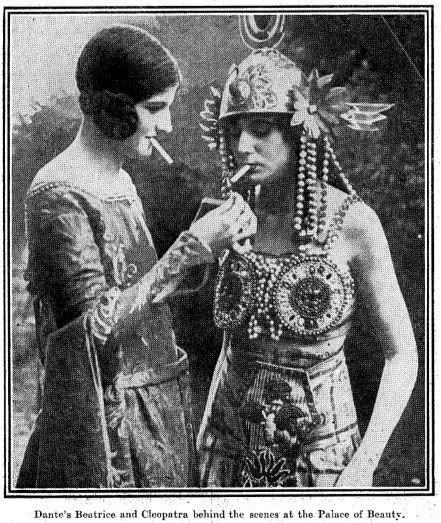
However, post war Ethel continued to star on stage and screen. Possibly a reflection of Ethel's stardom was her employment in the Pears' Palace of Beauty at the 1924 British Empire Exhibition. Ethel was Cleopatra in a tableau of some of the most beautiful women in history, which included Dante's Beatrice, Helen of Troy and, puzzlingly, Millais' Bubbles...
 |
Ida Mowbray as 'Bubbles', apparently
|
The Pears' Beauties worked 7 hour shifts in a 14 hour day, splitting the role with another actress. It was a very glamorous affair, as can be seen in this image of Cleopatra and Beatrice having a crafty fag between performances...
However, the cost of living an actress's lifestyle and raising a daughter on her own took their toll on Ethel, and in 1924 she was declared bankrupt with debts of £200, which was mostly dressmakers' bills. She only earned £5 per week as Cleopatra and had a mere £2 in savings. Still, again she bounced back with what would become her greatest hit and a stage sensation...

In 1927, Ethel took to role of Julia Price in Arnold Ridley's The Ghost Train (Arnold Ridley was Godfrey in Dad's Army and the great-uncle of Daisy Ridley, Rey in Star Wars). This was not a new play, having been debuted in 1925 but the special effect of the train rumbling through the theatre was enough to electrify and terrify the audience. One man saw it three times attempting to see how they got a whole train into the theatre. Once more Ethel was playing a thoroughly bad lot (sorry, spoiler alert) but one of her joys in life was playing a wicked women who managed to win the audience's sympathy by her performance. The Ghost Train undoubtedly made her a star. It also saw the debut of June Waller, her daughter, playing one of the minor roles.
Many plays followed, including The Lonely House in 1930, noteworthy as the cast also included a young actor called Bertram Dix. He was only a couple of years younger than June, but it was Ethel who caught his eye. While she continued to appear in movies and some stage work, the couple moved to Hendon and there opened a hairdressing salon and hat shop. Yes, that was a twist I was not expecting either. Despite claiming in later interviews that she had taken time away from showbiz to run the salon, Ethel still appeared in films such as The Man Outside in 1933, which can be watched on Amazon Prime...
This classic of cinema must have the poshest criminals in history and some exceptionally wooden acting, but obviously Ethel is marvellous as the spinster Aunt Georgina, complete with monocle...
 |
Ferocious Aunt Georgina, telling off bad actors
|
I was somewhat surprised by Ethel's hair, properly short from the 1920s and I wonder if that was the work of Bertram Dix. According to a 1934 newspaper article on the couple's salon, Dix was a hair artist and specialist in waves. He had brought his experience in theatrical and film hairdressing to the establishment at 7 Greyhound Hill, Hendon. Joining him in the venture was Ethel, there to give women beauty advice including which hats to wear with their new, beautifully waved hair. As the report stated 'The hats are marked by impressive distinction and originality yet they are available at exceedingly moderate prices'. I do enjoy a moderately priced hat.
The interior of the salon was decorated with Ethel's paintings and drawings, just too small in the newspaper photograph to be able to see what they were like. The couple had originally intended to open their place in the West End of London but Hendon was seen to have more charm, and I'm guessing less overheads.
This business lasted until 1938 when the couple returned to the stage once more in Poison Pen, selling the business. Then the war came, and the couple hastily wed, buying a cottage in Somerset. Dix went to fight in North Africa, while Ethel remained at home, becoming patroness of the Ebbor Players, a local theatrical group. She awaited the return of another husband, but when he returned in 1944, he no longer wanted to be married to her.
Ethel and Dix divorced in 1946, and Ethel carried on touring, starring in The Silver Cord in 1947 as it toured the south coast. She moved to Sussex, but found that in old age her career began to stall. In a letter to The Stage magazine in 1950, she reported the plight of older actors - 'The agents, bless them, are far too busy exploiting the youngsters to be bothered with us, and, save for a few exceptions, we're all out of work.' She suggested that manager should form a company of 'old timers', with no-one under 60 - 'There are many old actresses of petite stature, who, with the help of wigs etc, would give excellent performances as youngsters' she wrote, rather optimistically. She also complained that younger actors didn't talk loudly enough. Bless her.
Ethel died in the Cavendish Nursing Home, Bognor Regis on 12 September 1951, a couple of months shy of 71. Her obituary in The Stage listed her art school training, her Shakespearean glory days and her three tours of Australia. It also shaved a couple of years off her age. I'm sure she would have been delighted. I also hope that she would be pleased to know that I'm going to keep researching her because she is absolutely fascinating. After all, we game old birds should stick together...
If you have any information about possible paintings or drawings by Ethel, please drop me a line at stonellwalker@googlemail.com.