Showing posts with label Phoebe Traquair. Show all posts

Saturday, 12 December 2020

Saturday 12th December - St George and Una

 I'm not sure I'm up to all this passion and excitement, and we're only half way through Snogvent.  All the fence snogging and general connubial wrestling aside, I think I better go for something a little more restrained and classy today.  Don't worry, this turn towards tastefulness won't last long, so let's enjoy it while it lasts...

St George in Armour being kissed by Una (1914) Phoebe and Hilda Traquair

Blimey, but I do love Phoebe Traquair (1852-1936). As you will no doubt remember from this post, I live quite near a church decorated by her, despite not living anywhere near Scotland. Her work is gorgeously delicate and gloriously romantic and this embroidered panel is no different. This work was completed with her daughter Hilda (1879-1964), who figured in her mother's art long before she was a partner in it...

Hilda, aged 5 (1884)

Look at the little flower!  Bless.  Anyway, after doing exceptionally well at the Edinburgh School Art of Art (can you imagine the pressure to be good at art?), Hilda joined creative forces with her mum for a series of silk embroidered panels based on The Redcrosse Knight (St George) in Edmund Spenser's The Faerie Queene (1590).  I always thought that St George's love-interest was Princess Sabra because of images like this...

St George and Princess Sabra (1862) Dante Gabriel Rossetti

There are many and varied portrayals of the unlucky Princess Sabra in Pre-Raphaelite art, and the story is very similar to Andromeda and Perseus.  Sabra (who sounds like she was named after the latest Ford -  when I was in a new mum's group, there was a lass there whose son was called 'Orion', 'Like the stars, not the cars' she clarified, handily) is the princess of a land that is being terrorised by a dragon and she draws the short straw to be a sacrifice.  Luckily, along come St George, who kills the dragon and gets the girl.  That also has a slight echo, albeit unhappily, in the Biblical heroine Jephthah's daughter, who ends up being the sacrifice after King Jephthah vows to offer up the first thing he sees on his arrival home from a successful battle. Princesses do tend to end up as collateral damage in stories, and they don't always get rescued.   T'uh...

Jephthah's Vow: The Martyr (1885-6) Edwin Long

Not a happy ending there then, and definitely no kissing, so we won't worry about that. Anyway, back to Princess Sabra, and there is definitely lots of kissing there because I think you would be awful grateful to anyone who stops you being eaten by a dragon.  I do wonder about the logic of handing over someone to be eaten by a monster, as if that will stop them eating everyone else.  Looking at the winsome little wisps of girls that are often offered up to the horrible beasties, I don't think they would satisfy its appetite at all.  I don't mean to boast but I reckon that if a monster ate me, it would slow him down for ages, at least long enough for everyone else to escape.  I am built to give mythical monsters terrible indigestion and they would need a proper sit down and a snooze afterwards.  I'd also raise their cholesterol by so much it would probably kill them.  You're welcome. As my daughter would say, that's a weird flex, so I'll move on...

They Fared Forth Upon Their Dreadfil Quest (1914)

Una and the Redcrosse Knight are both characters in The Faerie Queene and although the upshot of the quest is the same (knight kills dragon), how we get there and what it means is somewhat altered.  Una, the Princess of the land terrorised by the dragon, saddles up alongside the Knight and joins him on the quest (like Samwise and Frodo, or Han Solo and Chewbacca.  Possibly not the second one).  Obviously Una represents the True Church and she also defeats the evil Catholic Church, no-one likes Mary Queen of Scots and Queen Elizabeth is great.  Boy meets Girl, Girl turns out to be Protestantism and defeats Catholicism, Boy and Girl galumph home after killing a metaphorical dragon, it's a tad cliche...

St George Kills the Dragon, Una Prays (1914)

When it comes to actual dragon slaying, that's a boy job, apparently.  Even if girls are brave enough to come on heroic quests, there is no big spear for them. The words at the top of the embroidery read that while Una prayed, St George 'pierced that false tongue'.  Does that mean the dragon spreads salacious rumours? 'I've heard Mrs Scoggins has been shoplifting again... Mr Smith starts drinking creme-de-menthe at noon... Beryl Jenkins passes off shop-bought cake as home-made...'  Honestly, the dragon had it coming.


Anyway, Una is so impressed with the way St George does in dragons that she goes in for a kiss.  Maybe she really likes men who do in massive malevolent reptiles.  Now, I understand having a type - honestly there is nothing more sexy than a man with a book in his hand (especially if it's one that I've written) but I'm not sure I'm with her on the whole dragon-killing thing.  Mind you, she makes a perfect match for St George, who is all about the dragon-killing and so I wish them every happiness. A bit messy though, but that's love for you.

See you tomorrow...

Monday, 4 December 2017

Monday 4th December: Annunciation (again)

I promise there will be a break from these endless annunciations soon, after all this isn't just annunciation-vent.  However, I am rather fascinated by the variations in how artists see the moment that our little Virgin Mary is annunciated.  Is that a word?  You know what I mean...

Annunciation (1900) Phoebe Traquair
Here we have a very jolly annunciation from Arts and Crafts High Priestess, Phoebe Traquair.  I like how Mary and the angel seem to be dancing almost, but there is an edge of unwillingness and force.  Look how the angel has hold of Mary's head and both of her hands are caught in his.  Also, no-one is smiling, contrasting with how light and bright the colours are.  I wonder if Mary's pretty bow is referencing her Virgin state - she is still an unopened parcel, if you excuse the expression.

Triptych: Motherhood (1902)

Despite being best know for her role in the Arts and Crafts movement in Scotland, Phoebe Anna Traquair (1852-1936) was born in County Dublin.  She studied  art at the School of Design of the Royal Dublin Society, and married paleontologist Ramsey Traquair, moving to Edinburgh to settle.  Her work, often spiritual, varies from tapestry to murals, book illustrations and metalwork, all jewel-like and beautiful.

Phoebe Traquair's illustration of Elizabeth Barrett Browning's Sonnets from the Portugese
She produced hundreds of pieces of art in her life, including wonderful church murals (including one I visited here) and her volume of work shows the breadth of her talent and flexibility of her vision. I like the tension in her Mary and the Angel which is less about meekly accepting the will of God and more having events unexpectedly thrust upon you, no matter how beautiful it is all meant to be.

See you tomorrow...

Saturday, 27 September 2014

Impromptu Celtic Revival/Souls Crossover Road Trip!

So it's the last Saturday in September and I had very little planned.  The next month will be very busy, so possibly it would be nice to have a weekend off.  Well, that was the plan.  Instead I ended up on an impromptu road trip to see a church...


In the heart of the New Forest, down on the south coast of England, is the little village of Thorney Hill.  Within that village is a nice Edwardian Baroque Church with the most amazing secret inside.  Built in 1906 by Detmar Blow, a follower of Ruskin and Morris, the Caen stone exterior is interspersed with plain glass windows that seem to promise a puritan interior.  However, as you'll see from the photo above, the semi-circular apse at one end has bricked up windows.  Step inside and you'll see why...


The rest of the church is painted in pale wash, but one end is a riot of colour and gold, all thanks to an incredible floor-to-ceiling mural by the artist Phoebe Traquair, an Irish-born artist allied to the Scottish Celtic Revival.  Painted in 1922, in memory of Lady Constance Manners, wife of Lord Manners who had commissioned the church in memory of their daughter almost 20 years previously.  The subject is Te Deum  and the figures depicted are somewhat familiar...


Starting with the left-hand side, we have Eric Gill, the sculptor (as St John the Baptist), Bishop Charles Gore (with a net, as St Peter), Constance Manners, Alfred, Lord Tennyson and William Blake...


Next to the Madonna and Child is a portrait of Raymond Asquith, who died in the Great War, like the Manners' son (more of that in a moment), next to him is St George and the Dragon, then Lord Lister and Louis Pasteur (in red gowns), on the right-hand side...


Above the scene, Jesus and all the children of Thorney Hill look down on the great and the good in a golden dome...


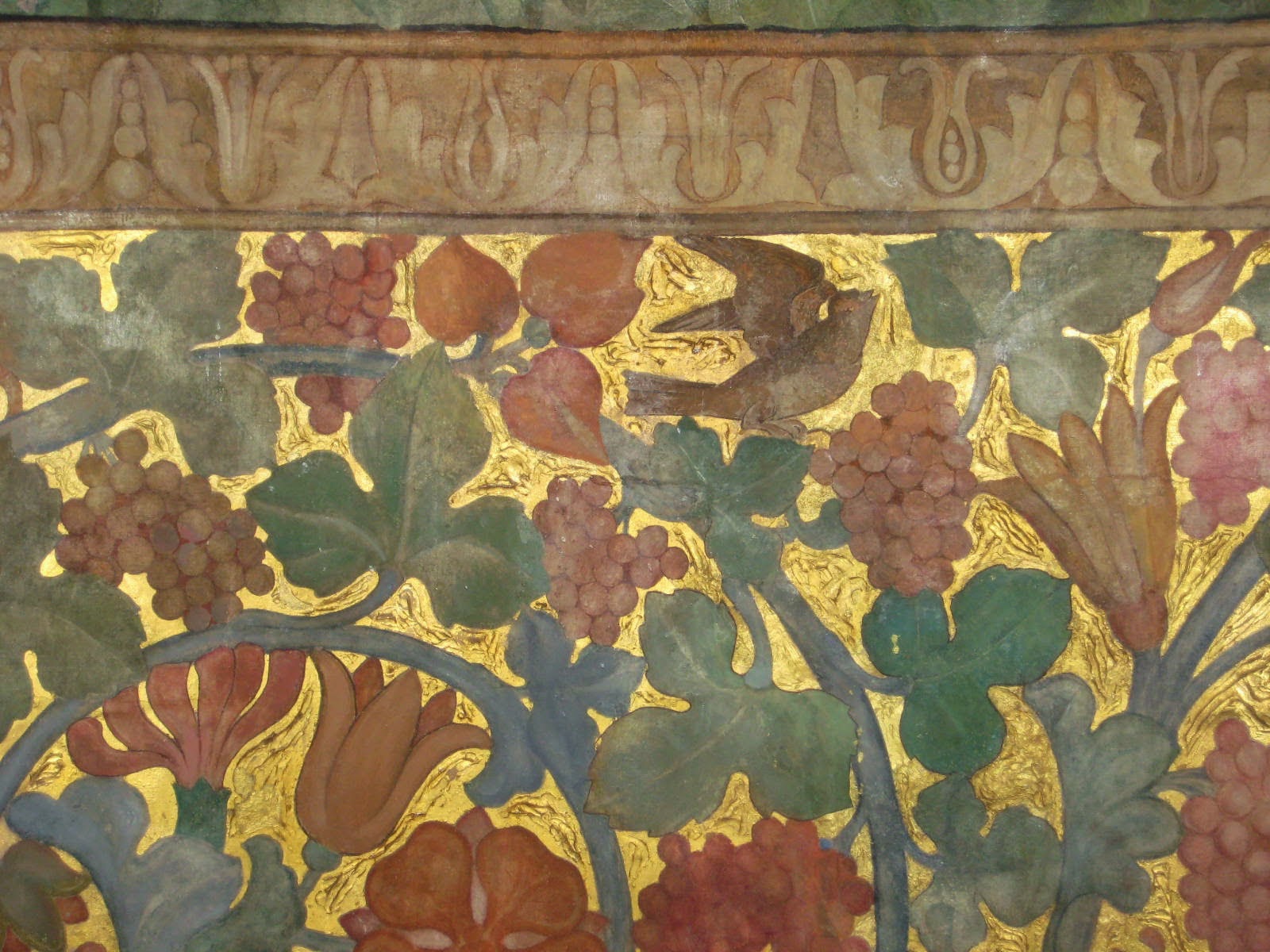
And below, a tangle of plants and beasts provides a luxurious border...


To say that the effect is amazing feels like an understatement; it is truly spellbinding.  In a gallery you would pause and admire the glittering majesty of the image, but to find it inside a small church on the edge of a New Forest Village is breath-taking.  It is a testament to the patronage of families in the early years of the twentieth century and like Mells (which you may remember from this post) it has a bittersweetness.  I suppose it started with a loss, that of the young daughter of the Manners family, but being of a certain age, they had a son who was old enough to go off to the First World War...


John Manners is majestically reclined like a knight cut down in the beauty of his youth.  On the wall next to him is a description of his death in combat.  Two angels weep over his name and dates. Not quite as mind blowing as the man on a horse which was Edward Horner's massive memorial at Mells, but his friend still is an imposing and moving presence in the tiny church, right next to the congregation.

View from the wooden gallery, next to the organ
The church is open from Easter, every Saturday afternoon until the last weekend in September (last weekend was this weekend), but you can phone to book an appointment to see it outside of this time.  Look on this lovely site to find details of who to contact (here).  Like all beautiful od buildings, this one is in constant need of maintenance and care, so this site has a link for donations, if you feel so inclined.  I thoroughly encourage a visit, it is an utter gem.

For a fairly comprehensive list of who is in the mural, look at this splendid blog (here).