Showing posts with label Arthur Hughes. Show all posts

Thursday, 23 December 2021

Thursday 23rd December - Uncertainty

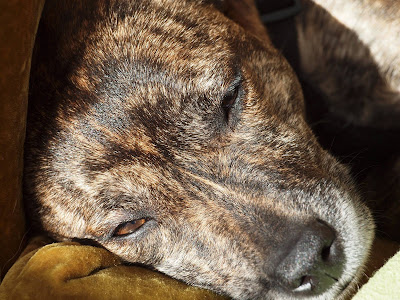
 I can't sleep so this post is being started in the middle of the night.  To be honest, I have an awful lot of stuff to achieve in the next 24 hours and so it's probably not a bad thing to be cracking on with this before I have to walk the dog, start preparing and baking various things to eat and clean the house from top to bottom.  Blossom doesn't seem to care very much about any of these concerns and is currently next to me, asleep...


Yes, yes, a fat lot of help you're going to be, don't let me disturb you.  I'll just get on with today's image...

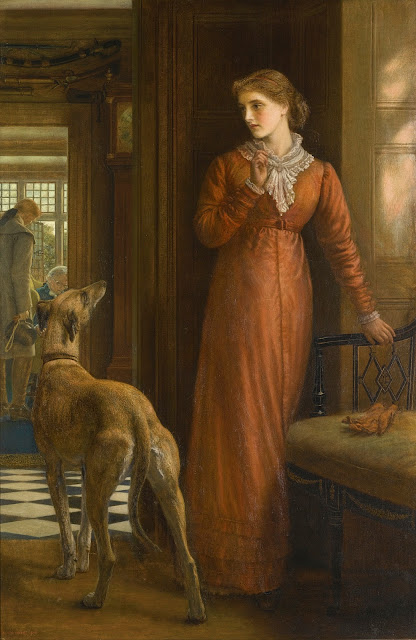
Uncertainty (1878) Arthur Hughes

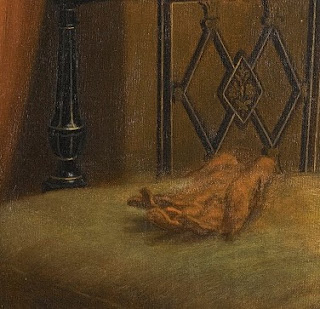
Arthur Hughes did a good dog.  I actually have three of his hounds today, but this picture was the least familiar, so I thought I'd start with it. Reading the notes from its sale at Sotheby's, it states that this is a painting of a girl waiting while her suitor asks her father if he can marry her. Contemporary accounts go on about how the girl is all modesty and maidenhood, awaiting the outcome of the meeting, however I have some questions, chiefly why is it called Uncertainty? If our young lady is such a passive pawn of her own future, awaiting the menfolk to tell her what's happening next, why is she having any thoughts, let alone negative ones, about her role in all this? Also, what's that in the chair?


Are they her gloves or his? They match the colour of our girl's dress and so I'd be tempted to think they are hers, especially as the chap talking to her father seems to have things in his hands, like a hat and a whip. Why then are the gloves just left on the chair? They remind me of the discarded glove in this picture...

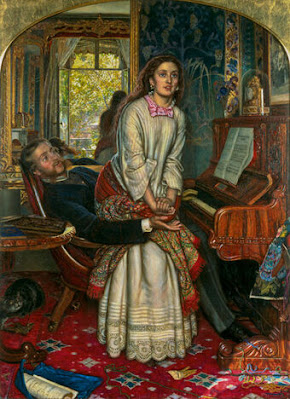
The Awakening Conscience (1853) William Holman Hunt

To be fair, whenever I see an abandoned glove, I always go straight to The Awakening Conscience.  I wonder if our lass in the hallway is also having an awakening moment as she doesn't look at all certain about stuff.  The dog is looking up at her in solidarity, and is widely supposed to represent loyalty as in this much more famous Hughes painting...

The Long Engagement (1854-9) Arthur Hughes

That is the shiny spaniel of loyalty and faithfulness, expressing the emotion that even though your engagement is unfeasibly long, you'll hang in there because you are such good people. That really isn't the vibe I'm getting off the hound in Uncertainty. I don't think that dog is hers, I think it belongs to the man asking to marry her.  I also think that in his hand, the man is carrying a dog whip. The look that is passing between the dog and the girl is 'Run!' because I don't think she will have a very good time of it. It's not that I'm not an old romantic, far from it, but if she married him, she'll end up like those gloves, excluded and discarded. You are right to be uncertain, Modest Maiden, I'd take the dog and leg it.

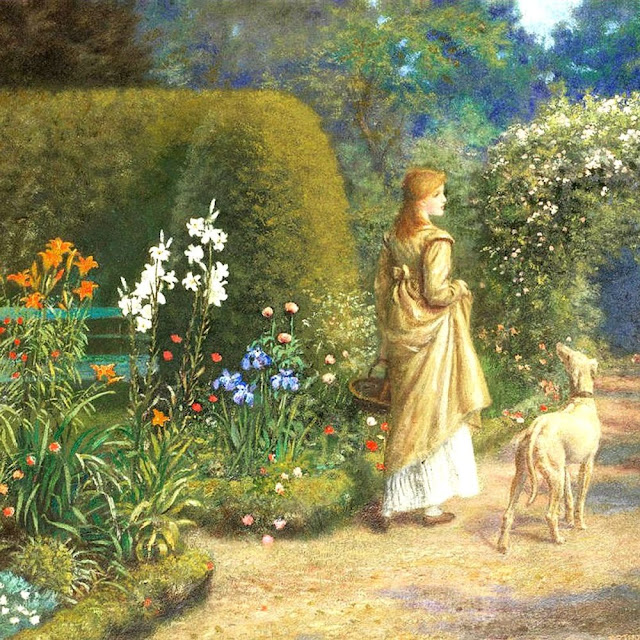
Friends (c.1900) Arthur Hughes
The pose in Uncertainty is linked to the pose in Friends and I like to think this is a picture of our lass after she made a run for it with the dog and now they live happily together in a little house with a lovely garden and no-one owns a dog whip. Well, that's a jolly way to end but I have one more picture from Mr Hughes which deserves a special mention for being just too gorgeous...

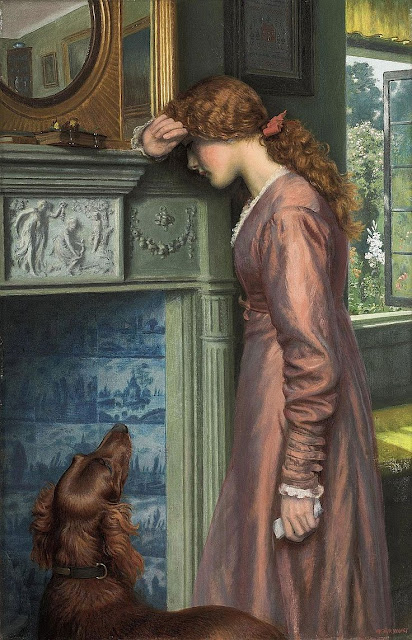
A Passing Cloud (1908) Arthur Hughes

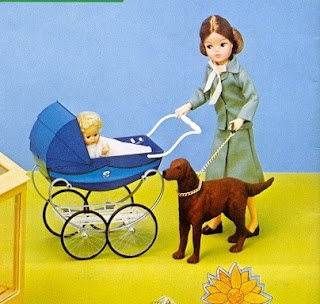
Again, we have a young lady in a salmon dress who seems to be having a moment, but look at that red setter! That is one of the most gorgeous dogs in art, but I might be biased as I grew up in the 1970s and 80s when they were extremely fashionable. Even Sindy had one...


Well, not my Sindy as mine had inherited my brother's Action Man boxer guard dog, which looked incredibly threatening rather than effortlessly stylish. Also, when she walked him in the park, she didn't take a pram, she borrowed Action Man's 1972 Scorpion Tank. It was a devil to park but the green brought out her eyes. I digress.

What A Passing Cloud and Uncertainty have in common for me is that they both offer the girl a form of escape.  The dog in Uncertainty is a hound, built for running.  This is no lap dog, but a creature who can exit at speed.  Similarly, in A Passing Cloud, the window is open.  Whatever is ailing the poor lass by the really gorgeous fireplace, she could be out that window in no time and away. I'm not saying running away with a dog is the best answer, but given the options for a Victorian woman, it's not a bad one.

I'll see you tomorrow for our final post of this Blogvent...

Tuesday, 10 December 2019

Tuesday 10th December - Home from the Sea

After all the sadness of lost loves and bladder stones yesterday, I thought I'd move the scene outdoors today...

Home from Sea (1857) Arthur Hughes
This is probably one of the better known paintings in Sobvent, which depicts a brother and sister in the graveyard, presumably at a grave of one of their parents.  Or maybe both.  Why do things by half?  She's been at home, sorting out burials and the suchlike while he's been off at sea in a wide straw hat and very fetching sailor suit.  He's returned, with his hankie on a stick (which I thought only existed in Tom and Jerry cartoons when Tom got kicked out of the house for not catching Jerry).  All he said was 'I'm looking forward to seeing Mum and Dad', and this is where his sister took him.  I bet she didn't know how to break it to him otherwise.  'You won't exactly be seeing them, but you will be within six foot of them...'

When this was exhibited in 1857 it was entitled The Mother's Grave but I like to think that they are now both penniless orphans and the sister will be reduced to playing Whitesnake hits on her accordion in the high street to save from starving.  If you fancy re-enacting the scene, Hughes used the churchyard in Chingford as the background, so you could get your hankie on a stick and throw yourself down dramatically under a tree, for fun.  Everyone needs a hobby.

He added the figure of the sister in 1862 when he changed the title to Home from Sea.  The girl is his wife, the lovely Tryphena Foord, who featured in last year's Blogvent.  She looks every inch the spaniel-haired Victorian girl, who is just a heap of black fabric with a tiny lace collar.  There is no fun in her future, just a lot of heavy, black mourning clothes and an afternoon trying to get grass-stains out of white trousers.  The orange of her brother's belongings bundle are a jolly, jarring note of colour which tonally makes reference to the roof of the church.  There are tiny flowers in the grass and in the bushes, just as the girl in her deep mourning has a tiny white collar.  I think it means that even while sorrow and grief are fresh and raw, there is hope and things will move on and get better again.

Oh dear, that's an awfully optimistic note to end on.  I'll do better tomorrow...

Thursday, 20 December 2018

Thursday 20th December: Tryphena Foord

Today I shall be brief and cheery for a change.  Christmas can be stressful and in the current political climate there doesn't really feel like there is much to be jolly about, however the subject of today's post should provide an antidote to any feelings of misery, if only for a moment.  I bring you Tryphena Foord...

April Love (1855-6) Arthur Hughes
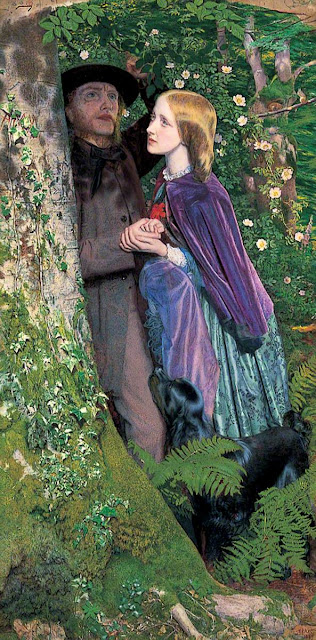
Possibly the nicest couple in the Pre-Raphaelite world are Arthur and Tryphena Hughes.  They married young, remained married apparently without the need of adultery, chloral or any of the other nonsense that seems to litter the lives of others of their circles.  Arthur Hughes (1832-1915) managed to pull off the thing that many of his contemporaries failed at - he happily married his model. The most famous of his paintings features this beautiful young woman, and she can be identified in others of his sentimental pieces, so who was Tryphena Foord?

(from left) Arthur, Tryphena, Amy and Agnes Hughes (1864) Lewis Carroll
Born in the autumn of 1828 (she was baptised on 14th December), Tryphena was the daughter of Robert and Ann Foord of Maidstone in Kent.  Robert was a master plumber and decorator for Robert Cutbush.  The Cutbushs and the Foords seem to have been close as on one census a member of the Cutbush family is a lodger in the Foord house.  Robert Cutbush is also the brother of Thomas Cutbush, who owned the garden that was suggested to be the location Arthur Hughes used for his painting April Love.  It might have been his search for an ideal location that brought Arthur Hughes into contact with Tryphena, and he apparently met her in 1850, the same year as he discovered the wonders of Pre-Raphaelitism through reading The Germ.  In the 1851 census, Hughes is staying with the Foords, and their engagement is presumed to have begun.

Sketch for April Love
Much of the work on the figures for April Love was done at Hughes' studio at 6 Upper Belgrave Place, which he shared with sculptor Alexander Munro.  It is thought that Munro might have posed for the mostly hidden figure of the man, and the girl was first modelled for by a country girl who left after she didn't like the way Hughes was painting her.  Hughes finished the piece using Tryphena, and married her at the end of it.  It seems a bit of a strange subject to paint your beloved as, the young couple in the midst of their first fight, the fleetingness of love and all that, but it might not have been the first thought for the painting.  Certainly when Ford Madox Brown saw the painting, he referred to it in his diary as 'the Lovers' quarrel', but William Allingham had apparently called it 'Hide and Seek' (as referred to in a letter from Hughes to Allingham) which hints at an entirely more playful relationship between the two figures.  Whatever the thought behind the painting, it united Arthur and Tryphena for the rest of their lives.

Arthur Hughes and Agnes (1863) Lewis Carroll
There are many reasons why Arthur and Tryphena Hughes are not the best recorded of people, which I will come on to, but one person who noted the couple was Lewis Carroll.  The Hughes family grew to the tune of six children, three girls and three boys (although middle son Edwin, a twin, didn't live very long), and to their home came Lewis Carroll to photograph the children and their blissfully happy parents.  Looking through Carroll's photographs, the Hughes family are quite easy to pick out because they mainly posed against a distinctive brick wall.

Amy Hughes (1863) Lewis Carroll
Lewis Carroll was a visitor to the Hughes home during the 1860s and Hughes painted  The Lady with the Lilacs for Carroll.  Carroll took portraits of little Amy and Godfrey on their own, as well as family groups of Arthur with little Agnes and Tryphena with little Arthur, and Amy and Agnes (baby Emily was born in 1861, twin sister of Edwin, and Godfrey was born in 1866).

The Long Engagement (1854-9) Arthur Hughes

Tryphena is quite easy to pick out of Hughes' paintings.  He often makes the most of her copper cap of hair, which is strikingly shiny even in Carroll's black and white photograph, and so she is 'Amy' in The Long Engagement, wondering when her marriage will occur.  I have read some commentators suggesting that Arthur and Tryphena also had to wait until they could afford to marry and this painting was a memorial to that period of their lives.  

Home from Sea (1862) Arthur Hughes
Tryphena is also the mourning sister beside her weeping brother on the grave of their mother who has died while the boy was at sea.  When the painting was begun in 1857, the sole figure in the composition was the boy, but in the production of the oil, Hughes added his wife as the sister, stoically sat beside her brother, her black clothing suggesting that she had the grief and business of a parent's death to deal with alone.  Despite at this point being in her thirties and a mother, Tryphena looks little more than a child in the work.
 
A Music Party (1864) Arthur Hughes
Another of Hughes' paintings that featured Tryphena was the subject of comment from Lewis Carroll after one of his visits in 1864, as recorded in his diary - 'Called on Mr A Hughes, and saw the two pictures nearly read for the Royal Academy, one a lady playing music to her husband and children (the latter done from Totty and Agnes).'   The 'lady' was again Tryphena and 'Totty' was the nickname of the Hughes' eldest son Arthur Foord Hughes.  Looking back up at the Carroll photograph, it seems a very similar composition of Tryphena and her children, with the addition of an unknown male model.

The Rift Within the Lute (1861-2) Arthur Hughes

What is interesting when looking through Hughes' paintings of his wife are how many of them carry an overtone (or undertone) of sadness.  Other than the death of Edwin, it is hard to see that the family's life was so melancholic, but maybe that is the point.  Tryphena is often portrayed in the paintings as a woman disappointed in love, which is patently not the case but possibly if the Hughes' marriage was unhappy he would not wish to immortalise that on canvas.  Again I am struck by Rossetti's joyful celebration of Elizabeth Siddall whom he made so unhappy, so the reverse could well be true of the Hughes paintings.  After marriage, Arthur and Tryphena moved to the suburbs of London, firstly to Egham in Surrey, then Beddington near Crydon and then to Kew.  It's hardly the rock and roll centre of Bohemain life, but that was possibly what Hughes required for his art.  He also was very aware of needing to feed his family so often his work is criticised for being sentimental and commercial, especially in his later works, but again his comfortable, happy family life was reward enough for safer choices.  His sons Arthur Foord and Godfrey became artists like their father and grandfather.  Eldest daughter Amy, possibly named after the girl in The Long Engagement married John Chester, a vicar, but died at the beginning of 1915, her father dying at the end of the same year.  Agnes married an Analyst (who knew there was such a thing in 1891) called John White, but Emily remained at home living with her widowed mother until Tryphena's death in 1921.  

When my Aunt had to move from the family home she had shared with my grandparents and my uncle for most of her life to a small bungalow, she burnt a large amount of our family photographs and papers which was devastating, however they were hers to burn.  I have read so many accounts of Arthur Hughes' life which all end with the fact that when Emily had to move from the large family home in 1921, she committed an act of cultural vandalism by burning her father's sketches and many of the family papers.  I don't believe it is fair to condemn her so harshly, as in 1921 people weren't exactly knocking down her door to celebrate her father's art.  He had died 6 years before and possibly she felt that had there been a desire for the paperwork of his life, it would have been requested.  Tryphena also could have donated the papers to a relevant collection but again didn't for whatever reason.  Saying that, it is easy to argue that the lack of minutiae of an artist's life has possibly meant that Hughes is not an 'A' list Pre-Raphaelite artist, despite producing at least two of the best known and loved works associated with the Pre-Raphaelite movement.  We will just then have to try harder to include Hughes and his images of Tryphena in the ever-growing conversation of Pre-Raphaelite art.

See you tomorrow. 

Saturday, 9 December 2017

Saturday 9th December: The Annunciation

Tomorrow we will have made it into double figures and so I will try and make this the last annunciation because we have rather a lot more of the Virgin Mary to get through in the next 15 days, but nevertheless we have to have this picture because it is rather gorgeous...

The Annunciation (1857-8) Arthur Hughes
Who doesn't love a bit of Arthur Hughes (1832-1915)?  Sure, he has some ropey days but when he is 'on fleek' (as I believe the young people used to say) his work is sublime and often quite purple-y.  So here we have Mary, cowering by a pillar while a golden, glowing angel bestows the ace news whilst hovering in a flowerbed.  Again, we have a bit of wardrobe synergy going on, with both figures sharing a palette of blues and purples but then this is a Hughes painting and so I begin to suspect he bought a job lot of those colours, what with the regularity they appear in his works.  In her hand the Virgin carries wool, from all that spinning and weaving we now know she does.

April Love (1855-6)
Seems in Hughes' art, you can't move for a woman in both an emotional crisis and a purple frock.  Maybe one is emblematic of the other?  Talking of emblems, Hughes included a bit of flower language into his annunciation with not only the obligatory lilies, but also a sneaky pot of irises, hinting at warning and danger.  The Victorians would have been completely au fait with reading extra layers of meaning in pictures via the foliage, for example the ivy in April Love symbolising longevity and clinging on, and the scattered petals as a broken love affair.

The Nativity (1857-8)
Hughes bookended the Virgin's story from annunciation to nativity, but although his annunciation is quite traditional, his nativity is striking, crammed into a small intimate space.  The feathers of the angels (purple, naturally) fan out in the straw and a kneeling Mary swaddles a tiny Son of God.  The paintings both have gothic-arch frames, echoing church architecture, but The Nativity makes it seem like you are looking into a cramped room rather than looking out into a garden.  The difference in Mary between the two paintings is marked - in the beginning she is hesitant, shy and unsure, but by the end she is posed and accepting, just getting on with the job.  I find it slightly odd how massive she is in comparison to Jesus, who you'd think would be the star of the show (no pun intended) but by having companion pieces, Mary is the narrative, her journey is the point and the focus.  She moves from the shadows of the first picture to the centre of the second and there is no-one else (human-wise) in either, just Mary and the heavenly creatures, one of whom she entrusts to hold the baby while she swaddles.  It makes a change to see Mary as the focus but after all she did do all the work.  

See you tomorrow.

Friday, 23 December 2016

Friday 23rd December - The Angels of Arthur Hughes

Almost there now, m'dears. Today and tomorrow and then it's Christmas.  The three wise men have been knitted, and sewn up ready for my father's knitted nativity. I have one more pressie left to finish, but on the whole presents are done.  I have cooking to do today, but before I do that I best get on with some angel business...

The Nativity (1858) Arthur Hughes
This has always been one of my favourite images of the nativity.  It lacks the beauty of Burne-Jones' epic canvases, or the realistic glory of Marianne Stokes, but for plain straight-out weirdness, you can't beat the girl-only, smallest-stable-in-the-world wonder of Arthur Hughes masterpiece.  No-one has any room, it is the epitome of too many people round for Christmas.  There are wings and knees and halos all jostling for space.  Mary is trying to wrap up her ever-so-small baby but there are people outside and it's impossible. For mid-nineteenth century, this is an amazing use of space on a canvas, and such a powerful image. The body proportions are weird (exactly how long is Mary's thigh?), Jesus is absolutely tiny but it has an intensity that others lack.

The Annunciation (1858)
The Nativity above wasn't Hughes only brush with an angel.  Hughes did both the Annunciation and the Nativity, which is only right and proper, so we have the Angel of the Annunciation with some very impressive wings indeed.  Unlike some of the more pushy angels who point at Mary's womb (which is a bit personal, if you ask me) or up at heaven, as if Mary is a half-wit (again, a bit rude), Hughes angel takes the standard primary school nativity pose of cross-your-heart arms. That's proper angel posing there.  I love how the gap in the foliage gives Gabriel a mock-halo, and how the fluffiness around the bottom of the wings morphs into lilies.  That typical Hughes palate of mauve and gold is all light in the Annunciation, then shadow in the Nativity, but is echoed beautiful between canvases.

He is Risen, The First Easter (1893-6)
Never one to leave a story alone, Hughes went as far as doing the Easter bit of the story too with yet another angel.  This time, the angel at the tomb is a shaft of light, greeting the women who have come to have a vigil outside the tomb.  There is also a nice little glowing dove in the tree behind them. It is a much later work and lacks the precision of the 1850s, which is a shame because The First Easter doesn't feel as individual as his earlier works.

Galahad Armed by an Angel (1857-8)
It's not just Biblical stories that inspired Hughes' angel art.  The quest for the Grail becomes all angel-y and the lovely Galahad gets his own heavenly host to help him on his way.  Here we have the bob-haired knight of the Round Table having his sword tied on by a very helpful angel.  His shoes are almost as big as her wings...

Sir Galahad on the Quest for the Holy Grail (1870)
Not hampered by his medieval clown shoes, our intrepid knight goes off to find the sacred cup with a trio of glowing ladies.  This is a beautifully composed work with the white angels reflecting the white horse, their heavenly light reflected in his armour.  I also really like the curving, jutting stones of the bridge which hint at his perilous journey. The angels are everything they should be: otherworldly, flying and glorious.

Little One who straight has come Down the Heavenly Stair (1888)
Oh deary me. When I first saw this particular painting, I had to ask if the baby was coming or going because forgive me, but that is a weird looking infant who has apparently just walked down those stairs accompanied by five angels. There is also a bit of oddness going on between the baby and the mother's face.  Believe me, it's no clearer in the flesh as I get the dubious pleasure of seeing this one quite often at the Russell-Cotes.  Don't get me wrong - the angel ladies are lovely, the figures of the parents are solidly done (although I have misgivings about what the father is doing with that shovel), but the baby is just peculiar looking.  I know, you are not meant to say that about babies.  You are meant to say euphemistic things about Winston Churchill and how they all look cutely funny when they are born. When I had Lily I was in a hospital bed opposite a baby that made the nurses yelp in surprise when they saw it.  The little girl had hair all over and sharp little teeth. And she howled for food in an unnerving manner. Bless her.

Sweep the Floor (1873)
As I conclude my exploration of angels in art I am pleased to bring you an angel who is being less than wonderful for a change.  I'm sure this was all very inspirational back in the day but to me it looks like the angel is saying 'Sweep harder child, the Big Man wants to be able to eat his dinner off this floor.'  The Victorians are typical of people who feel attacked in their own little world order, they repressed and made it sound like a good idea.  You better sweep the floor or Jesus will find out and will be cross.  You better not have impure thoughts, have ideas about bettering yourself or question authority because Jesus will see. Keep sweeping the floor, young 'un, and you'll get your place in heaven.  It's all very well if an angel turns up to tell you that you're going to have a holy baby, or that a holy baby has been born or that you have to go and find the holy grail.  How cheesed off would you feel if one turned up and told you to sweep the floor? I have a mother-in-law for that sort of thing.  I don't need the Angel Gabriel getting involved.

Okay, well that's all the angel pictures you are getting for this Angelvent as I want tomorrow to be a bit different.  I have an idea for a story for Christmas Eve but unlike last year, this is not a heartwarming tale of little robins and foxes...

It is 1865 and the week before Christmas. An artist stands before his last painting of his late wife shaking with fear and disbelief.  He writes a note to his sister-in-law that contains only two words:

SHE MOVED...

See you tomorrow...

Sunday, 29 November 2015

Exhibition Review: Enchanted Dreams

For my final review of the week, here's one that is very overdue indeed. I visited Enchanted Dreams: The Pre-Raphaelite Art of E R.Hughes at Birmingham Museum and Art Gallery back at the end of October, but so much has happened in the meantime (holidays, book publication) that it got somewhat delayed.  Before I launch myself into Blogvent (starting on Tuesday) I best tell you all about it...

Night and her Train of Stars (1912) E R Hughes
When Edward Robert Hughes died at the age of 62 in April 1914, he was still remembered as 'Arthur's nephew'.  The Birmingham Daily Post, in their death notice, mention how he was the foremost watercolourist of his generation but still, before all that, he had a Pre-Raphaelite uncle.  Possibly quite a fitting way to start the new exhibition at BMAG is this image...
Edward Robert Hughes as a child (1853-4) Arthur Hughes
There are many reasons to love Arthur Hughes but often his painting is not one of them.  Whilst a very lovely picture in many ways, the tiny hands in this picture are terrible and led to much giggling and whispering about how the small boy gets out of his frame at night and comes to find you and your normal sized hands. This is not helped by the fact that the ornate and fragile original frame is now contained within a modern box frame.  We deduced this was obviously an attempt on behalf of the museum staff to stop him getting out... Moving on...
 
Edward Robert Hughes, looking far less cherubic...
Ah, now that's better.  This is an exhibition about Edward Robert Hughes, not his Uncle Arthur, so on with the story...

And Then I Knew My Soul Stood Before Me (1871) Simeon Solomon
E R Hughes is probably the figure on the right

Born 5th November 1849, Edward ('Ted') Robert Hughes grew up to model for Dante Gabriel Rossetti (he was one of the models for Love in the replica of Dante's Dream) and Simeon Solomon (who described him as 'the beautiful Hughes' in a letter to a friend) and probably used him in And Then I knew my Soul Stood Before Me (1871) with Johnston Forbes-Robertson (who replaced him as Love in Rossetti's painting).

The Lady of Shalott (1905) William Holman Hunt (and a little bit of Hughes)
However, being a pretty face will only get you so far, and Hughes worked for over 15 years as studio assistant to William Holman Hunt, at the end of the Pre-Raphaelite Brother's life when his eyesight was failing. Hughes assisted in the completion of the massive Lady of Shalott and some attributed the colour palate to him.  Hughes' work was likened to Hunt's in the press at the time which is interesting as it isn't the most immediate comparison we would make now.  Thinking about it, there is definitely a link to be made between the ghostly children in Hunt's Triumph of the Innocents and Hughes' Night and her Train of Stars.

With the Wind (undated)
Back to Hughes, and it is easy to see why this is a beautiful exhibition, but it is harder to see why Hughes is not better known.  His work is very commercial - one recent review referred to him as a greetings card artist, which is true but infers commercial equals rubbish.  Hughes talent seems to be to find the soul-squeezingly gorgeous in everything and put it in front of you so you have no choice to respond.  It's easy to find the Symbolist-like lady with the swirly hair attractive, but how about a rotting corpse in a ditch?

'Oh, What's That in the Hollow...?' (1893)
Taken from Christina Rossetti's poem 'Amor Mundi' (1865), Hughes does not show the two lovers who find the body on their lazy downhill wander into Hell.  Instead we have an almost Solomon-handsome, sleeping beauty of a man, waiting out his eternity by being slowly consumed by nature.  The lovers are represented as butterflies who have been caught in the briar that covers the body.  What should be repellent, a corpse in a ditch, becomes Ophelia-like in his death-glamour, surrounded by flowers.  There is a hint in the exhibition that more could be read into Hughes' homosocial relationships, that his appreciation of male beauty (possibly influenced by Solomon) had conflicted feelings behind it but as he seemed to fall in love with women as well, I think the most you can claim for him is that he saw beauty in everyone, regardless of gender, and thank goodness for it because I love his man-damsels.  Apart from the following which creeps me out...

Blondel's Quest (1912)
Although I can see that technically it is a very skilled piece, I am not a fan of 'creepy harp-Jesus'. It refers to the minstrel Blondel's quest to find Richard the Lionheart (but also reminds me of a still from a 1960s sword and sandal epic).  The blue of Blondel's eyes is so piercing it is really quite disturbing and provides a neat counterpoint to some of Hughes' more 'comfortable' art.

Twilight Fantasies (1911)
If you know anything by Hughes, it is likely to be one of his blue fairy pictures, painted just prior to the First World War.  The powdery watercolours do nothing to dispel the feeling that Edwardian England was a sort of wonderland before the great reckoning of 1914-1918.  In their turn it could be argued that pictures such as Twilight Fantasy have inadvertently 'cheapened' Hughes' currency by being so accessible that they have adorned popular greetings cards and become the byword for frivolous Victorian folly.  Taken together as a set, the blue fairy fantasies are all at once beautiful, mysterious and a little threatening at times but always breath-taking.  As there are light-infused angels and spirits to welcome the day, so too are there darker winged creatures waiting in the shadows.

The Valkyrie's Vigil (1906)
Enchanted Dreams is a very easy exhibition to enjoy because E R Hughes' work is so very luscious, however the story of his life is equally as interesting.  It is hard to see how and why we forgot him in the great resurrection of the Pre-Raphaelites but his watercolours have such power that they refused oblivion.  This is a fabulous opportunity to go and revel in their tender power on a grand scale, and one I would urge you not to miss.

Enchanted Dreams: The Pre-Raphaelite Art of E R Hughes is on at Birmingham Museum and Art Gallery until 21st February.

There is sadly no catalogue for the exhibition, but you can read Victoria Osborne's thesis on Hughes online here. On the strength of it, I hope she gets the time and funding to write a catalogue in the near future.

Monday, 23 February 2015

Rose of the World

When I was republishing Stunner a couple of years ago, I considered having this image of Fanny Cornforth as the front cover...

Fair Rosamund (1861) D G Rossetti
Painted in the year between his marriage and the untimely death of Elizabeth Siddal, Rossetti chose to paint one of history's most famous mistresses. If we believe that a main concession in the Rossetti marriage was that the artist would forgo his mistress models, then this is somewhat a slap in the face to the ailing Elizabeth.

Many people don't like this picture of Fanny due to her high colour.  It is a very strong interplay of red and green, like a rose and its foliage.  In fact roses cover the canvas, from the glass, the pin in the windowsill, the necklace, her dress and the actual bloom in her hair.  Even the bottle-bottom glass behind her echoes the round of the rose.  She is a woman in full bloom, she is a flower in a garden.  On the other end of the silken cord is the object of her desire, the king, as shown by the heart and crown motif.  However the queen also wears a crown, and the legend says that the mistress was doomed to be a cut flower, by the hand of her lover's wife.

Was that what Rossetti dreamed of: his bride rising up to kill his mistress? There are moments when you feel that Rossetti is unable to stop his innermost fears and desire from appearing on his canvas, and it isn't unusual for him to portray the women he loves in the act of dying, as in Beata Beatrix and Dante's Dream.  He wasn't the only person to find Rosamund and Queen Eleanor enticing subjects for a painting...

Fair Rosamund and Queen Eleanor Evelyn de Morgan
Fair Rosamund, or Rosamund Clifford was the daughter of Walter de Clifford, a lord from the boarder counties between England and Wales. The family changed their name from 'Fitz Richard' (son of Richard) to that of their home, Clifford Castle, on the River Wye (lovely part of the world, for those who have had the pleasure of visiting).  She was the mistress of Henry II, and as such her life became somewhat dappled by fantasy and romance.  In truth all that is vaguely known is that she was born around 1150AD and she died c.1176AD, possibly in Godstow Nunnery, after the end of the affair.  Well, that isn't very exciting now, is it?

As you can see from de Morgan's painting above, nothing spices a story up like witchcraft, a wronged woman, a poisoned chalice and a doomed, innocent, pretty heroine. Throw in a secret love-nest in the centre of a maze and a silken cord for the lover to follow and you have a corker of a story.  I love how the tiny winged babies of love are floundering around on the floor, fleeing the serpents of black magic.  Queen Eleanor's dress resembles scales, like a serpent, and she reaches towards the window which shows Adam and Eve embracing in the garden of Eden.  Hang on, is de Morgan saying that the King and his mistress are the innocent party and the wife is the serpent?  That the love between the King and Rosamund is more pure and sacred than the love between husband and wife?

Fair Rosamund (1905-17) J W Waterhouse
So the legend of Fair Rosamund goes that King Henry loved this beautiful girl and in order to hide her from the nasty Queen, he built a maze at his home at Woodstock and placed her little house in the centre.  Only he could find it, by use of a silken thread that led through the maze.  All Rosamund did all day was wait by the window, by her silken thread and await his kingly presence.  One day however it wasn't the king that followed the thread it was nasty Queen Eleanor of Aquataine.  The Queen confronted her rival and gave her the option of a dagger or a chalice.  Rosamund chose the chalice, drank the poison and died.

First of all, the cloistering of a lover in a remote place, leaving her to just wait and wait has echoes in other romantic stories, such as Elaine of Astolat.  For the Victorians too, there were overtones of Mariana in her moated grange waiting, waiting for a man to come.  Waiting is a very feminine act, that of inaction, passivity, obedience, possibly the very virtues you might want in your mistress.  Or spaniel. Stay!

Fair Rosamund Arthur Hughes
From the straight forward story of a young royal mistress who had a couple of illegitimate kids and died reasonably young, it was spun up into a fairy tale.  It is unlikely that Rosamund was the only mistress, although by all accounts she was a favourite for whom he allegedly wished to leave his wife.  This, coupled with Rosamund's early death, seems to have led to the stories that Eleanor (a capable woman in her own right) had murdered her rival, even though we now believe that the King and Queen had been leading seperate lives since the birth of their final child.  That's not such a good story though, is it?

Queen Eleanor (1858) Frederick Sandys
In most Victorian portrayals of the story, Queen Eleanor is a bit of a crone, lurking much like the wicked stepmother in Snow White, waiting to poison/stab the fairest in the land.  Sandys image of Eleanor as a troubled, beautiful woman, preparing to sort out her rival, is unusually sympathetic. She would have been in her late forties by the time of her husband's dalliance with Rosamund, yet in Sandys vision she is young and beautiful.  In a way, siding with the Queen against her husband's adultery seems a far more natural Victorian position, but he is definitely on his own.  Love the cloak, reflecting a Book of Kells aesthetic before the Celtic Revival had taken hold in British art.

Fair Rosamund (1905) Herbert Sidney

 A similar figure is Sidney's Rosamund, delicately unwinding the silken thread so her lover can find her and ultimately allow her murderer to reach her too.  She could not look more innocent (or white) with the muted palate of white and gold, and a frock that will fall off if she sneezes.  Again, possibly a winning attribute in a mistress...

Queen Eleanor and Fair Rosamund Edward Burne-Jones

Queen Eleanor and Fair Rosamund (1862) Edward Burne-Jones
Burne-Jones did two versions of the confrontation between mistress and murderous queen.  In both, the queen is dark, powerful and in control (and looks a bit like Jane Morris), whereas Rosamund is caught, cornered, doomed.  In the second image Rosamund is literally caught in the cord that would lead her lover to her.

Fair Rosamund and Queen Eleanor (1920) Frank Cadogan Cowper
Still going strong in the 20th century, Cowper gives us Eleanor, armed with a knife, reeling in the feckless Rosamund by her lover-cord. I love the contrast between the impractical, endless white of Rosamund's cloak and the rich damask of Eleanor's frock.  As in many of the images above, Eleanor seems quite practically dressed, her cloak and hood almost masculine in their functionality.  Rosamund seems hampered by her acres of cloak.  She's not escaping.

Fair Rosamund (Annie Rogers) and Queen Eleanor (Mary Jackson) (1863) Lewis Carroll
Possibly the most disturbing of the images has to be Lewis Carroll's photograph.  It's not sexual, a charge often levelled at Carroll, but just plan odd with little Mary holding a big knife with which to finish little Annie.  A curious subject to act out with little girls, especially ones wrapped in what appears to be curtains.  However I love the genuinely murderous pout on little Mary's face.  I wouldn't trust her with a sword....

Fair Rosamund William Bell Scott
It is interesting what minor characters of history get immortalised as romantic heroines.  Of all of Charles II mistresses, for example, Nell Gwynn has a mythology around her that surpasses even Barbara Villiers. These days we know far too much about the sexual exploits of the high and mighty so we don't need to conjure tales about them, or if we did they would be quickly dispelled by the avalanche of fact or publicity.  Almost a thousand years ago there were stories told word-of-mouth, people trying to make sense of the disparate facts and weaving them into a narrative.  The silken cloth used in Rosamund's burial became known as a silken cord, a trysting place in the complex garden at Woodstock became a maze with a love-nest in the centre, all building towards a fairy tale with a real twist.  For the Victorians it seems the romance of the legend was far more beguiling than the rather more mundane truth.

Fair Rosamund (sketch) (1861) D G Rossetti
And my goodness me, didn't it make better paintings?