Showing posts with label Elizabeth Siddal. Show all posts

Friday, 10 October 2025

A Dragon, the Brontës and Two Doomed Marriages

 There are moments when I am busy researching one thing, and another small item comes across my desk and I'm hooked into a search for a story.  This is true of a Victorian exhibition catalogue which I was flicking through and saw that a Rossetti painting that was included was owned by an artist who also had a painting there.  Moreover, that painter was a woman, so I went in search, as I do like finding out about female artists/collectors in the nineteenth century (everyone needs a hobby). What I found was a tad on the tragic side, and you know how much we all love that.  Let's start with the painting by Dante Gabriel Rossetti...

The Wedding of St George and Princess Sabra (1863) Dante Gabriel Rossetti

This is one of his later watercolours but calls back to his pre-Cornforth period, where Siddal-esque damsels and handsome knights (that look a bit like the artist) live a simple, content life. Princess Sabra bears a definite resemblance to Elizabeth Siddal, which for 1863 is very interesting.  Likewise, the King and Queen are Rossetti's brother and sister, and one of the trumpeters looks remarkably like William Morris. So why did Rossetti reach back into his past for this painting?

Cartoon for Stained Glass Window design (1861-2)

A simple answer is that the original design for the painting came from the past, if only a couple of years.  The marriage of George and Sabra was one of the six designs Rossetti made for the newly formed Morris & Co in 1861-2.  These designs were created during the golden days of Rossetti's marriage to his beloved Elizabeth, and the vision of Camelot that William and Jane Morris and the Red House presented.  The painting of this scene was commissioned by Robert Henry Williams for his wife on the occasion of their marriage in August 1863. Quite how that sat with Rossetti, I'm not sure as it was just over a year since the sudden death of Elizabeth, by her own hand. This will unfortunately become relevant quite quickly.  I'll start with Robert and then we'll tackle who he married...

William Smith Williams, Father of the Groom...

Robert Williams was the son of the illustrious William Smith Williams who I talked about in this post. Robert was one of his many children, around sixth of eight in total, and unlike his father, he went into banking rather than publishing.  As you will recall, his father was a friend of Charlotte Bronte, nurturing her talent, and this will not be the only mention of that Haworth family today. Rossetti had met William Smith Williams at a friend's house (according to William Michael in his memoir with family letters), which is where the acquaintance with Robert may have stemmed. Robert had been with the Union Bank, but by the time of his marriage he was the London manager of the Mercantile and Exchange Bank at only 26 years old.  He was obviously a very talented young man.

The Studio at Townshend House by Emily Epps

He was marrying Emily Epps, daughter of George Napolean Epps.  George and his brother John were homeopathic doctors, who Charlotte Bronte wrote to in desperation at her sister Emily's medical condition in December 1848.  They sent medicine but Emily rejected it and shortly afterwards died. Emily was an artist, as were her sisters Ellen (or Nellie) and probably most famously Laura.  

Laura Alma-Tadema entering the Dutch Room at Townshend House (1873) Ellen (Nellie) Epps

The sisters were trained by artist John Brett, and were also friends with Maria and Christina Rossetti; the latter recorded visiting them in 1857.  Ellen was also taking instruction from Ford Madox Brown (she was a friend of Catherine Madox Brown), so the family were closely tied to the Pre-Raphaelites, closer than I actually realised - Laura subsequently married Lawrence Alma-Tadema and I wonder if that is why some people lump Larry A-T in with the Pre-Raphs, due to the links.

The Little Gardener by Emily Epps

I wonder if it was the connection to Charlotte Bronte that brought Robert and Emily together? Either way, the couple were married and Robert commissioned Rossetti's watercolour as a wedding gift for his bride. On their wedding certificate, Robert's home is 9 New Cavendish Street, where the couple set up home in a rather grand house as befitted a bank manager.  The Mercantile and Exchange Bank was started in 1863, a new bank with a young, bright manager and shortly before his wedding, negotiations concluded to take over the London Bank of Scotland with literally millions of pounds being discussed, which for 1863 must have seemed like impossible fortunes. Robert was clever, but allegedly highly strung and his health was a little delicate, but by the Autumn of 1863, Mr and Mrs Williams were a prestigious couple.  By the Autumn of 1864, Emily was a widow.

The Drawing Room at Townshend House by Emily Epps

The business of the bank was unpredictable, and in October 1864, the banking firm M. Souto in Brazil failed for a very large amount causing chaos, just as Brazil entered a war with Uruguay. Despite all the Bank's business with Brazil to be stable and correct, Robert found the news to be devastating and he plunged into a state of mental excitement.  On Sunday 16th October, Robert saw his father, who judged him to be depressed but otherwise in fine health.  Father-in-Law George also saw him and concurred, placing the blame his Robert's depression squarely at the feet of the rocky financial situation which Robert was managing to steer through. He felt he had overworked his brain which had given way due to the level of anxiety.  Robert encouraged Emily to go out for the evening on Monday with a friend, to the theatre.  When the servants got concerned about their master later on Monday night, George Epps was sent for and he went to his son-in-law's room and found him dead, poisoned by cyanide. The questioning at the inquest attempted to find out if Robert was a keen amateur photographer (and therefore could arguably have accidentally poisoned himself) but sadly not enough to have cyanide in the house for any reason other than this tragic one. The inquest concluded that Robert had taken his own life while the balance of his mind was disturbed.

A Family Group (1896) Lawrence Alma-Tadema
(from left to right Washington Epps, Ellen, Emily and Laura)

Strangely (and very tragically) Robert's death may have freed Emily to pursue her artistic interests. She continued to paint, using her brother-in-law's studio, creating narrow paintings of different parts of the Alma-Tadema home at Townshend House in Regent's Park.  She also shared a studio with her sister Ellen, and I wonder if she accompanied her sister when Ellen went on a European tour prior to her own marriage in the 1870s. Emily had 5 works at the Royal Academy between 1881 and 1889, as well as one from 1874 called My Doll's Picnic. I find it sad that in accounts of Ellen and Laura's art, no mention is made of Emily and her career, but she was present at her sister's side, in their studios if not in their biographies.

When Emily died in 1912, the Rossetti marriage painting was left to Ellen, by that time Lady Gosse, who sold it after her husband's death in 1928.  It remains in private hands to this day. I'm not one to believe that objects are 'cursed' but the irony of this blissful marriage image from one sad widow to another (well, shortly afterwards), and the fact the Rossetti marriage (21 months) and the Williams marriage (14 months) were both cut short by the hand of the spouse is not lost on me.  I would be interested to see what other art Emily owned and also what occasioned Robert to approach Rossetti to create the watercolour. If nothing else, it reminds us that even in the best known of families, some people slip from biographies and are lost.

Wednesday, 12 April 2023

Review: Elizabeth Siddal: Her Story by Jan Marsh

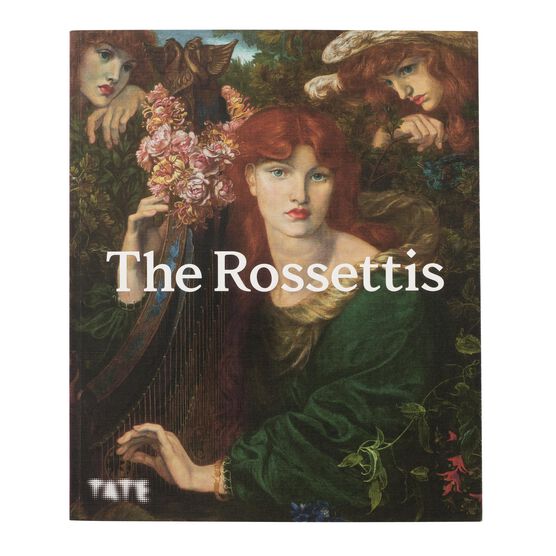
 Further to what I was saying yesterday, we not only have a swanky new catalogue to go with The Rossettis exhibition at the Tate, but also we have a brand new biography of Elizabeth Siddal from Jan Marsh...


Now, I was fortunate to have been sent a pdf copy of the forthcoming book which is due out any moment now from Pallas Athene so my review is about the contents rather than including details of the physical book but I've had books from Pallas Athene before and they do a lovely job. On with the review!
Photo of Elizabeth Siddal (c.1860s)

Arguably, in the last decade, we have moved from seeing Elizabeth Siddal as a muse to seeing her as maker. In fact, I would boldly assert that the shift in our perspective of her (as an audience, rather than you and me specifically) is breath-taking and something I can only dream about accomplishing with Fanny. For Miss Siddal, the two images of her, as model and painter/poet, are so well defined it is easy to see why people cling to the more tragic version of her, drug-taking, bath-bothering, abused wife rather than the woman of such agency that it lifted her to an artist who exhibited internationally.  Speaking as a biographer of 'colourful' women, it's the colourful bits that persist.  Where we start with Jan Marsh's new book is one of my favourite phrases - What is it that we actually know to be true?

Sketch for Ophelia (1851) John Everett Millais

So, where to start? Well, actually what has been told to us over the years is by people who are writing their own narratives.  Obviously, I know that to be true of Fanny but to my shame I never really thought about it with Elizabeth Siddal.  Starting with her iconic discovery in the hat shop - Really?  Do we know that to be true? Apparently not. That's rather mind blowing in itself...

Elizabeth Siddal (1854) Dante Gabriel Rossetti

When you start dismantling the narrative, you are left with the facts such as she was a painter, Ruskin was her patron, she went to France, she studied in Sheffield and wrote powerful poetry.  She also found herself on uncertain ground with her erstwhile lover who replaced her and moved his art style on then returned.  Much is made of her health and habits but not much is said of her strength and once you put into context the events that happened around her and what she dealt with, it is impressive she accomplished as much as she did. I am left wondering why on earth she loved Rossetti, arguably she could have had a more settled, sucessful life without him. 

St Agnes' Eve (1854) Elizabeth Siddal

Split into sections entitled 'Model', 'Studio' and on to the places she visited or studied and her marriage and death, this is both a simple telling of her life story and also a bold challenge to the many myths of Miss Siddal. While undoubtedly tragic things happened in her life, it is hard to find people who write about her without presenting her as a victim.  Would we feel the same way, and speak the same way about 'poor Lizzie' if she had died in childbirth like Joanna Boyce or merely lived a long life beside a philandering husband, like Georgie Burne-Jones.  We do not prefix either of those women as 'tragic' so why Elizabeth Siddal?

A lock of Elizabeth Siddal's hair

I very much like this book and it will be a refreshing resource for those wishing to see both the narratives and the facts in one pocket sized book.  At around 150 pages, it is a quick read but it does not beat around the bush and has little time for meandering into supposition.  It is illustrated throughout and written in a thoroughly engaging manner which makes it the perfect companion to the new exhibition at the Tate.  

Long may we challenge the narrative!


Tuesday, 11 April 2023

Review: The Rossettis at Tate Britain

 It's been a bit of a month, hence the peace and quiet you have enjoyed from my rambling. However, a lot has gone on in the meantime, so I have to do a flurry of posts on three different exhibitions and a book!  I also turned 50, which is painful.  Let's move on because first up is possibly the most hotly anticipated exhibition of the year, The Rossettis!

The Rossettis!  At Tate Britain!

I was lucky enough to attend the private view for this exhibition on my birthday, which made the whole 50 thing a lot less wretched and meant I got to spend the evening in the company of some marvellous chums (both on canvas and in real life) with my partner in crime, Miss Holman...


So what is the exhibition about? Well, obviously it's about the Rossetti family, but most pertinently Dante Gabriel, Christina and Elizabeth (a Rossetti by marriage). Now, William Michael and Lucy (another Rossetti by marriage) also get a look-in, as do the other members of the Rossetti clan, but honestly, it's about Gabriel, Liz and Chrissy.  And Fanny.  I'll come to that in a bit...

How Sir Galahad, Sir Bors and Sir Percival... (1864) Dante Gabriel Rossetti

The Haunted Wood (1856) Elizabeth Siddal

Let's start at the beginning, and the beginning is actually poetry.  As you enter the first room of the exhibition, there are spots on the floor where you can stand and hear the Rossetti poetry being murmured to you (if you aren't at a rather rambunctious opening that is).  I think as a nation, we have rather forgotten how much we love poetry and value poets, which is odd as we love songs (which are just sing-y poems).  However, the fame that both the Rossetti siblings found as poets still has a punch, with Christina especially reminding us what a powerful poet she was and how influential and inspirational, not least to her brother.  In turn, we have her poem 'In an Artist's Studio' which speaks of the 'one face' that looks out of the canvases and it is hard not to apply that as a criticism to her brother's works. Into all this comes Elizabeth Siddal (whether you give her one 'l' or two is an entire conversation in itself).  Her career and progression is placed in the context of the Rossetti family and it is joyful to see her works on display in such a grouping as it makes sense of her contribution and why, even as late as the 1940s, she was considered such a prominent Pre-Raphaelite. I think we can now agree that Miss Siddal has found her place in the narrative and it is marvellous to see.  Almost as marvellous as this room...


Lawks, but I gasped! That astonishing wallpaper is the realisation of a design by Rossetti and it takes your breath away. However, the object I was most intent on stealing has to be that painted piece...


You know me, I've always been one for a sizeable cabinet, and this beauty is the work of Ford Madox Brown, Edward Burne-Jones, William Morris, Val Prinsep, John Seddon and Rossetti from 1861.  I was especially drawn to this panel, I wonder why...

Yes, Fanny.  I was so excited when I heard that Fanny was going to get a hearing in the great Rossetti story. As I have banged on about for the last thirty years, Fanny is a difficult one to slot into any dignified story without making everything messy but there is a marvellous amount of slotting (in an artistic sense) here, as Fanny explains a few things about Rossetti which aren't otherwise apparent.  That leads me to Found...

Found (1854-1882) Dante Gabriel Rossetti

Found (1870s) Rossetti and Henry Treffry Dunn

Just as a side note, you have no doubt seen the predicatably awful review from Jonathan Jones in the Guardian and it was his comments on Found and Fanny that made me snigger the hardest. He sneeringly points out that Rossetti was rubbish because he kept painting Found with Fanny looking 'sensual' (more tea, Vicar?) which completely undermines the meaning of the piece.  Yes, Love, that's the point or did you not notice that it was unfinished?  Dear me, it must be awful to have to feel superior to everything all the time. How exhausting, poor lamb.  Anyway, Fanny is really looking splendid in this section, with her face gracing Bocca Baciata, Fazio's Mistress and Fair Rosamund.  I won't rhapsodise too much but the fact that Fanny is included and makes the Rossetti narrative messy is a joy to me. In this context, Fanny represents growth and change, none of it easy, and she leads us through to the glorious room of colour, that heralds Rossetti's golden years of oils and pastels - now I know the pastel era isn't there for good reasons, what with his health declining and everything, but that man was good with chalk...

Ligeia Siren (1873) Dante Gabriel Rossetti

Blimey, Alexa! There are some gorgeous pieces in the long room of Rossetti's canvases and Alexa Wilding becomes the face of this period, although obviously Mrs Morris is present too...

Jane Morris (1868) Dante Gabriel Rossetti

There is a feeling of both simplicity and concern in the final few room, beautifully illustrated by the final room which has a wall projection of Ken Russell's Dante's Inferno.  The regular, beautiful works that represent the last 10-15 years of Rossetti's life mask the crisis he was undergoing, but seen together you notice the way he shows Jane, which is different to how he sees Alexa. Do I read too much in because of what we now know about his chloral addiction?  It's impossible not to but in his cascade of full-lipped beauties it is not hard to see him looking for someone, or being haunted by someone.  It is very moving indeed.

Monna Pomona (1864) Dante Gabriel Rossetti
(Miss Holman's favourite)

I was always going to love it, and you will too.  It's a different way of looking at a talented family and makes you appreciate how much of their work we enjoy, without having to bring too much biography into it.  The lightness of touch on that front will probably relieve many and does mean you can look at the works without being overly worried about who was sleeping with whom or taking what drug at the time. The deep dives into things like 'Goblin Market' and The Beloved add real depth to the show and you leave very happy (or in our case, going back through about three times because things mesh together so beautifully you end up revisiting pieces with a variety of perspectives.)  You have until the end of September thank goodness, so I think a long summer of Rossetti goodness is on the cards for us all.Obviously, there is a catalogue for the show, although it's actually a book of essays on the subjects raised rather than a straight reproduction of the show in book form, which is smashing and offers longevity to the work. With essays by such people as Jan Marsh (on Elizabeth Siddal), Wendy Parkins (on Jane Morris) and Dinah Roe (on Christina Rossetti), it is a collection of new looks at familiar subjects and is a fascinating and beautifully illustrated read. I bought the £30 paperback as I had to carry it home on the train and it is corking.

So, I will be back tomorrow with another Rossetti-related review, but I'm actually sure that I'm preaching to the choir with this one and if you are able, you'll be there.  And you won't be disappointed.

Friday, 5 August 2022

Who's that Lady? It's Jesus!

This is a bit of a rambling post brought about by a letter I read in an old newspaper. I love reading accounts from the early twentieth century from people who, in old age, are recalling what they know about the Pre-Raphaelites. This is particularly interesting when they are praising the work as by the First World War and the Twenties, when a lot of these accounts appear, they are talking about deeply unfashionable artists.  However, a week or so ago, a rather interesting letter caught my eye. It all started because George Moore published a right old rip-snorter of a Biblical novel called The Brook Kerith. This is 1916, so you'd think people would have other things to worry about, but George had made his Jesus a bit girly and all hell broke loose...

George Moore (1879) Edouard Manet

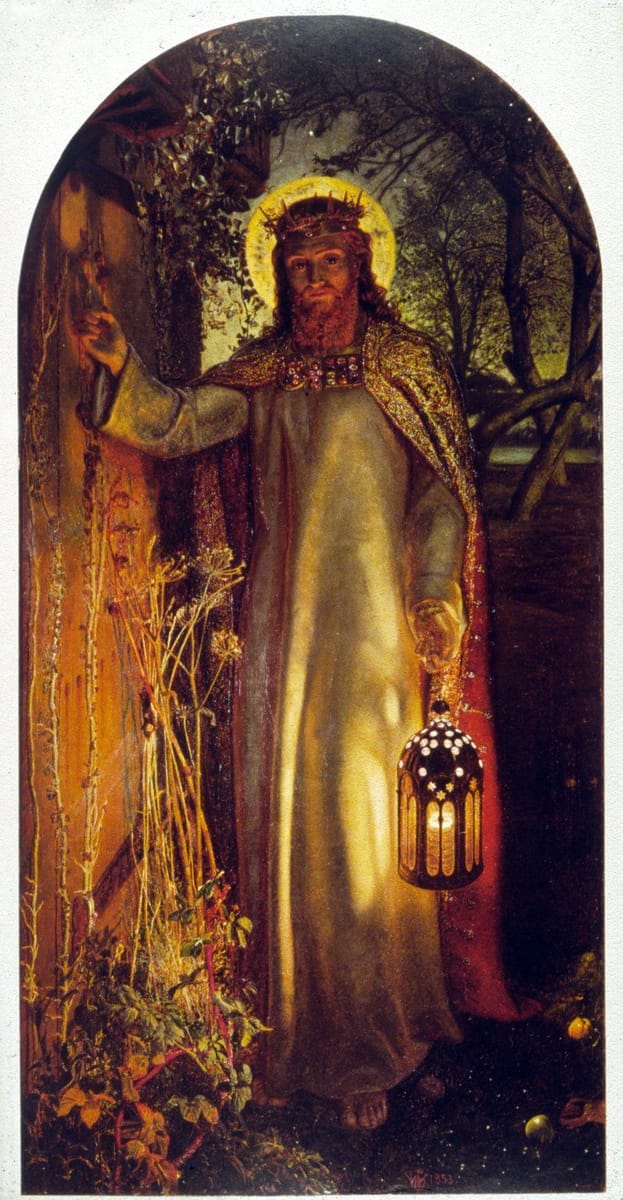
In a piece from the Westminster Gazette on Friday 15th September 1916, the author was forced to defend his depiction of Jesus, and he did so by invoking artistic precedents. When discussing the depiction of Jesus, he pointed out that from the 5th century onward, people had been killing each other over the correct interpretation of the scriptures, but one thing everyone could agree on was that the big JC 'must not be represented as a man.' This is an ecumenical conundrum as I'm guess depicting him as a squirrel would get you dispatched quite quickly, so what to do?  Mercifully, in the 15th century along came Fra Angelico who hit upon the idea of depicting Jesus as a pretty blonde lady and that's apparently fine. George Moore then brought everyone up to date and said Holman Hunt showed us a big girly Jesus knocking on the door, like a Holy Avon Lady. If the Pre-Raphaelites gave their Jesuses (multiple Jesus would be Jesi?) lady-faces then it's fine to have a lady-like Jesus in The Brook Kerith. Actually, having read the criticism of The Brook Kerith most of it is about the fact it's rubbish, and seeing as George had a reputation for writing saucy, scandalous books, I'm guessing the critics were already jumpy every time he published something new. So, George Moore's argument was that the Pre-Raphaelites made their Jesi look like chicks, so what's the big deal? Apparently, even the boy child Jesus in the Millais painting was a girl (according to George)...

Christ in the House of His Parents (1849-50) John Everett Millais

We then enter Round Two of the Big Girly Jesus fight, and on 21st September, Canon Horsley (an actual vicar and everything) weighed in on behalf of the enlightened church and said that if we are going to bring the Pre-Raphaelites into it, only a few people hated the painting and everyone else loved it (apparently). He finishes it up with a quote in Latin, which is always the best way to finish because no-one knows what you're talking about. Finally, and most sensibly, on the 25th September there was a letter from someone who really didn't seem to care if The Brook Kerith was any good but at least everyone could get their facts straight about the Pre-Raphaelites. The author of the letter was Mr Robert Ross, art collector, intimate of Oscar Wilde and all-round excellent chap. For starters, he said that the boy child Jesus in Millais painting was Noel Humphreys, the son of an architect, so George was talking absolute rubbish there but when it came to depictions of adult Jesi, Robbie Ross could give a few examples where it was the case that it was a lady...

The Light of the World (1851-3) William Holman Hunt

As Robbie says - 'Mr Moore remarks on the effeminate concept of Christ in the Pre-Raphaelite pictures, and the circumstance that a woman (Christina Rossetti) acted as the model for Hunt's Light of the World. There are other striking examples: Miss Siddal (Mrs Dante Rossetti) sat for the Christ in Madox Brown's picture of Maundy Thursday or The Washing of the Feet; and in Spencer Stanhope's picture, I Have Trodden the Wine-Press Alone - one of the most singular works of that unequal artist - Miss Ellen Terry posed for the figure of Christ.'

Jesus Washing Peter's Feet (Maundy Thursday) (1852-6) Ford Madox Brown

The Wine Press (1864) John Roddam Spencer Stanhope
In the Illustrated London News  of 1865, it was suggested that The Wine Press was very much after the manner of The Light of the World, an opinion repeated in books since and possibly reflecting that although it was painted in 1864, it was conceived years earlier, possibly nearer the time of Hunt's painting.  Robbie Ross finishes his letter suggesting that George Moore like to consider Henri de Groux painting Christ Aux Outrages (1889) as his frontispiece as it had been on is mind while reading George's book as it features a very feminine Christ.

Christ Aux Outrages (1889) Henri de Groux

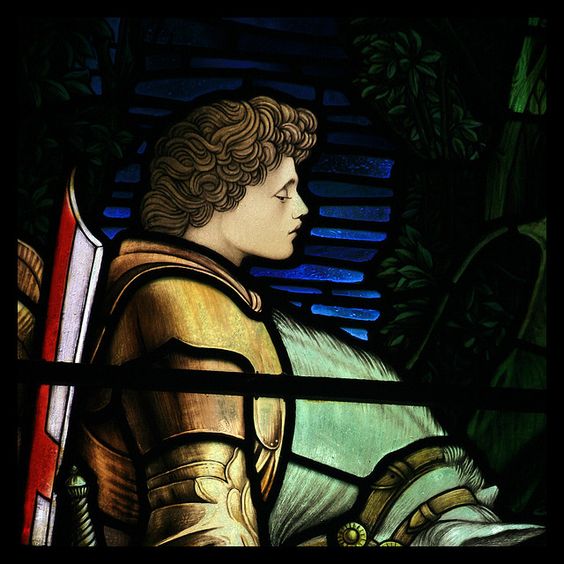
All these feminine figures for Christ left me wondering why no-one had reacted before.  I fully trust Mr Ross in his recollections, but also because we know that Holman Hunt used a few women for his Christ, and also Ellen Terry had form for posing as a chap.  Here she is as Sir Galahad, in a stained glass window from a painting by G F Watts...


...and here she is again, as a knight.  Maybe she just liked wearing the armour...?

Watchman, What of the Night? (1867) G F Watts

The stained glass window is in Freshwater on the Isle of Wight, where Julia Margaret Cameron routinely got girls to dress up as men...

Head of St John (1866) Julia Margaret Cameron

May Prinsep looks rather sombre as the head of John the Baptist (although seemingly very much still attached to the neck of John the Baptist). The place the girl/boy swap happened most often was with the Holy family...

The Holy Family (1864) Julia Margaret Cameron

The Madonna, or Mary Hillier, appears repeatedly in Julia Margaret Cameron's photographs, almost always clutching children of various sizes. Here she is clutching John the Baptist and Jesus, or Kate and Alice Keown as they were better known.  There are the occasional boys, for example Percy Keown, Freddy Gould or Julia's own grandson, Archie, but by and large, it's the Keown girls who are appearing as the various sainted boy-children. Freddy Gould was a very pretty little boy indeed, and he made a popular model, but the other boys are babies and so are fine while asleep but I'm guessing not the best models while awake. 

The Little Foot Page (1905) Eleanor Fortescue Brickdale

I think therefore the answer to why the Pre-Raphaelites used women as men is less to do with artistic tradition and more to do with availability.  As Robbie Ross pointed out, Millais used a boy as Jesus, not a little girl, so there was not an adherence to any ecclesiastical artistic tradition there.  The women brought in to model were friends, wives, sisters and lovers, therefore to hand and with nothing better to do (in the opinion of the artist). The Pre-Raphaelite ideal was to draw from life so if the only life you have to hand is Christina Rossetti then she better strap on a beard because she's going to be Jesus. Also, just because Elizabeth Siddal is washing some grumpy chap's feet as Jesus, it doesn't mean that she looks anything like what appears on the canvas, especially not in the topless version. Just because Walter Crane gave his (male modelled) Venus a six-pack in The Renaissance of Venus (1877) doesn't mean the Siddal Jesus had to have boobs...
Walter Crane, giving us a Venus who is more manly than Jesus...

In conclusion, art is often a combination of opportunity and tradition.  The male figures who are drawn from women are thus because women were to hand. If you asked me to name female artist's models, I could go on for ever but ask me to list male ones and I'd get a bit stuck after the hot Italian who was Julia Margaret Cameron's Iago. Women were to hand in the studios and houses of artists and although the faces (and six packs) of figures might have been finished from male models, preparatory sketches, emergency posing and all that stuff was more than likely done by a woman can yell for. If the tradition for painting Jesus is towards the feminine, then using Christina Rossetti to hold up your lamp is not outrageous as the finished figure has a great big bushy beard.  What surprises me is that Julia Margaret Cameron got away with May Prinsep as John the Baptist, looking completely like a girl and not really different from when she is posing as Zoe of Athens, Beatrice or just a portrait. There is no theatricality to her image (which is a surprise if you consider how Amateur Dramatics some of her Arthurian work is), it is a photograph of a head who also just happens to be a pretty girl. If you consider how devotional and religious Julia Margaret Cameron's work is, I'm surprised that no-one questioned it.  

Maybe they did and people just blamed Fra Angelico...


Thursday, 30 September 2021

Review: Rossetti's Portraits at the Holburne Museum

 Good Lord, it seems an age since I went to see anything pretty.  Very slowly the unlocking seems to have become a reality and museums are feeling brave enough to tempt us back in.  What a wonderful way to start my Autumn - a visit to Bath and the Holburne Museum, for this rather glorious exhibition...


Yes, it's an exhibition devoted to the portraits of Dante Gabriel Rossetti, which honestly sounds like a good time in my book.  As you can see, the exhibition is accompanied by a little precious gem of a catalogue (hurrah, catalogue!) and so I was over excited to attend (and get out of the house).


The exhibition is in one large room with the sections split between walls, and separated with a text panel about the subject.  We start with a few early sketches of both himself and his friends, before we move on to the women who dominate both his life and work.  This is very much an exhibition of  The Women Who Loved Rossetti, even though there are a few exceptions sprinkled in, just to show that he didn't need to be in love to make art.

Elizabeth Siddal (1854)

Obviously, Elizabeth Siddal is the first of the women who feature (other than family members and Emma Madox Brown).  It's a special experience being close to the intimate little drawings of Elizabeth leaning and sitting within the confines of Chatham Place. I had not really considered how caged and observed she looked in these sketches, but especially in the image above, I am reminded of paintings like Spencer Stanhope's Thoughts of the Past,  which I guess was painted at a neighbouring window a few years later...

Thoughts of the Past (1859) John Roddam Spencer Stanhope

Although she doesn't look as tortured as the poor soul in Thoughts of the Past, in the sketches of Elizabeth, she looks restless.  I wonder if that was how Rossetti saw her or indeed felt himself? The works of Elizabeth are at least less stagey and extravagant than what follows...

The Fanny Section!

Imagine my utter joy at discovering they had a Fanny section!  I was a very happy Fanny-Obsessed Art Historian indeed. This is the second exhibition where Mrs Cornforth got her own section and the fact that she has now firmly wiggled into the official narrative is such a proud and joyous thing for me.  She absolutely deserves to be there, sunning herself in the limelight.  Anyway, after I stopped having a moment, I was very pleased to be faced with this selection of beauties...

Sketch for Fair Rosamund (1861)

The Blue Bower (1865)

Fazio's Mistress (1863)

I have to give a special word of praise for Fazio's Mistress which I don't think I see that often and is not glazed, so you can get a really good look at under lighting. It's a cavalcade of gorgeous creamy flesh and high sensual drama, a complete change from the intimate reality of the previous section and I think the strength of his work with Fanny is what makes her special and of note within Rossetti's art history.  Yes, he follows with equally strong and sexy images of Alexa Wilding and Jane Morris but it's Fanny who opens the farmhouse door into Oz, if you know what I mean.  Talking of Alexa...

Detail of Monna Vanna (1866)

I am always amused by our endless puzzlement about Alexa, who is so mysterious and yet everywhere in Rossetti's work from 1865 onwards.  God bless Sylvia Broussine and Christopher Newall for name checking me for my Fanny-centric reading of Monna Vanna which is one of the hills I am happy to die on.  She's holding a fan! Anyway, Alexa and Annie Miller make an appearance before we move on to Jane Morris and Rossetti's endgame with his deep, rich tributes to his love of Jane. 

The Blue Silk Dress (Jane Morris) (1868)

Jane gets to be the poster girl for the exhibition and you can't help but be completely taken aback by the scale of the beauty in these portraits.  That blue seems to have so much texture and depth, it takes your breath away.  I also got to admire his rather nifty roundels...


That's the thing about Rossetti - yes it's his pictures we know him for now but he also thought about the frames and how we experience the whole thing as a piece of luxurious devotion. Not only that, I was delighted to see some of his jewellery in a little case...


I absolutely loved the exhibition; it was succinct and beautiful, giving you exactly what you need to see in a wonderfully calm and dreamy atmosphere.  The catalogue is equally deceptively small but packs a hefty punch in terms of interesting text and wonderful illustrations. It was the exhibition equivalent of someone giving you a big hug and saying 'Come on back outside for a bit, it'll be fine.'

Find out more about Rossetti's Portraits here.