Showing posts with label Jane Morris. Show all posts

Tuesday, 30 December 2025

Exhibition Review: Beauty of the Earth

 As you will know, I don't like Twixtmas, or the bit between Christmas and New Year so I thought I'd jolly it up by visiting the exhibition currently at the Arc in Winchester, entitled Beauty of the Earth: The Art of May, Jane and William Morris...

Okay, here I would normally put an image of the poster, however, none of the ones I can find on line are very high resolution and so here is a link to the website.

Also normally I would put some images of the exhibition in my review and do a bit of faffing about on social media, but there was no photography allowed, which is an interesting move for things that are very much out of copyright.  I was also asked not to touch anything, which is probably a fair judgement of my character. I was then faced with these beautiful open scrolls of wallpaper on the wall rather than in frames, so I have no doubt that the room guides heard me exclaim 'Oh, come on!' and not for the only time in this exhibition. I'll come to that, but first the positives as they are plentiful.

Right, first things first, this is a beautiful exhibition. I was interested to see how, in a year of Morris-ness, there was anything new to say, but I never doubt Suzanne Fagence Cooper, and rightly so. The rooms at the Arc are not the largest of spaces, as I saw when I visited the Fred Appleyard exhibition there. The available hanging space is supplemented with freestanding walls and everything is covered in gorgeousness. You will see plenty you are familiar with but also plenty you aren't and for a small space, it is ambitious to coherently display the work of all the Morris family, especially when William (for obvious patriarchal reasons) can both dominate and exhaust by the sheer volume. I remember getting my very first exhibition-fatigue at the 1996 V&A William Morris exhibition which was endless. This is not only beautifully balanced but also ties the work of all Morrises together fairly. William isn't just a powerhouse, May isn't just an acolyte and Jane is more than a pretty face. They are so intertwined that it now feels a bit rude to take one from the context of the others. I also suspect William would have thoroughly approved of this approach as he doesn't strike me as the patriarchy (see below)...

Well said, comrade. 

Anyway, I was delighted to see all the wonderful textiles, possibly my favourite part of the exhibition, especially this one...

Daisy Wallhanging, worked by William and Jane Morris

God, I hope that's the one that was there, as that is a picture of it at Kelmscott Manor, but I'm sure it was on one of the panels.  I really like it because of its simplicity and whenever I see it I think 'I could do that!' (I couldn't, well, possibly given time and resources) which is another thing I think Mr Morris would like to hear.

The theme of the exhibition is a love of nature and that love being your home.  Thinking about it, Morris's work is filled with nature, so exploring the world of Morris through the trees, streams, birds and flowers that populate it seems, if you excuse the pun, natural. Not only that, but they themselves are often portrayed as being at one with nature, such as in this painting (which was a pleasure to see again)...

Snowdrops (1873) Dante Gabriel Rossetti

I sometimes wonder what Morris would make of the fact that we can't talk about his wife without Rossetti being involved. Again, it was a bit part of her early life, but it seems a shame as it isn't exactly a positive thing (no offence to anyone involved), which I think is why I was so pleased to also see this image...

Jane Morris (c.1900) Charles March Gere

I'm very familiar with Evelyn De Morgan's image of Jane in older age (I just checked her age and she's not that much older than me here) but I hadn't seen this before that I remembered and it is such a beautiful painting by Arts and Crafts illustrator Charles March Gere (1869-1957), who worked with the Kelmscott Press. Including this image did take the edge off the often-overwhelming 'She was Rossetti's Muse!' narrative you can get elsewhere, and I think it's time we de-centred dear old Dante Gabriel from everything (again, no offence to him as I love him) as I think we only do it because he was the sexy one. Allegedly. Anyway, he has no business in such a family exhibition about working and living within the landscape of England.
Orchard Bed Curtain worked by May Morris

This is a lovely exhibition and a smashing way to end the year.  The use of audible birdsong was very welcome - I always love when there are sensory aspects to exhibitions and the birds singing away above things like the Trellis wallpapers and Orchard Bed Curtains make the space feel very special indeed. It also benefits those among us of the neurodiverse community who get so much more from the experience.

As I was leaving there is a massive banner that fills the exit that says 'William Morris was Right' - well damn straight, but I am also a shallow baggage and I want to be able to take a selfie with that, but wasn't allowed, so again I exclaimed 'oh, come on!' and went off to the cafe...


Full disclosure and probably TMI but shortly before I reached the Arc this morning I fell over in the street, twisting my ankle and scabbed up my knee. A kind gentleman at the door said he was exactly the same when he was drunk (well, here we are) and I need to be careful at my age (so very elderly). The first aider at the Arc gave me a massive plaster, but I was a little perturbed as I viewed the exhibition I was not allowed to photograph (a small thing, but matters to me).  What made my mood infinitely better, despite my elderly infirmity, was the pasty I bought from the cafe, which had been made from the Morris family recipe. It was absolutely delicious. 

You have until 4th February to go and experience the glorious exhibition and eat a delious pasty, and I thoroughly recommend it.

Friday, 10 June 2022

Review: How We Might Live: At Home with Jane and William Morris

 There is an absolute joy in wallowing in a wonderful new book, meeting old friends and seeing things in a different light, which is why I have been eagerly awaiting the publication of Suzanne Fagence Cooper's new biography of William and Jane Morris, How We Might Live...


You might think that as a couple neither of the Morrises are exactly short on biography, but what has been missing, arguably, is seeing them as a functioning couple. Indeed, one thing we have been told over the years is exactly the opposite, that they did not love each other, both were miserable - he was bullish and she was sulky. I've always been #TeamWilliam, mainly because biography of Fanny tended to be lost in the gushing over Jane that started almost as soon as Rossetti died. However, if we have learned anything, then it is definitely to not believe a damn word anyone else tells you about a person if they have a blatant ulterior  motive (Yes, I'm looking at you, Hall Caine). 

Also, yesterday afternoon about 5pm, I suddenly realised that William Morris was autistic. Yes, I will back that up, but let's crack on...

Mrs William Morris (1858) Dante Gabriel Rossetti

There are many reasons why I absolutely loved this book, but I'll start with just how enjoyable it is to read. The tone is friendly, packed with knowledge and easy to read. The Morrises are referred to as William and Jane, which immediately invests you in their lives,and their world is where we will be for a mighty 536 pages. While I am sure by now we know that Jane was not just the passive observer of her own life, I was still surprised by her laughter, which was 'unforgettable' and exactly how active she was in the creation and management of her life, art and legacy. It is also shocking to see how the interpretation of others is still taken as gospel when it comes to how she felt about the men in her life, but I'll come to how much I want to slap Wilfrid Scawen Blunt in a bit (You can also read about how much I loathe him here). This book takes us through their lives, step by step so you can see the journey, understand the steps they took and appreciate for yourself that Jane and William Morris were extraordinary for so many reasons, but utterly relatable in ways that we just don't give them credit for. 

William Morris (1880) Emery Walker

Starting with William, he had read all of Walter Scott by 7 years old, which is incredible, but that wasn't the most interesting thing I took away. As a child, he preferred the calm of girls to the rough and tumble of boys. His vivid memories of childhood involve sensory recall - 'To this day, when I smell a may-tree I think of going to bed by daylight.' His intellect, his tempers and melt downs that involved beating his own head and destroying work, the social difficulties, inability to full acknowledge the needs of others above his singlemindedness, his endless energy on his own projects and even the curious way he walked, all discussed in the book, lead me to believe that William was on the autism spectrum, which is something I hadn't really considered until now. The comorbidity of autism with epilepsy might also provide an explanation of Jenny's condition, but beyond that, understanding the neurodivergence of such a familiar figure gives such a different view of their life. As someone on the spectrum myself, I also absolutely loved the sensory nature of the book - the smell of things, the feel and sound of fabric - which is so evocative of place and person that it is impossible not to immerse yourself. I also liked the placing of Morris in time - the detail that he was taking his entrance exams in 1852 just as the Pre-Raphaelites were gathering momentum gives you context to see what he would be entering into in a matter of years.

La Belle Iseult (1858) William Morris

But what of Jane? There is a silence over Jane's life before that fateful meeting with the artists in the theatre, and as frustrating as that is, it is also part of the story, as it was orchestrated and controlled by Jane herself. It is interesting to see the contrast between William and his good friend Edward Burne-Jones in terms of wealth, but it is another step again for Jane. She appears from the streets of Oxford, from too-small rooms, outbreaks of cholera and little money, to become a queen for a group of young men, one of whom had his own suit of armour and pony as a child. And she married him.

The Morris marriage will always be a matter for discussion, mainly because of the lack of scandal it seems to have generated. What I appreciated in How We Might Live is acknowledging the difficulty in Jane's position as well as William's. I think it is well past time we stopped romanticising Rossetti's obsession with Jane and discuss how much his mental illness impacted all their lives. That is not to say that she did not love him, and they did not have an affair, but the nature of their affair, William's escape to Iceland and Rossetti's own behaviour need to be looked at without rose-tinted glasses, which I think is done accurately here. It is also a joy to read an account of William being beloved by his family, being the storyteller, the craftsman, the adventurer, not just the cuckold to Rossetti's Casanova.  It's impossible not to see who comes out of this the happier man with the better life and it is refreshing not to see obsession romanticised. We possibly need to be reminded on a regular basis that the Jane who exists on Rossetti's canvas is his invention and beyond her control. Which leads me to a huge part of the story...

The Blue Silk Dress (1868) Dante Gabriel Rossetti

How do we know that William and Jane Morris had a miserable marriage? Because Wilfrid Scawen Blunt said she told him so.  This is the same man who slept with Jane in order to feel closer to Rossetti so I'm happy to ignore his nonsense, thank you very much, however this does raise an interesting point.  William Morris was an Eminent Victorian (TM) and so much written about.  The couple's friends and admirers were not backward in writing their views on both him and her and so what we end up with is a tapestry of other people's opinions, much of which if we think about it, is unrealistic and missing the point that both Jane and William were human beings, able to experience dodgy marriage spells, mid-life crisis and attraction to other people without it completely defining their entire lives. We can possibly say that there were times in the Morris marriage which were not happy, but that does not equate to an unhappy marriage. On the contrary, throughout even the unhappy patches of their marriage, the couple care about each other - when Morris escapes to Iceland, Jane frets that she has not heard from him. How We Might Live shows us that it is possible to love two people at the same time and that not all love is the same. It's interesting that even though the Burne-Jones marriage takes many turns no-one ever claims that they were miserable and had a loveless marriage. Is the difference Rossetti?

Kelmscott Manor 1905, May, Jane, Jenny and Ada Peerless, Jenny's nurse

We follow the Morris family from place to place, experiencing their lives in that time and place, until we end up at Kelmscott at the end of Jane's life. Her obituary acknowledged that 'only her intimate friends knew the kindliness, the good sense and the girlish love of fun, which remained until the end of her life.' This nod towards the myth making that both Jane and William suffered from is backed up by a visit to the elderly Jane by the poet Richard Le Gallienne who could not cope with being given a jar of homemade jam by the goddess of Rossetti's imagining.  This brought me right back to a similar statement from Swinburne after Morris proposed marriage to Jane, over half a century before - 'The idea of marrying her is insane. To kiss her feet is the utmost men should dream of doing.' 

The M's at Ems (1869) Dante Gabriel Rossetti

The blessing of How We Might Live is that it takes us through the stages of a marriage and of two lives with such precision that you can absolutely see the myths obscuring the truths. It seems a shame that we should have to be so vigorously reminded that the Morrises had an extraordinary life together, for all the challenges and sorrows. Jane left origins of poverty and found life experiences that would have been well beyond her grasp.  She had influence and impact that mean we feel we know her over a century after her death. The book is a marvel for the senses, from the smell of jasmine and the feel of silk to the taste of hot pot and marmalade, both of which are included in the recipes passed from Jane to May Morris. This is a warm hug of a book, filled with wisdom and heart, and as William Morris would say 'O my word! So very, very gorgeous!'

How We Might Live is available now from all fine bookshops and from the publisher.

Thursday, 30 September 2021

Review: Rossetti's Portraits at the Holburne Museum

 Good Lord, it seems an age since I went to see anything pretty.  Very slowly the unlocking seems to have become a reality and museums are feeling brave enough to tempt us back in.  What a wonderful way to start my Autumn - a visit to Bath and the Holburne Museum, for this rather glorious exhibition...


Yes, it's an exhibition devoted to the portraits of Dante Gabriel Rossetti, which honestly sounds like a good time in my book.  As you can see, the exhibition is accompanied by a little precious gem of a catalogue (hurrah, catalogue!) and so I was over excited to attend (and get out of the house).


The exhibition is in one large room with the sections split between walls, and separated with a text panel about the subject.  We start with a few early sketches of both himself and his friends, before we move on to the women who dominate both his life and work.  This is very much an exhibition of  The Women Who Loved Rossetti, even though there are a few exceptions sprinkled in, just to show that he didn't need to be in love to make art.

Elizabeth Siddal (1854)

Obviously, Elizabeth Siddal is the first of the women who feature (other than family members and Emma Madox Brown).  It's a special experience being close to the intimate little drawings of Elizabeth leaning and sitting within the confines of Chatham Place. I had not really considered how caged and observed she looked in these sketches, but especially in the image above, I am reminded of paintings like Spencer Stanhope's Thoughts of the Past,  which I guess was painted at a neighbouring window a few years later...

Thoughts of the Past (1859) John Roddam Spencer Stanhope

Although she doesn't look as tortured as the poor soul in Thoughts of the Past, in the sketches of Elizabeth, she looks restless.  I wonder if that was how Rossetti saw her or indeed felt himself? The works of Elizabeth are at least less stagey and extravagant than what follows...

The Fanny Section!

Imagine my utter joy at discovering they had a Fanny section!  I was a very happy Fanny-Obsessed Art Historian indeed. This is the second exhibition where Mrs Cornforth got her own section and the fact that she has now firmly wiggled into the official narrative is such a proud and joyous thing for me.  She absolutely deserves to be there, sunning herself in the limelight.  Anyway, after I stopped having a moment, I was very pleased to be faced with this selection of beauties...

Sketch for Fair Rosamund (1861)

The Blue Bower (1865)

Fazio's Mistress (1863)

I have to give a special word of praise for Fazio's Mistress which I don't think I see that often and is not glazed, so you can get a really good look at under lighting. It's a cavalcade of gorgeous creamy flesh and high sensual drama, a complete change from the intimate reality of the previous section and I think the strength of his work with Fanny is what makes her special and of note within Rossetti's art history.  Yes, he follows with equally strong and sexy images of Alexa Wilding and Jane Morris but it's Fanny who opens the farmhouse door into Oz, if you know what I mean.  Talking of Alexa...

Detail of Monna Vanna (1866)

I am always amused by our endless puzzlement about Alexa, who is so mysterious and yet everywhere in Rossetti's work from 1865 onwards.  God bless Sylvia Broussine and Christopher Newall for name checking me for my Fanny-centric reading of Monna Vanna which is one of the hills I am happy to die on.  She's holding a fan! Anyway, Alexa and Annie Miller make an appearance before we move on to Jane Morris and Rossetti's endgame with his deep, rich tributes to his love of Jane. 

The Blue Silk Dress (Jane Morris) (1868)

Jane gets to be the poster girl for the exhibition and you can't help but be completely taken aback by the scale of the beauty in these portraits.  That blue seems to have so much texture and depth, it takes your breath away.  I also got to admire his rather nifty roundels...


That's the thing about Rossetti - yes it's his pictures we know him for now but he also thought about the frames and how we experience the whole thing as a piece of luxurious devotion. Not only that, I was delighted to see some of his jewellery in a little case...


I absolutely loved the exhibition; it was succinct and beautiful, giving you exactly what you need to see in a wonderfully calm and dreamy atmosphere.  The catalogue is equally deceptively small but packs a hefty punch in terms of interesting text and wonderful illustrations. It was the exhibition equivalent of someone giving you a big hug and saying 'Come on back outside for a bit, it'll be fine.'

Find out more about Rossetti's Portraits here.

Sunday, 5 January 2020

Venus in your Garden

Excuse the brief, rambling nature of this post but it's just a thought that I wanted to write down and as you're here, I'll tell you.  Yesterday, I was having a very lovely look around the Beyond the Brotherhood show in Southampton with some lovely friends, and we found ourselves stood in front of this beauty...

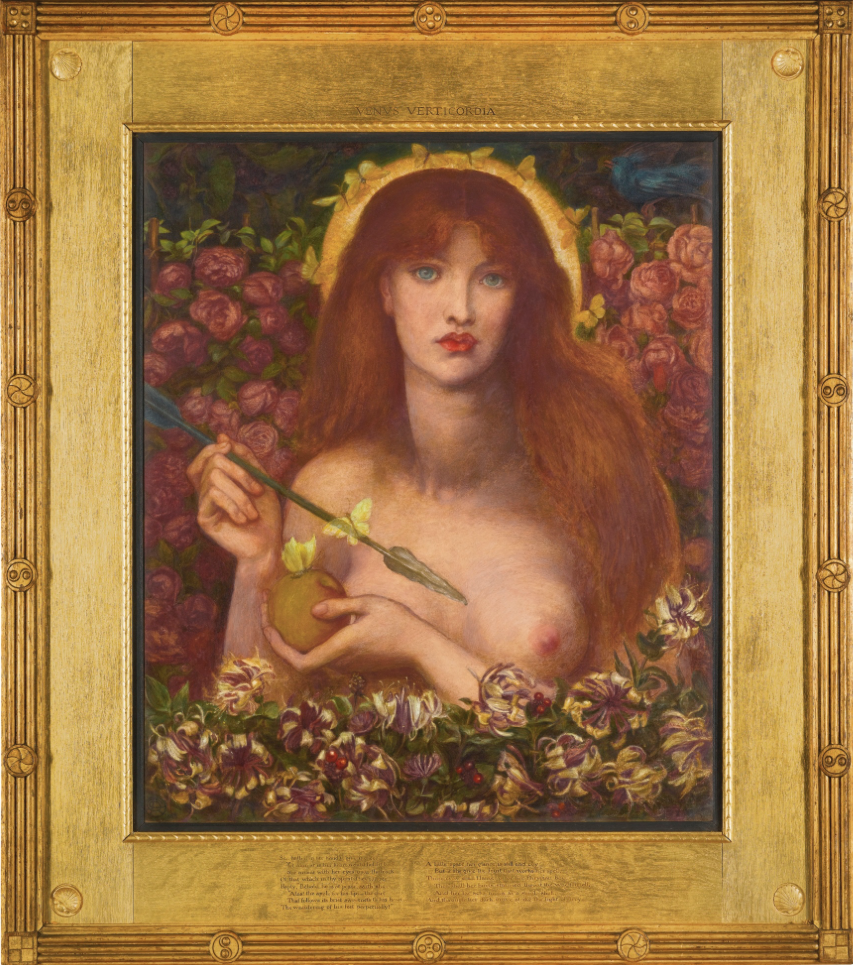
Venus Verticordia (1864-8) Dante Gabriel Rossetti
Yes, yes, all very lovely.  Now, the problem I have with this image, which I liked so much I used it on the front of my novel about Alexa Wilding, is that it is hard to get a decent reproduction of it, and secondly, you just end up looking at Alexa and her assets because she is so very luminous, which means you often don't give a massive amount of thought to all the other bits and pieces in the picture. That might well just be me, because it seems rude not to stare at her boob, especially as she is going to the trouble of pointing at it and everything.  Anyway, I was stood to one side of the painting yesterday, talking about how Rossetti scraped out the face to add Alexa and the suchlike, when I was attracted to the blue bird in the corner.  Now, obviously I had seen the bird before, I'm not that boob-obsessed (not quite) and in fact it is one of my favourite bits as the blue adds a spark of something that contrasts with the pinky-russet of the piece, highlighting her eyes.  Anyway, what I had not really clocked before was what the bird was sitting on. It's a trellis, although, in this reproduction, you'd be hard pressed to see it.  Hang on...

Bird! (Also present but not pictured, boob)
Okay, that is not very helpful, but you can just about see that the blue bird is clinging to the struts of a trellis that the roses are climbing up.  In the chalk version from 1863-8, it has moved...

Weird ghost bird over right shoulder...
But in the watercolour replica of 1868, it is where it should be...

Smashing frame!
And in fact a little bit easier to see...


All this rambling is because the friends we were with asked what the significance of the bird was.  Well, blue birds are a symbol of fertility, renewal, birth, possibly there to contrast with the butterflies that symbolise the fleetingness of life in a whole 'circle of life' thing without having to bother Elton John.  However, something about that bird seemed familiar...

Trellis (1864) William Morris
Hang about, I thought, that reminds me of Trellis!  Why had I never noticed that before?! Trellis is probably my favourite William Morris print (don't tell Strawberry Thief) and his first design.  Legend has it that it was inspired by the trellis work in the gardens at the Red House.  Look at the date, right there at the inception of Venus Verticordia and the little flying insects that look somewhat like tiny butterflies.  A couple of Philip Webb's blue birds (Morris couldn't do birds so got his friend to do them) look awfully like the blue bird in the corner of Venus Verticordia. Hmmm...

So what can we surmise from this? Possibly nothing other than it is a co-incidence, or that Rossetti and Morris discussed the design and Rossetti included it as an homage to his friend.  Or pinched it because it was a nice touch and he was a bit blurry on boundaries when it came to pinching stuff or wives. The fact that both Trellis and Venus concern rose covered trellises, even though Rossetti's is somewhat more overblown (show off) makes me suspect that it isn't a simple co-incidence. The scandalous novelist in me wants to read far more, obviously, and suggest that by 1865 when Venus was in full swing, Rossetti was falling back into love with Morris' wife and by including the Trellis bird in the canvas he was signalling that she had 'turned his heart' like Venus. 

What it probably should tell us is that you should never, ever, let Rossetti anywhere near your trellis, but I think we knew that already...

Wednesday, 16 October 2019

Pre-Raphaelite Women (with an emphasis on the 'men')

That sound, my gentle readers, is the repeated bang of my head against the desk.  I should have seen it coming, yet I was still rather surprised when, at the end of a marvellous talk on Pre-Raphaelite women recently (given by someone else, hence the 'marvellous') the first question was 'why do they all look like men?' Sigh.


When the National Portrait Gallery launched the publicity for their new exhibition Pre-Raphaelite Sisters, the first comment on social media was, and I quote...

PRE-RAPH BLOKES IN DRAG

Gosh, how original, thought I, but after a quite extensive period of eye rolling I felt I should put some thought into an answer of why people keep saying this.  So, do they all look like blokes?

Let's start with this...

Detail of Ophelia, but you all knew that
I never get tired of seeing this image and the face in Ophelia may well be my favourite of all Pre-Raphaelite women, which is a bold claim, but as 'portraits that aren't actually portraits' go, it's photographic and astonishing.  I can't say that I get a strong masculine vibe from this.  How about this one...?

Portrait of a Girl (Sophia Gray) (1857) John Everett Millais
I've heard grown men come over all unnecessary while talking about this striking portrait and George Saucy-Pants Boyce had it next to Bocca Baciata, so we can guess his thoughts about it.  It's a strong portrait but it would be stretching it to argue it's a masculine portrait.

Washing Hands (1865) D G Rossetti
The lovely Ellen Terry washing her hands is not at all bloke-y.  It's absolute perfection in its delicacy. So let's cut the chase.  It's Jane Morris, isn't it?

It is, isn't it?


It massively is, I can tell.  With her broad shoulders, defined jaw line and obvious physical presence, it is usually Jane, as portrayed by Rossetti, that comes in for the flack.  It would be easy to say 'well, that is just how Rossetti chose to show her...' but actually, she did pretty much resemble his images of her.

Jane Morris (1865) John R Parsons
Coming in a close second, it's Holman Hunt's over-paints of Annie Miller with his wife Fanny/Edith (they both look very much alike) that get a bit of abuse but again, the Waugh girls did look a bit like their painted selves...

Edith Waugh (1874) Elliott & Fry
Before we start unpacking all that, I might just add that of course, conversely, Edward Burne-Jones gets criticised for making his male figures too feminine, as Willie Bridgman MP complained (read about it in this post) and Pre-Raphaelitism is not short of 'man-damsels' flopping about looking sexy...

Exhibit A Chatterton (1856) Henry Wallis

Exhibit B The Wounded Cavalier (1855) William Shakespeare Burton
While we're on the subject, from the outset Pre-Raphaelite art was definitely up for a bit of cross-dressing, but with girls dressed as boys, as in...

Valentine Rescuing Sylvia from Proteus (1851) William Holman Hunt

and this one of course...

Twelfth Night (c.1850) Walter Howell Deverell

But you know, it's Shakespeare, it's all good.

Venus Verticordia (1864-8) D G Rossetti
She can't be a bloke, she's got her teapot lid out...

So, if the painted images of the women look like them (as much as any picture that isn't a portrait is going to, see also this post) then what people are actually objecting to is that women who look like that feature in pictures and here we are into much murkier territory.  Who exactly gets to say what a woman looks like?  Why can't a woman have a strong jaw, big eyebrows, be tall, have broad shoulders?  If a woman has those things, who are you to say that she isn't a woman, and a damn fine looking woman at that?  

Pomona (Alice Liddell) (1872) Julia Margaret Cameron
It boils down to the commentator firstly finding that an image does not fit in their narrow category of 'woman' and secondly objecting to that woman being glorified in art.  This is partly an exclamation of 'I don't fancy you therefore you don't deserve a picture'. I have occasionally thought 'Good heavens, I would extremely saucy things to you' while looking at certain paintings, but have never thought the opposite.  I mean really, whether or not someone was a suitable subject for a painting 150 years ago is somewhat of a moot point.  Rossetti doesn't care if you fancy Jane Morris; He fancied Jane Morris, so you can shut your face. Also, he's dead, so he really doesn't care.

Fading Away (1858) Henry Peach Robinson
 Also, what are people looking for in a female image? Someone who is one cough away from an open grave?  Gosh, that woman in Fading Away is so hot, she looks like a proper woman and everything with her deathly pallor and prominent bones.

Too Late (1858) William Lindsay Windus
Look at the walking stick on this girl! I like my women to not be able to escape quickly. That's a proper woman.

Look, if you are in the business of telling women what they can and can't look like then Pre-Raphaelite art is not for you.  The Pre-Raphaelite artists purposefully set out to paint women they found attractive, not really giving a jot for what society thought.  They treasured red-hair as the rest of society found it unlucky, they sought out women in their circle to play the Virgin Mary, suffering all manner of abuse for it.  Holman Hunt went off to the Holy Land to find Jewish models to play the Holy family and was not thanked for it.  Women in Pre-Raphaelite art are, for the most part, strong, healthy, lusty looking lasses and through their challenge to the prevailing aesthetic that narrow little band of what is acceptable for womankind widened a few inches.  

No-one gets to say a damn word about the appearance of a woman, especially, and I cannot emphasize this enough, if that word is a negative matter of opinion.  The moment we start saying what a woman looks like, everything is dangerous ground.  If a person is a woman, then that is what a woman looks like.  If a woman looks strong, thoughtful, drought and famine resistant then that is what a woman looks like, as is every variation therein. I get very nervous when women are required to look thin, sickly and passive as that does not speak well of the men in our society. That is not to say that thin, sickly women are not what women look like either, because some women are that and therefore it is still what women look like and that still isn't a man.  

Proscribing what a woman should look like tends to be part and parcel in with what should come out of her mouth or what should go through her mind. A society that sneers at any woman who does not look like the narrow ideal should worry us all - if you let a damaging opinion go by just because it doesn't affect you personally then tomorrow it might be you that gets sneered at, which by the way means that nothing you think/do/feel is valid or listened to. We are better than this, and if we really aren't then we should aspire to be or learn to think before decreeing what a gender is or is not.

So when you hear 'but they all look like men!' please answer and inform, not just for those women but for all women.

Monday, 26 March 2018

Mistress of None

Hello again and apologies for the brief break in service.  I have been busy at work on my book about Pre-Raphaelite women, due out at in the Autumn (and available for pre-order here (UK) and (USA), but whilst doing research and the suchlike, I started wondering about a word that kept being bandied about.  That word is 'Mistress'...

Fazio's Mistress (1863-73) Dante Gabriel Rossetti
Language has power and it is up to us to see when more is being said than the mere words spoken or written.  This is definitely the case with the word 'Fat' (see this post) and 'Old' (see this post) which carry with them value judgments, but how about the word 'Mistress'?  What do we mean when we call a woman someone's mistress?

Mistress of the Moat (1898) Herbert Alfred Bone
On the one hand, in a very basic way, 'mistress' is just the female version of 'master'.  This posh lady on a horse is married to the man who owns the house, I'm guessing, but just her very regal presence on her equally regal horse makes her the boss of the moat.  Look how the various birds look at her with birdy respect.  She is in charge of everything, well, until her husband gets home.

'O Mistress Mine, Where are you Roaming?'  (1899) Edwin Austin Abbey
Moving on, the word 'mistress' is often said in a possessive sense, as in 'my mistress' (or in the case above 'mistress mine'). It's difficult sometimes to define exactly how this is meant - a servant might refer to his mistress but then it means something different to when a man says it.  When the man in the above painting asks the question 'o mistress mine, where are you roaming?' is he asking as he equal or her inferior?  Is the inference one of respect or possession?  Also, being called a man's mistress is a very loaded term...

Lillie Langtry, mistress
So, I'm writing my mini-biographies of 50 Pre-Raphaelite women and one word that comes up quite a bit is 'mistress'.  For women like Lillie Langtry, it refers to her relationships with married men, although half the time she too is married, so what is the equivalent term for chaps who have affairs with married women?  Also, with women like Lillie, many of the men she was having affairs with weren't married so they definitely count as the male equivalent of 'mistress' - 'masters'?  no, that has the connotation of being the superior partner in a relationship that definitely isn't one of equality.

The Awakening Conscience (1853) William Holman Hunt
This is probably what most people think of when they think of Victorian mistresses.  This young lady is a 'kept woman', in her own luxurious little house in St John's Wood, where her rich gentleman acquaintance can pop in for a tickle on her ivories.  He is married, she is not, least of all to him.  He is wealthy, she is not, and everything she now possesses is courtesy of her chap with the implication that he can remove it as swiftly as he bestowed it. If she is his mistress, he very definitely is her master.

The Reluctant Mistress (no date) Raimundo de Madrazo y Garreta
Look at this woman: he's given her a bunch of flowers, what more does she want? There is a definite sense that women, when provided with nice furniture and a very pleasant tea-service should be available for naughtiness.  There is an unspoken (but very loudly hinted at) commercial transaction going on.  She is what we think of as a mistress, a sort of luxury item that rich men have.  Do poor men not have mistresses?  Is that a word that also then has socio-economic implications (get me with the big words)? Therefore, is 'mistress' the sort of word you use for a rich man's poppet, when if she was involved with a poor man, you'd call her a rude name?  A bit like 'mad' and 'eccentric', it's what people say when they'd like to insult you but you're too rich, so they can't.

Portrait of Emma Hill (1852) Ford Madox Brown
The reason I started my meandering through all this was because of Emma Hill.  Reading the many different accounts of her and Ford Madox Brown's relationship, she is repeatedly described as his 'mistress'.  Admittedly, a couple of months ago, I didn't know very much about Emma and Brown so assumed, because of the 'mistress' tag, that Brown was still married when he started shacking up with Emma.  However, he had been widowed and Emma was his model who declared her love for him.  They were both free and single so why is she is his 'mistress'?

Jane Morris, apparently also a mistress
Type in 'mistress' in Bridgeman Art Library and lo and behold you get Jane Morris.  Undoubtedly, she did have an extra-marital affair but the 'marital' was on her side, so why is she 'mistress'?  Such is the link between sex and inspiration in the narrative of Pre-Raphaelite art, that we seem to use the words 'muse' and 'mistress' interchangeably.  The women are seen as the lesser-partners in all this, what they bring to the party is sex and nothing more.  It's not just about being married/unmarried, but also the status of men both in and out of wedlock.  'Mistress', once a term simply denoting the woman in charge of something, has now become irreversibly linked to sex, and not only that but relationships, like that of Emma and Brown, are made implicitly about sex and with the understanding that it isn't a partnership.

And then, the lover sighing like furnace... (1883) Charles Seton
Is it too loaded a word for us to use now?  Leaving aside the rights and wrongs with messing about with married men, what does it say about our use of language that we have changed the meaning of a word to say something derogatory about women?  Even if we seem to be able to apply the term, without prejudice, to a woman in the past, once into the 19th century it becomes synonymous with sexually-available, bought woman, and not the coy-romance of the gentleman in the picture above who is sighing like a furnace 'with a woeful ballad made to his mistress' eyebrow'. In those terms, she is mistress of his heart, and possibly that window seat. It seems we have become quick to downplay not only women's role in relationships but the strength and meaning of those relationships.  It could be argued that there is a moral implication against the man who has a mistress that is not present in, for example, 'boyfriend and girlfriend'. Mind you, once you get past a certain age, it's hard to describe your partner as your 'boyfriend' if he has grey hair.  We need better words.

Now, what is the word for a single man having an affair with a married woman?  Okay, we all need to behave ourselves until we have this sorted out...