Showing posts with label Ellen Terry. Show all posts

Friday, 5 August 2022

Who's that Lady? It's Jesus!

This is a bit of a rambling post brought about by a letter I read in an old newspaper. I love reading accounts from the early twentieth century from people who, in old age, are recalling what they know about the Pre-Raphaelites. This is particularly interesting when they are praising the work as by the First World War and the Twenties, when a lot of these accounts appear, they are talking about deeply unfashionable artists.  However, a week or so ago, a rather interesting letter caught my eye. It all started because George Moore published a right old rip-snorter of a Biblical novel called The Brook Kerith. This is 1916, so you'd think people would have other things to worry about, but George had made his Jesus a bit girly and all hell broke loose...

George Moore (1879) Edouard Manet

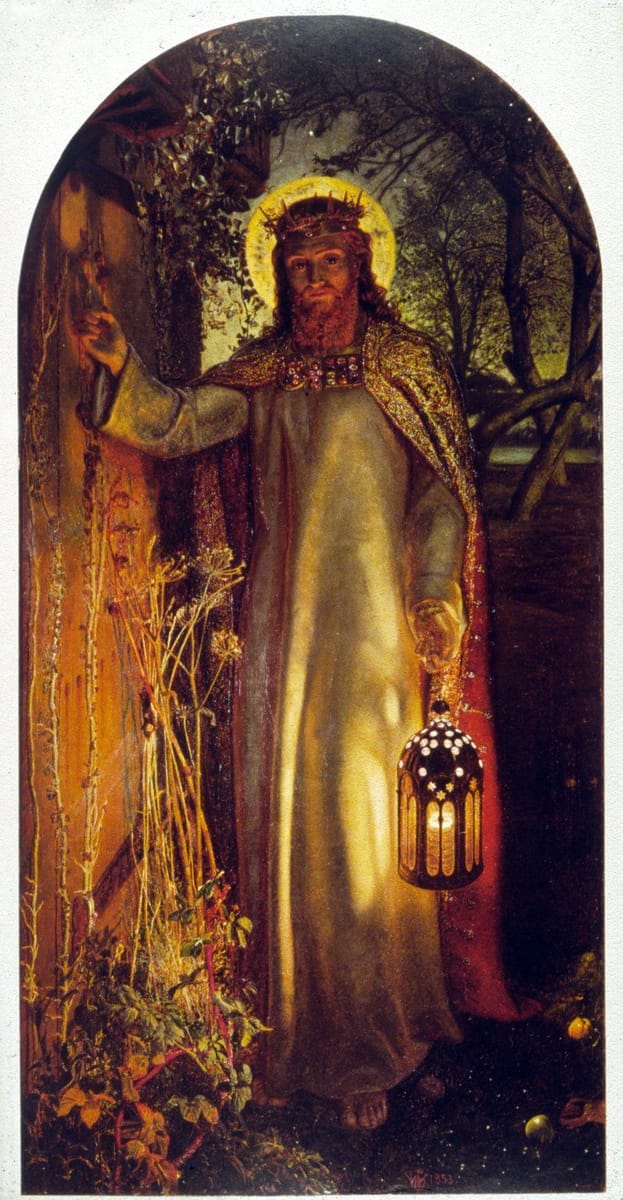
In a piece from the Westminster Gazette on Friday 15th September 1916, the author was forced to defend his depiction of Jesus, and he did so by invoking artistic precedents. When discussing the depiction of Jesus, he pointed out that from the 5th century onward, people had been killing each other over the correct interpretation of the scriptures, but one thing everyone could agree on was that the big JC 'must not be represented as a man.' This is an ecumenical conundrum as I'm guess depicting him as a squirrel would get you dispatched quite quickly, so what to do?  Mercifully, in the 15th century along came Fra Angelico who hit upon the idea of depicting Jesus as a pretty blonde lady and that's apparently fine. George Moore then brought everyone up to date and said Holman Hunt showed us a big girly Jesus knocking on the door, like a Holy Avon Lady. If the Pre-Raphaelites gave their Jesuses (multiple Jesus would be Jesi?) lady-faces then it's fine to have a lady-like Jesus in The Brook Kerith. Actually, having read the criticism of The Brook Kerith most of it is about the fact it's rubbish, and seeing as George had a reputation for writing saucy, scandalous books, I'm guessing the critics were already jumpy every time he published something new. So, George Moore's argument was that the Pre-Raphaelites made their Jesi look like chicks, so what's the big deal? Apparently, even the boy child Jesus in the Millais painting was a girl (according to George)...

Christ in the House of His Parents (1849-50) John Everett Millais

We then enter Round Two of the Big Girly Jesus fight, and on 21st September, Canon Horsley (an actual vicar and everything) weighed in on behalf of the enlightened church and said that if we are going to bring the Pre-Raphaelites into it, only a few people hated the painting and everyone else loved it (apparently). He finishes it up with a quote in Latin, which is always the best way to finish because no-one knows what you're talking about. Finally, and most sensibly, on the 25th September there was a letter from someone who really didn't seem to care if The Brook Kerith was any good but at least everyone could get their facts straight about the Pre-Raphaelites. The author of the letter was Mr Robert Ross, art collector, intimate of Oscar Wilde and all-round excellent chap. For starters, he said that the boy child Jesus in Millais painting was Noel Humphreys, the son of an architect, so George was talking absolute rubbish there but when it came to depictions of adult Jesi, Robbie Ross could give a few examples where it was the case that it was a lady...

The Light of the World (1851-3) William Holman Hunt

As Robbie says - 'Mr Moore remarks on the effeminate concept of Christ in the Pre-Raphaelite pictures, and the circumstance that a woman (Christina Rossetti) acted as the model for Hunt's Light of the World. There are other striking examples: Miss Siddal (Mrs Dante Rossetti) sat for the Christ in Madox Brown's picture of Maundy Thursday or The Washing of the Feet; and in Spencer Stanhope's picture, I Have Trodden the Wine-Press Alone - one of the most singular works of that unequal artist - Miss Ellen Terry posed for the figure of Christ.'

Jesus Washing Peter's Feet (Maundy Thursday) (1852-6) Ford Madox Brown

The Wine Press (1864) John Roddam Spencer Stanhope
In the Illustrated London News  of 1865, it was suggested that The Wine Press was very much after the manner of The Light of the World, an opinion repeated in books since and possibly reflecting that although it was painted in 1864, it was conceived years earlier, possibly nearer the time of Hunt's painting.  Robbie Ross finishes his letter suggesting that George Moore like to consider Henri de Groux painting Christ Aux Outrages (1889) as his frontispiece as it had been on is mind while reading George's book as it features a very feminine Christ.

Christ Aux Outrages (1889) Henri de Groux

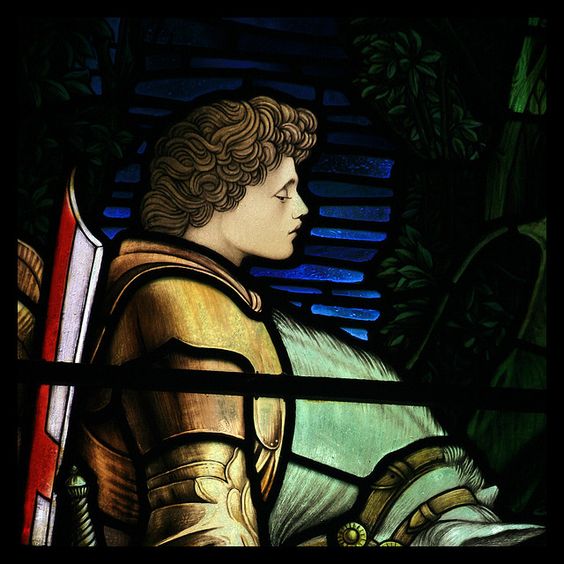
All these feminine figures for Christ left me wondering why no-one had reacted before.  I fully trust Mr Ross in his recollections, but also because we know that Holman Hunt used a few women for his Christ, and also Ellen Terry had form for posing as a chap.  Here she is as Sir Galahad, in a stained glass window from a painting by G F Watts...


...and here she is again, as a knight.  Maybe she just liked wearing the armour...?

Watchman, What of the Night? (1867) G F Watts

The stained glass window is in Freshwater on the Isle of Wight, where Julia Margaret Cameron routinely got girls to dress up as men...

Head of St John (1866) Julia Margaret Cameron

May Prinsep looks rather sombre as the head of John the Baptist (although seemingly very much still attached to the neck of John the Baptist). The place the girl/boy swap happened most often was with the Holy family...

The Holy Family (1864) Julia Margaret Cameron

The Madonna, or Mary Hillier, appears repeatedly in Julia Margaret Cameron's photographs, almost always clutching children of various sizes. Here she is clutching John the Baptist and Jesus, or Kate and Alice Keown as they were better known.  There are the occasional boys, for example Percy Keown, Freddy Gould or Julia's own grandson, Archie, but by and large, it's the Keown girls who are appearing as the various sainted boy-children. Freddy Gould was a very pretty little boy indeed, and he made a popular model, but the other boys are babies and so are fine while asleep but I'm guessing not the best models while awake. 

The Little Foot Page (1905) Eleanor Fortescue Brickdale

I think therefore the answer to why the Pre-Raphaelites used women as men is less to do with artistic tradition and more to do with availability.  As Robbie Ross pointed out, Millais used a boy as Jesus, not a little girl, so there was not an adherence to any ecclesiastical artistic tradition there.  The women brought in to model were friends, wives, sisters and lovers, therefore to hand and with nothing better to do (in the opinion of the artist). The Pre-Raphaelite ideal was to draw from life so if the only life you have to hand is Christina Rossetti then she better strap on a beard because she's going to be Jesus. Also, just because Elizabeth Siddal is washing some grumpy chap's feet as Jesus, it doesn't mean that she looks anything like what appears on the canvas, especially not in the topless version. Just because Walter Crane gave his (male modelled) Venus a six-pack in The Renaissance of Venus (1877) doesn't mean the Siddal Jesus had to have boobs...
Walter Crane, giving us a Venus who is more manly than Jesus...

In conclusion, art is often a combination of opportunity and tradition.  The male figures who are drawn from women are thus because women were to hand. If you asked me to name female artist's models, I could go on for ever but ask me to list male ones and I'd get a bit stuck after the hot Italian who was Julia Margaret Cameron's Iago. Women were to hand in the studios and houses of artists and although the faces (and six packs) of figures might have been finished from male models, preparatory sketches, emergency posing and all that stuff was more than likely done by a woman can yell for. If the tradition for painting Jesus is towards the feminine, then using Christina Rossetti to hold up your lamp is not outrageous as the finished figure has a great big bushy beard.  What surprises me is that Julia Margaret Cameron got away with May Prinsep as John the Baptist, looking completely like a girl and not really different from when she is posing as Zoe of Athens, Beatrice or just a portrait. There is no theatricality to her image (which is a surprise if you consider how Amateur Dramatics some of her Arthurian work is), it is a photograph of a head who also just happens to be a pretty girl. If you consider how devotional and religious Julia Margaret Cameron's work is, I'm surprised that no-one questioned it.  

Maybe they did and people just blamed Fra Angelico...


Thursday, 11 October 2018

In Defence of Rosa Corder

Whilst writing Pre-Raphaelite Girl Gang there were a couple of ladies that I really only had a passing knowledge of before researching for the book.  One of those was Rosa Corder, included because her involvement with Pre-Raphaelite art was somewhat unique and she seemed to be rather an interesting person, so I started to do a bit of digging. You know me, I never take anyone's word for anything, especially when it comes to the word of people who didn't even know them.  As I wrote in this post, always remember - what is it that we know for sure?

Let's start with the accepted knowledge when it comes to Miss Corder. 

Mr._ and Miss._ nervously perpetuating the touch of a vanished hand (1922) Max Beerbohm
 Rosa Corder is known primarily to Pre-Raphaelite fans as a grand faker of Rossetti pictures, peddled by her erstwhile loverboy, Charles Augustus Howell (whose naughtiness is talked about here).  She is portrayed as sneaky and wicked, the moll to Howell's criminal mastermind.  The description that bothered me the most came from Stanley Weintraub's 1974 biography of Whistler:

"She exuded sexual appeal, and knew it, and, in her mid-twenties, had no interest in marriage although considerable interest in men." (page 165)

Well, that's a little bit creepy. Thanks Stan.

Let's start at the beginning of Rosa's story. She was born in 1853, the daughter of London merchant and musician Micah Corder, one of six children.  Her siblings were by and large successful and she seems to have been especially close to her brother Frederick with whom she took music lessons.  She was also talented at languages and published a translation of Science Without God by Rev. Father Didon before she was 20 years old. Frederick went on to become a composer and a Fellow and Curator of the Royal Academy of Music but Rosa took training in painting and portraiture, studying under Felix Moscheles (painter and advocat for peace and Esperanto).  

Portrait of Rosa Corder, from an etching by Mortimer Menpes, 1880
 She continued her studies with Frederick Sandys, where she excelled as a draughtsman and copyist.  Before we all jump to conclusions here, being a copyist was all part of becoming an artist (and possibly still is).  Actually, making copies of famous works of art for buyers was a roaring trade legitimately - for example Sir Merton Russell-Cotes wanted a copy of Love Locked Out by Anna Lea Merritt but she refused, so he got Henry Justice Ford to do it for him, and it hangs in the collection of the Russell-Cotes in Bournemouth today.  To prove how good Rosa was, we have this...

The Marriage of St George (1870s) Rosa Corder
The above is a copy of Rossetti's cartoon for stained glass, by Rosa.  Rossetti was actually so impressed with her work he considered employing her as an assistant and it is through Rossetti that Rosa met Howell. There began a beautiful friendship (of forgery and adultery...)

Charles Augustus Howell (1882) Frederick Sandys
Right, just to slam on the breaks for a moment, if we take Rosa and Howell's relationship to date from the early 1870s, then Rosa was barely 20, whilst Howell was into his 30s.  It is arguable that Howell saw Rosa's potential as the producer of forgeries but quite what Rosa knew of their partnership is another matter.  I'm not arguing that Rosa was some unwitting rube in all this - Rosa was a very clever girl indeed, and some of the pictures that she copied were Henry Fuseli, referred to as 'objectionable' by subsequent biographers, which I think is fancy talk for 'boobs'...

An Incubus Leaving Two Sleeping Girls (1793) Henry Fuseli
I think we can safely say that Rosa wasn't an innocent lady painter, but making the leap from someone who was an independent spirit and broadminded to criminal is a bit harsh.  Also, it seems to me that those qualities appear to be enough to condemn her rather than the forgery.  

Arrangement in Brown and Black, Portrait of Miss Rosa Corder (1878) James McNeill Whistler
It was Howell who asked for the portrait of Rosa to be painted by Whistler.  Weintraub suggests that Rosa had received some drawing instruction from Whistler and '...spent time in Whistler's studio, if not also in his bed' (p.165). Again, thanks for that. Howell offered Whistler £100 to paint their allegedly shared mistress.  The artist got her to stand in a doorway - '...with the darkness of a shuttered room behind her, her firm body clothed in black and turned away from him, her face in profile, left hand on hip, a dark plumed hat in her right hand.' (p.165).  Whistler took his time, with 40 sittings, or in fact standings, which took hours until she passed out.  It was only when Rosa decided it was done that Whistler finally gave it up and let the poor woman go.  It is an amazing portrait, with 25 year old Rosa looking self possessed and confident.  In regards to Weintraub's above quote can I draw your attention to 'firm body' and 'hand on hip'. Seriously Stan, please dial it down.

Fred Archer (c. 1880) Rosa Corder
So, whilst being the evil temptress forger, Rosa also managed to set herself up as a painter in Newmarket.  In the 1880s Rosa took over the studio of Harry Hall, an accomplished equine painter, in a town devoted to horse racing.  There was a little resistance to this woman coming into what was undoubtedly a male-dominated world, but Rosa had a love of animals that drew her to her subjects both human and otherwise.  It wasn't long before she fitted in completely.  One firm friend was the jockey Fred Archer who Rosa painted a couple of times during his prolific career.  Rosa was very close friends with Ellen Terry, who gave an account of visiting Rosa in her studio: 

'"How wonderfully different are the expressions on terriers' faces," I said to her, looking at a painting of hers of a fox-terrier pup. "That's the only sort of pup I should like to have." "That one belonged to Fred Archer," Rosa Corder said. "I dare say he could get you one like it." We went to Archer and from him "Fussie" [Terry's dog] was obtained.' (from The Story of My Life by Ellen Terry)

Now, Ellen Terry actually knew Rosa and so I always like to hear the opinions of people who were there at the time, so let's see what she has to say...

Ellen Terry, Fussie and Drummie (her terriers)
Ellen described Rosa as 'plain-beautiful', 'so far more attractive than some of the pretty ones', she was pale with great hair and she wore 'odd clothes'.  Fellow painter W. Graham Robertson described her as 'gentle and crushed looking'.  None of which says sexy siren exactly... Back to Newmarket, and sporting newspapers spoke glowingly of Rosa's pictures of the race horses.  Her paintings became popular engravings and she became a fixture in the town.  In secret, she had given birth to Howell's daughter the same year as she had moved to Newmarket.  Her love of animals also brought her into conflict with some of her potential clients and fellow Newmarket residents.  She seems to have been fined regularly for refusing to muzzle her dogs in public and in 1890 she was a witness at a trial against animal cruelty.

Mrs Charles Augustus Howell (Kitty) (1873) Frederick Sandys
When Howell's wife Frances Kate (Kitty) died in 1888, Rosa took care of the Howell's daughter Rosalind, who grew up alongside her half-sister, Rosa's daughter Beatrice.  Howell died in 1890 and it was rumoured that he had been found with his throat cut in a gutter with a sovereign between his teeth but the truth was somewhat more mundane.  He developed pneumonia after a chill and was confined to a hospital where Rosa visited him daily.  Rosa only outlived her mentor by a couple of years, much in the same way as Alexa Wilding and Rossetti, or Dorothy Dene and Leighton.  Rosa's love of animals proved her undoing as she too developed pneumonia after taking extra time to ensure her horse was dry on a cold wet day before seeing to her own needs.  She died in 1893, aged only 40.

Right then, so what is it that we can say for sure?  Rosa was bright and talented with an independent spirit.  This we know because of her many accomplishments and the fact that she represented herself in male-dominated art and sports worlds.  She obviously loved Howell who she not only had a child with but also cared for at the end of his life.  She also cared deeply for animals, proved by her willingness to stand up in court and testify against an owner who had mistreated his horses.  She undoubtedly produced the forgeries that Howell sold but we don't know if the young woman knew what her lover was doing or that she felt comfortable within that relationship to object.  It seems to me that in reading accounts of the whole forgery business, Rosa and Howell are seen as equal partners in the villainy.  Actually, more than that, Howell is seen as a crook but Rosa is seen as a temptress, sexually promiscuous even before she meets Howell.  Weintraub's casual assertion that she had probably jumped from bed to bed before ending up with Howell is a judgement not a fact.  He's not the first to condemn her - in Murray Marks and His Friends (1919), G G Williamson says that Rosa lived on 'very intimate terms' with Whistler, Rossetti and Howell.  When Ellen Terry refers to her friend as 'plain-beautiful' somehow there is no judgement. I don't know what it is about Rosa that makes writers want to believe she was promiscuous and immoral, where as someone like Howell can get away with being 'a bit of a rogue' or even criminal. For a woman, being criminal is not enough, she also seems to have to be slutty.  I think that says far more about the biographers than it does Miss Rosa Corder.

Anyway, I think it is probably better for us to think of Rosa as an animal-loving young woman who may or may not have known what her much older lover was up to, but still stuck by him and his daughter until the end of her life.

Friday, 18 May 2018

From Fun to Nun...

"It has been a wonderful life.  It passed through many dark places 
but there was always light enough to walk by 
and now, thank God, He is bringing me to the haven."

As final words go, those are rather lovely.  They are actually not the very last words, but some of the parting sentiments of a Victorian actress, star of stage and Henry Irving's first leading lady.  Of course by the end of her life, she was Mother Superior in a convent. Welcome to the amazing journey of Isabel Emilie Bateman...
Who?  I know, until doing the research for this post I had no idea beyond the fact that she had posed for Julia Margaret Cameron and was an actress.  After reading a lot, including a wonderfully pious biography, I am fascinated in what we aren't told about a woman who isn't as famous as she should be.  You've heard of Ellen Terry?  Then you should have heard of Isabel Bateman, and yet through the politics of biography, she has been overlooked, dismissed and forgotten. So, let's start remembering.

She was born in Cincinnati, just after Christmas in 1854, the youngest daughter of Hezekiah Linthicum Bateman, theatre manager and impresario, and his actress/writer wife, Sidney Frances Bateman. Mrs Bateman was the daughter of a British comedian who had settled in America, and was remembered as intellectual and energetic, with a fierce devotion to her children.  The Batemans had seven children that survived infancy including five daughters.  Isabel was close to her sister, Virginia, two years her senior, and the pair were known for their interest in religion.  In her biography, there is a odd but sweet story of how the pair wondered if they could achieve martyrdom by eating an entire bar of soap...

Isabel (seated), Sidney and Virginia Bateman
What we know of Isabel's childhood is quite rose-tinted.  She was clever, with a talent for reciting.  At two years old, her party piece was 'Mary had a little lamb', and by four years, she was absorbed in reading the history of Greece and arguing with Virginia about Achilles and Hector. Meanwhile, older sisters Kate (1842-1917) and Ellen (1844-1936) were being celebrated as child actresses.  Kate debuted in 1847 and by the time her sister was five, the girls were appearing in New York, reciting passages from Shakespeare.  Between 1850 and 1852, P T Barnum sponsored the girls in a tour of the UK, then a tour of the USA, as they performed their Shakespeare to an enraptured crowd.

Ellen as Richard III!  Kate as the Earl of Richmond!
The girls retired from being child stars in 1856, at the grand old age of 12 and 14, but graduated to adult acting, including in plays adapted by their mother.  Kate especially found popularity due to her emotional range, and in 1866, she married a doctor, George Crowe and moved to England.  Her family followed.  Isabel attended school in Clifton near Bristol, and was famous for her ability to recite Tennyson by heart, including a memorable rendition of 'The May Queen' when she was 15.  She also had a French governess and spoke and read French fluently.  Her ability to memorise and recite so beautifully inspired her mother to remove her from school and enroll her in the family business of acting.  Virginia had little interest in acting and Kate and Ellen had grown and were managing their own careers.  Isabel was her parents' new project...

Virginia and Isabel Bateman (c.1870)
In order to launch their daughter onto the unsuspecting London theatre-goers, Mr Bateman bought a West End theatre, the Lyceum, just off the Strand.  Bateman looked about for a suitable leading man to match his wonderful daughter and found an up-and-coming chap called Henry Irving...

Isabel Bateman and Henry Irving in Othello, 1876
The Lyceum had been in crisis, with a succession of failures and structural problems.  The superstitious acting profession saw the place as unlucky, but Irving, tempted from the employ of Ruth Herbert at St James' Theatre by the hope of permanent leading man status, joined the Batemans in their venture.  After a couple of false starts, Irving convinced Bateman to produce The Bells, a melodrama about a man driven mad by the guilt of a murder he has committed.  Ironically, Isabel did not have a part in The Bells, but the play was a sensation and Irving and the Lyceum became the talk of the town. On the journey home from the theatre on the opening night of The Bells, Henry Irving's wife of two years turned to him and asked 'Are you going on making a fool of yourself like this all your life?'.  Legend has it that Irving got out of the cab and walked away, never seeing his wife again.

Isabel (c.1870s)
The newly unattached (but never divorced) Irving was embraced into the Bateman family.  At weekends, he would go to Margate for seafishing with Mr Bateman while Isabel, Virginia and their mother would await the fish to cook in the evenings.  Irving acted as big brother to the girls, taking them off to dressmakers for new outfits and taking care of them.  In Charles I, Irving played opposite Isabel as his leading lady.  Irving used Van Dyke's portrait of the king to perfect his make-up and Isabel took the role of Queen Henrietta Maria, which gained praise in the newspapers for the prettiness of her French-English and the depth of her emotional portrayal.  Isabel was fascinated by Charles I, whom she regarded as a martyr.  It seems to have been a defining role for her as she was photographed by Julia Margaret Cameron in the role in a number of pictures.

Queen Henrietta Maria and her daughter Princess Elizabeth (1874) Julia Margaret Cameron

Queen Henrietta Maria (May, 1874) Julia Margaret Cameron
A star, praised in the press and reviews and sought by artists for portraits, Isabel had flattery heaped upon her, but did not lose her serious, religious edge.  At a luncheon party filled with celebrities, a politician told a story in French about a party he had attended where someone had turned up dressed as God.  Disgusted, Isabel got up and left.  She was 19 and harboured a secret.  Despite being the most famous and celebrated actress in London, Isabel hated acting. She was torn between her love of religion and her love of Henry Irving.  Dilemma!

Isabel being torn between being a nun and Irving-fun
As it turned out there were a couple of minor problems with her crush on Irving.  Firstly, he was not a religious man, quite the opposite having grown up with a very religious mother who he found oppressive.  Although Isabel contemplated giving up her faith for him, he was married and likely to remain so.  This was a massive problem for Isabel, but not for Mrs Bateman who encouraged the relationship and implied she didn't mind if Isabel became Irving's mistress as long as they were great on stage.  The other problem however was that Irving didn't think of Isabel that way.  The successes kept coming with Isabel being the Ophelia to his Hamlet and the Desdemona to his Othello but the awkwardness had set in.

She Walks in Beauty (1874) Julia Margaret Cameron
For what happened next you have to read a number of biographies.  You have to wonder how long Irving had been aware of the problem and if the death of the Bateman's son, Richard in March 1874, made him delay his decision.  Richard had been travelling in the east and was lost at sea when the French steamer 'Nil' was wrecked on submerged rocks between Hong Kong and Yokohama.  The Lyceum continued to produce hits, including Hamlet in 1874.  According to Irving's grandson's biography of his grandfather, Isabel's portrayal of Ophelia was so moving that 'she quelled the restive elements in the audience, rekindled their interest, and had them once more enthralled.'  The Prince of Wales declared that the only thing worth looking at in Hamlet had been Isabel Bateman's face.

Isabel c.1872
Interestingly, one thing we know is that when Isabel needed time to think, she liked to travel.  Obviously aware of the problems surrounding her involvement with Irving, Isabel visited her friend Julia Margaret Cameron.  Having posed for her in 1874, Isabel made the long journey to Ceylon the next year.  We do not know enough about Cameron's photography in these last years of her life, but it is possible that another photo session was attempted but either lost or not completed.  In 1876, Cameron still held Isabel in high esteem and wrote to a friend that she longed to photograph her 'in these mountain heights, far from theatrical heights.'  Unfortunately for Isabel, issues were about to come to a head.

Isabel Bateman (1874) Julia Margaret Cameron 
In 1875 Mr Bateman dropped dead in March of heart disease, after an attack of angina pectoris, leaving Mrs Bateman in control of a restless Irving and three actress daughters.  Kate had returned to the stage, unable to stay away, but did not like Irving one little bit.  She also harbored jealousy against Isabel after all the publicity that the younger sister had received.  Neither Virginia or Isabel were particularly happy on the stage, and Virginia refused to appear with Kate.  Irving and Isabel had a somewhat strained relationship, due to Isabel's crush and he requested the option to bring in an alternative leading lady, Miss Ellen Terry.

Ellen Terry as Juliet (1882)
Sorry Ellen, this post is not about you
Now, depending on who's biography you read, Irving either brought in Ellen because Isabel was nothing more than a sister to him and he felt embarrassed, or he brought in an actress equal to his talents, or Isabel was rubbish and Irving wanted to be shot of her.  Ellen Terry's biographer's, definitely more recent ones, have gone with the latter version of the story, that completely writes Isabel out of the cannon of great Victorian actresses, rather unkindly in my opinion.  Irving's grandson goes with a middle ground that Isabel and Irving were both embarrassed and this hindered their performance, so Irving had no choice but to bring in a new actress.  When Irving asked, Mrs Bateman, possibly seeing the control of the Lyceum sliding from her to Irving wrote in defense of Isabel's feelings - 'It would be an endorsement signed by you - a friend of her family and me - her mother - of her entire incompetency.'  

In truth, Mrs Bateman, in order to earn more after her husband's death, had bought Sadler's Wells theatre in Clerkenwell.  At the time, Sadler's Wells had been run down and plans had been submitted to turn it into bath house and it was a roller-skating rink for a while. Finding her finances stretched Mrs Bateman gave the Lyceum over to Irving and moved her family and half the company over to Sadler's Wells.  It might also have been a mark of how much Mrs Bateman saw Irving as a surrogate son that she could not refuse him, coupled with the drop in wages Isabel would suffer in her demotion under Ellen Terry. In 1878, Irving took over the lease, moving in Ellen Terry as his leading lady and Bram Stoker as his General Manager.  The rest was history.

Charles Warner, actor
Over at the Sadler's Wells, things were somewhat less rosy.  Isabel took over the book keeping as well as leading lady duties with Charles Warner as her leading man.  The renovations cost £8,000 more than planned and took a year more than scheduled impacting on the earning potential.  Sadler's Wells was rebuilt on a lot of borrowed capital and despite some success, it was not enough to keep afloat.  Waiting for an omnibus one evening after a performance, Mrs Bateman caught a chill which turned to pneumonia and she died in 1881. When Irving visited to pay his respects, he was received very coldly by Kate.  When Mr Bateman had died, Irving was embraced in the family and attended the funeral with them.  Kate did not include him this time, and Irving did not go, which he regretted later in life, but the bonds between the Batemans and Irving had been well and truly severed.

Kate Bateman as 'Medea' (1872-3)
The three sisters agreed to shut Sadler's Wells and settle the enormous debt as best they could.  Virginia and Kate found work in provincial theatres, so it was left to Isabel to let the house, sell as much as possible and go through their mother's enormous hoard of theatre memorabilia, giving away or destroying as much as possible.  Her desire to leave the stage was as strong as ever but as long as the debt existed, she needed to act in order to pay the bills.  However, a brief trip to New York to visit elder sister Ellen helped clear her head  and she returned in 1882 with a plan.  She did recitals, for which she was famous, but the wages on the stage were better so she returned to the boards at the Adelphi Theatre.  She combined her acting with giving recitals which she actually enjoyed doing, and managed to raise money for charity with her performances.

Virginia Bateman (1870s)
In 1885, she travelled with Kate and her husband, Virginia and her husband and their children, together with Isabel's fox terriers to Great Malvern for a marvellous holiday.  Isabel was remembered fondly by her many nieces and nephews as a sweet, witty woman.  The holiday was cut short by a request for Isabel to take a part on Drury Lane.  She travelled with plays, taking care of the children involved in the performances.  When she was 30, she learnt the piano just so she could teach the child-actors to sing. She was much admired as an actress for her physical skills - in 'The Anatomy of Acting' in Longman's Magazine in 1888 she was quoted: '"I often turn pale," writes Miss Isabel Bateman, "in scenes of terror or great excitement.  I have been told this many times, and I can feel myself getting very cold and shivery and pale in thrilling situations."'.  She might not have loved her craft, but that didn't mean that she wasn't good at it.

1894 Programme for Miss Isabel Bateman at the Prince's Theatre
Irving admitted privately that he always felt uneasy about how he had treated Isabel until later in life Isabel wrote a letter to him, expressly forgiving anything he felt needed forgiving.  Finally, the death of Isabel's niece Claudia in 1897 brought an unexpected gift.  Obviously beloved by her niece, Claudia left Isabel enough money in her will that Isabel could clear her mother's debts once and for all.  With the need to act removed there was nothing more for it than to pack up her belongings and enter the community of St Mary the Virgin, Wantage, Berkshire...

The doorway to St Mary Virgin Convent
Ellen, whose daughter Claudia had left the money, had become an aetheist at the death of her daughter and so was somewhat depressed by her sister's faith but in time was happy that her sister had finally found peace.  Isabel's career as a nun was not entirely removed from the outside world. Sister Isabel Mary chose to work in the St James Home in Fulham, saving girls from immoral lives.  She appeared at a drawing-room meeting in order to appeal for funds and raised £300.  In her speech she suggested that the audience might like to donate the cost of their last hat.  It was in this public appearance, her first since taking holy orders, that her fellow nuns discovered her former profession and it was a sensation in the newspaper.  Sister Isabel Mary became well respected for her care of those that came to the home and loved by the girls who contributed their find memories to the biography From Theatre to Convent, published after Isabel's death, in 1936.

Isabel (seated right) at St Mary's Home, Bangalore (1923-4)
Nor was Isabel denied the pleasure of travel as a nun.  After being made Mother, Isabel travelled to South Africa, India and Europe, visiting religious communities and enjoying the beauty of the landscape and architecture of the places.  Obviously used to travelling all over the place as an actress, her accounts of journeys as a nun are rich and fearless.  

Portrait from 1930
Eventually old age caught up with her and on travels through South Africa, the high altitude made it impossible for her to enjoy herself in her normal manner.  She returned to Wantage and there died in 1934, remembered by all the nuns as a thoroughly lovely woman in the S.P.C.K published biography, From Theatre to Convent: Memories of Mother Isabel Mary  CSMV.  Of the rest of the Bateman family, Kate died in 1917 of a cerebral hemorrhage after a long and celebrated stage career. Ellen died in 1936 and Virginia last of all in 1940, but the Bateman legacy did not end there. Despite not being comfortable on stage, Virginia  married actor-manager Edward Compton and her daughter Fay became a celebrated actress, best known for her Shakespearean roles.  In the 1930s it became somewhat of a newspaper sensation when the niece of Isabel Bateman played Ophelia opposite John Gielgud, great-nephew of Ellen Terry, which is all rather incestuous.

John Gielgud and Fay Compton in Hamlet (1939)
In conclusion, Isabel Bateman caught my eye for more than just her talent and beauty.  Like many of the women we discuss here, Isabel is the victim of history and our seeming need to form a narrative to suit ourselves.  We rightly celebrate the wonderful Ellen Terry as an actress, but in telling Terry's story it seems we cannot help but down-play Isabel.  Irving and Mrs Bateman's relationship had some questionable moments (as does the Batemans' attitude to their daughters and acting).  A reason that excuses Irving and Terry's apparently callous discarding of Isabel was that she was not a good actress.  In Nina Auerbach's mighty tome on Terry from 1987, Isabel is referred to as 'untalented' and Irving was desperate to be rid of the 'dependent Bateman women'.  All this seems a tad harsh, especially as Terry herself wrote in admiration of Isabel's performances, and a self-depreciating reticence about following in her footsteps in roles such as Queen Henrietta Maria. Yet again, in celebrating the life of one woman we seemingly need to trash the lives of others, as if we only have room for one 'great actress'.  Did Ellen Terry kick Isabel Bateman out of the Lyceum?  Of course not.  Did Irving and Mrs Bateman handle the difficult situation of Mr Bateman's death, Irving's desire to expand as an actor and her money trouble well?  Of course not, but then it's easy for us looking back to see what a mess people get into when trying to give everyone what they want.

Mother Isabel Mary (1923)
While I fret about the injustice of female biography, it is a comfort to know that despite everything, Isabel got her dream of becoming a nun, the one role she was always meant to play and one she did with immeasurable grace.

Wednesday, 21 January 2015

Review: Art & Soul Catalogue

If you are unable to get to Exeter this Spring to see Art & Soul: Victorians and the Gothic (website here), then I may have a solution for you.  The lovely people at Samson & Co have sent me a catalogue of the exhibition, and here is my review...


I hadn't really thought about it, but if you use the words 'medieval' or 'gothic', then you probably aren't using them in the same way as a Victorian.  In fact, after the advent of the film Pulp Fiction, to 'get medieval' on someone implies a swift and brutal end, and saying that someone or something is gothic is more to do with black nail varnish than arched windows.

Before Thomas Dudley Fosbroke coined the term 'Medieval' in 1817, the period between the 5th and 15th century was known unimaginably as 'the Middle Ages', that is the bit between 'bye bye Romans *sniff*' and 'it's all got a bit Tudor-y'.  That in itself got split when the early part of the Middle Ages became known as the Dark Ages.  Nobody liked the Dark Ages.  Gothic was used not specifically to describe the Germanic tribes that had migrated north in the 5th and 6th century (as the Romans had used it), but to describe culture in the Middle Ages, then the heavy typeface and architecture in the 19th century.

Page from 1865 manuscript of Idylls of the King by Alfred, Lord Tennyson

The Victorians loved history in a similar way to us, but for them the chance to own it through image and word was a novelty.  The Victorian year was filled with anniversaries of battles, coronations, executions, and books on all time periods filled the shelves of libraries everywhere.  This wasn't just a time of knowledge and learning, it was also an expression of the intense anxiety about the future.  If learning about history told them anything it was that not even the best society in the past was safe from destruction and steps forward in science showed how species, like nations, could vanish.  There was a move to protect the history of the nation with groups like The Society of Antiquaries and SPAB, plus an effort to collect folk traditions and songs.  Public galleries opened and a taste for images of the past, brought vividly to life, could be seen by everyone.  The imagination began to run scared from the present and the furthest it could go back was the Medieval period.  It was the first British period to be fully documented and had an aura of a pastoral golden age.  Even Gothic architecture was seen as more organic, more in touch with nature and not a product of the scary industrial world.

The Funeral of a Viking Frank Bernard Dicksee

Industrialisation had revolutionised the lives of ordinary people but in the generations after, it began to be seen as a cause of a loss of craftsmanship, pollution, bad housing, dangerous machinery, poor health and generally not improving the lot of workers.  During the 1840s, the 'hungry 40s' as they were known due to food shortages, the Medieval period was seen as a time of a more natural way of life and bountiful food. As a flipside of that, do you think our nostalgia for rationing in the 1940s and 50s is an expression of our obese society now?
Queen Victoria and Prince Albert at the Bal Costume, 12 May 1842 Edwin Landseer

Queen Victoria and Prince Albert (or The Parting) William Theed
 No-one was safe from this nostalgia, even if you were Queen.  Victoria and Albert embraced the medievalism which fitted with her Germanic roots and they were portrayed in art and sculpture as the perfect Medieval couple.  Even a spot of Viking heritage was reflected in Alexandra of Denmark, thereafter Princess Alexandra after her marriage to Albert Edward.  Tennyson described her as the 'daughter of the vanished Vikings'.  Again, it's interesting how the use of that word has changed.  Viking now tends to be more complex than the rape 'n' pillage stereotype, although the splendid recent tv series lobs in more violence than trading, but for the Victorians, the Vikings were noble warriors, reflected in romantic adventures by writer like Walter Scott and Charlotte Mary Yonge.

Ellen Terry in King Arthur

It would be impossible to talk about the Medieval without talking about King Arthur.  Not actually a king, but promoted by Geoffrey of Monmouth in his 12th century History of the Kings of Britain, then compounded by Mallory in his 15th century Morte d'Arthur which added round table, grail and Arthur's death to the existing legend of wizards and magic swords.  The pinnacle of this king-worship has to be Joseph Comyns Carr's play King Arthur of 1895, produced by Henry Irving, music by Arthur Sullivan and sets and costunes by Edward Burne-Jones.  A veritable who's who in artistic Britain, it's source material was Idylls of the Kings by a man who carries quite a bit of responsibility for the Arthurmania, Alfred, Lord Tennyson.

The Lady of Shalott (1894) John William Waterhouse

Oh, Tennyson, you've got a lot to answer for, not least the Elaine of Astolat variation, The Lady of Shalott.  Between 1862 and 1913 more than 26 paintings on the subject were exhibited and people had been inspired to create pictures and illustrations both before and after that main period.  For the Victorians, Tennyson and others inspired by the Medieval maidens were both supporting and challenging the sexual status quo; the women were maidens in distress, separated from society in towers, waiting to be rescued by daring men, but they were also sexual transgressors, destiny-seizing creators of art sacrificing their lives to be free.

King Arthur and Sir Lancelot, from the Tristram and Isolde stained glass panels, designed by William Morris (1862)
 Craftsmanship was re-embraced by Morris and Co who mixed Medieval designs with the desire to bring the 'joy' back to the workplace by removing industrial drudgery.  The firm produced furniture, tapestries and stained glass panels.  Morris was also responsible for the Kelmscott Press bringing a level of craftsmanship to book production hot on the heels of the industry's ability to mass produce.

Lord Eglinton dressed as the Lord of the Tournament (1840) Edward Corbould

Gothic and Medieval crept into every aspect of Victorian life, from the designs of the Houses of Parliament down to what your face looked like.  One of my favourite influences of medievalism is the notion expressed in the catalogue that the Victorian beard was a by-product of the fashion for Anglo-Saxon chic.  Beards were not fashionable in the 1830s and 40s but grew in popularity, coupled with some extreme fashion for armour, as worn at the 1839 Eglington Tournament. How we think of the Victorians to cultural products which we regard as being typical of the era are all infused with the cultural influences and historical aspersions of the thousand years that became the Medieval period. However you look at it, the two are arguably inseparable and change the way you look at the period and possibly reassess our own.

The catalogue by Joanne Parker and Corinna Wagner is beautifully written and richly illustrated.  Without knowing it, sometimes we forget exactly how pivotal the notion of Medieval is to the Victorians, both in fact and developed fantasy.  It shaped and changed society, expressed an interest in the past and their terror at the present and future.  In many ways it made me reflect on our current concerns with the past and how we are not so very different from our Victorian forebears.

To buy the catalogue look here (UK) or here (US)...