This is a bit of a rambling post brought about by a letter I read in an old newspaper. I love reading accounts from the early twentieth century from people who, in old age, are recalling what they know about the Pre-Raphaelites. This is particularly interesting when they are praising the work as by the First World War and the Twenties, when a lot of these accounts appear, they are talking about deeply unfashionable artists. However, a week or so ago, a rather interesting letter caught my eye. It all started because George Moore published a right old rip-snorter of a Biblical novel called The Brook Kerith. This is 1916, so you'd think people would have other things to worry about, but George had made his Jesus a bit girly and all hell broke loose...
 |
| George Moore (1879) Edouard Manet |
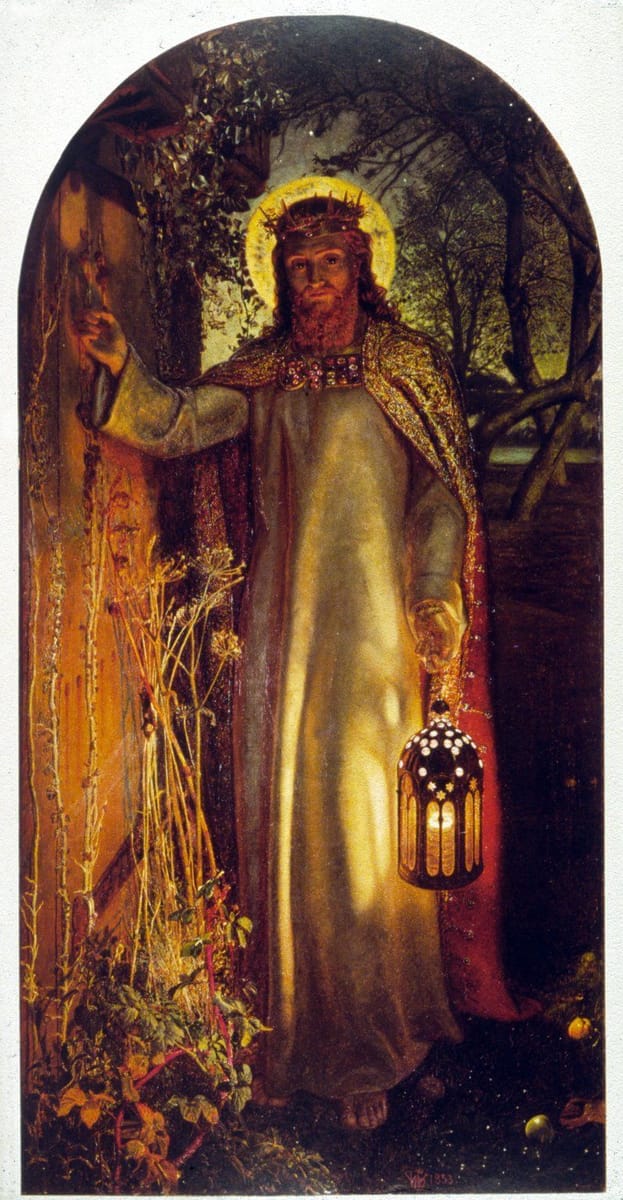
In a piece from the Westminster Gazette on Friday 15th September 1916, the author was forced to defend his depiction of Jesus, and he did so by invoking artistic precedents. When discussing the depiction of Jesus, he pointed out that from the 5th century onward, people had been killing each other over the correct interpretation of the scriptures, but one thing everyone could agree on was that the big JC 'must not be represented as a man.' This is an ecumenical conundrum as I'm guess depicting him as a squirrel would get you dispatched quite quickly, so what to do? Mercifully, in the 15th century along came Fra Angelico who hit upon the idea of depicting Jesus as a pretty blonde lady and that's apparently fine. George Moore then brought everyone up to date and said Holman Hunt showed us a big girly Jesus knocking on the door, like a Holy Avon Lady. If the Pre-Raphaelites gave their Jesuses (multiple Jesus would be Jesi?) lady-faces then it's fine to have a lady-like Jesus in The Brook Kerith. Actually, having read the criticism of The Brook Kerith most of it is about the fact it's rubbish, and seeing as George had a reputation for writing saucy, scandalous books, I'm guessing the critics were already jumpy every time he published something new. So, George Moore's argument was that the Pre-Raphaelites made their Jesi look like chicks, so what's the big deal? Apparently, even the boy child Jesus in the Millais painting was a girl (according to George)...
 |
| Christ in the House of His Parents (1849-50) John Everett Millais |
We then enter Round Two of the Big Girly Jesus fight, and on 21st September, Canon Horsley (an actual vicar and everything) weighed in on behalf of the enlightened church and said that if we are going to bring the Pre-Raphaelites into it, only a few people hated the painting and everyone else loved it (apparently). He finishes it up with a quote in Latin, which is always the best way to finish because no-one knows what you're talking about. Finally, and most sensibly, on the 25th September there was a letter from someone who really didn't seem to care if The Brook Kerith was any good but at least everyone could get their facts straight about the Pre-Raphaelites. The author of the letter was Mr Robert Ross, art collector, intimate of Oscar Wilde and all-round excellent chap. For starters, he said that the boy child Jesus in Millais painting was Noel Humphreys, the son of an architect, so George was talking absolute rubbish there but when it came to depictions of adult Jesi, Robbie Ross could give a few examples where it was the case that it was a lady...
 |
| The Light of the World (1851-3) William Holman Hunt |
As Robbie says - 'Mr Moore remarks on the effeminate concept of Christ in the Pre-Raphaelite pictures, and the circumstance that a woman (Christina Rossetti) acted as the model for Hunt's Light of the World. There are other striking examples: Miss Siddal (Mrs Dante Rossetti) sat for the Christ in Madox Brown's picture of Maundy Thursday or The Washing of the Feet; and in Spencer Stanhope's picture, I Have Trodden the Wine-Press Alone - one of the most singular works of that unequal artist - Miss Ellen Terry posed for the figure of Christ.'
 |
| Jesus Washing Peter's Feet (Maundy Thursday) (1852-6) Ford Madox Brown |
 |
| The Wine Press (1864) John Roddam Spencer Stanhope |
In the
Illustrated London News of 1865, it was suggested that
The Wine Press was very much after the manner of
The Light of the World, an opinion repeated in books since and possibly reflecting that although it was painted in 1864, it was conceived years earlier, possibly nearer the time of Hunt's painting. Robbie Ross finishes his letter suggesting that George Moore like to consider Henri de Groux painting
Christ Aux Outrages (1889) as his frontispiece as it had been on is mind while reading George's book as it features a very feminine Christ.
.jpg) |
| Christ Aux Outrages (1889) Henri de Groux |
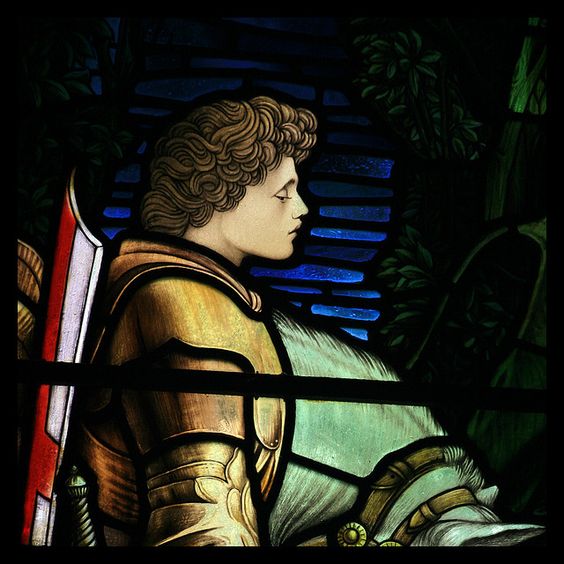
All these feminine figures for Christ left me wondering why no-one had reacted before. I fully trust Mr Ross in his recollections, but also because we know that Holman Hunt used a few women for his Christ, and also Ellen Terry had form for posing as a chap. Here she is as Sir Galahad, in a stained glass window from a painting by G F Watts...
...and here she is again, as a knight. Maybe she just liked wearing the armour...?
 |
| Watchman, What of the Night? (1867) G F Watts |
The stained glass window is in Freshwater on the Isle of Wight, where Julia Margaret Cameron routinely got girls to dress up as men...
.jpg) |
| Head of St John (1866) Julia Margaret Cameron |
May Prinsep looks rather sombre as the head of John the Baptist (although seemingly very much still attached to the neck of John the Baptist). The place the girl/boy swap happened most often was with the Holy family...
 |
| The Holy Family (1864) Julia Margaret Cameron |
The Madonna, or Mary Hillier, appears repeatedly in Julia Margaret Cameron's photographs, almost always clutching children of various sizes. Here she is clutching John the Baptist and Jesus, or Kate and Alice Keown as they were better known. There are the occasional boys, for example Percy Keown, Freddy Gould or Julia's own grandson, Archie, but by and large, it's the Keown girls who are appearing as the various sainted boy-children. Freddy Gould was a very pretty little boy indeed, and he made a popular model, but the other boys are babies and so are fine while asleep but I'm guessing not the best models while awake.
 |
| The Little Foot Page (1905) Eleanor Fortescue Brickdale |
I think therefore the answer to why the Pre-Raphaelites used women as men is less to do with artistic tradition and more to do with availability. As Robbie Ross pointed out, Millais used a boy as Jesus, not a little girl, so there was not an adherence to any ecclesiastical artistic tradition there. The women brought in to model were friends, wives, sisters and lovers, therefore to hand and with nothing better to do (in the opinion of the artist). The Pre-Raphaelite ideal was to draw from life so if the only life you have to hand is Christina Rossetti then she better strap on a beard because she's going to be Jesus. Also, just because Elizabeth Siddal is washing some grumpy chap's feet as Jesus, it doesn't mean that she looks anything like what appears on the canvas, especially not in the topless version. Just because Walter Crane gave his (male modelled) Venus a six-pack in The Renaissance of Venus (1877) doesn't mean the Siddal Jesus had to have boobs...
 |
| Walter Crane, giving us a Venus who is more manly than Jesus... |
In conclusion, art is often a combination of opportunity and tradition. The male figures who are drawn from women are thus because women were to hand. If you asked me to name female artist's models, I could go on for ever but ask me to list male ones and I'd get a bit stuck after the hot Italian who was Julia Margaret Cameron's Iago. Women were to hand in the studios and houses of artists and although the faces (and six packs) of figures might have been finished from male models, preparatory sketches, emergency posing and all that stuff was more than likely done by a woman can yell for. If the tradition for painting Jesus is towards the feminine, then using Christina Rossetti to hold up your lamp is not outrageous as the finished figure has a great big bushy beard. What surprises me is that Julia Margaret Cameron got away with May Prinsep as John the Baptist, looking completely like a girl and not really different from when she is posing as Zoe of Athens, Beatrice or just a portrait. There is no theatricality to her image (which is a surprise if you consider how Amateur Dramatics some of her Arthurian work is), it is a photograph of a head who also just happens to be a pretty girl. If you consider how devotional and religious Julia Margaret Cameron's work is, I'm surprised that no-one questioned it.
Maybe they did and people just blamed Fra Angelico...



.jpg)

.jpg)


.JPG)


