Showing posts with label Mary Hillier. Show all posts

Saturday, 30 January 2021

A Drawing of Mary Hillier

 One of the things I most love about this blog is being contacted by people who have images to show me, and then being able to bring you those pictures for your pleasure too.  Also, I love the fact that we often act as a hive mind to solve art mysteries and this is a bit of both. This weekend I have been contacted by someone who had a drawing of Mary Hillier.  Imagine my utter delight because, after all, this book appeared last year...


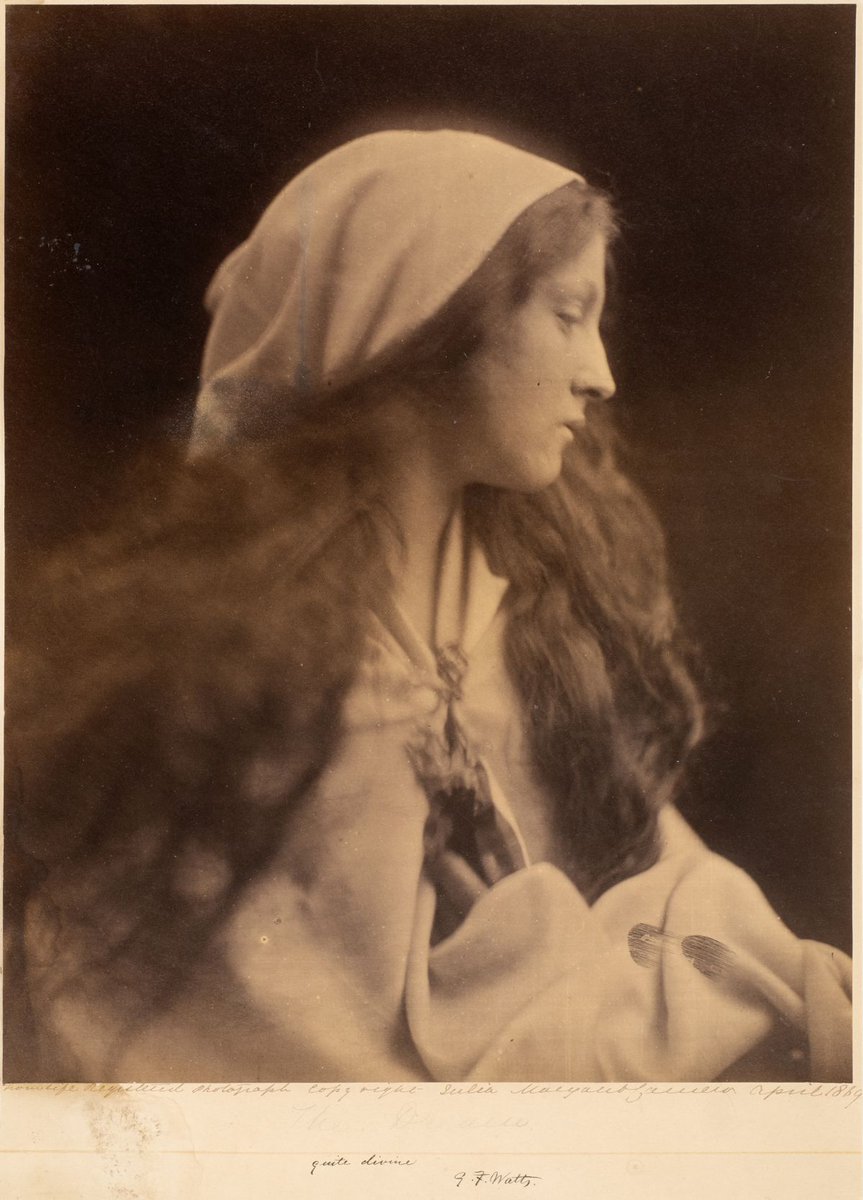
Up to that point, I was unaware of many, if any, drawings of Mary, who only seemed to exist in the photographs of Julia Margaret Cameron and a bas relief by Murial Perrin. As you can see by that post, the Perrins also drew Mary, but as an old woman.  However, I knew that Mary had acted as a traditional artists model, as in a 1926 local newspaper interview, she talked about sitting for people like G F Watts and Coutts Lindsay, but I had never come across their, or any, other sketches of Mary.  I am fairly certain that Watts turned this photograph given to him by Cameron...

The Holy Family (1864) Julia Margaret Cameron

...into this painting...

Charity (1898) G F Watts

...however, up to this point I had not seen anything like the chalk drawing I was shown, which I shall now show to you.


Right, to start with, it was bought as 'Portrait of a Scottish Girl' by Margaret Cameron, but is clearly Mary Hillier (who wasn't even vaguely Scottish, in case you were wondering).  Here are a couple of useful photographs for comparison...

Group (1870) Julia Margaret Cameron

Study After The Elgin Marbles (1867) Julia Margaret Cameron

The nose bump gives it away. As far as we know, Cameron did not draw as well as photograph, but her circle certainly contained enough artists to be likely candidates.  I have to admit, I was strongly reminded of some of Dante Gabriel Rossetti's sketches of Fanny Cornforth, like these...

Fanny Cornforth (late 1860s) Dante Gabriel Rossetti

Fanny Cornforth (1865) Dante Gabriel Rossetti

 Whilst we know Rossetti knew Julia Margaret Cameron, so it isn't out of the question he borrowed her best model, we also know that Rossetti avoided her company, and didn't visit her on the Isle of Wight.  Rossetti would have mentioned it in his copious correspondence that we still have, and I can't imagine for a moment that Julia would have been able to hold back from telling everyone she could if she managed to get Rossetti in the doors of Dimbola.  Plus, she would have definitely have photographed him.  

Okay, so who else?  Edward Burne-Jones was in the Little Holland House circle, so could it be him? He doted on Cameron's niece Julia Jackson, so could he have used the lovely Mary as a model too?

Desiderium (1873) Edward Burne-Jones

Whilst Burne-Jones did have the opportunity, his style of drawing is often more stylised.  I mean, we can all pick a Burne-Jones woman out of a line up, they are so willow-y perfect.  However, that's not to say that he didn't do the chalk sketch of Mary, he had range as we can see from Desiderium.  However, are there any other suspects?

Portrait of a Girl (undated) Val Prinsep

How about a member of the family, like Val Prinsep, who would have had lots of access to Cameron's home? I don't know enough of Prinsep's drawings to be able to compare, and I haven't seen any chalks by him.  This is where you lot come in - do you have any ideas who did this wonderful chalk of Mary Hillier?  If so, tell me, I'll be excited to hear you thoughts.  It's such a gorgeous chalk and I am so pleased to see other artist's imagery of Mary.  


 I look forward to hearing from you...


Thursday, 17 December 2020

Thursday 17th December - The Kiss of Peace

 This has been a bit of a peculiar year, to say the least.  One wonderfully sparkly highlight for me has been the publication of my biography of Julia Margaret Cameron and Mary Hillier, Light and Love.  It would be remiss of me to not include one of Cameron's wonderful photographs as part of Snogvent, so let's have this one...

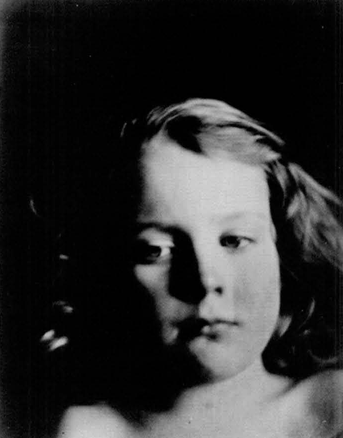
The Kiss of Peace (1869) Julia Margaret Cameron

Here we have little Elizabeth Keown being kissed on the forehead by Mary Hillier. A 'kiss of peace' is a traditional Christian greeting, where a blessing of peace is given to the recipient. These days in church you normally only have to shake someone's hand awkwardly during the Peace, there's no kissing (thank goodness, because it doesn't need to be made more awkward than it already is), unless you belong to the sort of church where you're more relaxed about that sort of thing.  Lawks.  Anyway, it got me thinking about the  the array of meanings of kissing in Cameron's art.

Romeo and Juliet (1867)

It's not that Cameron doesn't do romance - her pride in the match of Mary Ryan, her housemaid, with Henry John Stedman Cotton was expressed through their appearance as Romeo and Juliet on the occasion of their engagement.  It is a bit of a wonder that she didn't go the whole hog and show them as King Cophetua and the Beggar Maid, as Cameron was so proud that her Irish 'beggar maid' would go on to become Lady Cotton.

The Affianced (1867)

It actually came as a surprise when I started thinking and searching for more images of young people in love that I didn't find more than just the Cottons. Heaven knows Cameron was no prude, and had a healthy adoration of handsome men and beautiful girls and all things delicious.  I think The Affianced is one of the sweetest images of love I've seen for ages as they would have had to sit there staring at each other for quite a while while the photograph was taken.  I suppose that is why she didn't do more, as you would have to sit or stand around kissing someone, absolutely still, while the image formed on the plate.  Unless you were very much in love, that would have become weird quickly. Also, it has to be taken into account that photographs of kissing, unlike paintings, had unseemly shades of 'gentlemen's relish' rather than maintaining the pretense of art...

Kissing Couple (early 20th century postcard)

Cameron had loftier artistic intentions than titillation or mere dizzy romance so however pretty that early 20th century postcard is, it is not aiming any higher than a bit of romantic fluff.  Cameron places her real-life lovers in the context of Shakespeare, elevating a civil servant and a housemaid into literary icons personifying love, in all its complexity, triumph and tragedy. For the most part though, the kisses in Cameron's photographs are not those of romance, but of a different type of love...

Iolande and Floss (1864)
 

The two novices, Iolande and Floss, are characters from Henry Taylor's 1862 play St Clement's Eve.  Iolande falls in love with the Duke of Orleans and then gets shot by an arrow at the end (sorry, spoiler alert).  Her fellow novice, Floss gets to witness all the stabby, shooty excitement and say things like 'approach her not' to murderers and the such like. The swirling of developing fluid over the image gives the girls, Mary Hillier and Kate Dore, a ghostly and ethereal presence as they float morally above the murderous awfulness of life.  The kiss between these women is one of solidarity, one of sisterhood, a bit like this one...

The Salutation (1864)
 

Mary Hillier is kissed on the forehead by Mary Kellaway in a presumably Biblical manner.  This vague moment of greeting might refer to the Virgin Mary greeting Elizabeth on the revelation of both of their miraculous babies, however neither Mary looks particularly cheerful or hopeful.  I know these images took a long time and so sometimes the facial expressions are those of quiet impatience and boredom, but these women seem to be greeting each other with sorrow and a shared understanding of their unhappiness.  Being generous, it could be that these two women with their holy babies have a moment of fate and realise that neither son will live long lives.  Motherhood is as terrifying and devastating as it is joyful and I've been in mothers groups where we greet each other in tired resignation and sometimes horror and sorrow. They don't put that on a baby-grow in JoJo Maman Bebe...

The Turtle Doves  (1864)

Children kissing is a different matter.  Cameron is no different from a lot of Victorian artists in portraying the innocence in children kissing each other.  Honestly, it looks a bit weird to us now, but it's still cute.  Again, I am struck by the fact that these images are not moments in time but the girls, Alice and Elizabeth Keown, would have had to sit there pressed together for a good few minutes. Either Cameron was terrifying (so I have read) or she knew how to bribe children. Possibly both.

Grace Thro' Love (1865)

The kisses I'm most familiar with in Cameron's photography are those bestowed by Mary Hillier in the role of the Virgin Mary upon the children she cuddles.  Here she holds little Freddy Gould as a little Holy bundle with his beautiful wavy hair. Her kiss is of quiet peace and comfort, a kiss that expresses all the goodness of the bestower.

Blessing and Blessed (1864)

These are from a series of images of Mary as the Blessed Virgin, often kissing the children she holds.  The kisses she delivers are a blessings, special gifts that pass on a bit of that holiness on to the recipient. The kiss that most frequently happens in Cameron's photographs are those of mother to child, but also from someone with power to those without.  The kiss bestowed by Mary Hillier upon little Freddy Gould is one that says 'It will be okay, hang in there, I'm here.' It seems deeply unfair in a year that would really benefit from some reassurance like that, we are not allowed to kiss each other, so all we can do is offer the same strength to each other in words.

It will be okay, hang in there, we'll all see each other again soon.

I'll see you (virtually) tomorrow...


Friday, 7 August 2020

Coming Soon - Light and Love...

We're a month away from the launch of my new book Light and Love and so I thought I'd tell you about it.  Also, I have a very special offer from my publisher. Anyway, here's my lovely new book...

Light and Love: The Extraordinary Developments of Julia Margaret ...


As you can see it's called Light and Love: The Extraordinary Developments of Julia Margaret Cameron and Mary Hillier and it is a biography of a relationship.  I wanted to write something about both Mary and Julia for a few years now but when I started to write about them I realised what I wanted to explore was how each woman influenced and affected the other, and how the result of that relationship was the wonderful photographs by Julia of Mary.  So, this is the journey of a friendship and how the relationship between two people can create extraordinary works of art.

Julia Margaret Cameron - Maud [Mary Hillier], 1875 | Flickr
Maud (1875) Julia Margaret Cameron

The book is in three parts, much like the stages of wet collodion photography.  The first part of the book is like the preparation of the glass plate, and all the things that need to happen in order to be ready to create something amazing.  I have written about Julia's journey towards becoming a photographer, her upbringing in India and travels to Africa and Europe.  I find her choice of friends fascinating, how she purposefully befriends educated men who helped her become more than just a colonial wife and hostess. Julia's path goes far beyond what is expected of her and is inspiring. I love how people found her baffling, adorable, infuriating and overwhelming in equal measures.  She is also a woman who does not hide her emotions, especially about those she loves.  In an era when women were meant to keep everything in check, her flurries of love and enthusiasm are astonishing and touching.

JULIA MARGARET CAMERON (1815–1879) | Mary of Bethany (Mary Hillier ...
Mary of Bethany (1865) Julia Margaret Cameron

Part two reflects the taking of the image, the patience and chance at play in capturing a picture on your glass plate.  In this part, Mary and Julia begin their journey in photography.  Through Mary, Julia was able to find her ideal and express her notions of beauty, piety and harmony.  Through Julia, Mary was able to learn the science of photography and become a celebrity who met princes and poets. The relationship between one woman who had travelled the world and the other, over thirty years younger, who had only known one rural village, brings the most incredible images that still move and electrify us today.  This duality appears in memoirs of their contemporaries and I was surprised to read accounts that talk not only of Julia but of her muse and the strange thrill of seeing this 'angel' serving up the dinner at Dimbola Lodge.

JULIA MARGARET CAMERON (1815-1879) | 2nd Version of Study after ...
Study after the Elgin Marbles (1867) Julia Margaret Cameron

Part three follows Mary after the departure of Julia to Ceylon.  How does a former muse deal with life after the departure of the artist they inspired?  I have often wondered about the lives of the models I research.  It's hard to think how much the process of art changes your expectations of life, and how the existence of the immortal 'you' changes how others act around you.  Also, I have written about Mary's family, her children and her expectations for them which I believe were changed by her experiences at Dimbola.  Whether or not she got her wishes, you'll have to read to find out.

Dominic Winter on Twitter: "The Dream, 1869 A fine and signed ...
The Dream (1869) Julia Margaret Cameron

This book is the result of many years of research, archives, meeting people, looking at photographs, taking photographs, breathing in chemicals and reading more books than I can remember.  It's also been an exploration of what relationships mean to us, what they bring in terms of inspiration, both in life and art.  If lockdown has taught me anything, it is that relationships with people that inspire you are vital to existence.  I can't wait for you to read my new book and discover this remarkable relationship for yourselves.  To that end, the smashing people at Unicorn have a special offer for you.  If you preorder Light and Love with them from now until 9 September you can have a signed copy for an extra-special price...


Everyone deserves a bit of light and a whole lot of love right now, so visit Unicorn and use the code 'LIGHT' to get it for a tenner.

Thanks as always go to the wonderful team at Unicorn for making this such a beautiful book and I look forward sharing it with you.

Thursday, 16 January 2020

A Mother of a Mystery...

As many of you will know, I am currently writing a biography of Julia Margaret Cameron and her maid Mary Hillier, due out in September (more on that another time) but whilst gathering lots of lovely illustrations, I came across this image...

Portrait of Adeline Pattle-de l'Etang, the mother of the Photographer (1874) Julia Margaret Cameron
What a smashing photo of Julia Margaret Cameron's mum!  Such elegance and grace, and having been born around 1793, she isn't looking bad for 81.  Mind you, she had the benefit of being dead for the previous 29 years, which would account for how well-preserved she looked...

Adeline in happier, more alive times...
So, here's the thing - this can't really be her, unless the big twist in my new book is that JMC's mum was a zombie or a vampire (sorry, she wasn't), so who on earth is this then? Adeline Pattle (nee de L'Etang) died on the journey back from Calcutta with the body of her husband.  Both she and her husband James Pattle were buried in St Giles' Church, Camberwell, in 1845.  However, Julia Margaret Cameron had a sister called Adeline - aha!  so it must be her!  An understandable mistake, the sister of the photographer, rather than the mother etc etc.  Problem is that Adeline Maria Pattle, daughter of Adeline de L'Etang Pattle, born 1812, died in 1836.  Rats, so it's not her either.  As every other person in the Pattle family was called Adeline, Virginia or Maria, I had a shufty through all of them and was damned if I could find anyone else who was even vaguely likely, called Adeline.  Okay, so how did we end up in this pickle?


Written below the photograph, in Cameron's own hand, is this little message which is the root of the confusion.  It reads 'My gift to her beloved mother'.  Obviously, the people who owned this before the Rijks Museum (who now own the image) assumed that it was a portrait of Adeline Pattle, by JMC, that her daughter, Julia, had given to her as a gift.  However, that doesn't quite scan, because surely in that case she would have written 'My gift to my beloved mother'.  Whose mother is it then? Who is this woman?

Julia Margaret Cameron (1870) Henry Herschel Hay Cameron
 So, my first thought was 'Is it actually JMC herself?  Is this a self portrait?'  It is definitely a photo by Julia Margaret Cameron, and looking at the woman, I feel she is a Pattle, there is a bit of a resemblance, but could it possibly be Julia?  We have a few photos of Julia, most famously this snap by HHH Cameron, her son, which is only four years before the 'mother' picture.  I also wondered if JMC was dressed to look like her mother, as all the draped lace is rather old fashioned and unlike what you would expect from what JMC normally wore - she was more silks and velvets.  Actually, it looked more like this image of Anne Thackeray...

Anne Thackeray (1870) Julia Margaret Cameron
But, on the whole, JMC did not tend to take photographs of older women.  Famously, she was supposed to have made some disparaging remark about any woman over the age of twenty or something, and yet continued to take images of beardy old chaps.  Well, it is true that her aesthetic muse seemed to spark on young women of her staff or family, whereas her portraits of the great and good tended to be older men, mainly because that's what great and good looked like in mid Victorian Britain.  Don't blame me because the patriarchy got all the good photos.  Anyway, there is the odd older woman in JMC piccies, who sneak in because they are family, for example...

Maria 'Mia' Jackson (1872-5) Julia Margaret Cameron
Okay, so Pattle sister Mia has to be a suspect, as she has the same lace-y headdress thing (I want to say 'mantilla' but I think that's something else) and she is in possession of the Pattle looks, so it could well be her, but a bit like JMC, her hair looks rather straight in this picture, whereas the woman in the 'mother' image has a crimp-y touch, but it all depends on the day, the hairstyle etc I suppose.  There are stories of how Julia liked to wash the hair of her beardy old chaps to make it all fluffy, like this one...

Sir John Herschel (1875) Julia Margaret Cameron
So very fluffy. But I digress, and this remains a mystery because Mrs Cameron did not leave us any clue apart from the face.  All we can speculate upon is that this is either a photograph of a woman intended to be given to the mother, who is much beloved - 'My gift (of this lovely photograph of your daughter) to her beloved mother' or it is a gift for someone who Julia owes a lot to, so she repays that by taking a photograph of the friends mother - 'My gift (which I can never repay to this female friend so have chosen to bestow this upon her nearest and dearest) to her beloved mother'.  So this is my most outlandish suggestion...

Mary Hillier (1868) Julia Margaret Cameron
Highly unlikely, but I wondered if it was Mary Hillier's mum.  Mrs Cameron was not above dressing people up, so the clothes the older woman is wearing might well be out of the Cameron dressing-up box.  As Mary and her sister Sophia both modelled for Mrs Cameron's photographs, and Mary was an special model and muse for her, I wouldn't put it past Julia to drag in another member of the family.  Julia also had slightly lax guidelines on the age of local people in her photographs, with the occasional older woman creeping in, but I think Julia's prejudice against older women has been somewhat over-played anyway.  I also wondered about the possible double meaning of the word 'mother'.  Mary Hillier had been playing 'mother' in Julia's photographs for over a decade by this point, despite being a teenager when she started.  She is, in the photographs of Julia Margaret Cameron, the 'beloved mother', so I wondered if that photograph had been taken as a gift to Mary, 'the beloved Mother' of Mary's mother.  

It's only a theory and I have nothing to back it up.  More than likely, unless someone recognises her, this particular lady will remain a mystery. Or a zombie! Probably just a mystery.

Wednesday, 28 August 2019

Book News! Light and Love

This is the sort of post I adore writing because it is to do with a forthcoming book.  For a while now I have been working on my research on Mary Hillier, maid and model to Julia Margaret Cameron and the part that she played in Julia's photography.  I have also been fascinated with Julia's spirit, her attitude to life and her work, and so I am now delighted to announce that I will be publishing a biography of Julia and Mary in 2020, entitled Light and Love...

The Kiss of Peace (1869) Julia Margaret Cameron
I had intended to write a straightforward biography, but the more work I did, the more I found that Julia's life before Mary foreshadowed the impact that the two women would have on each other.  I wanted to explore the path that brought the two together and what happened when the two women parted.  As is ever the case with models, it has often been expressed that Mary's life only had interest when she was in front of the lens, but her life after the photographs was as eventful as the years she spent posing.  

Call, I Follow, I Follow, Let Me Die! (1867) Julia Margaret Cameron
In my book I want to explore the tension of 'celebrity' in Freshwater, the impact of the influx of the mainland into the village and how royalty and money, as well as bankruptcy and criminality, followed.  Mary, barely into her teens, combined the role of domestic maid with being the epitome of beauty for an artist and became the face of the inception of the blending of art and photography.  What brought Julia to that point, what informed her ideals of beauty so that they could be fulfilled by a girl from an island village?

Mary Hillier (1860s) Julia Margaret Cameron
When Julia returned to Ceylon, what became of Mary?  What impact did her life in front of the lens have on her later life?  Mary Hillier's life after Julia demonstrates the creative process and its legacy in all it touches in both wonderful and tragic ways.  She lived long enough to see her face rediscovered for a new generation, healing after the First World War, and to have her life interpreted for the amusement of the Bloomsbury set. 

Light and Love (1865) Julia Margaret Cameron
Lushly illustrated with Julia Margaret Cameron's beautiful photographs, this will be a book as beautiful as both women deserve.  This is the biography of two lives, clashing cultures, dangerous chemicals, triumph, tragedy and an awful lot of love.

Light and Love will be published by Unicorn in Autumn 2020.

Wednesday, 28 November 2018

Cameron and Rossetti

A bit of a holy grail for me is Julia Margaret Cameron's lost image of Christina Rossetti.  We know that Cameron managed to capture an image of the poet as 'Christina Rossetti, profile' is listed on the lid of a negative box.  Whether or not that particular negative or any resultant images survived is another matter.  Questions immediately arise - how would Cameron portray Christina?  Would it be a gravitas-packed image, like those of Tennyson or Browning, or something lighter, prettier, like those of Anny Thackeray?

Robert Browning (1865) Julia Margaret Cameron
Anny Thackeray (1870) Julia Margaret Cameron
Whilst pursuing Miss Rossetti, we have at least the photographs Cameron took of her brother, William Michael, taken in 1865, and in a similar vein to Browning and Tennyson (definitely the same hat)...

William Michael Rossetti, Study 2 (1865) Julia Margaret Cameron
The one Rossetti who escaped her lens was the one she chased the hardest and with whom, arguably she had the most in common.   Julia Margaret Cameron met the Rossetti family when they were drawn into the orbit of Little Holland House in 1856.  The person who had taken him there was fellow Pre-Raphaelite brother, William Holman Hunt. Cameron took Hunt's photograph and his influence in her work is clear from works such as Pre-Raphaelite Study (1870).

William Holman Hunt in Eastern Dress (1864) Julia Margaret Cameron


Pre-Raphaelite Study (1870) Julia Margaret Cameron
Isabella and the Pot of Basil (1868) William Holman Hunt
On paper, Dante Gabriel Rossetti and Julia Margaret Cameron seemed to be kindred spirits.  Both had translated the Gottfried Burger poem 'Lenore', Cameron in 1847, three years after Rossetti's, and both had dedicated great time and effort into illustrations for collections of Tennyson's poetry.  When significant people in their lives had died prematurely, both had reacted creatively, capturing their deaths in striking artistic pieces, Rossetti with Beata Beatrix and Cameron with the post-mortem photographs of Adeline Clogstoun.  Yet, Rossetti resisted, despite profiting from the acquaintance, and Cameron found it difficult to cease her pursuit.

The Rossetti Family (1863) Lewis Carroll
Rossetti had a well-established relationship with photography.  He welcomed Cameron's friend and rival Lewis Carroll in to his home and garden to capture his family (including modest sister Christina in some of the most beautiful portraits you'll see of her), not to mention the epic cycle of photographs of Jane Morris, taken by John Parsons under the direction of Rossetti.  However, his relationship with Mrs Cameron seems to have a double edge to it, in turns warm and retreating, yet undeniably influential.


On the face of it, Rossetti wrote letters to Mrs Cameron filled with friendship and admiration. He writes of her 'beautiful photographs', praising The Kiss of Peace as being 'a most lovely thing' and that one of her photographs was like 'a Lionardo' (sic). It is, of course, possible that the miss spelling is not a coincidence and he was mocking her, but I don't get that impression from the rest of their lettes. She gave him photographs and he allowed her to borrow photographs of his paintings.

The Rosebud Garden of Girls (1868) Julia Margaret Cameron
I think a very interesting aspect of their relationship is that they had such a wide group of shared friends and even people I wouldn't immediately connect with Rossetti were part of the Society that both artists moved in, mostly centred around Tennyson or Little Holland House.  When Rossetti was sent a copy of The Rosebud Garden of Girls as a 'kind present' he was 'half ashamed to accept', he described it as 'full of beauty'.  He writes Nellie and Christina (on the left) would 'bear away the palm' (of beauty), but that the photographer 'is not always a trustworthy reporter', which is an interesting comment because you would think the camera would be trusted (before Photoshop, anyway).  It could have been that Rossetti felt there was no difference between painting and photography in terms of art form and its ability to express and enhance beauty.

Cameron was always a generous friend, a thing that embarrassed people as much as endeared her to them.  She gave Rossetti not only photographs but also an illustrated copy of Edwin the Fair and Philip Van Artevelde by her friend and model Henry Taylor.  There is some disagreement over how many of Cameron's images Rossetti owned, but there are initially seven that Cameron herself gave to Rossetti as presents in 1867, a year after they seem to have started a correspondence.  They are:

Ophelia (1867) Julia Margaret Cameron
Ophelia is the most immediately 'pre-raphaelite' subject, and Rossetti's copy had the following dedication written on it - 'For Dante Gabriel Rossetti with my best remembrance, Julia Margaret Cameron.' The image of Mary Pinnock reminds me of images of Elizabeth Siddal, and the strong focus of the woman without any narrative (the title is almost superfluous, different from the far more dramatic rendering of the subject featuring Emily Peacock) brings to mind Rossetti's 'beauties' of the 1860s.

Rosealba (1867) Julia Margaret Cameron
 This photograph of the model Cyllena Wilson is one of three images that Cameron gave to Rossetti of the girl.  This one is entitled 'Rosealba', referring to the white rose on her dress.  Another a straight portrait of Cyllena.

Cyllena (1867) Julia Margaret Cameron
Rossetti referred to this picture of 'Selina', probably because he heard the photograph's subject referred to before seeing her name written down.  I am unsurprised that Rossetti liked the images and Mrs Cameron was extremely shrewd to choose Cyllena for her gift to Rossetti as the girl is very much like Fanny Cornforth in her broad open face and long flowing hair.  She was also an adventurous soul, but we'll talk about that next month.

Rachel (1867) Julia Margaret Cameron
The most awkward of the portraits of Cyllena is this one, and you have to have pity on girl having to pose for goodness knows how long with that vase on her head.

Kate Keown (1866) Julia Margaret Cameron
A curious inclusion in the collection are the images of children, firstly this one of Kate Keown and the next of Freddy Gould.

Freddy Gould (1866) Julia Margaret Cameron
This two young models are interesting inclusions in the gift as Rossetti is not known for his interest or inclusion of children in his art.  On the surface I suppose Cameron might have been thinking of the angelic figure in Rossetti's  The Girlhood of Mary Virgin (1849), which I can definitely imagine Cameron being influenced and inspired by, but children were never part of Rossetti's artistic vision.

Mignon (1866-7) Julia Margaret Cameron

The Blue Bower (1865) Dante Gabriel Rossetti
The final image of the set given to Rossetti by Cameron was another image of young Kate Keown, but she appears to be playing the part of a little stunner in a pose that is very reminiscent of The Blue Bower of a year earlier.  Even though Mignon is from a session entitled The Minstrel Group (which included both Mary Ryan and Elizabeth Keown as well as Kate), it is only the single figure, posed with a musical instrument that Cameron sends to Rossetti.  It might have been entirely accidental but she appears to have sent him a virginal version of The Blue Bower, just as Rossetti's art was turning from the obvious charms of Fanny Cornforth to the untouchable icy beauty of Alexa Wilding.

Hypatia (1867) Julia Margaret Cameron
Rossetti also received other photographs from Mrs Cameron.  For the portrayal of ancient philosopher Hypatia, Cameron chose Marie Spartali.  A decade later, Spartali would appear in Rossetti's A Vision of Fiammetta, but in 1867 she was an aspiring painter, learning her craft under Ford Madox Brown (just as Rossetti had, sort of) and posing for her Isle of Wight friend, Cameron.  The dress with the criss-cross pattern used in Cameron's photographs reminds me of both Burne-Jones' Sidonia Von Bork 1560 (1860) and Frank Cadogan Cowper's Vanity (1907).  Spartali was also a recipient of Mrs Cameron's famous generosity; in a letter from 1869, Rossetti tells Cameron he will pass a copy of The Kiss of Peace to Spartali when he sees her, a photograph Rossetti considers a 'masterpiece'.

The Kiss of Peace (1869) Julia Margaret Cameron
Beyond the images Rossetti owned (and by his death it is rumoured he owned up to 41 of her prints), the couple shared inspiration.  Many people have commented on the similarities between 'Call, I Follow, I Follow, Let Me Die!' and Beata Beatrix, which were hanged together in a recent exhibition, but exactly who drew inspiration from whom is unclear.  Certainly, Cameron's photograph predates Rossetti's finished oil but his sketches of The Return of Tibullus to Delia, which prefigure Beata Beatrix date from the mid 1850s. I have read people argue the matter both ways - that Cameron saw Beata Beatrix on a visit to Rossetti's studio and that Rossetti received a copy of Cameron's print.


'Call, I Follow, I Follow, Let Me Die!' (1867) Julia Margaret Cameron

Beata Beatrix (1864-70) Dante Gabriel Rossetti
Beyond the purely visual, Cameron found inspiration in the poetry of the Rossetti siblings, starting with the aforementioned Minstrel group, which she based on Christina Rossetti's 'Advent'...

The Minstrel Group (1866) Julia Margaret Cameron
It's not the most obvious tribute to Rossetti's poem and had Cameron not inscribed some prints with 'We sing a slow contented song / and knock at paradise' the connection might not have been made.  I do wonder if sometimes Cameron just named a photo on a whim after the fact, but Mary Ryan and the Keown girls are supposedly the 'patient virgins wise' of the poem.

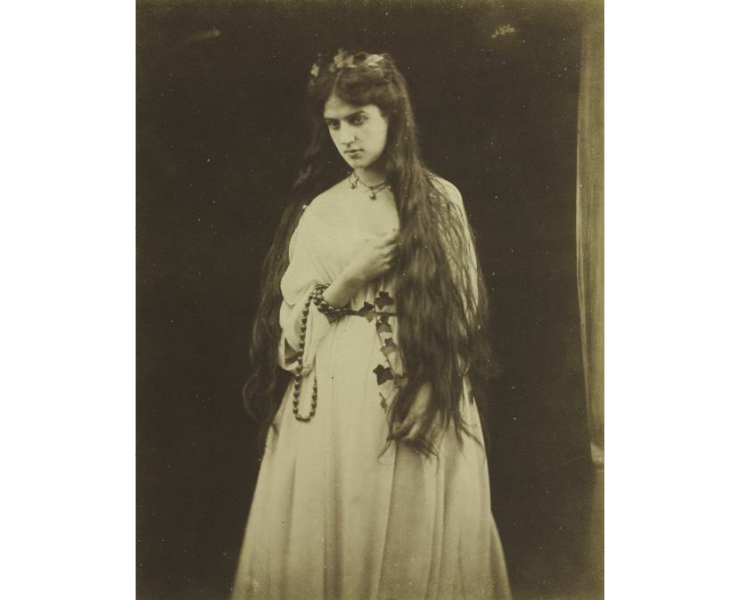
'And the Stars in her Hair were Seven' (1870) Julia Margaret Cameron
 On more intentional ground, we have Marion 'Pinkie' Ritchie as the Blessed Damozel of Dante Gabriel Rossetti's poem.  It is a beautiful and lesser known of Cameron's photographs and makes the lovely Miss Ritchie look absolutely delightful.  I particularly love the fact that her 'stars' appear to be flowers, and this portrait is softer than others of her as Mary Queen of Scots.  I rather like Pinkie and will be returning to her next month.

Mnemosyne (1868) Julia Margaret Cameron
Mnemosyne (1881) Dante Gabriel Rossetti
Cameron's image of Mnemosyne, the goddess of memory, predates Rossetti's by over a decade and some argue that Rossetti may have been inspired by her image, which was in his collection of prints, although far more likely is that it is a repeat of Astarte Syriaca.   

The Annunciation (1864-5) Julia Margaret Cameron
The real question becomes why did Rossetti resist the relationship with Cameron?  Whilst staying with their mutual friend William Allingham in 1868, down in the New Forest, Rossetti writes that he wants to walk by the seaside, with no 'impending female photographers or even poet laureates'.  When Cameron sent Allingham several insistent notes to come and sit for her, bringing Rossetti with him, Rossetti replied with a equally insistent 'no'.  It's not a secret that Cameron could be rather overwhelming and although the pair seemed to respect each other as artists, possibly in later life, Rossetti did not feel comfortable being a model for Cameron.  Thinking about it, I'm not even sure Rossetti had modelled for any female artists after Elizabeth Siddal, and we have proof that he felt uncomfortable about portraits taken of him after her death.  It is just as likely that the refusal from Rossetti was as much about his feelings about his own image as his feelings about the photographer.  Either way, it probably didn't do Cameron any harm to be told 'no' now and then, despite depriving us of what would undoubtedly be an interesting portrait of a conflicted, brilliant artist.  

I still remain hopeful that Christina's photo will appear at some point, I best go and check the attic again...