Showing posts with label John Singer Sargent. Show all posts

Friday, 21 August 2015

Annie Louisa Swynnerton

There are artists whose paintings you will recognise but when you come to look into their lives, there is surprisingly little information available.  You may find a couple of entries in artist dictionaries, a Wikipedia entry and that will be it.  About a week ago I featured this painting over on my Facebook page (come join me there, it's delightful and filled with gossip)...


The Letter (1900-1920) Annie Louisa Swynnerton
Gorgeous!  Someone asked me if she had really only lived 20 years, but that is the date range of the picture (to add to the confusion it was actually shown at the Royal Academy posthumously in 1934).  Annie in fact lived a long and happy life and I'll try and do her justice here...

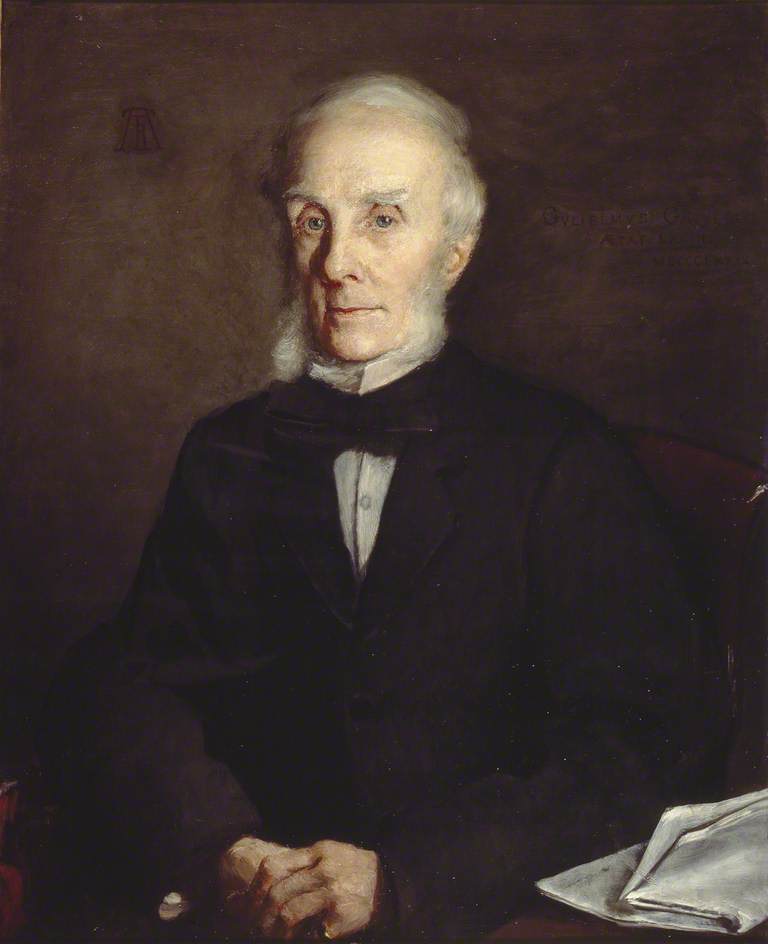
Annie Louisa Robinson was born 26th February 1844 in a central area of Manchester.  Her birth place is often given as Hulme, but within a few years her parents seemed to have moved to Chorlton-on-Medlock and then Greenheys. Her father, Francis (1815-1889) was a solicitor and the family seemed to have been Methodists, attending the non-conformist chapels in the area.  It might have been in her childhood that Annie met the non-conformist minister William Gaskell, husband of the author Mrs Gaskell, who she painted in 1879.

William Gaskell (1879)
Of the six Robinson daughters, at least three of them worked as artists. Annie and her sisters Emily and Julia were all artists and all founder members of the Manchester Society of Women Painters, which I'll come to in a minute. One of the other sisters, Adela, married an artist engraver called John Brownlie, so it seems that artistic matters were valued in the Robinson household, enough to influence the life-choices of the sisters.

The Dreamer (1887)
According to The Women's Suffrage Movement: A Reference Guide 1866-1928, during a period of financial difficulty, Annie started to sell her watercolours for money, but judging by the course of Annie's life over the following years, either the period was short or her painting sales were extraordinary successful.  After attending the Manchester School of Art from 1871, where she won a gold prize and a scholarship for an oil and watercolour painting, she moved to Rome to study. Annie stayed in Rome with fellow Manchester artist Susan Isabel Dacre (known as Isabel) from 1874 to 1876 after which the pair moved to Paris where they studied at the Academie Julien. A portrait of Isabel dating from this time was given by the sitter to Manchester Art Gallery in 1932...

(Susan) Isabel Dacre (1880)
On their return from Paris, Annie and Isabel, together with other local artists formed the Society of Women Painters to provide a place and facilities for the members to work together and study from life.  Apparently in those days you had to leave Manchester to see a naked man.  Anyway, the Society saw it as their duty to disseminate the principles of true art among the students of the art schools.  They had rooms in Barton House, Deansgate where classes were held in elementary drawing, drawing from the antique and drawing and painting from living models.  Isabel Dacre was the president, Annie served as secretary, her sister Emily was treasurer and other members included E Gertrude Thomson, Eleanor S Wood, Jane Atkinson and Julia Pollitt (nee Robinson, Annie and Emily's sister).  The Society held annual exhibitions which were described in the local press as 'one of the most pleasing events in the artistic year in Manchester.'

Tryst or A Salford Lass (1880)
In 1880 Annie exhibited The Tryst, described in the press as a remarkable picture.  It was immediately bought by Henry Boddington jnr (of the brewing family) who gave it to the Salford art gallery.  Interestingly, I couldn't find too much information on the artistic career of her sisters, but whereas Annie's work received praise in every instance I found it mentioned, very little is ever said about either Emily or Julia. One of the few mentions I found was in the 1880 review in the Manchester papers describing Emily's picture Scene from Esmond as not accurate to the source material, although it did not elaborate what the problems were.

Joseph Swynnerton
Whilst in Rome, Miss Dacre and Miss Robinson made the acquaintance of Joseph Swynnerton, sculptor.  Swynnerton had been attending art school, the Academy of St Luke, since 1869. In the 1882 Manchester Society of Women Painters exhibition, Isabel exhibited a three-quarter length portrait of Swynnerton.  In the summer of 1883, Annie and Swynnerton married and returned to Rome where they lived until the year of his death, 1910.  The couple do not seemed to have stayed exclusively in Italy, however, and Annie's career continued steadily back in England.  In 1883 she showed various paintings in exhibitions, including Oleander, described in the press as 'a perfect gem'...
Oleander (1883)
During this period both Annie and Isabel Dacre became active in the suffrage campaign.  In 1889, Annie signed the Declaration in favour of women's suffrage and in 1897 she signed the claim for women's suffrage.  During this period she also  continued to catch the eye of reviewers, her paintings travelling world wide.  Her painting Florence Nightingale at Scutari was sent over to the Women's Exhibition in Chicago in 1893, as well as regularly exhibiting in the Royal Academy exhibitions and the Royal Scottish Academy, as well as the Royal Glasgow Institute, continuing her work with the Society of Women Artists and many others. In 1895, Annie was only the second woman ever invited to sit upon the hanging committee of the Liverpool Autumn Exhibition.

Cupid and Psyche (1890)
One of her most famous paintings, Cupid and Psyche, was first exhibited at the Walker Gallery in 1891.  It was described in the local papers as robust, showing thorough and straightforward workmanship: 'the work shows such research of plastic beauty, the drawing so firm, the head and limbs so well modelled, that they give one the idea of being the work of a sculptor.' It might be that the reviewer is hinting at the influence of her husband, but even today the unruly curve of the wings and awkward beauty of the pair still captures the imagination.

The Glow Worm
Annie was influenced and supported by G F Watts and Edward Burne-Jones, and she tackled figurative and allegorical subjects.  I find her style clearer and less impressionistic than Watts but his influence can be clearly seen in works such as Mater Triumphalis...

Mater Triumphalis (1892)
The Edwardian period brought more success and after her husband's death in 1910, Annie seems to have lived more in London than abroad.  Her painting Oreads of 1907 was acquired by John Singer Sargent, a great admirer of her work and he helped her to become the first elected ARA (Angelica Kauffman and Mary Moser being founder members) in 1922.  Annie also headed the section of Chelsea artists in the coronation procession of George V in 1911, organised by the women's suffrage societies.

The Sense of Sight (1895)
The picture that seems to have secured her place in the halls of the greats is The Sense of Sight, a painting showing an angel who has found heaven on earth in everything she sees (possibly as a reflection of how Annie felt in her role as a visual artist). In his 1905 book Women Painters of the World, Walter Shaw Sparrow reproduced the picture in monochrome (red).

Mrs Florence H Musgrave
Annie appeared in reviews of the Royal Academy and other exhibitions after the First World War, usually in unreservedly approving terms.  In a 1929 exhibition of Aberdeen Artists' Society, one reviewer noted - 'Among the strangers (ie the non-Scots)... we liked better the work of Cadell, David Foggie and Annie Swynnerton.'

New Risen Hope
 In the wonderfully disappointed review of the 1924 Royal Academy exhibition in the Western Daily Press, entitled 'Not Exactly Brilliant', the reviewer praised the painting New Risen Hope, which had been selected to be purchased for the nation via the Chantry Bequest, one of three of her works that would be purchased in her lifetime.

Dame Millicent Fawcett (1930)
Another to be purchased, in 1930, was her portrait of feminist and suffragist Millicent Fawcett, which was described in the art press as 'full of character and as fine a piece of colour as anything in the exhibition.'  Laura Knight, the next woman artist to become ARA after Annie, met Annie in her old age and remembered her as a formidable and eccentric woman who had done much for the status of women artists.  Gladys Storey in her book Dickens and Daughter (1939) remembered Annie a little less euphemistically: 'She was a talented artist and an accomplished woman, though scarcely one of whom it could be said she possessed a charm of matter.  Indeed, by maintaining the courage of her convictions she was at times embarrassingly outspoken.'

The artist at her easel
Annie's eyesight failed her in old age.  She moved down to a house called 'Sicilia' in South Hayling on the south coast of England in 1930, preferring the air and sunshine to her London home.  She died there on 24 October 1934, leaving a studio full of 170 pictures, all but 12 of them unfinished and unframed.  When this collection was sold the following year they made £601 which is just short of £40,000 in today's money.

Annie Swynnerton's Grave, St Mary's Church, South Hayling
To conclude, I always like to find a way to bring my research home to me and with Annie it was fairly straightforward.  Last Tuesday my daughter and I drove along the coast to Hayling Island and found Annie's grave.  In the quiet graveyard, overlooked by a 'Light of the World' stained glass window, is Annie Swynnerton's grave, marked by a large plain stone.  The inscription reads

'I have known love and the light of the sun.'
 
What more can you ask for?

Monday, 23 March 2015

Review: Sargent - Portraits of Artists and Friends

This is the second review from my trip to London, and it is my great pleasure to bring you John Singer Sargent at the National Portrait Gallery!


I have never been to a bad exhibition at the NPG, it is a very reliable pair of hands when it comes to crafting small, riveting exhibitions.  The V&A are going have to pull out some stops to beat the NPG's gorgeous Julia Margaret Cameron exhibition.  Anyway, back to Sargent: Portraits of Artists and Friends...

Madame Ramon Subercaseaux (1880)
Split over eight rooms, the exhibition shows many important figures in the world of the arts as seen through the unique portraiture of John Singer Sargent.  It is suggested that as he was rarely commissioned to paint formal portraits, choosing instead who he wished to portray, he was able to create works that reached further than mere likenesses to become works of art in their own right. Amalia Subercaseaux, wife of a Chilean diplomat and artist, faces you as you enter the exhibition and sets the standard for exactly how blown away you will be.  The above image does not do justice to how clear the white of her dress is and how the red burst vividly out.  The theme of music in Sargent's work is repeated later, but Amalia used to play while he painted her, the black and white of the instrument echoed in her dress.  The portrait itself was important in terms of his career as it earnt Sargent a second-class medal at the Salon of 1881 which meant he could exhibit at the Salon without having to submit to the jury.

Robert Louis Stevenson and His Wife (1885)
I have to admit to always loving this image as it makes Stevenson look as if he was drawn by Quentin Blake.  This image has such an accidental look to it, like a snapshot, with the scant, rangy form of the author walking away from his wife, barely seen on the periphery. The picture contains tension (Fanny Stevenson doesn't look entirely pleased to be in the picture) and the mystery of the open doorway, bisecting the canvas and creating a bar between husband and wife.  It's odd, informal and modern and a surprising portrait of an author who was growing in fame.

Carolus-Duran (1879)
More traditional but no less engaging is Sargent's portrait of his teacher Carolus-Duran. Painted five years into Sargent's time with the charismatic master, it received an honorable mention at the Salon in the same year that Carolus-Duran won the medaille d'honneur.  I love the softness in the paint on the clothes compared to how sharply the eyes are fixed on the audience, really giving you a sense of the power of the teacher's personality and why Sargent held him in such esteem.

Portraits de MEP...et de Mlle LP (1881)
Among the portraits are a few of children and special mention has to go to perhaps the creepiest pair of kiddiwinks I have ever seen.  Even Lily-Rose stopped and said 'well, they're not right...' The two poppets are Edouard and Marie-Louise Pailleron.  Marie-Louise became a historian and author when she grew up and recounted no less than 83 sittings for the portrait with battles over hair and dress which might explain why the children look so malevolent.  I have the copy of Turn of the Screw which has this as the cover image, and it is perfect as there are just so many disquietening notes in the picture - the slightly awkward hand positions, the little girl's torque bracelet and her brother's sneering expression.  Marvellously odd.

Carnation, Lily, Lily, Rose (1885-6)
Far less chilling is this image and predictably this was one I really want our daughter to see.  Lily-Rose informed those around us that it was her picture, which mercifully people found charming.  Mr Walker and I saw this picture back in the 1998 Tate exhibition on Sargent, the day before he got his first museum post and it has always stayed with me.  The effect of the paper lantern-diffused light on the white of the girl's dresses and the petals of the flowers is just magical.  Described as Sargent's brush with Pre-Raphaelitism, I have to say I don't agree unless it is the idea of painting outside and among flowers.  It is a beautiful piece of English Impressionism, with the light and the powdering of flowers through the unruly grass.

Ellen Terry as Lady Macbeth (1889)
It is the portraits of women that were my favourites and two deserve special mention.  Firstly and possibly also predictably, is Ellen Terry as Lady Macbeth, a massive and powerful image of an actress becoming her part with alarming conviction.  Alice Comyn Carr's beetle-wing dress is off-set by the rich red of her hair and the golden crown hovering like a halo over her. Her expression is one of exaltation, fear, power and uncertain control.  I had never considered before that Sargent posed Terry in an act that does not occur in the play but in itself is a hidden theme: how Lady Macbeth's pursuit of the crown is far more vicious and brave than her husband's, how she ultimately wants the crown more, or at least is willing to do what it takes to make it happen.

Mrs George Batten Singing (1897)
Finally then I will leave you with my favourite piece in the exhibition. Mabel Batten was a leading patron of the arts and a brilliant mezzo-soprano, also playing the piano and the guitar.  She was the lover of the Prince of Wales among others and wife of the private secretary to the British Viceroy in India and an all-round woman of excitement.  Sargent's portrait of her encompasses many aspects of her personality, as she is superficially shown holding the final note of 'Goodbye' by Paolo Tosti, but the image can easily be seen as a far more intimate, erotic piece.  The cropping of the work to concentrate on her tiny waist, low-cut dress and transported expression hints at a woman in the throes of passion, illuminated by lamplight.  Such a striking and beautiful image was worth the entry fee alone.

If you see one exhibition in London this spring, please make it this one.  It's gorgeous, thrilling and thoroughly enagaging.  I was particularly impressed that the shop boasts not only the expensive catalogue but also a £10 mini-guide with all the images illustrated, together with a brief piece on each.  If you can't make it to the exhibition, the little book is well illustrated and very interesting.  Bravo NPG!

To find out more about Sargent: Portraits of Artists and Friends visit the website here.

Tuesday, 5 August 2014

Pleasure in Idleness

When I was a teenager (so, really not that long ago) I had this picture on my wall...

Dolce Far Niente (1904) John William Godward
I bought the poster from Woolworths for a couple of quid and I adored the sultry, languid idleness of the image, from the lily-pond, still and mirror-shining, to the beautiful woman curled up on the fur rug.  I thought that was how life would be when I was a grown-up.  Well, I don't have a peacock feather fan yet, but otherwise it's remarkably similar.

Years later, I was fascinated by this image by William Holman Hunt...

Dolce Far Niente (1866) William Holman Hunt
Not liked by many people, Hunt painted over the original face and hair (which belonged to Annie Miller) with those of his beloved Fanny, his wife.  The over-painting is not entirely successful but the whole, tightly packed image has a luxurious, voluptuous feeling in keeping with the title of the picture.  Dolce Far Niente means 'pleasantly doing nothing' or 'sweet idleness' and refers to the pleasure that lies in leisure.  For the Victorians, it was a theme they would return to in art repeatedly...

Dolce Far Niente John William Godward
Godward liked the subject so much, he painted it twice.  Again, he presents us with a supine lady on a fur, swathed in rich, translucent fabrics, engaged in nothing much.  The air of luxury is essential for the images it seems, I suppose because the rich could afford the idleness cultivated with such splendour.

Dolce Far Niente (1880) John William Waterhouse
Waterhouse presents a woman who has at least got off the floor, but she holds a peacock fan.  The peacock would be the perfect bird for these images as they aren't known for their industry or use, just their ornament and vanity, which may also have a resonance with the subjects of the paintings.  Hunt's woman is unusual as reflected in her mirror are bookcases, hinting that she had been reading if nothing else.  For the most part you have to ask what the women have stopped doing in order to be idle?  Surely there has to have been action in order for the enjoyment of inaction to be appreciated?

Dolce Far Niente (1882) Lawrence Alma-Tadema
Maybe then it is the women who are the pleasures of idleness for the men who observe them.  We, the presumably male viewer, can while away delightful hours, gazing upon these decorative creatures as they roll or loll about looking gorgeous.  They are merely part of the pleasurable view, as inanimate as the peacock fan and equally as decorative.  It's as simple as that, or is it?

Dolce Far Niente Frederick Arthur Bridgman
It could be there is a warning in the images.  Arguably its history taints it, but Hunt's picture unsettles some people and makes them feel that Hunt is not endorsing the pleasure inherent in the title.  Bridgman's voluptuous maiden above is the epitome of an idle pleasure, but possibly she is not so good for you.  Having no worth other than her voluptuous pleasure is rendering her viewer powerless, idle and an idle man is not a good thing in 19th century terms.  She is the siren luring her victims to a terrible fate of sitting and looking at her semi-naked splendour.  Steady gentlemen, try to resist for a few moments at least. Remember you're British and Victorian at heart!

Dolce Far Niente (1884-87) Mortimer L Menpes
The Italian title and the oriental dress are somewhat at odds, but both have resonance with aestheticism.  Rending oneself into a subjectless tableau of inaction, beautiful and inert, suits both the title and the movement as displayed by the rather bemused woman in a kimono above.  She does look as if she has forgotten where she left her keys rather than enjoying idleness.  She's standing up and everything.

Dolce Far Niente John Singer Sargent
Unusually, Sargent shows men enjoying the pleasure of idleness, but they aren't really idle in the true sense. Some read, some play suitably sensible games.  I bet they are all thinking jolly hard about manly stuff too.  Men are apparently rubbish at being idle, but then their natural state is very vigorous and active, so anything that doesn't involve striding across the countryside and wrestling wild animals counts as idleness.

Dolce Far Niente Stanley Cursiter
When women are idle, there are really only fans involved.  The fans possibly hint at foreign parts, suggesting that for true idleness you have to look beyond English shores.  With the delightful casual racism that garnished the 19th century, the inference is that foreigners are obviously more idle than good British girls.  Add a bit of sexual racism in there too, then the sultry supine maidens take on another aspect.  Is the danger of a idle woman, an idle foreign woman, that she may corrupt the upstanding British manhood she gets her sultry idle hands on?  Gentlemen, please show a pretense of resisting, for heavens sake!

Dolce Far Niente William Quiller Orchardson
In order not to lose my gentlemen readership to the lure of idle, foreign temptresses, I will end my post with my favourite couple of idle women.  Orchardson shows us a young woman on an oriental couch, leopard skin and fan on the floor but with a notable addition to the scene...

Dolce Far Niente Auguste Toulmouche
Her feet rest on a furry rug and she is surrounded by luxury, but on her lap is an open book.  Both Toulmouche and Orchardson's women are idle during reading.  How often, when reading a brilliant book, do you find yourself paused, gazing away, thinking of the plot, the characters, the world created by the wonder of the prose?  The idleness of the title is simply an external state because inside these women they are racing through the imaginary worlds of their novels.  The summer's heat renders me useless and there is no greater escape from the oppressive heat then to cradle a book and allow it to whisk you away.  If the novel is wonderful then after a certain point you can step into the imagination of another and the book falls away briefly.  You might be meeting a character, walking through a landscape, trying to make the right decision to reach your happy ending.  Whatever captures you, when roused from your revelry by an onlooker and asked the foolish question of what you were thinking about, the answer is invariably 'Nothing...'

Dolce Far Niente, indeed.