Showing posts with label William Holman Hunt. Show all posts

Sunday, 8 February 2026

Bye Bi-Centenary

 Do we celebrate 200th year anniversaries? Last year's Jane Austen 250 was a blast, so I turned an excited expectant face to my beloved Mr Walker and asked if there were any rumours of exhibition for the bicentenary of the Pre-Raphaelite Brotherhood that will be occurring in 2027 (Holman Hunt), 2028 (Rossetti) and 2029 (Millais).  He gave me his long suffering look (which I am very familiar with) and said words to the effect of 'What do you think?' 

Before anyone points out the obvious, I am very well aware that time/money/resources/money/logistics/ money and money are the main problems here and even Mr Walker had to agree that if the government gave a lovely big sack of cash over to the museums of this land and said 'have at it,' getting a retrospective of Homan Hunt/Rossetti/Millais or anyone else would be possible.  A lot of work but possible. All this led me to wondering about 100 years ago and the sort of fuss that went on for the centenary of the PRBs...

Another thing that got me wondering was coming across this cartoon (by E H Shepherd of Winnie the Pooh fame) which was in the newspapers in response to the very popular William Morris centenary exhibition in 1934 at the V&A. Morris was still known and popular, with thousands of newspaper article about him which only increased in 1934 when everyone was talking about him.  There were special editions of book reviews about his literary output, plus new biographies about him.  The exhibition was opened by Stanley Baldwin (yes, I know, I will come to that in a moment), who was about to become Prime Minister again, so that got a lot of traction in the papers. Baldwin talked about how unique and amazing Morris was and he was declared a genius once more. Stanley Baldwin was, of course, the nephew of Morris's best mate, which doesn't hurt and draws on an essential point - Centenaries only work when people are around to remember you.

Let's start with Holman Hunt as the oldest of the main PRB trio, therefore his centenary appeared in 1927. I must admit I thought HH was going to be the one with the slimmest newspaper coverage, but I had not counted on the power of a widow.  Fanny Holman Hunt (sister of the first wife Edith - he married them alphabetically which is handy) had an open house and told stories of her husband to members of the Londoners' Circle who did some sort of Holman Hunt pilgrimage and she told a special story about this painting...

Christ and the Marys (1847-c.1900) William Holman Hunt

Hunt apparently hated his weird palm tree (he had never seen a palm tree at that point) so much he turned it to the wall and refused to look at it for decades until finally finishing it in old age. The papers also latched onto the craze for The Light of the World that had gripped the world when it went on tour to the Empire in 1905 to 1907, drawing massive crowds. This would have been within living memory for many of the readers, and of course Hunt died in 1910, so his centenary was less than 20 years later.  He would have been very much remembered.

Morning Music (1867) Dante Gabriel Rossetti

I put money on Rossetti being the one that drew the most newspaper coverage for his centenary in 1928. I was very much wrong. Firstly, I fully appreciated the people of Sheffield claiming Elizabeth Siddal as a 'Sheffield Girl' (Sheffield Daily Telegraph 16 & 24 May 1928) - how fitting that Rossetti's special year was made in part about how amazing Miss Siddal was. Hastings also had a celebration at St Clement's Church (where he married the Sid).  Birmingham Museum and Art Gallery had a 'small' centenary exhibition, drawn from their own collections with two exceptions - they borrowed Morning Music from Mrs J R Holliday (wife of James Richardson Holliday, although they apparently gave the work to Birmingham in 1927) and a chalk sketch of a figure from Dante's Dream which was borrowed from Misses Ethel and Helen Colman (of the mustard family) of Carrow Abbey.  The sisters also owned the finished oil (now in Dundee) which they would have lent as well but it was so huge no-one could work out how to move it safely.

Dante's Dream on the Day of the Death of Beatrice (1880) Dante Gabriel Rossetti

The Daily Express published a very interesting piece about the lack of 'Rossetti Girls' in society in 1928. Apparently, you could go to all manner of parties in Chelsea these days and never meet 'one tall woman with great weary eyes, the butterfly mouth and hollow cheeks which the Pre-Raphaelite idea demanded' - well, quite. Apparently, women are all unnatural energetic these days and refuse to be languid. I hope you are all ashamed of yourselves.

I think some of the confusion over the Rossetti centenary is that his poetry was not really fashionable and his painting was overshadowed by his love-life which was neither spicy enough for the tabloids or romantic enough for the academics to be of great interest. Also, people kept making it about other people - not only Elizabeth (well done Sheffield) but also Frederic Shields, Walter Deverell, not to mention bloody Hall Caine who popped back up like a cold sore, in case we forgot who loved Rossetti the most. So many of the little articles seem to begin 'the centenary of Rossetti's birth reminds me of this entirely other person.' Sorry Rossetti, you will have to wait until everyone thinks you are the most important one...

Just Wake or Waking (1865) John Everett Millais

Millais's hundredth birthday the year after obviously benefitted from the heightened awareness the previous two brought. He had already been mentioned multiple times in the retellings of the PRB origin stories. Millais, like Hunt, also benefitted from surviving children, with his daughter placing a red rose on his statue in Tate Britain's garden. Birmingham also held a centenary exhibition (well done Brum) throughout June.  Southampton claimed him as a son of a city (born round the corner from TK Maxx) and Christie's sold Just Awake (now known as Waking) complete with a rather high profile visit from Mary Millais (1860-1944), the model (aged 5). Despite the extra publicity and an expected price of two thousand guineas, it only made five hundred.

John Ruskin (1853-1854) John Everett Millais

Scotland claimed Millais, fighting off the claims of Southampton and Jersey and the Sphere had a double-page retrospective of his life, work and Presidency of the Royal Academy.  It had a picture of Holman Hunt and a picture of Ruskin, but no picture of Rossetti, which is telling. Very little of the press coverage was about his marriage and the surrounding scandal, with only the Sphere mentioning Ruskin at all. I wonder if that was because, like Hunt, the children and grandchildren were around to steer conversations? On that note, Esme Millais, granddaughter of the artist got engaged in the same year (excellent timing) and received far more publicity than it possibly warranted.

Going back to the cartoon, the amount of publicity around Morris's centenary in 1934 surprised me. May Morris was obviously still with us (as was Jenny) and he was declared 'the greatest of Victorians' in the Salisbury Times which is a bold assertion.  

Clerk Saunders (1861) Edward Burne-Jones

The one that shocked me most was Edward Burne-Jones. 1933 should have been his year, especially after the roll over of the PRB where he was sometimes mentioned but no. The Saturday Review started their piece on him with "Anything to do with Camelot makes me sick," quoting a young person in response to poor old Ned. Wales claimed Burne-Jones, with the Western Mail declaring he was the greatest of all Welsh artists which is a bold move for a chap from Birmingham. They also claimed King Arthur and Camelot was Welsh too, so there's that. Stanley Baldwin also opened a centenary exhibition at the Tate for his uncle, declaring that modern life could be so vulgar and ugly, we all need a bit of beauty. Gwen Reverat (Granddaughter of Charles Darwin) referred to the 'childishness of Burne-Jones ideal' in her review. Ouch.

Love and the Pilgrim (1896-7) Edward Burne-Jones

Possibly reflective of a general lack of interest, when Love and the Pilgrim sold in March of 1933, it only made £210, as opposed to almost £6k it had made in 1898. The Truth pondered what the problem was, as you got value for money in size (10 feet by 5) but concluded that slumps come to us all, and probably no-one would want to buy a Burne-Jones for many a year to come...

So, going by my very unscientific newspaper-extrapolation of information, I was surprised at the levels of interest and attitude on both ends of the scale.  I was aware that by the late 1920s, love for the Pre-Raphs was not going to be at a pinnacle, but I did not see the dislike for Burne-Jones on my bingo card.  The people giving the reviews were artists (because the Guardian's Jonathan Jones was yet to be born/fashioned in the darkened cave devoid of joy and whimsy) with both Gwen Reverat and Robert Anning Bell not exactly raving about Ned's angels and knights. Starting your review quoting someone who is nauseated by Burne-Jones is an exciting stance. I wasn't surprised by the low interest in Holman Hunt, although the coverage he got was positive. Millais' coverage was respectful and quite family orientated. Rossetti's was scatter-gun and about lots of other people.  Morris was triumphant. People's love for him, his genius, his contribution to the world, made the press coverage positive and weighty. Burne-Jones got less than 400 mentions in his year, Morris got almost 2.5K; the only other one near him was Millais with 1.6K, and that included his granddaughter's wedding announcement. Morris went last, but I don't think he benefitted from that because surely Burne-Jones would have had more too, but I wonder if Burne-Jones and Millais suffered at all from their bad auction results? Despite Millais otherwise positive year, there was a bit of niggling over the drop in auction result, despite the visit from the model.

Next year is Holman Hunt's bi-centenary and I am fairly certain no-one has a big retrospective planned (please correct me!) and in fact, of all the Pre-Raphaelite and adjacent artists who should have one, I don't think I've ever attended a purely HH show. Following on from that, I have heard rumours for Rossetti, but nothing for Millais.  Possibly Morris and Burne-Jones stand a better chance as there are public bodies who have sizeable collections of their works to form a basis for an exhibition. Herein is the problem - exhibitions are expensive (yes, Mr Walker, I am listening) and the sheer expense of loans and getting them to you is a problem. While I argue that such exhibitions would be popular, my sensible husband points out the logistical nightmare that has to be balanced, and that is nationally speaking.  When those works of art are now spread over the world, that is yet another layer. Which brings me to Jane Austen...

250th logo from the Austen Centre

Last year was Austen's 250th anniversary of her birth and didn't we all know about it? Ever the queen of transmedia, I saw ads for tea-towels, tea=cups, special editions of her novels, showings of the films, walking tours of Bath etc and numerous small exhibitions.  She managed full coverage which will no doubt continue as we have yet another Pride and Prejudice on Netflix and The Other Bennet Sister coming to the BBC this year. Maybe this is the model we need for our Pre-Raphs. There was no big exhibition (British Library had a small display) but she was omnipresent in an impressive way.  So how about some documentaries, showings of The Love School and Dante's Inferno? Small exhibitions all over the place together with tea-towels and t-shirts. Walking tours of graveyards and riverbanks. I'm up for it all. Jane Austen has shown us that maybe we don't need a blockbuster to make an impact. 

So, let's get planning.

Thursday, 12 December 2024

Thursday 12th December - The Awakening Conscience

I can't believe we are half-way through Catvent already! Thank you everyone for your comments, messages and general smashing-ness.

I'm intense and so is my cat

I really wanted to include a proper Pre-Raphaelite cat in this Catvent, but my mind kept wandering to all of Millais's dog, which was no good.  Then I was suddenly reminded of the Perfect Pre-Raph Pussy! (apologies, that sounded so less weird in my head...)

The Awakening Conscience (1853) William Holman Hunt

How could I not include this painting? It is also a rarity amongst the paintings that I found for these posts, as the cat is being a right little sod.  I love the Chairman dearly but I'm under no illusions that he has a liking for catching little squeaky, chirpy things.  Actually, these days he prefers to sit on top of the hen house and look at the birds rather than commit carnage, as it is far too much effort. I also suspect that someone else left me the giant dead rat outside my door the other day, as he doesn't tend to kill things, instead he prefers to play with them which is worse in my opinion. Yikes.


Look at that little swine - you know his name is Monsieur Fluffles or some such nonsense, but he is known as Satan to his friends.  He has caught what appears to be a sparrow and is tormenting it.  The action is meant to mirror the fancy man and his feckless mistress above, but does it?  The sparrow clearly knows it is in massive amounts of danger and distress, but the girl rising from Lover Boy's knee looks hopeful and filled with salvation.  Of course, that is not the original face on our lass...

Someone had a glow-up...

It is one of Pre-Raphaelitism's greatest mysteries - what did the original face on The Awakening Conscience look like? I will merrily admit that The Awakening Conscience is one of the paintings that got me hooked on the Pre-Raphaelites as it is such a rich narrative not only within the picture but about the picture.  We all know now that the shining face of one of the Waugh sisters (I want to say Fanny) is not the original face nor expression that our lass is meant to have.  Like the sparrow, she is meant to be rising in horror at being trapped. It also struck me that if the bird is not a pet bird (I can't see any hint of a bird cage in the room) then, like the girl, it is just a common bird that strayed somewhere it didn't belong and is now in danger.


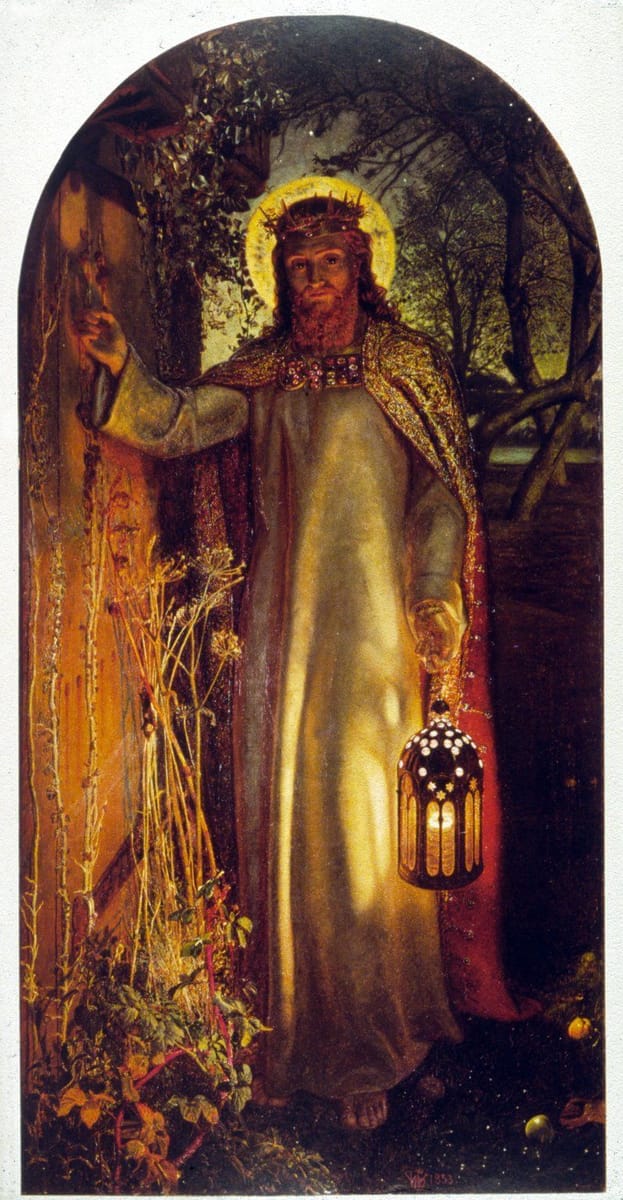
On that note, both cat and man are in the same position, with their right arm extended, catching their prey, while looking up.  I knew that the cat and bird mirrored the man and woman in meaning but looking again, their pose is identical, his arm preventing her from escaping through the open window.  The painting is meant to be displayed with The Light of the World so that the girl is rising and reacting to Jesus knocking on the door, but without that context, the girl and bird are both looking towards the window in hopes of escape, but neither have a good chance. First of all, she's in her underwear, which might hamper any flight from her sin-shack in St John's Wood.  Secondly, little Satan under the table has no intention of letting his bit of fun escape any time soon and the bird will not be leaving alive. No wonder the girl originally looked horrified.

From Pre-Raphaelite Cats (2014) Susan Herbert

There is a note of hope - Chairman Meow can be a little hapless with his rat-presents which are brought to me alive (so that we might play with it together, oh joy) and they invariably escape (with much screaming from me, I must admit) so maybe Satan will get cocky and the bird will get a chance to escape.  Likewise, maybe our feckless heroine will just take off in her undergarments through the open window and get away, although I am struggling to know what she would end up doing for the better.  Maybe it's best she sits back down and enjoys her St John's Wood Sin Palace (sorry Jesus) and starts saving her money so that she can affect a proper escape. Actually, I'm sure Jesus would understand as he was a decent chap.  Good luck to you, Love.

I'll catch up with you all tomorrow...


Thursday, 8 December 2022

Thursday 8th December - Rienzi

 I thought I'd tackle a very familiar painting today, mainly because although I know it very well, I didn't actually know anything about the death involved.  It's this one...

Rienzi Vowing to Obtain Justice for the Death of His Younger Brother etc etc (1849)
William Holman Hunt

Apologies, I wimped out on the whole title, it's Rienzi Vowing to Obtain Justice for the Death of His Younger Brother, Slain in a Skirmish Between the Colonna and the Orsini Factions, so unsurprisingly it's normally known as simply Rienzi.  It's one of the first Pre-Raphaelite painting that founding Brother William Holman Hunt produced, exhibited alongside John Everett Millais' Lorenzo and Isabella at the Royal Academy in 1849.  Its source material was the novel Rienzi (1835) by Edward Bulwer-Lytton, about Cola di Rienzi (1313-1354), who styled himself as the last tribune of the Roman people.  The scene presented is one of Adriano, Rienzi's brother, who had been collecting flowers for their sister Irene.  He gets caught between two rival factions, the Colonna and the Orsini (think Montagues and Capulets) and is killed in the resultant scrap.  This tragedy transforms Rienzi from a scholar to a politician, determined to unify his country and end the violence.

The figure of Rienzi was modelled on Rossetti who, as Holman Hunt said in 1886, 'would do much for art at a considerable amount of personal inconvenience, and so with characteristic good nature he sat for that figure.'  It is a very handsome likeness of the young man - I often feel puzzled about what Rossetti actually looked like as we have his early, extremely pretty self portrait then his later photographs where he looks like (forgive me) a chonky Tim Curry. I like the image of him here, together with his appearance in Millais's Isabella as you get the sense of a good looking young chap who was a bit of a one before life got the better of him.  


Beside him, William Michael Rossetti looks on the tragic dead figure of John Everett Millais, as the poor Adriano.  William Michael was evidently not shy about modelling for his Pre-Raphaelite brothers as he crops up quite a bit in these early paintings.


One of the soldiers was painted from a costermonger and due to his likeness to Dante, was used as a model by Rossetti subsequently, according to Hunt. Although Rienzi was dismissed and unsold to start with, eventually there was much praise for the painting, both within Hunt's lifetime and in the 1960s revival, although the Illustrated London News of 1969 remarked it would have been a better picture if the centre of it wasn't dominated by a couple of horses's backsides.


The death of Adriano in this picture is the catalyst for change rather than an end in itself.  Rienzi is not vowing revenge but justice, for the strength to lead a revolt against the Pope, reunify Italy and restore power to Rome.  It is probably one of the most constructive murders in Stabvent, being a moment of change and the impetuous for a better future (sorry Adriano).  It also seems to signify the end of innocence, with the blonde body of Adriano looking very young and blameless and the flowers still clutched in his hand, incongruously close to the dropped swords. So, is Holman Hunt saying Innocence is not helpful and needs to be dispensed with?  Possibly he is inferring that innocence is a luxury and a dangerous one at that.  The real world requires action and knowledge in order to facilitate change.  In that way, the PRB boys embody this, studying the teachings of Ruskin in order to change the world of art.

This is the painting that Holman Hunt poured all his new-found artistic spirit into, inspired by reading John Ruskin's book Modern Painters (1843).  He spent hours in the Tower of London, drawing armour and horses from John Blount Price, together with his friends and acquaintances as his figures.  The fact it didn't sell almost broke him, leaving him starving and desperate until fellow artist Augustus Egg arranged for a collector to see the picture. The spectre of poverty and having to quit art for a proper job apparently haunted Holman Hunt for the rest of his life, making him one of the hardest working and most dedicated artists of his generation.  He also is arguably the only one of the original Brothers who stayed true to Ruskin's teachings for his entire life.  By the time of his death, Holman Hunt was the last of the PRB painters left, a household name and never stopped, as Ruskin insisted, going to nature 'in all singleness of heart...rejecting nothing, selecting nothing and scorning nothing.' The result is one of the prettiest corpses you will see this month.

See you tomorrow...

Friday, 5 August 2022

Who's that Lady? It's Jesus!

This is a bit of a rambling post brought about by a letter I read in an old newspaper. I love reading accounts from the early twentieth century from people who, in old age, are recalling what they know about the Pre-Raphaelites. This is particularly interesting when they are praising the work as by the First World War and the Twenties, when a lot of these accounts appear, they are talking about deeply unfashionable artists.  However, a week or so ago, a rather interesting letter caught my eye. It all started because George Moore published a right old rip-snorter of a Biblical novel called The Brook Kerith. This is 1916, so you'd think people would have other things to worry about, but George had made his Jesus a bit girly and all hell broke loose...

George Moore (1879) Edouard Manet

In a piece from the Westminster Gazette on Friday 15th September 1916, the author was forced to defend his depiction of Jesus, and he did so by invoking artistic precedents. When discussing the depiction of Jesus, he pointed out that from the 5th century onward, people had been killing each other over the correct interpretation of the scriptures, but one thing everyone could agree on was that the big JC 'must not be represented as a man.' This is an ecumenical conundrum as I'm guess depicting him as a squirrel would get you dispatched quite quickly, so what to do?  Mercifully, in the 15th century along came Fra Angelico who hit upon the idea of depicting Jesus as a pretty blonde lady and that's apparently fine. George Moore then brought everyone up to date and said Holman Hunt showed us a big girly Jesus knocking on the door, like a Holy Avon Lady. If the Pre-Raphaelites gave their Jesuses (multiple Jesus would be Jesi?) lady-faces then it's fine to have a lady-like Jesus in The Brook Kerith. Actually, having read the criticism of The Brook Kerith most of it is about the fact it's rubbish, and seeing as George had a reputation for writing saucy, scandalous books, I'm guessing the critics were already jumpy every time he published something new. So, George Moore's argument was that the Pre-Raphaelites made their Jesi look like chicks, so what's the big deal? Apparently, even the boy child Jesus in the Millais painting was a girl (according to George)...

Christ in the House of His Parents (1849-50) John Everett Millais

We then enter Round Two of the Big Girly Jesus fight, and on 21st September, Canon Horsley (an actual vicar and everything) weighed in on behalf of the enlightened church and said that if we are going to bring the Pre-Raphaelites into it, only a few people hated the painting and everyone else loved it (apparently). He finishes it up with a quote in Latin, which is always the best way to finish because no-one knows what you're talking about. Finally, and most sensibly, on the 25th September there was a letter from someone who really didn't seem to care if The Brook Kerith was any good but at least everyone could get their facts straight about the Pre-Raphaelites. The author of the letter was Mr Robert Ross, art collector, intimate of Oscar Wilde and all-round excellent chap. For starters, he said that the boy child Jesus in Millais painting was Noel Humphreys, the son of an architect, so George was talking absolute rubbish there but when it came to depictions of adult Jesi, Robbie Ross could give a few examples where it was the case that it was a lady...

The Light of the World (1851-3) William Holman Hunt

As Robbie says - 'Mr Moore remarks on the effeminate concept of Christ in the Pre-Raphaelite pictures, and the circumstance that a woman (Christina Rossetti) acted as the model for Hunt's Light of the World. There are other striking examples: Miss Siddal (Mrs Dante Rossetti) sat for the Christ in Madox Brown's picture of Maundy Thursday or The Washing of the Feet; and in Spencer Stanhope's picture, I Have Trodden the Wine-Press Alone - one of the most singular works of that unequal artist - Miss Ellen Terry posed for the figure of Christ.'

Jesus Washing Peter's Feet (Maundy Thursday) (1852-6) Ford Madox Brown

The Wine Press (1864) John Roddam Spencer Stanhope
In the Illustrated London News  of 1865, it was suggested that The Wine Press was very much after the manner of The Light of the World, an opinion repeated in books since and possibly reflecting that although it was painted in 1864, it was conceived years earlier, possibly nearer the time of Hunt's painting.  Robbie Ross finishes his letter suggesting that George Moore like to consider Henri de Groux painting Christ Aux Outrages (1889) as his frontispiece as it had been on is mind while reading George's book as it features a very feminine Christ.

Christ Aux Outrages (1889) Henri de Groux

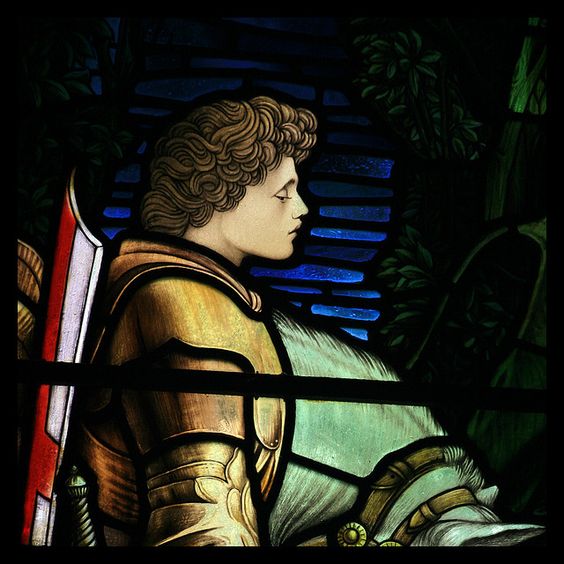
All these feminine figures for Christ left me wondering why no-one had reacted before.  I fully trust Mr Ross in his recollections, but also because we know that Holman Hunt used a few women for his Christ, and also Ellen Terry had form for posing as a chap.  Here she is as Sir Galahad, in a stained glass window from a painting by G F Watts...


...and here she is again, as a knight.  Maybe she just liked wearing the armour...?

Watchman, What of the Night? (1867) G F Watts

The stained glass window is in Freshwater on the Isle of Wight, where Julia Margaret Cameron routinely got girls to dress up as men...

Head of St John (1866) Julia Margaret Cameron

May Prinsep looks rather sombre as the head of John the Baptist (although seemingly very much still attached to the neck of John the Baptist). The place the girl/boy swap happened most often was with the Holy family...

The Holy Family (1864) Julia Margaret Cameron

The Madonna, or Mary Hillier, appears repeatedly in Julia Margaret Cameron's photographs, almost always clutching children of various sizes. Here she is clutching John the Baptist and Jesus, or Kate and Alice Keown as they were better known.  There are the occasional boys, for example Percy Keown, Freddy Gould or Julia's own grandson, Archie, but by and large, it's the Keown girls who are appearing as the various sainted boy-children. Freddy Gould was a very pretty little boy indeed, and he made a popular model, but the other boys are babies and so are fine while asleep but I'm guessing not the best models while awake. 

The Little Foot Page (1905) Eleanor Fortescue Brickdale

I think therefore the answer to why the Pre-Raphaelites used women as men is less to do with artistic tradition and more to do with availability.  As Robbie Ross pointed out, Millais used a boy as Jesus, not a little girl, so there was not an adherence to any ecclesiastical artistic tradition there.  The women brought in to model were friends, wives, sisters and lovers, therefore to hand and with nothing better to do (in the opinion of the artist). The Pre-Raphaelite ideal was to draw from life so if the only life you have to hand is Christina Rossetti then she better strap on a beard because she's going to be Jesus. Also, just because Elizabeth Siddal is washing some grumpy chap's feet as Jesus, it doesn't mean that she looks anything like what appears on the canvas, especially not in the topless version. Just because Walter Crane gave his (male modelled) Venus a six-pack in The Renaissance of Venus (1877) doesn't mean the Siddal Jesus had to have boobs...
Walter Crane, giving us a Venus who is more manly than Jesus...

In conclusion, art is often a combination of opportunity and tradition.  The male figures who are drawn from women are thus because women were to hand. If you asked me to name female artist's models, I could go on for ever but ask me to list male ones and I'd get a bit stuck after the hot Italian who was Julia Margaret Cameron's Iago. Women were to hand in the studios and houses of artists and although the faces (and six packs) of figures might have been finished from male models, preparatory sketches, emergency posing and all that stuff was more than likely done by a woman can yell for. If the tradition for painting Jesus is towards the feminine, then using Christina Rossetti to hold up your lamp is not outrageous as the finished figure has a great big bushy beard.  What surprises me is that Julia Margaret Cameron got away with May Prinsep as John the Baptist, looking completely like a girl and not really different from when she is posing as Zoe of Athens, Beatrice or just a portrait. There is no theatricality to her image (which is a surprise if you consider how Amateur Dramatics some of her Arthurian work is), it is a photograph of a head who also just happens to be a pretty girl. If you consider how devotional and religious Julia Margaret Cameron's work is, I'm surprised that no-one questioned it.  

Maybe they did and people just blamed Fra Angelico...


Saturday, 18 December 2021

Saturday 18th December - The Lantern-Maker's Courtship

 Blimey, school has broken up, I'm not in the office again until next year and so things are beginning to look a lot like Christmas! It's Saturday morning and so I'm taking it a little easy before we deliver some presents this afternoon. I also need to write a shopping list for Christmas food at some point as I'm doing an early raid on the supermarket during the week, then battening down the hatches. Whatever you are up to today, take care out there.  Right, on with today's picture...

The Lantern-Maker's Courtship (1854-60) William Holman Hunt

This is probably a very familiar painting to you, one of Hunt's Holy Land-inspired scenes showing everyday life in the East. A young lantern-maker is sitting outside the workshop and is attempting to woo a young lady by trying to have a feel of her face.  In response to this encounter, the girl has popped her foot.  Is this the international sign of cute romance? You can even get decorations for your wedding cake with the popped foot...

Why is that a thing? I'm puzzled.  Also, I have a few questions about why it's cute that he's fondling her face through her veil but I'm letting that go for now because I want to talk about how cute that dog is...


That is a very good boy indeed.  The wonderfully touchable fur has such depth and layers.  Even though we can't see his face, we know he's a noble looking chap. Is the fact that we can't see the dog's face connected to the fact that the young lady is veiled? Both of their faces are hidden but both also have to put up with the lantern-maker's nonsense.  The dog is asleep next to our bare-foot lothario's shoes keeping well out of the palaver that is going on above him. I bet he sees it all the time.  The lantern-maker has shiny lamps, girls like shiny lamps.

Steering away from the 'courtship' for a moment (and as far as I'm concerned, rubbing your hand on some poor girl's chops is not courtship, for goodness sake), apart from the very lovely dog, the other thing that always catches my eye is what's going on it the background...

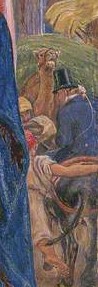
There is a western chap in a top hat on a donkey. The camel has a look of surprise which frankly I share and the gentleman has a whip in his hand which it looks like he's using against another chap.  What on earth is going on back there?! It can't be too loud or I'm sure the dog would be interested.  Blossom gets involved in all noise and rumpus.  Possibly again, the dog has seen far too many embarrassing foreigners and can't be bothered to react to yet another one. The dog has a right idea.  May you too be as relaxed as the lantern-maker's dog today and I'll catch you tomorrow...

Saturday, 22 December 2018

Saturday 22nd December: Eugenie Sellers Strong

Today's post is brought to you courtesy of my other job.  When I am not fighting my way out of a pile of Pre-Raphaelite books I am actually wrestling with books about archaeology as I manage a small specialist library for Historic England's archaeology teams.  Recently I have been engaged in finding books about lady archaeologists of the past and found one that fitted in the middle of the Ven diagram of my work-life.  Say hello to Eugenie Sellers Strong...

Eugenie Sellers (1890) Constance Phillott
Oh for a subject who not only has a wikipedia page about her but actually a mighty fine biography which I thoroughly recommend, by Stephen L Dyson.  Miss Sellers was born in 1860, the eldest daughter of Frederick Sellers, a wine seller.  She had a fairly European schooling in both France and Spain before ending up back in Cambridge, at Girton College where she obtained her degree in the classics in 1882.  She taught for a year in St Andrews in Scotland before heading back down south to London in order to study archaeology.  Not that Eugenie Sellers Strong isn't a fascinating woman in her own right, but in regards to this post it was while in London she joined in amateur dramatics and moved into the circle of people that we're interested in...

Oscar Wilde who met her during this period called her a 'young Diana' and there was a rumour that she had to deliver her lectures from behind a screen because her beauty was so distracting.  Certainly the painters of the period thought so and there was a kind of cross-over between the classical paintings of Lord Leighton and Alma Tadema and Eugenie's studies.  For a dramatic performance such as 'The Tale of Troy', in which Lionel Tennyson played Ulysses and Eugenie was Helen, Leighton was one of the artists brought in to advise on costume (all that draping!) and scenery.  The 'tableau' (which are just poses plastiques but respectable because everyone is rich) were reported in the newspapers in glowing terms of how marvellous it all was, and as they did it in both Greek and English, the almost-nudity was intellectual.

Eugenie Sellers Strong's book plate
It was during this period that Eugenie Sellers was close friends with Jane Harrison who had taught her at Newnham College.  It is an interesting point of biography that until recently, attempts had been made to write Eugenie out of Jane Harrison's biography and vice versa, and the reason for this is probably that they had a romance that ended badly.  However, in books such as Mary Beard's The Invention of Jane Harrison and Sandra J Peacock's Jane Ellen Harrison: The Mask and the Self such nonsense is being put to one side.  It's bad enough that women are written out of history by men, we really don't need to be doing it to each other, for heaven's sake.

Anyhow, I feel a bit guilty, when faced with such an important subject to only be interested in her face, but that's me and this is why she's been included in Blogvent...

Eugenie Sellers (c.1895) William Holman Hunt
In 1888, William Holman Hunt wrote to Eugenie requesting to paint her, although it is uncertain whether she took him up on his offer at that point.  What we do know was when Holman Hunt was working on his oil paintings of The Lady of Shalott from the 1880s until his death, he was in need of a model.  As quoted on the Maas Gallery site, in 1893 he wrote to F J Shields saying he needed a woman over five feet seven and a half inches tall (which is what I am on a good day and must have been really tall at the time).  Hunt used professional models for the standing around side of business, but for faces he liked to use women of his own circle, and so Eugenie was suggested.  She had a long neck and strong features (which judging by the photograph in Dyson's book, Hunt made stronger and more dramatic) and so she appeared in both of the finished oils from this time...

It's like playing spot the difference, isn't it?

Lady of Shalott (1886-1905, as is the above) William Holman Hunt
Eugenie married Sandford Arthur Strong, fellow academic and archivist for the Duke of Devonshire, in 1897, but he died in 1904.  Eugenie continued his work in the archives until the Duke's death in 1908.  She received a CBE in the 1920s and from 1909 she was assistant director of the British School in Rome, where she lived until her death in 1943 in the Polidori Clinic (cue tenuous Rossetti link).  Another reason why she has been a bit of a difficult figure to talk about is that she was a strong supporter of Mussolini, allegedly because of his devotion to archaeology and visions of the past.  It is an unedifying fact that when it comes times to general elections and I scour the political manifestos that are thrust upon us, the party that claims to support Heritage the most are right wing because they are 'tapping into' (I'll refrain from saying 'exploiting') notions of a glorious past, a nostalgia for the lost values that they can preserve.  As Eugenie's life was her work, it is easy (if not excusable) to see how her priorities could be with any political figure who would value her work.  It's not our business to 'like' people in the past or agree with their choices, so I suggest you all buy yourself a Christmas pressie of Stephen L Dyson's book and learn more about this fascinating archaeologist/doomed Arthurian woman because, well, any excuse for a new book.

See you tomorrow...


Monday, 13 November 2017

A Chat With Gordon Giltrap and Review of The Last of England

I love when marvellous, unexpected things come in to my life and that is just what happened to me when I was last in Birmingham for the Pre-Raphaelite Society AGM.  I nipped into the Birmingham Art Gallery shop and picked up what I thought at first was a calendar, but turned out to be something much more magical. I bought it immediately...


Available to buy on both CD and vinyl (obviously I bought vinyl, and it's orange vinyl to boot!), this album is inspired by Pre-Raphaelite art works, from the title track, though April Love, Work and The Light of the World.  I was familiar with Gordon's work beforehand, but for those who have not yet had the pleasure, his work is beautiful instrumental pieces, with his guitar telling sound-stories which perfectly match the paintings and the mood of the album.  From the rolling tide of 'The Last of England', and the lazy wamth of 'All the Days in May', through the unexpected strength and industry of 'Work'.

Gordon Giltrap

I love Gordon's music as it is so distinctive and beautiful, and this is a brilliant album, bringing a further dimension to the paintings, an interpretation though emotion rather than words.  I think the title track is my favourite but 'Work' really caught my imagination too with the sound of the workmen, striking stone and metal. The album has the romanticism and wistfulness you would expect from music inspired by Pre-Raphaelite art but there is more than that here.  I definitely recommend this as your Pre-Raphaelite soundtrack for the winter, especially if you need the comfort of beauty and gentleness in the rather rough present.  Add to your Christmas list now or better yet, buy a copy for yourself.

I was doubly fortunate enough to get in touch with Gordon and he answered some questions for me...


Q. When did you first discover the Pre-Raphaelites?

It was all down to my wife Hilary who had been an admirer of their work for many years, and showed me shortly after we had met a beautiful book from a Pre Raphaelite exhibitions she had attended. I instantly fell in love with those beautiful other worldly images, and when I saw the Holman Hunt "Light if the World" I recognised it from my childhood. That very image hung in my grandmother’s cottage, so in fact I grew up with that haunting image, never truly knowing anything about it.  It was like a home-coming for me when I saw these paintings and felt drawn to compose  pieces inspired by them, very much in the same way as Visionary way back in 1975. 


Q. I interviewed Robin Lawrie about his book illustrations for Tennyson in the 1960s and he said he saw a 'movement' of 1960s/70s Pre-Raphaelite musicians.  Would you identify with this?  

In many ways yes, in relation to the Blake inspired Visionary album mentioned earlier where powerful images (I keep using that word) completely captivated me and in some way obsessed me and drove me passionately to compose a suite of tunes, but in Blake's case it was a mixture of poetry and paintings, once again with an other-worldly spiritual feel to them, but of course that was exactly what the great man was all about.


Q. Did you always want to write music around Pre-Raphaelite art?  Could it be seen as a (somewhat delayed) sequel to 'Visionary' (after the art of William Blake)?

No, because I'm a relative later comer to the movement. I think in many ways with the new album it feels like a full circle from the mid-seventies to the present day, so maybe it could be described as a somewhat late sequel. In 1981 I released an album inspired by the illustrations of Alan Aldridge with The Peacock Party album, but I feel it pales somewhat in the light of this latest album, but then it would do, wouldn't it? And how marvellous to have one of the greatest images in English art as my album cover. It doesn't get any better than that, does it? I'm delighted it has had a vinyl release to truly show off the painting. I think a number of folk have bought it even without having a turntable on which to play it, and  just having it as a piece of art is enough for them, and indeed why not?


Q. How did you choose the paintings you wrote pieces for?  Were there paintings you would have liked to include? (I'm obviously angling for another album as I loved this one so much)

I simply chose paintings I could relate to like The Light of the World and Work with it's obviously busy, forward motion of honest labour and the street scene. The title track is so evocative and a gift for any composer to be inspired by, with the promise of a sea voyage and the underlying trepidation on the faces of the young couple. I don't think there are any other images that grabbed me as much as the ones I chose. Chatterton of course is such a tragic story and a challenge to try and capture musically that silent scene of death.

The Death of Chatterton (1856) Henry Wallis
Q. Why orange vinyl?  And also thank you for orange vinyl, I got stupidly over-excited by it because I am old enough that coloured vinyl is massively exciting...

Pete Bonner from the record company chose the colour which matched a colour in the Millais painting.


Q. If you had to pick one, what is your favourite Pre-Raphaelite painting?

I love so many of them, but I guess it has to The Last of England. My second choice would be The Light of the World.

The Last of England (1855) Ford Madox Brown


On a personal note, it is a small miracle that this album exists, because before getting ill in 2015,I had decided not to make any more albums, because I felt I had sort of said all I needed to say musically, but it was whilst recovering from my first lot of surgery that a thought occurred to me that I had already had an early incarnation of some of these pieces that formed part of an album I did with Rick Wakeman released about seven years ago. I felt then that the pieces deserved far more work than was put into them at the time.

 I approached my dear friend and collaborator Paul Ward about coming on board and helping me to realise this dream of an album that stretches back to 1987 when I first started work on the suite, and now all these years on it exists. I'm truly humbled by the response the music has received, which I guess at its heart has a resonance of truth about it and for that I'm very grateful.

I thank you so much Kirsty for asking me to do this interview,it has been a privilege.

As a final note I want to thank my lovely wife Hilary for her constant support and inspiration without whom much of this music of mine would not exist, and it was due to her diligence and determination that The Birmingham Museum and Art Gallery has it gracing their gift shop!

Spring (1859) John Everett Millais
Many, many thanks to Gordon and Hilary for their time and patience, and for making such a gorgeous album that I can't recommend enough.  Pop into BMAG if you are close enough but if not, it is available on Amazon.