Showing posts with label John Everett Millais. Show all posts

Sunday, 8 February 2026

Bye Bi-Centenary

 Do we celebrate 200th year anniversaries? Last year's Jane Austen 250 was a blast, so I turned an excited expectant face to my beloved Mr Walker and asked if there were any rumours of exhibition for the bicentenary of the Pre-Raphaelite Brotherhood that will be occurring in 2027 (Holman Hunt), 2028 (Rossetti) and 2029 (Millais).  He gave me his long suffering look (which I am very familiar with) and said words to the effect of 'What do you think?' 

Before anyone points out the obvious, I am very well aware that time/money/resources/money/logistics/ money and money are the main problems here and even Mr Walker had to agree that if the government gave a lovely big sack of cash over to the museums of this land and said 'have at it,' getting a retrospective of Homan Hunt/Rossetti/Millais or anyone else would be possible.  A lot of work but possible. All this led me to wondering about 100 years ago and the sort of fuss that went on for the centenary of the PRBs...

Another thing that got me wondering was coming across this cartoon (by E H Shepherd of Winnie the Pooh fame) which was in the newspapers in response to the very popular William Morris centenary exhibition in 1934 at the V&A. Morris was still known and popular, with thousands of newspaper article about him which only increased in 1934 when everyone was talking about him.  There were special editions of book reviews about his literary output, plus new biographies about him.  The exhibition was opened by Stanley Baldwin (yes, I know, I will come to that in a moment), who was about to become Prime Minister again, so that got a lot of traction in the papers. Baldwin talked about how unique and amazing Morris was and he was declared a genius once more. Stanley Baldwin was, of course, the nephew of Morris's best mate, which doesn't hurt and draws on an essential point - Centenaries only work when people are around to remember you.

Let's start with Holman Hunt as the oldest of the main PRB trio, therefore his centenary appeared in 1927. I must admit I thought HH was going to be the one with the slimmest newspaper coverage, but I had not counted on the power of a widow.  Fanny Holman Hunt (sister of the first wife Edith - he married them alphabetically which is handy) had an open house and told stories of her husband to members of the Londoners' Circle who did some sort of Holman Hunt pilgrimage and she told a special story about this painting...

Christ and the Marys (1847-c.1900) William Holman Hunt

Hunt apparently hated his weird palm tree (he had never seen a palm tree at that point) so much he turned it to the wall and refused to look at it for decades until finally finishing it in old age. The papers also latched onto the craze for The Light of the World that had gripped the world when it went on tour to the Empire in 1905 to 1907, drawing massive crowds. This would have been within living memory for many of the readers, and of course Hunt died in 1910, so his centenary was less than 20 years later.  He would have been very much remembered.

Morning Music (1867) Dante Gabriel Rossetti

I put money on Rossetti being the one that drew the most newspaper coverage for his centenary in 1928. I was very much wrong. Firstly, I fully appreciated the people of Sheffield claiming Elizabeth Siddal as a 'Sheffield Girl' (Sheffield Daily Telegraph 16 & 24 May 1928) - how fitting that Rossetti's special year was made in part about how amazing Miss Siddal was. Hastings also had a celebration at St Clement's Church (where he married the Sid).  Birmingham Museum and Art Gallery had a 'small' centenary exhibition, drawn from their own collections with two exceptions - they borrowed Morning Music from Mrs J R Holliday (wife of James Richardson Holliday, although they apparently gave the work to Birmingham in 1927) and a chalk sketch of a figure from Dante's Dream which was borrowed from Misses Ethel and Helen Colman (of the mustard family) of Carrow Abbey.  The sisters also owned the finished oil (now in Dundee) which they would have lent as well but it was so huge no-one could work out how to move it safely.

Dante's Dream on the Day of the Death of Beatrice (1880) Dante Gabriel Rossetti

The Daily Express published a very interesting piece about the lack of 'Rossetti Girls' in society in 1928. Apparently, you could go to all manner of parties in Chelsea these days and never meet 'one tall woman with great weary eyes, the butterfly mouth and hollow cheeks which the Pre-Raphaelite idea demanded' - well, quite. Apparently, women are all unnatural energetic these days and refuse to be languid. I hope you are all ashamed of yourselves.

I think some of the confusion over the Rossetti centenary is that his poetry was not really fashionable and his painting was overshadowed by his love-life which was neither spicy enough for the tabloids or romantic enough for the academics to be of great interest. Also, people kept making it about other people - not only Elizabeth (well done Sheffield) but also Frederic Shields, Walter Deverell, not to mention bloody Hall Caine who popped back up like a cold sore, in case we forgot who loved Rossetti the most. So many of the little articles seem to begin 'the centenary of Rossetti's birth reminds me of this entirely other person.' Sorry Rossetti, you will have to wait until everyone thinks you are the most important one...

Just Wake or Waking (1865) John Everett Millais

Millais's hundredth birthday the year after obviously benefitted from the heightened awareness the previous two brought. He had already been mentioned multiple times in the retellings of the PRB origin stories. Millais, like Hunt, also benefitted from surviving children, with his daughter placing a red rose on his statue in Tate Britain's garden. Birmingham also held a centenary exhibition (well done Brum) throughout June.  Southampton claimed him as a son of a city (born round the corner from TK Maxx) and Christie's sold Just Awake (now known as Waking) complete with a rather high profile visit from Mary Millais (1860-1944), the model (aged 5). Despite the extra publicity and an expected price of two thousand guineas, it only made five hundred.

John Ruskin (1853-1854) John Everett Millais

Scotland claimed Millais, fighting off the claims of Southampton and Jersey and the Sphere had a double-page retrospective of his life, work and Presidency of the Royal Academy.  It had a picture of Holman Hunt and a picture of Ruskin, but no picture of Rossetti, which is telling. Very little of the press coverage was about his marriage and the surrounding scandal, with only the Sphere mentioning Ruskin at all. I wonder if that was because, like Hunt, the children and grandchildren were around to steer conversations? On that note, Esme Millais, granddaughter of the artist got engaged in the same year (excellent timing) and received far more publicity than it possibly warranted.

Going back to the cartoon, the amount of publicity around Morris's centenary in 1934 surprised me. May Morris was obviously still with us (as was Jenny) and he was declared 'the greatest of Victorians' in the Salisbury Times which is a bold assertion.  

Clerk Saunders (1861) Edward Burne-Jones

The one that shocked me most was Edward Burne-Jones. 1933 should have been his year, especially after the roll over of the PRB where he was sometimes mentioned but no. The Saturday Review started their piece on him with "Anything to do with Camelot makes me sick," quoting a young person in response to poor old Ned. Wales claimed Burne-Jones, with the Western Mail declaring he was the greatest of all Welsh artists which is a bold move for a chap from Birmingham. They also claimed King Arthur and Camelot was Welsh too, so there's that. Stanley Baldwin also opened a centenary exhibition at the Tate for his uncle, declaring that modern life could be so vulgar and ugly, we all need a bit of beauty. Gwen Reverat (Granddaughter of Charles Darwin) referred to the 'childishness of Burne-Jones ideal' in her review. Ouch.

Love and the Pilgrim (1896-7) Edward Burne-Jones

Possibly reflective of a general lack of interest, when Love and the Pilgrim sold in March of 1933, it only made £210, as opposed to almost £6k it had made in 1898. The Truth pondered what the problem was, as you got value for money in size (10 feet by 5) but concluded that slumps come to us all, and probably no-one would want to buy a Burne-Jones for many a year to come...

So, going by my very unscientific newspaper-extrapolation of information, I was surprised at the levels of interest and attitude on both ends of the scale.  I was aware that by the late 1920s, love for the Pre-Raphs was not going to be at a pinnacle, but I did not see the dislike for Burne-Jones on my bingo card.  The people giving the reviews were artists (because the Guardian's Jonathan Jones was yet to be born/fashioned in the darkened cave devoid of joy and whimsy) with both Gwen Reverat and Robert Anning Bell not exactly raving about Ned's angels and knights. Starting your review quoting someone who is nauseated by Burne-Jones is an exciting stance. I wasn't surprised by the low interest in Holman Hunt, although the coverage he got was positive. Millais' coverage was respectful and quite family orientated. Rossetti's was scatter-gun and about lots of other people.  Morris was triumphant. People's love for him, his genius, his contribution to the world, made the press coverage positive and weighty. Burne-Jones got less than 400 mentions in his year, Morris got almost 2.5K; the only other one near him was Millais with 1.6K, and that included his granddaughter's wedding announcement. Morris went last, but I don't think he benefitted from that because surely Burne-Jones would have had more too, but I wonder if Burne-Jones and Millais suffered at all from their bad auction results? Despite Millais otherwise positive year, there was a bit of niggling over the drop in auction result, despite the visit from the model.

Next year is Holman Hunt's bi-centenary and I am fairly certain no-one has a big retrospective planned (please correct me!) and in fact, of all the Pre-Raphaelite and adjacent artists who should have one, I don't think I've ever attended a purely HH show. Following on from that, I have heard rumours for Rossetti, but nothing for Millais.  Possibly Morris and Burne-Jones stand a better chance as there are public bodies who have sizeable collections of their works to form a basis for an exhibition. Herein is the problem - exhibitions are expensive (yes, Mr Walker, I am listening) and the sheer expense of loans and getting them to you is a problem. While I argue that such exhibitions would be popular, my sensible husband points out the logistical nightmare that has to be balanced, and that is nationally speaking.  When those works of art are now spread over the world, that is yet another layer. Which brings me to Jane Austen...

250th logo from the Austen Centre

Last year was Austen's 250th anniversary of her birth and didn't we all know about it? Ever the queen of transmedia, I saw ads for tea-towels, tea=cups, special editions of her novels, showings of the films, walking tours of Bath etc and numerous small exhibitions.  She managed full coverage which will no doubt continue as we have yet another Pride and Prejudice on Netflix and The Other Bennet Sister coming to the BBC this year. Maybe this is the model we need for our Pre-Raphs. There was no big exhibition (British Library had a small display) but she was omnipresent in an impressive way.  So how about some documentaries, showings of The Love School and Dante's Inferno? Small exhibitions all over the place together with tea-towels and t-shirts. Walking tours of graveyards and riverbanks. I'm up for it all. Jane Austen has shown us that maybe we don't need a blockbuster to make an impact. 

So, let's get planning.

Saturday, 10 December 2022

Saturday 10th December - The Meeting on the Turret Stairs

Well, my boiler has broken down so it is very chilly here at Chez Walker but we have blankets and fluffy socks so we will survive until Wednesday when the Boiler Man cometh.  I remember the Winter of 2000 when we were poor, we had no heating for the entire time and we managed to survive.  Mind you, I got horrific bronchitis but there you go.  Stay warm, my lovelies, and let's crack on with a splendid murder...

The Meeting on the Turret Stair (1864) Frederic William Burton

Gosh, I've been looking forward to this one as it is one of my favourite paintings and it is such a jolly murder. It is also the most beloved painting in Ireland, apparently.  I have it on a tote bag and everything. I digress.  Here we have Hellelil passing Hildebrand on the steps of a turret where Hellelil and her family lived.  Hildebrand was part of the armed guard her father had arranged for his daughter, but the pair had fallen in love. Let's just say 'The End' and leave it there, shall we? Of course not, because like so many stories like this, it does not end well...

Isabella (1849) John Everett Millais

Whenever I see the Turret Stair painting, I always end up thinking of this picture by Millais, as the story has a lot in common.  A girl falls in love with a possibly unsuitable boy (as far as her family are concerned) and therefore stabbing ensues.   Poor old Lorenzo, here sharing his blood orange with his beloved Isabella (women love a blood orange), didn't stand a chance and ends up fertilising her herb garden (not a euphemism).  When Hildebrand is accosted by Hellelil's father and brothers a massive fight ensues and he takes out all but one of the brothers.  Hellelil calls for mercy for her youngest brother and Hildebrand, badly wounded, falls to the floor, dead.

Tragedy, also available in green...

Now, when Hildebrand knew he was going to have to fight Hellelil's family, he said to her not to speak his name or else it would mean his death - 'Name me not, lest my death thou be', but when he was merrily slashing through her family she calls to him to spare her little brother. Well, there we go then.  The little brother is not exactly grateful for her sacrifice, and instead ties her to his horse saddle and takes her off home with the intention of killing her.  Families, t'uh. Mum has a better idea and swaps her for a whopping great big bell.  Bear with me, this is all completely normal. Anyway, Hellelil tells her mother her story and the great bell rings, and Hellelil dies in her mother's arms.  In Burton's friend Whitley Stokes's translation of the original Danish tale (most likely where the inspiration for the painting came from) the ungrateful younger brother tortures her, sells her into slavery and then she dies.  William Morris's poem on the subject brings us the strange detail of the bell.  Burton chooses to focus on a less gory element of the story, a moment of passion between the two as they pass in the castle.  I am reminded of this sort of thing...

The Black Brunswicker (1860) John Everett Millais

I could have easily gone with the Huguenot one instead but there are a few Millais paintings that touch on romance that is doomed, or love in the face of death.  I love The Black Brunswicker especially as the handsome young man who is portraying the doomed Brunswicker off to perish at the Battle of Quatre Bras was actually a soldier who died shortly afterwards.  That's commitment. Anyway, Burton's couple come from a Pre-Raphaelite genre of doomed lovers parting - sure, it's not an actual moment of danger exactly, Helle and Hilde are only passing on a stair, but the swift embrace he pulls her into is enough to seal their fate. It is also bad luck to pass on a staircase - superstition apart, this might be to do with being attacked on a stair and your sword being inaccessible due to being against the wall.  Look at where Hildebrand's sword is tucked at an awkward angle, inferring that his passion for Hellelil is putting him at a disadvantage and at risk. Well, that's an understatement.

I understand that people of wealth and station looked to their daughters to make advantageous matches in order to secure lands and even more wealth but for goodness sake, is all this kerfuffle worth it?  Remember, if a relative brings someone home for Christmas who you don't think is right for them, violence is never the answer.  Even if it does result in a big shiny new bell or a lovely crop of basil.

See you tomorrow.


Monday, 20 December 2021

Monday 20th December - Isabella

 Well, we really are on the downhill slope now and tomorrow is the shortest day!  It's all sunny days after that, all the way to summer.  Okay, I'm being a little optimistic but as it is dark as the underside of the crow outside at the moment I'm looking for the positives right now. In that spirit, I have two of the nicest dogs in art for you today...

Isabella (1848-49) John Everett Millais

We're back with Millais again as he does do a  decent dog. Before I get on to the dogs, can we take a moment to appreciate how good the hawk is? 

I mean, sure, he seems to be using a dove's feather to tickle his own feet but I'm sure that came from his friend, Dovey, who gave it to him as a present.  He certainly hasn't eaten a dove, and is using a quill to pick the bits of dove out of his beak.  Moving on...

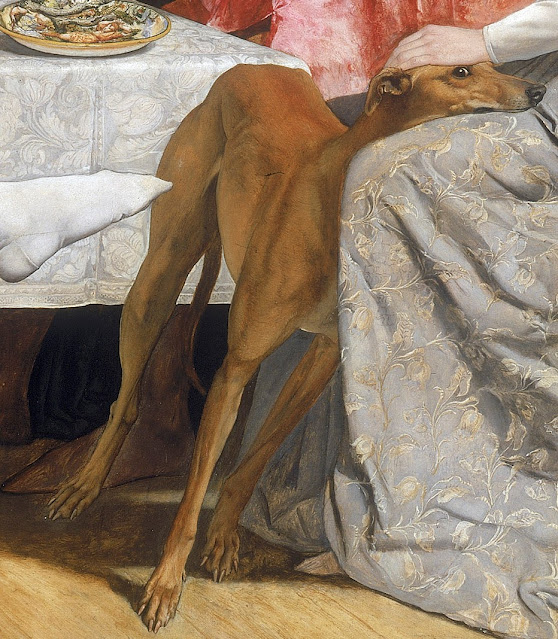
The dogs have always been the aspect of this picture that I love the most. There are two and one often gets over looked but in a painting that drips in tension, I find the peril of both to be compelling and far more expressive of the danger the lovers are in than the humans. Let's start with the one being kicked...

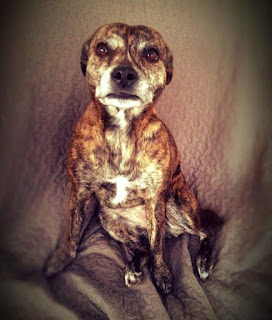
The expression on the dog's face shows that she is taking things far more seriously than anyone else. Is she looking at us? She's leaning so hard against Isabella's skirt, away from the kicking foot, that she is almost falling over. She's got what is known as 'wall eye' which actually not the correct term as 'wall eye' refers to a disease that affects the eye, but people used it when I was growing up to refer to when you can see the whites of an animal's eyes, indicating that they are afraid to turn their heads but can't not look at something that frightens them. Blossom has seizures and when she is in the midst and can't turn her head she swivels her eyes round like that, it's very odd to see as normally you don't see much white, if any...

Dog face!
Anyway, back to the dog being kicked, and I find the smoothness of her coat absolutely echoes the smooth white leg kicking at her. The brother who is being Freudian with the nutcrackers is like a snarling dog, yet neither of the dogs in the picture are vicious, in fact quite the opposite.  The dogs seem to represent our lovers, docile and unwary, unprotected against the violence coming their way. The chair dog especially puts me on edge...

I can't cope with how this dog is about to get a chair stamped on him and he doesn't know yet. Somehow the cracking of the nuts and the imminent cracking of the dogs legs are audibly linked in my mind when I look at that.  It's such a visual tension that's unbearable. The claw-feet are so menacing against his little greyhound legs which look so spindle-y. He's all tucked up and asleep, it's horrifying.

 Looking at the preparatory sketches, this particularly striking element was never in Millais' plan...

The chair dog is barely in this version, just roughly sketched behind the kicking brother.  The main action is the brother kicking the leaning dog, this time in boots.  His apparent lack of footwear in the oil painting does disturb me, but then it doesn't look like anyone is wearing shoes in the oil.  I find that very strange.  In the drawing you can see that the brother is absolutely fixated on tormenting the dog, not really paying attention to Isabella or Lorenzo.  In the oil, his face is so screwed up and dark, it's hard to see exactly what he is looking at, but it is assumed his nut-cracking fury is aimed at his sister. 


In this drawing, the chair dog is present but the chair is not leaning and so the sleeping hound (who is a bit of a chonker, as my daughter would say) is not threatened in any way.  Again, it's all about the brother and the leaning dog. Is it meant to express that the brother is taking out his anger with his sister on her dog? In the finished oil painting, there is no doubt that the coiled-spring brother is aiming his anger at his sister, the dog is just collateral damage, getting in the way.  In the drawings, it really does seem to be about the brother and the dog. I suppose it is meant to express his cruelty which will lead to him killing Lorenzo, but it's all a bit odd. Takes all sorts I guess...

Catch you tomorrow for the shortest day...

Sunday, 19 December 2021

Sunday 19th December - The Order of Release, 1746

 Sunday is meant to be the day of rest but I have a fridge to clean out and Lily wants to try out her new roller skates, so no rest for the wicked.  On with today's image...

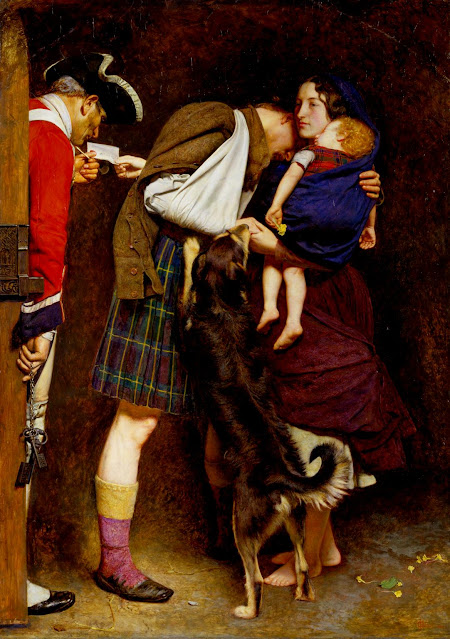
The Order of Release, 1746 (1853) John Everett Millais

That is a very beautiful dog.  I mean, the rest of the painting isn't too shabby either, but that is a glorious dog. Sure, those are some exquisitely executed baby feet, but that dog has fur you could sink your fingers into.


He is a silky chap with a sprightly tail. He obviously is there to represent loyalty and faithfulness and all that malarkey, but also as it is a collie, to represent the man's former life - a shepherd, a farmer, a husband and father - before he took off soldiering and getting himself locked up.  It is a balance between ideals and realities, of what you should risk for bigger pictures and what is sacrificed.  Interestingly, in this essay the tartans worn by the husband and the baby are identified as Gordon and Drummond, which raises some questions about the emotions and actions.  The husband wears the Gordon tartan, but for the Jacobite uprising in 1745, Clan Gordon  were split with Cosmo Gordon, the 3rd Duke, supporting the English, whereas his brother Lord Lewis Gordon raised two Jacobite regiments against them. Clan Drummond, whose tartan the baby is wrapped in and is suggested to be the wife's clan, were fully Jacobite, slaughtered at Culloden and paid dearly for their rebellion. The husband's clan was split, showing the conflict of interest, but he fought, risking his and his family's future.  The wife's clan had no such conflict and were punished, but she is at the prison, reassembling her family in the face of a battle, picking up peaces and keeping going.

When I look at the painting, the wife's face is the only one I see in total and she is not only the focal point of the image but also the one doing all the work.  She is carrying a baby, handing over a get-out-of-jail-free card and grabbing her husband.   The dog, the baby and the wife all have no shoes, the men on the have shoes. I wonder if it is suggesting that whatever big picture conflict is being fought, life goes on for women as it has to - children need feeding, farms need running, husbands need getting out of jail, or else what is all the fighting for and what will he be coming home to?


You know I am a sucker for the meaning of flowers and falling form the baby's hand are primroses, suggesting it is Spring, and the husband is a prisoner from the April battle at Culloden. Primroses symbolise youth and love, which explains why the baby has them in his little hand, but also 'I can't live without you', the youthful impetuousness of love.  However, an awful lot of those flowers are on the floor.  Possibly, with those flowers behind her, that youthful idealism is behind the woman now, but she still is devoted and loyal to her husband, whom she is fetching. Love is greater than flowers, love is bare-foot prison breaks.

A few of the commentaries suggest that as Millais replaced a monetary ransom for the simple note in the picture, that the wife had paid her husband's way out of prison some other way, if you know what I mean. To me, that reflects the fact that people don't like the fact that the woman is sorting it out on her own.  I don't know what she has done in order to get that bit of paper, possibly just shown up with a screaming baby (it's how we got an estate agent to give us the keys to our new house in double quick time.  Lily has an impressive lung capacity), either way, that's not the point of the picture. The point for me is that life can be brutal and rubbish at time and the best you can do is keep going. If you are my loved ones, I will always come and get you from prison and Blossom is on hand to help get you out.


See? Who could resist that?

See you tomorrow.

Friday, 21 December 2018

Friday 21st December: Edith Ramage

Almost at the end of Blogvent now and for the shortest day I thought I'd bring you one of the littlest models, who will be very familiar to you...

Cherry Ripe (1879) John Everett Millais
I have quite a bit of history with this painting as it was given to me as a jigsaw one Christmas in the 1970s (hence my very nylon nightie and that wallpaper).

Yes, that's me.  The 70s shame.
It was a very dark and difficult puzzle (which I still don't have the patience to finish completely) and didn't exactly enamour me to Mr Millais.  I mean, it just so revoltingly cute.  Then, at the Millais exhibition at the Tate a decade ago, I saw it in the flesh and it was brilliant.  I was horrified to find that the most chocolate-boxy, kitsch piece of Victorian whimsy was actually breathtaking in the flesh.  So who is the cute little moppet in the mop cap?

Well, actually that is a bit of a double question.  Let's start with the easy bit - the girl in the picture above is Edith Ellen Murray Ramage, aged around four and a half years old. Her great uncle (on her mother's side) was Willam Luson Thomas, artist and editor of The Graphic.  At the fancy dress ball given by The Graphic in 1879, Little Edith, or 'Edie' as she was known, arrived dressed as Penelope Boothby and was the hit of the party.  Her great uncle, being either enormously fond of his little great-niece or a man of indisputable business acumen, asked John Everett Millais to immortalise the little poppet in her finery for ever more. Or rather The Graphic asked, with an eye to reproducing the image as an engraving in their Christmas edition, which they did and sold somewhere between 4000,000 to 600,000 issues, according to Millais' son.  He claims that, had all the orders for copies, been fulfilled, it would have shifted a million.

Penelope Boothby (1788) Joshua Reynolds
A note about Penelope Boothby - she was the daughter of Sir Brooke Boothby (1744-1824), immortalised in Joshua Reynolds' portrait, aged 4 years old, the same as Edie. If you have ever studied eighteenth century culture, you will be family with the Boothby family as being the subject of this heart-rending piece of poetry - 'The unfortunate parents ventured their all on this frail Bark. And the wreck was total.' This is from Penelope's tomb, as poor little Miss Boothby died at only 5 years old.  At a time when we were on the threshold of rejecting the notion that infant mortality was inescapable (for certain classes at least), the loss of their one, beloved child, ruined the Boothbys.

Xie Kitchin as Penelope Boothby (1875-6) Lewis Carroll
Okay, let me just get this off my chest.  What sort of parent dresses their daughter up as a girl whose unfortunate claim to fame is that she died early and emotionally desolated her parents?!  For crying out loud, I wouldn't even let Lily dress as Hedwig when we visited the Warner Bros Harry Potter tour (sorry if you haven't read the last book).  It's creepy.  Mind you, look at Xie Kitchin (who does not known how to wear a mop cap properly) who was rocking the Boothby look earlier in the decade.  Awful and weird.

A Momentary Vision that once befell Young Millais (1916) Max Beerbohm
The fact that The Graphic requested that Millais paint little Edie in her party outfit lets him off the hook on copying a Reynolds picture, although you have to wonder what young, idealistic Millais would have made of older, richer Millais and his habit of accidentally worshipping Joshua Reynolds.  Anyway, the Millais painting differed from the original by the inclusion of some cherries of the left, and the reference to the 16th century poem (which became an eighteenth century song).  The conceit is that Edie is selling cherries, although that raises some interest questions about employment practices. Anyway, the print was a sensation, so what happened to little Edie then?

In the 1881 census, Edie and her parents were living in Richmond and she had managed to survive her fifth birthday.  Her father, David, was a builder and her sisters seem to have been taught at home with a governess.  In a rather ghastly echo of the painting, Edie's sister Sheila, just 3 years younger than Edie, died in 1887.  Had it been poor Edie who perished I can imagine all sorts of articles on the curse of Penelope Boothby...

In 1896, Edie married Francisco de Paula Ossorio, a gentleman of Spain and retired to a life of respectable married life with her daughter joining the family in the winter of 1896.  Around 1900, the painting was acquired by a South Africa gold multi-millionaire art collector, Sir Joseph Robinson, who only let his close friends view his collection.  In 1910, Robinson's works went into storage and the painting slipped form the public consciousness.  That was until 1958, when the Royal Academy held a massive Millais exhibition and the painting was brought back into the light when the public asked who the little girl was...

Edith Ossorio (1858) Muriel Wheeler
The Sphere magazine (which had subsumed The Graphic) continued the story in November 1959.  Signora de Paula Ossorio had been located and invited to view her small, poppet-y self at the Millais exhibition.  She met the wife of the President of the Royal Academy, Lady Muriel Wheeler who then painted her portrait, eighty years after her first portrait, both of which hung at the Royal Academy within a year of each other.

Edith died in 1970, at the grand old age of 96.  By that time she was a widow living in Devon, and she was buried at Budleigh Salterton in November of that year.  Within a few years I received the jigsaw portrait of her, which I grant you is not a massive coincidence but tickled me.

See you tomorrow.

Wednesday, 19 December 2018

Wednesday 19th December: Alice Russell Scott

Whilst looking at the account in John Guille Millais' biography of his father of John Everett Millais painting Esther yesterday, I kept reading.  I was intrigued by the following report of Anne Thackeray's reaction to Millais' painting The Romans Leaving Britain - 'I thought of you one day last week when we took a walk with Tennyson and came to some cliffs, a sweep of sand, and the sea; and I almost expected to see poor Boadicea up on the cliff, with her passionate eyes.'  
She was talking about this...

The Romans Leaving Britain (1865) John Everett Millais

This painting was a bit of a sensation when it was exhibited.  The Christian Spectator has one of my favourite contemporary reviews because it is just so gossipy: 'There, take your time over it. Is that not a glorious woman? "Too much akin to the creature whose skin she wears?" Not a bit of it. She certainly has not had the advantage of being trained at an Establishment for Young Ladies, nor would she make a model District Visitor, nor can I fancy her filled with gushing admiration for a nice young curate; but it is refreshing to get away from the be-crinolined namby-pambyism that so many of Eve's daughters have degenerated into ... and breathe the fresh air of this Dorsetshire coast as one might have seen it a thousand years before young ladyism was invented.' My goodness me Christian Spectator, you write an interesting review.  No-one was ever in any doubt who the young lady embracing her Roman beau was.  Back to my friends at the 1865 Christian Spectator - 'It is said that a daughter of Mr Scott Russell sat to the painter: do you notice that empty oyster shell in the corner? It is a trifle but suggestive.'

Hang on there, what is meant by that?  Are we suggesting that the oyster shell is suggestive of something arousing that has been discarded, used up?  Why has the reviewer conflated this point with the identity of the sitter?  Who is besmirching the good name of Mr Scott Russell's daughter and why?

John Scott Russell
John Scott Russell (1808-1882) was a graduate of Glasgow University and had worked on naval engineering and architecture in Edinburgh before moving down to a massive house in London.  Once in London, he became the secretary of the Royal Society of Arts and joint-secretary for the Great Exhibition.  He is most famous for his work with Isumbard Kingdom Brunel on The Great Eastern.  He had married rather well, to Harrietta, the daughter of Sir Daniel Osborne, the 12th baronet of Tipperary.  The couple had one son, Norman, and three rather splendid daughters.  The eldest daughter, Louise (1841-78) was nicknamed 'Lady', their second daughter, Mary Rachel (1846-1882) was nicknamed 'Chenny' and their youngest, Alice (1847-1936, well done for getting into the twentieth century) was nicknamed 'Dickie'.  I am indebted to Michael Ainger in his dual biography of Gilbert and Sullivan for details on the sisters, and I am also grateful to Arthur Sullivan for having such naughty relations with at least one of the sisters.  Naughty Sir Arthur.  

Now, the problem I have is that neither Christian Spectator nor John Guille Millais go as far to tell me which of the Scott Russell girls is holding the handsome gent from the continent to her bosom.  So let's do a bit of digging.  One of the most fun bits of researching is ending up reading books I normally wouldn't have read in order to find out vital details.  This morning I was avidly reading George S Emmerson's 1977 biography of John Scott Russell,which isn't my normal fare but should be as it is splendid.  Likewise, despite performing in a goodly amount of G&S operettas (I particularly liked The Mikado) I hadn't read a biography of Arthur Sullivan (although I have watched 'Topsy Turvy' more times than is decent).  I now quite fancy reading the love letters between Sullivan and Rachel Scott Russell (ordered from Amazon this morning for Christmas reading).  Going back to naughty Sir Arthur, his rather reckless affair with Rachel as a pennyless aspiring composer, could be what the empty oyster shell is about, but this would be a rather nasty and judgmental thing for Millais to do, and also it presumes that Millais knew of the affair in the first place.

Actually, I have Sullivan to thank for the identity of the British woman on the cliff - in Arthur Darling, George S Emmerson's 1980 book about the Russell Scott-Sullivan romance, it is stated it was actually Alice who posed for the woman.  So who was Alice Scott Russell?


Alice was the baby of the Scott Russell family.  Born in 1847, she would have been in her late teens when she posed for the maiden on the cliffs (in Truro, rather than the often quoted Dorset or Kent in reviews).  Looking at the strong and handsome figure, it's either the skill of the artist or the young lady's astonishing beauty that brings us such a strong, serious figure of a woman.  Actually, the 1873 Athenaeum gave their own opinion on the subject thus: 'This lady who sat for the figure of the "Britoness" was, a few years ago, well known and much admired in London Society; but Mr Millais has of course exaggerated not heightened the charms of the lady, and it is hard to avoid seeing that the result is hardly a happy one.' I think the inference is that Alice had become some glorious super-savage and the reviewer had trouble with the fact that it was obviously still recognisable as Alice, but now she looked 'exaggerated'.  As it was, the reviewer was all praise for the intensity in the stare of the woman, the strength in her figure, from her brow to her feet.

In real life, Alice was not quite as dramatic as the part she played, although I still have an eye on naughty Sir Arthur (if you have seen 'Topsy Turvy' you'll understand).  Alice, as you will have seen by the dates of the sisters, was the longest lived of the girls.  At the same time as one or both of her sisters were secretly seeing Sir Arthur, she was engaged to fellow composer Frederic Clay, but that was not to last and he broke off the engagement.  She was married in 1869 at St Bartholew's church, Sydenham, to Francois Arthur Rausch. Rausch was a fellow of Trinity College, Dublin and from Rauschenberg in Switzerland.  Luckily, as we have seen from other women in Blogvent, she married before her father's money troubles (and arrest for assault) in the 1870s.  Alice and Francois had three children, Ida (1870-?), Armond (1876-1953) and Hugo (1879-1942) and it might be that the family returned to the land that bore the family name, Rauschenberg.  She died in 1936.

See you tomorrow.

Tuesday, 18 December 2018

Tuesday 18th December: Susan Muir-Mackenzie

It's a lovely feeling when you discover the model of one of your favourite paintings by one artist also modelled for another of your favourite artists.  That is a bit of a convoluted way of talking about the subject of today's post, Susan Anne Eliza Muir-Mackenzie...

Esther (1865) John Everett Millais
This painting took my breath away when I saw it at the Tate's exhibition about a decade or so ago and I've had her blu-tacked to my work cupboard ever since.  She is a decent size, just over a metre tall,  and that cloak is madly beautiful.  When I started to think who to talk about this month, I wanted to cover some of the women who appear in those huge Millais canvases, and so was delighted to see a name in the exhibition catalogue.  I'll talk about the painting first, then about the fascinating lady.

The painting of the Old Testament queen, a heroic woman who saved her people from genocide, is a feast of deep glorious colours and textures.  The queen is presented in a flowing golden robe with dense smears of colour, holding her crown while removing pearls from her long, loose hair.  The model was Susan Muir-Mackenzie, daughter of Sir John William Pitt Muir-Mackenzie (1806-1855), a baronet from Perthshire.  The Muir-Mackenzie family moved to London in 1855, possibly due to the death of Sir John.  The painting happened a decade later when Susan and her mother were living at 68 Cadogan Place, Chelsea.  The invaluable John Guille Millais, in his biography of his father recorded the painting's creation, which involved the yellow 'jacket' awarded to General Gordon, after his secondment to the Chinese army.  The jacket can also be seen in Val Prinsep's portrait of the General which hangs in the Royal Engineers' mess-hall at Chatham. I always wondered why the silk embroidery was seemingly just impressionistic smears of colour, which seemed at odds with the precise depiction of her face.  The answer is, of course, Millais turned the garment inside out 'so as to have broader masses of colour', as Millais Junior reports - 'Millais was painting Miss Mackenzie's head when the Yellow Jacket was brought in, and, as he draped it on her, he said: "There! That is my idea of Queen Esther; you must let me paint you like that."'

Symphony in White, No 1 (1861-2) James Abbott McNeill Whistler
I was interested to read in the 2008 catalogue of the Millais exhibition at the Tate that Millais might have been influenced by Whistler's images of single female figures in aesthetic surroundings.  Certainly the painterly effect of the silks inside the gown worn by Queen Esther struck me as having more in common with Whistler's handling of paint than the precision of Pre-Raphaelitism.  The loose, flowing auburn hair also echoes Jo Hiffernan in Whistler's work, but the saturation of colour in Millais' painting is at odds with the white space created by Whistler's modern vision.  What always appeals to me when I look at Millais' queen is that she not only looks attractive, a queen who will save her people through her beauty, but she also looks rather capable, and that is a markedly strong arm holding the crown, which seems to have more in common with Judith's dealings with Holofernes.  So who was Miss Susan Mackenzie?

Susan Anne Eliza Muir-Mackenzie seems to have been a fascinating young woman. She was a great friend of Gertrude Jekyll, which is handy because as an unmarried woman, her achievements and talents might have gone unrecorded.  Mercifully, as Sally Festing says in her 1991 biography of Jekyll, we know that Susan was a fellow art student and toured Italy with Jekyll in 1868.  We have one of Susan's paintings in a national collection.

Montague Johnstone Muir Mackenzie (1893-1903) Susan Anne Muir Mackenzie
The subject of her painting was her younger brother Montague (1847-1919), a barrister and legal writer, who shared his sister's love of music.  Susan sang and played the piano and so it is interesting that she chose to portray her brother playing a cello rather than with some sort of law symbolism.  Susan's family were an interesting lot on the whole.  I am particularly tickled by her sister Georgina who went off round Europe with her friend, planning to travel by hitch-hiking on hay carts, before being arrested for being a spy.  Splendid.  Susan's interest in art extended to her not only posing for one queen, but two...

Boadicea (1865) Julia Margaret Cameron

In November 1865, at the French Gallery in Pall Mall, Julia Margaret Cameron exhibited a photograph of Susan Muir-Mackenzie, which presumably is this one, as held by the National Portrait Gallery.  Taking the Millais portrait as a comparative image for the same date, there are  few others images from 1865 (or 1864-66, as the Complete Catalogue published by Getty have them) which might be Susan...

Unknown Woman as Diana (c.1864-6) Julia Margaret Cameron
I wonder if this too is Susan, and my eyes are again drawn to the sturdy arms of the goddess Diana.  Those strong arms were criticised by G F Watts to whom she sent the only copy, who disliked that she had 'put young limbs into such positions as call forth muscular development.' (as repeated on the V&A collection, where the only print of this image is held).  Apparently Watts did not like his women to look like they could take him in an arm-wrestle, but I rather like that.

Susan's love of art was also demonstrated by her home called High Barn Farm or Warren Farm, but renamed 'the Hermitage', a refuge for artists who found themselves short of cash.  In the design and building of the home and its garden she called in her friend Gertrude Jekyll again, and possibly Edwin Lutyens.  There is also another home in Effingham in Lutyen's Close, called the Red House, which was apparently built by Lutyens for Susan.  It is gorgeous.

What a gorgeous house!
The Hermitage also became somewhere her family could stay when they found themselves in the country, as her brother John, an Indian civil servant, did and his daughter was born there in 1894.  As an unmarried woman, Susan actually seems to have enjoyed greater freedoms that would have been denied her as a wife, and her acts of charity are recorded to her, no disguised by her husband's name.  In the Hermitage she kept a small household of a cook, two maids and 'an outdoor man' (as recorded in an advert in 1902) and she gave her money to other charities beyond the one she ran, as recorded in the Morning Port of April 1898: 'On behalf of the Homeless Poor on the Thames Embankment we have received 10s from Miss Mackenzie, The Hermitage, Effingham, Surrey.'

When Susan died on 22 August 1908, she left her sizable, £12,000 fortune to her brother Montague and her nephew Kenneth, who had also trained as a barrister.  She is buried at St Nicolas Church, Great Bookham, close to her home in Effingham. She is definitely a woman I'd want to know more about and hopefully her time in the limelight will come.

See you tomorrow.

Monday, 17 December 2018

Monday 17th December: The Armstrong Sisters

We are week away from Christmas Eve and today's post is as much about a painting as it is about the models.  Plus, because I am in the Christmas-y mood, I bring you three models for the price of one.  First though, I ought to tell you a bit of background...

The Ladies Waldegrave (1780) Joshua Reynolds
I did a year of eighteenth century art and literature during my degree and so had quite a bit to do with Joshua Reynolds and his fancy portraits of ladies.  In The Ladies Waldegrave you can see the three daughters of the 2nd Earl Waldegrave working together on a piece of embroidery, showing off their lady skills and pretty faces, just in case you fancied marrying one of them.  It's all very lovely, but we don't like any of that do we?  We're Pre-Raphaelite people and we dismiss Sir Sloshua and all he stands for!

William Holman Hunt's cartoon of John Everett Millais dismissing Sir Joshua Reynolds
Well, we despise Sir Sloshua only as long as it take to end the Pre-Raphaelite Brotherhood, then all bets are off.  The one thing that I never got my head round was how much Millais seems to attempt to equal Reynolds in his later career, in his Penelope Boothby homage Cherry Ripe (which I'll talk about another day).  When someone dared to suggest that he would never paint anything as good as The Ladies Waldegrave, Millais begged to differ....

Hearts Are Trumps (1872) John Everett Millais
Walter Armstrong, who had risen from a draper to become a merchant, saw Millais' triple portrait of the artist's daughters, Sisters in 1868 and wished to have such a portrait of his three daughters Elizabeth, Diana and Mary.  Whether or not Armstrong was aware of the Reynold painting is uncertain, but Millais and his family were frequent visitors to Strawberry Hill, home of the Countess Waldegrave, so had ample opportunity to see the picture.  The three Armstrong sisters were all approaching 20, the eminently marriage age for young ladies, and so rather than a painting of three little girls, this is a painting of three women who would (hopefully) make rather good marriages.

Three Ladies Adorning a Term of Hymen (1773) Joshua Reynolds
Reading more about the three daughters of Walter Armstrong, I was also reminded of another Reynolds portrait of three sisters.  Three Ladies Adorning a Term of Hymen shows the Montgomery sisters celebrating how marriageable they are by hanging flowers around the god of marriage.  The sister on the far right, who has gone past the statue has achieved marriage (hurrah for her!) and the other two are on the starting blocks.  I wondered if there was something like that going on with Hearts are Trumps.

Walter and Mary Armstrong's daughters Mary, Diana and Elizabeth are shown in highly fashionable, bustle dress, seated in a conservatory, playing dummy whist.  Looking up at the Reynold's original, the Armstrong girls are in equally elaborate dresses but far simpler hair than their Waldegrave equivalents and rather than doing needlecraft, the girls are playing cards.  This apparently caused a little friction between Walter and Millais, as Walter allegedly disliked the idea of his girls doing something so vulgar.  In the newspapers, a story was circulated about this: 'a story good enough to be quite true is going the rounds with reference to [Millais'] 'Hearts are Trumps' in the Academy. I may promise I do not believe either egg or shell of the anecdote, but here it is:- Mr Armstrong was dissatisfied with the portraits, and chiefly with their 'motive'. It was indiscreet of Mr Millais to paint his daughters in the act of playing cards. "Well," the artist is reported to have replied, "you need not have the picture unless you like. If you don't have it though, I shall clap an extra thousand on the price, and call the work 'Wanted: a partner'"(from the Forres Elgin and Nairn Gazzette, 21 July 1872).

In this rather dubious anecdote, it is made clear that the painting is about the girls' marriage status, and also it seems that only one partner is required.  Putting this together, and considering the Montgomery sisters and the symbolism of the statue, it becomes clear that one of the Armstrong sisters was not like the others.  The portrait was painted in 1872 and it is clear that Mary Beatrice, far right, has a very advantageous hand.  She was engaged to Rowland Ponsonby Blennerhasset (brilliant name) and married in September 1876 and she had ever right to be confident in her hand.  Her Irish Hole Rule, Queen's Counsel husband did very nicely for the family.  By the time of her death in 1928, the widowed Mary left her son over £19,000.  

Next to her, also behind the Chinese screen, is seated Diana, middle daughter of Walter Armstrong.  Her attitude to her cards is very interesting as she looks to her sister rather than the game.  She too was probably engaged by this point as she married a few months before her sister in April 1876.  She married John Herbert Secker, a barrister, who at his death in 1903 left his wife and children £51,000. Good lord! 

'Hearts Are Trumps' (1866) for a stereoscope and allegedly inspirational to Millais.  Allegedly.
The sister not sat in the darkened space of the screen, Elizabeth, had to wait until 1883 in order to find her 'partner'.  It is suggested therefore that the dummy hand facing the viewer is for a partner to come and join her.  She married Charles James Tennant Dunlop, but the marriage was not to be a long one as he died in 1899, leaving her £4,000. By the standards of the women listed in this Blogvent, the sisters did very well, had long lives and many children.  Splendid.

Nineteenth century piggies playing cards. And why not?

Turning back to painting, it had a somewhat more varied life.  Walter Armstrong, whether he liked the painting of his wildly gambling daughters or not, purchased the piece, but in the same year as he married off two of his three girls, a fraud on the London and Westminster Bank bankrupted him.  His art collection sale was reported in the Art Journal of 1876: 'Among the pictures belong to [Armstrong], the only one worthy of special record was Mr Millais's 'Hearts are Trumps', the large painting of four (sic) ladies, daughters, it is generally understood, of Mr Armstrong, playing at cards; it was exhibited at the Academy in 1872 and bought now by Mr Agnew for 1,300 guineas.'  The picture however was saved for the family by Diana's husband, John Secker within 2 years.  The painting was frequently lent to exhibitions it seems, if newspaper reports are to be believed, and at a 1898 private view of a Millais memorial exhibition, it was noted in the Pall Mall Gazette that Diana Secker was one of the viewers in the gallery, as well as being on the wall.  The painting passed down to her son Walter, then to the Tate in 1945 for the lesser sum of £1050.

See you tomorrow...


Wednesday, 12 December 2018

Wednesday 12th December - Beatrice Buckstone

Here we are, half way through Blogvent already!  Today's is a bit harrowing, so feel free to have a stiff drink handy.  It concerns cute little uber-poppet, Beatrice Buckstone...

Sweetest Eyes Were Ever Seen (1881) John Everett Millais
Alluding to Elizabeth Barrett Browning's poem 'Catarina to Camoens' (but not Elton John's 'Your Song'), Millais' painting is of child actress Beatrice Buckstone, who was discovered by the artist's daughters one night at the theatre.  As (mis)remembered by John Guille Millais in his epic biography of his father, the relationship ran thus: 'About this time, to the great delight of Millais, a new and most charming model was discovered in the person of Miss Beatrice Buckstone, grand-daughter of the famous comedian J. B. Buckstone, and with the consent of her parents (for she was then but a child of 12 or 13) she sat for the three pictures, "Cinderella", "Caller Herrin" and "Sweetest Eyes Were Ever Seen".  It was at St James' Theatre in the winter of 1880-81, that this happy discovery was made.'

John Baldwin Buckstone (1850s) Charles Watkins
I am indeed grateful to Millais junior for the above account as it gave me lots to go on in finding Miss Buckstone.  Actually J. B. Buckstone was her father, although you'd be forgiven as Mr Buckstone had been married twice and Beatrice was one of the many children of his second marriage.  Mr Buckstone was born in 1802 and went on the stage at 18, performing at the Surrey Theatre in 1823 and writing his first play in 1826.  All in all he wrote more than 150 comedies and farces and managed the Haymarket Theatre from 1853 to 1876.  He was married first to Anne Honeyman, but after her death in 1844, he married again, to Bella Copeland.

Isabella Buckstone (nee Copeland) (1850s)
In one of  J. B. Buckstone's obituaries it is stated that he married Fanny Copeland, Isabella's cousin, but although it might have been that they were engaged after Fanny's first husband, actor Edward Fitzwilliam died in 1852, Fanny herself died in 1854, putting pay to all that.  Instead, 55 year old Buckstone married the 18 year old Isabella in 1857 and went on to have 12 children between 1857 and 1876.  At least three of these children followed their father into the theatre, including John Copeland Buckstone, Lucy Isabella Buckstone, and Beatrice, born in 1869.

Caller Herrin' (1881) John Everett Millais
This painting, inspired by the Scottish song about fresh herring (as seen in the creel, or basket).  To continue Millais junior's account of Beatrice, after his father had seen Beatrice acting in Good Fortune, her debut on the stage, he wrote to her mother for permission for Beatrice to pose for him: 'This being granted, little Beatrice presently appeared in the studio, when we all agreed that never in our lives had we seen a more lovely child. Her face was simply perfect, both in form and colour, and nothing could be more charming than the contrast between her bright golden hair and those blue-grey Irish eyes that peeped at you from under the shade of the longest black lashes that ever adorned the human face.'  Although this is all very florid, you get the impression that Beatrice was a beautiful young lady and even at 12 years old, she was making an impression on stage and off.  I wondered if her debut onto the stage was partly due to the family's fall in fortunes.  In old age J.B. Buckstone had lost his ability to act and write and in 1878 he was declared bankrupt with substantial debts.  A subscription was raised to help the family.  It was reported in the newspapers that as Buckstone had done so much to amuse the public, the least they could do was to help him in his time of need.  The money was no doubt gratefully received by the family, but in October of the next year, Buckstone died.

Cinderella (1881) John Everett Millais
In the Era newspaper of 1881, it was reported that the little actress of Good Fortune was being painted by Millais and that Lord Leighton had requested her to model next, although I'm not sure if she did or not.  After all of Millais junior's raving at how beautiful Miss Buckstone was I tried to find an actress card for her.  I failed but found this instead...

Cinderella (1881) Rupert Potter
When I saw this as a thumbnail I thought it was just a black-and-white reversed photo of the painting but in fact it was a photo recreation of the painting by Beatrix Potter's father.  Here we can see what a lovely young lady Beatrice was, even more so than the paintings.  Her face seems so modern and it is such a striking photograph, I was stunned.  However, Beatrice does not seemed to have made such a splash on stage as her father or acting siblings.  After the bankruptcy and death of her husband, Mrs Buckstone went into lodgings in Croyden.  The house was owned by Frederick Lawrence and Isabella Buckstone remained there, acting as housekeeper, for the rest of her life.  Census returns show her children coming to stay with her so Mr Lawrence can't have minded his housekeeper's family dropping in and out, and possibly, as Isabella stayed so long, it became more like the family home than her employer's residence.  Beatrice was still there in 1891, but also staying was Walter Pelham Warren, an artist of the scenic variety. Walter's father had also been involved with the theatre as a playwright so possibly the families knew each other.  Beatrice and Walter were married on 20th August 1891 at St John the Evangelist Church, Upper Norwood. However, the marriage was not a happy one.

Sketch for Sweetest Eyes Were Ever Seen (1881) John Everett Millais
I always feel conflicted when I have to read divorce papers as research because they hold vast amounts of useful and interesting information, but are invariably awful, more so if the woman files them because of the weight of evidence she has to provide.  Within two years of their marriage, Walter was unfaithful to Beatrice and gave her gonorrhea.  In the divorce documents, Beatrice reports years of verbal and physical abuse, culminating in an attempt to strangle her and throwing her, face first, into a door.  He threw her out of the marital home and refused to let her back in leaving her homeless.  In 1901 Beatrice was back staying with her mother in Croyden.  By 1904, Beatrice alleged Walter was living with his mistress at 525 Holloway Road in London and in 1908 finally filed for divorce.  Walter denied all charges.  Beatrice was granted her divorce and by the look of the papers, her costs were paid.

Beatrice lived to a decent age, dying aged 86 in the Charnwood Nursing Home in Worthing, but rather like the remark in the newspaper about her father's financial hardship, I rather hoped that someone who gave me such pleasure looking at her image would have a happy life, or at least wouldn't be married to someone who was so appalling.  Mind you, that is the peril of both life and research, you never know what will happen and not all of it will be good.  All you can do is deal with what arises and learn that even the sweetest eyes that were ever seen could have a rough time of it.

See you tomorrow.