Showing posts with label Fanny Cornforth. Show all posts

Saturday, 20 September 2025

Following Fanny's Footsteps

 Bonjour!  I am in Paris, which is awfully fancy and filled with delicious things to see and eat. Other than trying to see how many moelleux au chocolat I can pack back, I am also in hot pursuit of Fanny Cornforth.  I grant you I am 161 years late, but still Fanny Cornforth's adventures in Paris are something I think we should all be talking about.

Venus Verticordia (c.1863) Dante Gabriel Rossetti

The year is 1864, two years after the death of Dante Gabriel Rossetti's wife, Elizabeth and two years since Fanny Cornforth became Rossetti's exclusive lady friend, with a house just round the corner from Cheyne Walk.  Yes, she was still married to Tim Hughes, but for the most part, she was Rossetti's world, his model, muse and lover.  She was the face of his art, appearing in numerous domestic sketches as well as Fazio's Mistress, Woman Combing Her Hair, the precursor for Lady Lilith and Venus Verticordia, not to mention The Blue Bower. Therefore, when Rossetti travelled to Paris on 28th October 1864, he took Fanny with him.

I talk about this in Stunner but it really isn't discussed anywhere else, and no surprise really as Rossetti only talked about it in a letter to George Price Boyce, about how he and Fanny had just returned from Paris. In no other correspondence from the actual trip does he mention Fanny's presence, but then he was writing to his family and so that is unsurprising because (a) it's Fanny and (b) the last time he went was his honeymoon, which would have all seemed a bit distasteful.  Honestly, that detail does make me cringe a little - let's go on holiday to the same place as you honeymooned with your recently deceased wife! Such larks! Anyway, let's start with the Grand Hotel...


When Fanny and Rossetti arrived in Paris, they first stayed at the Grand Hotel on the Rue Scribe, at right angles to the Opera House.  The Opera House, or Palais Garnier (because you are worth it) was under construction from 1861 to 1875, so some of it would have been apparent. When they arrived in 1864, the hotel was a mere two years old and was part of the reconstruction of Paris under Baron Haussman. With 800 rooms on four floors, it was vast and luxurious and caught the public imagination, with royalty staying there, Victor Hugo hosting parties and Emile Zola's character Nana dying of smallpox there. Smashing. I didn't catch smallpox, but I did visit the same square...


Say hello (or rather Bonjour) to the Intercontinental Paris Le Grand, a five star experience which will set you back rather more than we spent on our hotel.  According to The Diamond Guide for the Stranger in Paris (which is not as filthy as it sounds) from 1867, it had a majestic dining room, a reading room, coffee room, telegraph office and rooms that cost between 4 and 40 francs a night which translates as around what it starts at now (a couple of hundred pounds a night) so maybe it isn't a surprise that Rossetti and Fanny only stayed there a couple of nights, moving to the Hotel de Dunkerque et de Folkestone at 32 Rue Laffitte...


We walked around a kilometre beyond the Opera House, past the Galeries Lafayette and up the endless, uphill Rue La Fayette until you reach the crossroad with Rue Laffitte.  I took a picture looking up towards Notre Dame de Lorette (covered in scaffolding I think). Fanny and Rossetti stayed in number 32 which I am pretty much outside of but has long since been replaced by a modern building. Dunkerque and Folkestone was a much older hotel, listed in Bradshaw's Illustrated Travellers Handbook as being small and well-kept with 'every kind of attention paid to its visitors'.  English and German were spoken and the food was plain and good, which is not exactly what you'd hope to read but is reassuring.


The couple were in Paris for around a month before returning to London, and whilst there they visited the zoological gardens in the Jardin des Plantes, a 6km walk (or carriage ride). At the zoo, they tickled a wombat, who liked it (according to Rossetti). They also visited Louisa Desoye's shop at 220 Rue de Rivoli, which is the extremely busy and expensive row of shops outside the Louvre. Louisa Desoye was a leading importer of Japanese objects and was frequented by many artists at this time (see here for more information on the Desoyes).  Unfortunately for Rossetti, James Tissot had beaten him to it and bought all the costume, so no kimono for Fanny, sadly. Rossetti settled for some books and the piece of gossip that his rival collector Whistler, another of Desoye's customers, was terribly jealous of Rossetti's blue and white collection, which leads me to wonder if that was the spark for The Blue Bower...

The Blue Bower (1865) Dante Gabriel Rossetti

Also, while in Paris Rossetti visited with fellow artists and galleries, seeing works by the Impressionists which Rossetti did not care for at all calling them 'scrawls'. I think what I am left with by this visit is that Rossetti could take Fanny out and about in the city without anyone asking questions or feeling judgemental.  I have a few questions about why Rossetti would take Fanny to a city that he had taken his wife to only a couple of years earlier but I get the impression that it was a work trip of sorts for Rossetti. He loved the work of Delacroix (who had died the year before), and wanted to see his work on show in the capital. Henri Fantin-Latour had wanted to include Rossetti in his painting Homage to Delacroix...

Homage to Delacroix (1864) Henri Fantin-Latour

Just as a side note, Rossetti was meant to be in this picture but Whistler (in the middle, stood up) couldn't persuade him.  Likewise, Julia Margaret Cameron was desperate to take Rossetti's picture, but again he refused.  He hated G F Watts' portrait of him so much that he gave it to Fanny.  I wonder if he had sat for all the portraits he was asked to do, Rossetti might be taken more seriously today, but I also wonder if his refusal to have his likeness taken was a symptom of his declining mental state. I digress...

Fanny Cornforth (1868) Dante Gabriel Rossetti

Walking in Fanny's footsteps in Paris was an interesting experience, not least because it was her only experience of foreign travel, something unthinkable for her, a girl from rural poverty. Although the hotels promised English speaking staff, she would have been in the company of people who did not speak English, including her companion. How would she have felt? Would she have known if they were talking about her? The noise and bustle of Paris would not have been any different than that of London but, of course, it was totally unfamiliar. It was 1864 and Rossetti was beginning his long walk towards substance abuse, mental instability and eventually death, but were they, at that moment, happy? It would be quite the experience to find yourself in a foreign land with a man whose affections were uncertain, whose mental state was unreliable and would start his obsession with Jane Morris within the year, not to mention swapping Fanny's face for that of Alexa Wilding. I hope Fanny ate, drank and was thoroughly spoiled in Paris, enjoying the attention of other artists and the man she loved, Rossetti. 

Because, as the Palais Garnier says, she was definitely worth it.

Tuesday, 11 April 2023

Review: The Rossettis at Tate Britain

 It's been a bit of a month, hence the peace and quiet you have enjoyed from my rambling. However, a lot has gone on in the meantime, so I have to do a flurry of posts on three different exhibitions and a book!  I also turned 50, which is painful.  Let's move on because first up is possibly the most hotly anticipated exhibition of the year, The Rossettis!

The Rossettis!  At Tate Britain!

I was lucky enough to attend the private view for this exhibition on my birthday, which made the whole 50 thing a lot less wretched and meant I got to spend the evening in the company of some marvellous chums (both on canvas and in real life) with my partner in crime, Miss Holman...


So what is the exhibition about? Well, obviously it's about the Rossetti family, but most pertinently Dante Gabriel, Christina and Elizabeth (a Rossetti by marriage). Now, William Michael and Lucy (another Rossetti by marriage) also get a look-in, as do the other members of the Rossetti clan, but honestly, it's about Gabriel, Liz and Chrissy.  And Fanny.  I'll come to that in a bit...

How Sir Galahad, Sir Bors and Sir Percival... (1864) Dante Gabriel Rossetti

The Haunted Wood (1856) Elizabeth Siddal

Let's start at the beginning, and the beginning is actually poetry.  As you enter the first room of the exhibition, there are spots on the floor where you can stand and hear the Rossetti poetry being murmured to you (if you aren't at a rather rambunctious opening that is).  I think as a nation, we have rather forgotten how much we love poetry and value poets, which is odd as we love songs (which are just sing-y poems).  However, the fame that both the Rossetti siblings found as poets still has a punch, with Christina especially reminding us what a powerful poet she was and how influential and inspirational, not least to her brother.  In turn, we have her poem 'In an Artist's Studio' which speaks of the 'one face' that looks out of the canvases and it is hard not to apply that as a criticism to her brother's works. Into all this comes Elizabeth Siddal (whether you give her one 'l' or two is an entire conversation in itself).  Her career and progression is placed in the context of the Rossetti family and it is joyful to see her works on display in such a grouping as it makes sense of her contribution and why, even as late as the 1940s, she was considered such a prominent Pre-Raphaelite. I think we can now agree that Miss Siddal has found her place in the narrative and it is marvellous to see.  Almost as marvellous as this room...


Lawks, but I gasped! That astonishing wallpaper is the realisation of a design by Rossetti and it takes your breath away. However, the object I was most intent on stealing has to be that painted piece...


You know me, I've always been one for a sizeable cabinet, and this beauty is the work of Ford Madox Brown, Edward Burne-Jones, William Morris, Val Prinsep, John Seddon and Rossetti from 1861.  I was especially drawn to this panel, I wonder why...

Yes, Fanny.  I was so excited when I heard that Fanny was going to get a hearing in the great Rossetti story. As I have banged on about for the last thirty years, Fanny is a difficult one to slot into any dignified story without making everything messy but there is a marvellous amount of slotting (in an artistic sense) here, as Fanny explains a few things about Rossetti which aren't otherwise apparent.  That leads me to Found...

Found (1854-1882) Dante Gabriel Rossetti

Found (1870s) Rossetti and Henry Treffry Dunn

Just as a side note, you have no doubt seen the predicatably awful review from Jonathan Jones in the Guardian and it was his comments on Found and Fanny that made me snigger the hardest. He sneeringly points out that Rossetti was rubbish because he kept painting Found with Fanny looking 'sensual' (more tea, Vicar?) which completely undermines the meaning of the piece.  Yes, Love, that's the point or did you not notice that it was unfinished?  Dear me, it must be awful to have to feel superior to everything all the time. How exhausting, poor lamb.  Anyway, Fanny is really looking splendid in this section, with her face gracing Bocca Baciata, Fazio's Mistress and Fair Rosamund.  I won't rhapsodise too much but the fact that Fanny is included and makes the Rossetti narrative messy is a joy to me. In this context, Fanny represents growth and change, none of it easy, and she leads us through to the glorious room of colour, that heralds Rossetti's golden years of oils and pastels - now I know the pastel era isn't there for good reasons, what with his health declining and everything, but that man was good with chalk...

Ligeia Siren (1873) Dante Gabriel Rossetti

Blimey, Alexa! There are some gorgeous pieces in the long room of Rossetti's canvases and Alexa Wilding becomes the face of this period, although obviously Mrs Morris is present too...

Jane Morris (1868) Dante Gabriel Rossetti

There is a feeling of both simplicity and concern in the final few room, beautifully illustrated by the final room which has a wall projection of Ken Russell's Dante's Inferno.  The regular, beautiful works that represent the last 10-15 years of Rossetti's life mask the crisis he was undergoing, but seen together you notice the way he shows Jane, which is different to how he sees Alexa. Do I read too much in because of what we now know about his chloral addiction?  It's impossible not to but in his cascade of full-lipped beauties it is not hard to see him looking for someone, or being haunted by someone.  It is very moving indeed.

Monna Pomona (1864) Dante Gabriel Rossetti
(Miss Holman's favourite)

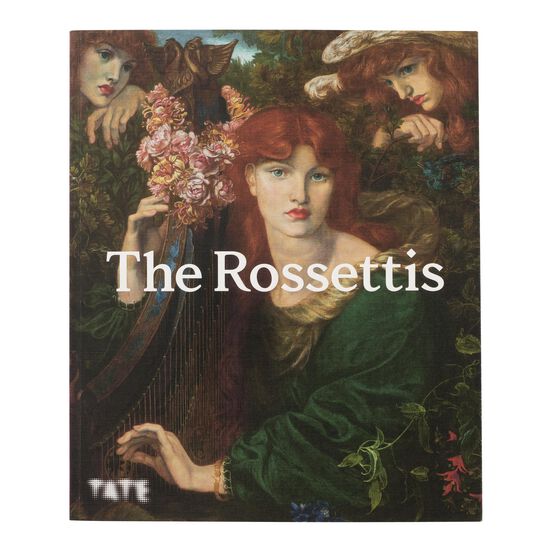
I was always going to love it, and you will too.  It's a different way of looking at a talented family and makes you appreciate how much of their work we enjoy, without having to bring too much biography into it.  The lightness of touch on that front will probably relieve many and does mean you can look at the works without being overly worried about who was sleeping with whom or taking what drug at the time. The deep dives into things like 'Goblin Market' and The Beloved add real depth to the show and you leave very happy (or in our case, going back through about three times because things mesh together so beautifully you end up revisiting pieces with a variety of perspectives.)  You have until the end of September thank goodness, so I think a long summer of Rossetti goodness is on the cards for us all.Obviously, there is a catalogue for the show, although it's actually a book of essays on the subjects raised rather than a straight reproduction of the show in book form, which is smashing and offers longevity to the work. With essays by such people as Jan Marsh (on Elizabeth Siddal), Wendy Parkins (on Jane Morris) and Dinah Roe (on Christina Rossetti), it is a collection of new looks at familiar subjects and is a fascinating and beautifully illustrated read. I bought the £30 paperback as I had to carry it home on the train and it is corking.

So, I will be back tomorrow with another Rossetti-related review, but I'm actually sure that I'm preaching to the choir with this one and if you are able, you'll be there.  And you won't be disappointed.

Friday, 26 August 2022

Nuts!

 This is a bit of a rambling post but it's something that has always puzzled me, but I've never been able to put my finger on what the problem is.  Anyway, the point of this post is to try and unpick a very famous anecdote.  

It's a truth universally acknowledged that this is the first picture that Fanny Cornforth appears in...

Found (1854-1881) Dante Gabriel Rossetti

To be exact, she appeared in a sketch for this unfinished piece, probably something like this one...

Study for the Girl's Head in Found (c.1858) Dante Gabriel Rossetti

In Fanny's account, which has never been disputed, she said that after they met, Rossetti invited her to the studio where he put her head against the wall and drew it for what she called 'the calf picture' or as we know it, Found. The story behind Found is that a country chap comes to London and discovers his former beloved, who had abandoned him for the bright lights of London. She's been living a thoroughly sinful life that seems to have turned her green and she is very ashamed of herself.  Somehow, this account of an innocent country girl who becomes a sex worker in London has also become co-opted as Fanny's story. The simplicity of Found is in stark contrast to the utterly bizarre nature of Fanny's own alleged origin story, and there is just something about the details of that fable that have always bothered me. Let's start with a famous quote...

'He met her in the Strand. She was cracking nuts with her teeth and throwing the shells about: seeing Rossetti staring at her, she threw some at him. Delighted with this brilliant naivete, he forthwith accosted her to sit to him for her portrait' (Autobiographical Notes of the Life of William Bell Scott (1892) William Bell Scott)

This is the now infamous account about how Rosetti met Fanny.  It is, of course, utter bobbins, but was sort of backed up by William Michael Rossetti in his book on his brother, where he says 'I cannot recollect ever hearing anything about the nuts, but do not contest Mr Scott's statement on that point.' It has to be noted that William Michael did not like Fanny, especially around the time he was writing.  Also, William Bell Scott was not present at the alleged meeting in the Strand. Why William Bell Scott would make up such an elaborate lie is something that really interests me. The reasoning I always go for is this entry in William Allingham's diary, Sunday 26th June 1864: 

'Enter Fanny, who says something of W. B. Scott which amuses us. Scott was a dark hairy man, but after an illness has reappeared quite bald, Fanny exclaimed, ' O my, Mr. Scott is changed ! He ain't got a hye-brow or a hye-lash — not a 'air on his 'ead ! ' Rossetti laughed immoderately at this, so that poor Fanny, good-humoured as she is, pouted at last— ‘Well, I know I don't say it right,' and I hushed him up.'

From the diary entry, it doesn't seem it was at a party or said to anyone other than Allingham and Rossetti but I don't put it past Rossetti to have to told William Bell Scott this 'hilarious' anecdote. I also don't feel, from Allingham's record of the incident, that Fanny meant the remark maliciously, she was just exclaiming on the change in Scott's appearance. Scott, by reputation, was proud of his looks, but his sudden alopecia after his illness had caused him great embarrassment. Like Rossetti, he appears to have been a very good looking chap in his youth but not so much later on.

William Bell Scott (1850s) Arthur Hughes

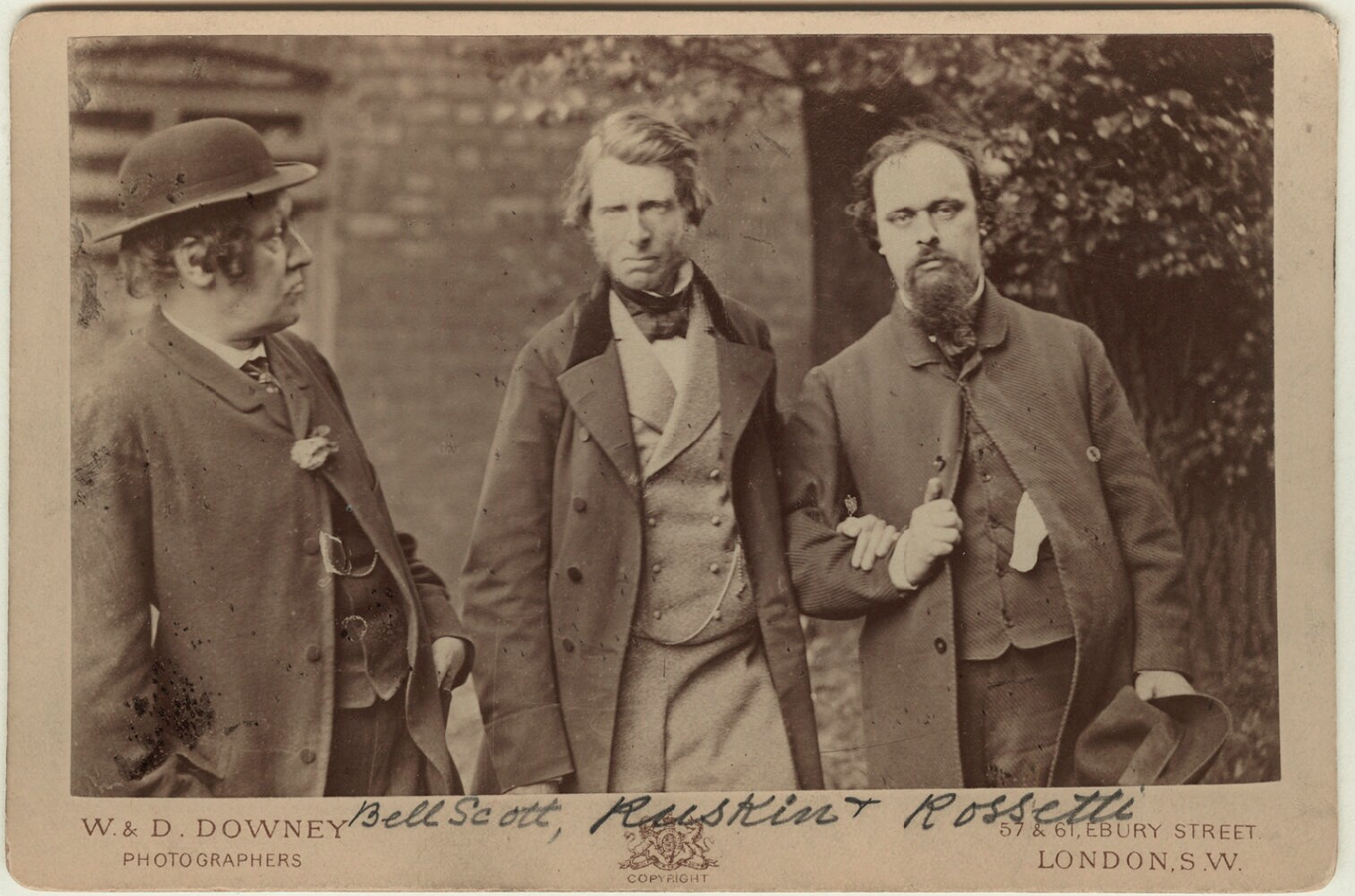
Bell Scott, Ruskin and Rossetti in 1863

I also wonder about the fact that Bell Scott was born in 1811, older even than Ruskin, but in with a crowd  two or more decades younger than he was, with all that youthful energy.  Bell Scott is a great painter, wonderful landscapes and interesting genre pieces but never the most interesting man in the room. He is obviously allowed to dislike Fanny and I understand his problem with her, even before she made a comment on the one thing he didn't want commenting on. She had no qualities he seemed interested in.  She was not ethereal or quiet, she was not well-bred and titled (his mistress was Alice Boyd, the painter and sister of the Laird of Penkill Castle).  She was also Rossetti's mistress and not to be too judgemental, Rossetti could be an absolute git-weasel, so what does that say about her if she likes that?  In hindsight, with all the evidence we now have, we can see that Rossetti's behaviour is all coming from a very dark and sad place but that doesn't mean that he couldn't be a antagonistic to be with, especially for people who had no appreciation of the vagaries of mental health conditions. Anyway, in a way, I'm not surprised that William Bell Scott lashed out in memoir form, after all he was writing at the time when lots of people were claiming the narrative of the Pre-Raphaelites and Rossetti. What interests me is the story itself, and to be exact, the nuts.

Rebecca Davies in Desperate Romantics

In the BBC's Desperate Romantics, Fanny Cornforth cracks nuts between her teeth and spits the shells at Rossetti (‘Do you make a habit of spitting?’ ‘Depends what I have in my mouth at the time, sir…’). In Scott's account Fanny is cracking the nuts in her teeth and throwing the shells about, but that rapidly became spitting the shells, hands-free, which is quite impressive. I've always maintained that the cracking in the teeth is the important part, that Scott was labelling Fanny an animal, but I never considered the nuts themselves.  What do they symbolise?

Fanny Cornforth in the garden of Tudor House (1863) W & D Downey

Yes, well, we have the very obvious body parts.  Scott was judgemental of Rossetti's attachment to Fanny, which he obviously didn't approve of or understand, so it would be understandable that he'd think it was purely sexual and that Fanny had Rossetti by the nuts, as it were.  There is also the connotation of the 'nut' being the head, and possibly Fanny being a cause of the mental change of Rossetti, that she was 'cracking' his nut, damaging or lowering his IQ by her cheap, tarty presence. It's also interesting that the nuts are in her mouth, whether she spits them or not. She is not even cracking them in her hands. The nuts have become the words that she uses to communicate.  They come from her mouth and are either spat or thrown. Her non-verbal, semi-violent methods or attracting attention again make me think of animals but also of a lack of intelligence and threat. That Rossetti is 'delighted' with this 'brilliant naivete' says quite a bit about how Scott perceived him.  Was Rossetti that sophisticated that he needed a break from it? It does mark Rossetti as a man who enjoys simplicity, or put less politely, crudity. Seen with hindsight of his painting and poetry output of the 1860s, especially the more fleshly stuff (which involved Fanny), you could draw the conclusion that Rossetti liked pretty girls doing things with their mouths and that's all. It rather takes one of the great painter/poets of the nineteenth century down a peg or two.

Fair Rosamund (1861) Dante Gabriel Rossetti

So, nuts - why nuts? I did wonder if they had any significance and so turned to the language of flowers and the symbolism of food as I was interested to see that if you type in 'language of flowers' and 'nuts', many websites come back with 'stupidity'. It's not a massive shock if Scott intended the nut to represent Fanny's stupidity, especially when coupled with her brilliant naivete. In Mrs L Burke's 1865 The Miniature Language of Flowers, there are no nuts, but the Bladder Nut Tree symbolised frivolity and rather crude amusement due to the fact that the seeds make a rude noise when you squeeze them. For the Romans, nuts symbolised fertility and the shells were thrown before bridegrooms and brides. Taken with Fanny's perceived occupation as a sex worker, this symbolism would fit as well. Although she didn't have any children, Fanny is often seen as a bountiful, luxurious, extra woman, with her size and appearance.  In Theresa Dietz's 2022 The Complete Language of Food, various different nuts have interesting meanings, including brazil and pecans (hospitality), sweet chestnuts (luxury and interestingly, chastity) and macadamia (ingenuity). Scott didn't specify a nut, but subsequent writers have opted for walnuts which are often linked to Christianity (the shell being the church and the kernel, the congregation), but also of male virility and power, which would link to how forward and proactive Fanny is in the story of their meeting.  I especially liked the symbolism of walnuts as representing people who are tough on the outside and sweet and soft inside, which I think fits Fanny as shown by her actions, but I very much doubt that is what Scott intended unless I have misjudged him.

Woman Combing Her Hair (1864) Dante Gabriel Rossetti

If you fancy a really way-out reading of the nut story, I can offer you the Celtic Revival and Echtra Cormac (Cormac's Adventure in the Land of Promise), which Whitley Stokes offered in translation in 1891.  Within this tale of Irish mythology, there is a very interesting passage which goes something like this...
'Lo, it is custom for those who dwell in that city to break the nut with their teeth and swallow the fruit within. For others it is custom to break the nut and give food to those near them, who sate the hunger of others with the nuts which they are eager to take.' 

Okay, so it's a stretch, but the symbolism of the nut as knowledge or faith being learned, digested or shared, is an interesting one. Read in this way, Fanny's nut cracking and throwing is an act of sharing, but it is only the shell she throws. If her nut cracking and throwing is truly symbolic, then it is an act of sharing something useless, that she keeps the good things for herself and shares that which is no use to anyone. This sort of symbolic reading of Fanny is repeated in Violet Hunt's The Wife of Rossetti (1932) where she talks about Fanny's ancestor who would promise to share peaches and apricots when all she had was apples. Hunt learned her version of the Pre-Raphaelite drama from Scott, who was a family friend, so the use of symbolism might have come from him. 


Found (study of a head of a woman) (1853-7) Dante Gabriel Rossetti

So, where does all this leave us? Honestly, I have no answers, as the reason why William Bell Scott would write down such an elaborate lie is mysterious.  Was the intended target Fanny or Rossetti?  He brands one a sex worker and the other a man who likes women with strong teeth and weird soliciting techniques. It does occur to me that Scott might have seen a sex worker perform such a trick (I'm guessing with peanuts rather than walnuts unless she had really sturdy false teeth) and kept that in mind for when he was writing up his memoir, but why bother? Had Fanny really upset him that much? Part of me is really doubtful that Fanny was the intended target as that is a lot of weird effort to go to in order to get even with a working class woman, who by that point had retreated to obscurity. I have a feeling a lot of the appalling things said about Fanny are actually about Rossetti - she becomes collateral damage in people getting even with Rossetti, who alienated a lot of people, if not actually infuriated them. By the 1890s, William Michael had actually done a fairly decent job in creating the myth of 'the great man' Rossetti, backed by various biographers who had piled on after Thomas Hall Caine's unctuous offering, Recollections of Dante Gabriel Rossetti (1882). I can see people who may have felt aggrieved or felt that they had a different story to tell, getting in on the act. 

Woman with a Fan (1870) Dante Gabriel Rossetti

So, we end up with nuts. Whether it is about the thrower or the target is unclear but the story only came to define one of the people involved. The fictitious Fanny with her strong teeth may symbolise strength, masculinity, emasculation, luxury, ingenuity or idiocy but that is not the woman who Rossetti approached in a dining alcove at a firework event in 1856 and pulled the pins from her hair. Let's hope we never forget that again.


Friday, 15 July 2022

Dolly

 I feel this might well be a ranty post as doing the research for this infuriated me and I'm hoping I will leave you well ticked off as well. It is about a young woman called Dolly who died at the hands of the artist who painted her, but it is also about how we write about women.  As always, it's also about Fanny Cornforth, because everything I write is about Fanny in the end. It all started when I looked again at some pictures of witches for an article I was writing for Enchanted Living.  I was reminded how much I loved this striking image...
The Witch (1913) John Currie

I liked this image because it was a bit of a change from pointy hats and broomsticks, and plays into one of my favourite subjects, the banality of evil. Really evil people never look particularly evil or else they wouldn't be able to do what they do. You'd see them coming a mile off if they were all flashing cloaks and twizzling moustaches. Anyway, who says the witch has to be evil? There was just something about John Currie's witch that was slightly unsettling, that let you know she had all the power and she knew it. Mr Currie is a bit out of my normal realms of interest, although I don't mind a bit of Gertler and Carrington, so I didn't know the story behind this image. I do now and I'm hacked off.  Not only that but I'm tagging Fanny in to back me up.  Let's start with the witch above, because this is her story.

Dorothy Eileen Henry was born in the Autumn of 1893.  Her parents, Thomas and Kate had met in Colchester, after Henry had come over from Ireland and married when Kate was barely 15. Around a dozen children swiftly followed, with Dorothy somewhere in the middle, making the Henry household somewhat packed.  Thomas worked as a travelling salesman, so the family started by living with Kate's widowed mother before moving out on their own. Not all the children survived childhood but on the whole, an impressive number of the Henry children lived until the latter end of the 20th century. By 1901, Thomas and Kate and 9 of their children lived at 20 Kendall Road, Colchester, a mid-terrace house that must have been a squeeze. Kate continued having children until 1907, so it's unsurprising that the older children made their way into the world as soon as possible. Eldest daughter Katie got married, as did next oldest John. Dorothy's brother Thomas, named after his father, only made it to his 12th birthday before he died. Dorothy decided she wanted to see a bit of life and so she took herself off to London.
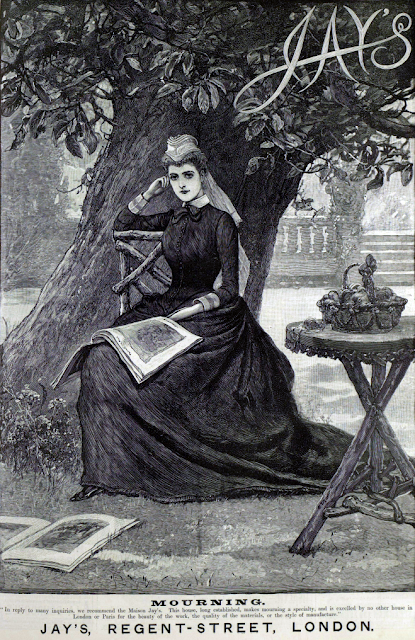
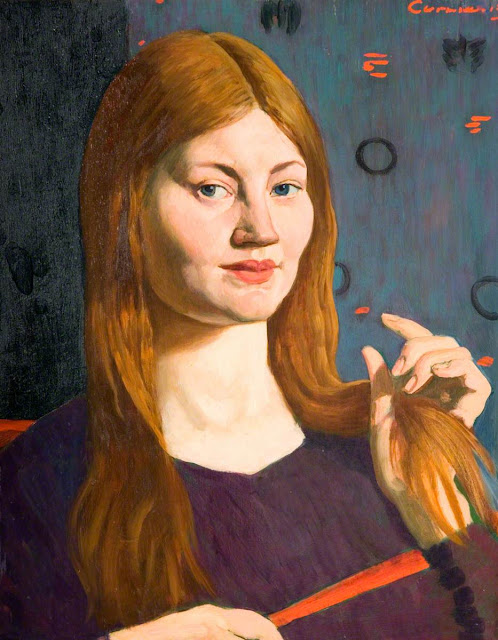
When in London, Dorothy became 'Dolly' and found work both in domestic service, then as a dress model at Jay's on Regent Street.  Jay's had started out as a Mourning Warehouse, a place to get everything you needed for that full Victorian experience of death. This particularly wonderful page on it describes it as 'the Argos of grief'. It became so ubiquitous that by the turn of the century it was known simply as Jay's, rather than it's full title of 'The London General Mourning Warehouse' (magnificent) and by the look of the adverts it wasn't selling itself solely on the mourning, unlike early ads like the one above. Even a very pleasant summer tea-gown in apple green was covered in black net in 1900, so maybe those habits died hard, if you excuse the expression. Anyway, Dolly had found work as a dress model by the summer of 1911.  She had flame red hair and a beautiful face and I'm sure she looked smashing in black. She met artist John Currie who was immediately attracted to her and asked her to model.  She agreed and he produced a portrait of her, Head of a Girl.  She was 17 years old.
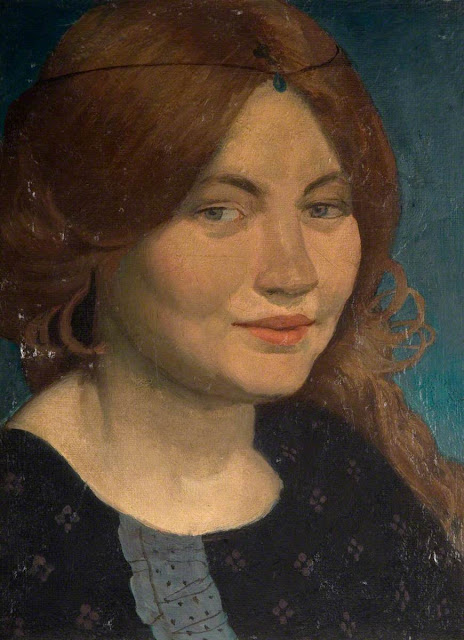
Head of a Girl (Dorothy Henry) (c.1911-14) John Currie

John Currie was 27 and married. Originally from Staffordshire where he had painted ceramics at the potteries, he had studied at the Royal Academy from 1904 to 1906, before becoming a teacher of art in Bristol for 18 months, then an Inspector under the Department of Agriculture and Technical Instruction in Ireland until 1909. Interestingly, both John and Dolly are referred to as 'Irish' in various accounts of their lives, despite neither actually being from Ireland. I wonder if it is a handy slur to explain the violence of their relationship.  After that, he decided that he needed to return to college and took himself to London and the Slade, studying part time with Mark Gertler and Augustus John.  He still had to work to afford it, and he is listed in the 1911 census as an 'Art Instructor', living on his own in Hampstead.

 John had married Jessie Brandon, a Grocer's daughter from Staffordshire in 1907, their son Mark appearing in 1908, but Jessie did not follow John to London or if she did, she had returned home by 1911 when he met Dolly. The timeline of their affair is a little uncertain, but according to later accounts, Jessie Currie asked her husband to stop his affair with Dolly, but John refused so she broke off relations with him.  John took young model Dolly to live at 1 St George's Square, Pimlico, before the couple went to Newlyn and joined the artists's colony there.

Okay, I'm pausing because what comes next is horrible.  However, does this story remind you of anyone so far? Sarah Cox came to London to find work and was discovered by an artist and she became 'Fanny'.  When I saw the above image of Dolly from 1911, I was instantly reminded of this...
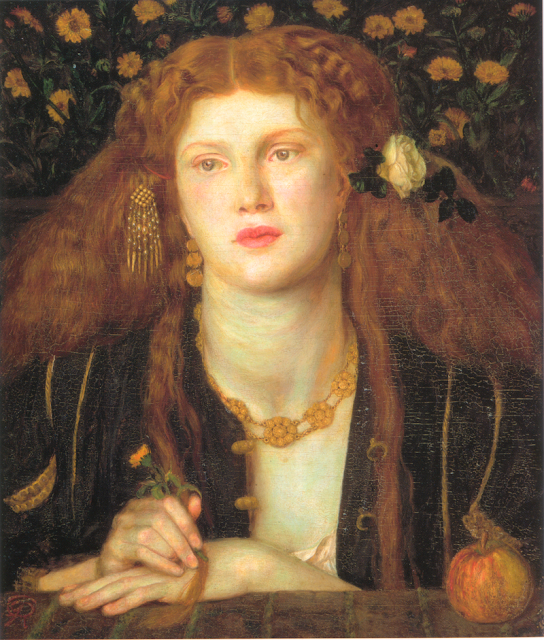
Bocca Baciata (1859) Dante Gabriel Rossetti

A beautiful, desirably, red-haired girl looks out of the canvas of her lover.  Both paintings are warm and sensuous, Dolly and Fanny looking coy and knowing. Because of the title, Bocca Baciata seems to imply more about Fanny than Dolly's plain Head of a Girl but both paintings seem to add biography to their subjects rather than to their creators.  That is doubly true of Dolly's portrait The Witch and arguably Fanny's outing as Lady Lilith...
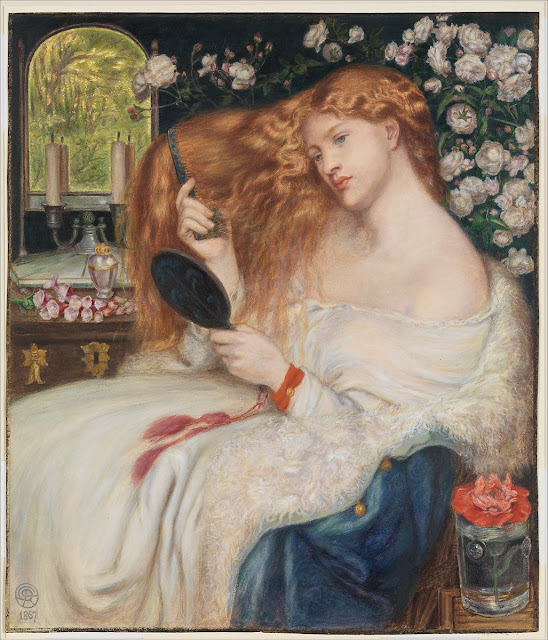
Lady Lilith (1867) Dante Gabriel Rossetti

Both women, at the end of their love affairs (allegedly) with the artists, pose for paintings as witches. Fanny and Rossetti were drawing to the end of their flurry of romance after the death of Elizabeth Siddal, and he would famously paint over her in the oil of this image, never again using Fanny as his main model. For many of Rossetti's friends and subsequent biographers, this image of Fanny, drawing her fingers through her hair, engrossed in her own reflection, summed up how deeply they hated her. She was unnatural, wicked, able to possess the artist and make him weak. Never did they acknowledge the cataclysmic mental health disaster that Rossetti went through. Somehow, Fanny and her evil powers were at the root of Rossetti's problems and would eventually be the death of him. Looking at it in those terms, I am almost inclined to forgive Fanny's critics as they were trying to explain something that had happened to their friend and brother without opening the box marked 'mental health'. They didn't know what to do with his titanic self-destruction so they blamed it on Fanny, after all Fanny survived.  They make Rossetti's art about Fanny, and that is ridiculous. Back to Dolly...

There are some much fuller accounts of the years 1912-1914 (here for example) but it didn't take long for John and Dolly's relationship to become violent. This leads me to wondered why Jessie was already living with her parents in 1911, and it could be that she had left with her son before Dolly was even on the scene. While in Cornwall, Dolly fled from John who threatened her with a razor, and was found by Laura Knight hiding in her garden among sunflowers. An artist from Eastbourne, St. Clare O'Malley, reported how he had met Dolly who was sporting a black eye given to her by John in one of his jealous moods. John wrote to Dolly's parents promising to marry her, leaving out the part where he was already married until they found out and he promised to get a divorce. He didn't.  Dolly turned 18 years old.
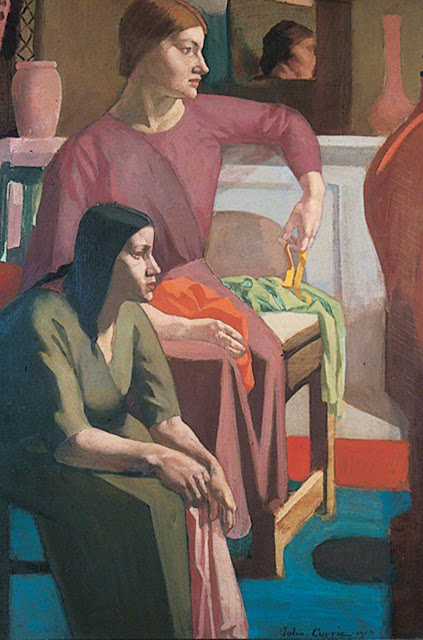
Seamstresses  (Dolly and her cousin Mary) (1913) John Currie

Mark Gertler, tremendously in awe of John's talent, hooked up with the couple to make an odd threesome that travelled to Ostend together. Mark was closer to Dolly's age than John's and hero worshipped him. He had his own romantic problems, in love forever with Dora Carrington and arguably attracted to John, with not a little jealousy about Dolly. John Woodeson's 1972 biography of Gertler is not the place to go looking for a fair assessment of Dolly's life, but you certainly get an idea of what she was up against. Gertler became enmeshed in the couples dysfunctional, violent menage, and took John's side. He wrote to a friend "Currie is ill with rheumatism...so most of my evenings are spent with him in his rooms. Henry makes supper. I enjoy these quiet and peaceful evenings very much." Other friends of John and Gertler visited and passed judgement on Dolly - "the fair-haired girl was evidently not highly educated" remarked one, and patron of the arts, Edward Marsh gave his own verdict "There was no great harm in her but she was extremely vain and quite empty-headed - and jealous of his work." 
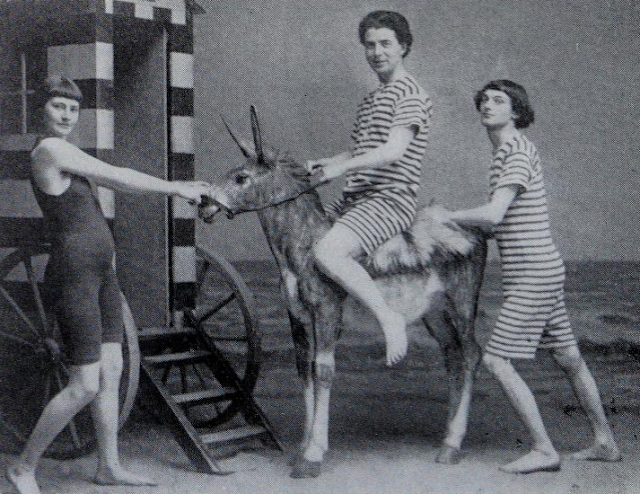
Dolly, John and Mark in Ostend (1912) from John Woodeson's biography

I have a special level of anger for when grown men feel entitled to pass judgement on teenage girls but really any privileged man who feels the need to comment negatively on a working class woman is going to receive my ire. Fanny Cornforth received heaps of criticism from Rossetti's circle, the majority of which was class-based in origin - the difference between Fanny, Elizabeth Siddal and Jane Morris was that Elizabeth and Jane allowed themselves to be elevated out of one class into another, by training, talent and keeping their mouths shut. Fanny did not lose the accent, nor have a talent for art,and she did not remain quiet and still.  All of these things were commented on,  even by William Allingham who, arguably, did not mean to criticise how she spoke or how she ran about the garden after the 'chicking', but it comes off as an educated man commenting on an uneducated woman. Luckily for Fanny, Rossetti was a cluster-mine of personal issues so when his mental health deteriorated most of his friends primarily blamed the death of Elizabeth rather than his relationship with Fanny.  Had Elizabeth not died would Rossetti still have had the mental health he did? One thing Fanny was never blamed for was Rossetti's mental health - she was blamed for possibly enabling his addictions, but I suspect that to blame Fanny for Rossetti's depression would mean acknowledging it existed. Luckily for John Currie's friends and supporters, the blame for his mental health issues and violence could be placed squarely at the feet of a teenage girl.

I think the moment I really connected Fanny and Dolly in my mind was when I read Mark Gertler's comment - "It was bad enough when she kept quiet but now that she gives herself airs and talks, I can't stand it." This was said in response to Dolly attempting to talk about art with the men. The art that she appeared in. Others concentrated on how Dolly was destroying John with her womanly powers, as contemporary novelist Michael Sadleir wrote in his memoirs -

 "Her lure for men was irresistible, and Currie was of course utterly enslaved to her physical attraction, a fact of which she was well aware. In her way she had a genuine love for him; but no glimmer of a notion that art could be of importance to anyone. Resenting his absorption in his work, determined herself to be his dominant preoccupation, she used her power to goad him from abject desire to baffled fury, and then, suddenly complaisant, to win him back again. This dangerous cruelty led to violent quarrels, and I suspect to blows."

At this point they are describing a woman of 20 who had lived with a violent man for 2 years.  She would not live to see 21.

Dolly left John, and when her mother came looking for her, found her daughter with a razor-scrape across her throat, given to her by John of whom she was terrified. However, yet again she returned to him when he called for her. John had a new source of anger, a belief that Dolly had been spreading lies about him to his fellow artists, but I can find no reporting of what these untruths were. Dolly had told other artists that John beat her, possibly that is what he was referring to. Before the couple left for Brittany, for the good of John's health, he wrote to Edward Marsh, a patron and friend, apologising for his recent bad behaviour - "I have behaved badly lately, but I am not well...Dolly is doing all that anyone could do to help. There is peace, but much is lost for the time."

The trip to Brittany remind me very much of Rossetti and Fanny's trip to Cumbria. It is a little relief in what is a god-awful situation. Both couples were happy for a while, with letters back from Brittany from John saying how they have danced and laughed, but soon Dolly left to return to London and Cornwall. They had met another English artist in Brittany who told her to her face that she did not appreciate art as she wasn't clever enough. That is no worse than everyone seems to have been saying behind her back but it was enough to drive her back, at least in John's report. It seems to me that Dolly had put up with far worse in the previous three years, so the words of a stranger seem a bit light to have sent her packing when it had been fear of John himself that had previously driven her away.  Despite proclaiming himself content without Dolly, he followed her to Cornwall and threatened to throw her off a cliff and once more she fled.  She stayed at Alderney Manor, near Poole in Dorset, with John's old friend Augustus John who didn't like her - "She was an attractive girl or used to be when I knew her first, but seemed to have deteriorated into a deceitful little bitch." Augustus John's portrait of her, The Woman in Green hangs in the South African National Gallery in Cape Town.
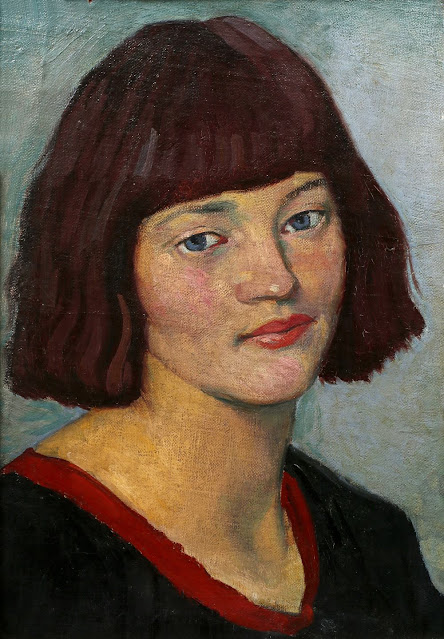
Dolly Henry (1913-4) William Strang

Dolly's last home was a flat in Paultons Square in Chelsea. She found work as a nude model but once more John found her, enraged that others were seeing her naked. On the 8th October 1914, John came to the flat early in the morning. When shots rang out, neighbours rushed to find Dolly in her nightdress, bleeding profusely on the landing and John, in the bedroom, with chest wounds. The defence of Dolly and John after their death was done by friends and family. Only Dolly's mother came forward to report the violence of the previous three years. John's wife appeared at the inquest, described as 'a slightly built lady of youthful appearance', and described her husband as having a 'passionate temperament' and told how she was trying to rebuild their marriage but he was too involved in his intrigue with Dolly. Michael Sadleir, a friend of John's, stated "Dolly drove Currie mad, and deprived the world of a genuine artist and a devoted worker." At the end of the entry on Paultons Square in the marvellous Murder Houses of London by Jan Bondeson, it is noted that because the murder happened not long after the First World War started, it was not given a great amount of publicity, so John's friends were able to buy up his work and it never dipped in price.  If they had shown as much care for his behaviour as they did for his artistic reputation then maybe he would have had a longer life and Dolly might not have spent her late teenage years being attacked before being murdered.
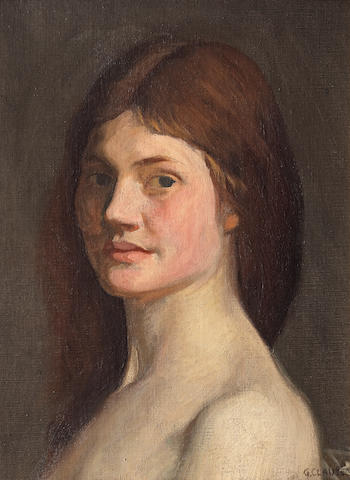
Head of a Woman (Dolly Henry) (1912-4) George Clausen

I get very angry about the way Fanny Cornforth is written about in the biographies of her contemporaries and later, because not one iota of space is given to what she dealt with, for which she had absolutely no experience or preparation. Fanny never let go of Rossetti, but possibly that's because the moment she took her eyes off him in 1872, he attempted suicide. She provided him with his drugs along with his paint as she just wanted him to continue living. It took around 8 years for Fanny to go from 'the kissed mouth' to 'the witch'; it took Dolly Henry barely 2. Rossetti's family shaped a narrative to disguise a reclusive man's mental illness, but John Currie's friends took his existing problems and placed them on the shoulders of a 17 year old girl. John Currie is an obscure artist now, kept from entirely slipping from view by interest in Dolly's murder, which is how I found him. Still the narrative that Dolly was a temptress who drove him mad is prolonged - for example, she is referred to as 'the volatile Dolly' in Bondeson's book, and the accounts of John's friends are repeated without question in their modern biographies. We need to be quicker to question these received 'facts' from the past and look at who is telling us what and why. Hopefully these days if a 27 year old man, a married man, hooked up with a 17 year old girl, we would know which way that power dynamic was flowing. 

We need to do better because history, and life, is full of women like Fanny and Dolly and after the appalling things they had to put up with, they are overdue some respect.

Thursday, 30 September 2021

Review: Rossetti's Portraits at the Holburne Museum

 Good Lord, it seems an age since I went to see anything pretty.  Very slowly the unlocking seems to have become a reality and museums are feeling brave enough to tempt us back in.  What a wonderful way to start my Autumn - a visit to Bath and the Holburne Museum, for this rather glorious exhibition...


Yes, it's an exhibition devoted to the portraits of Dante Gabriel Rossetti, which honestly sounds like a good time in my book.  As you can see, the exhibition is accompanied by a little precious gem of a catalogue (hurrah, catalogue!) and so I was over excited to attend (and get out of the house).


The exhibition is in one large room with the sections split between walls, and separated with a text panel about the subject.  We start with a few early sketches of both himself and his friends, before we move on to the women who dominate both his life and work.  This is very much an exhibition of  The Women Who Loved Rossetti, even though there are a few exceptions sprinkled in, just to show that he didn't need to be in love to make art.

Elizabeth Siddal (1854)

Obviously, Elizabeth Siddal is the first of the women who feature (other than family members and Emma Madox Brown).  It's a special experience being close to the intimate little drawings of Elizabeth leaning and sitting within the confines of Chatham Place. I had not really considered how caged and observed she looked in these sketches, but especially in the image above, I am reminded of paintings like Spencer Stanhope's Thoughts of the Past,  which I guess was painted at a neighbouring window a few years later...

Thoughts of the Past (1859) John Roddam Spencer Stanhope

Although she doesn't look as tortured as the poor soul in Thoughts of the Past, in the sketches of Elizabeth, she looks restless.  I wonder if that was how Rossetti saw her or indeed felt himself? The works of Elizabeth are at least less stagey and extravagant than what follows...

The Fanny Section!

Imagine my utter joy at discovering they had a Fanny section!  I was a very happy Fanny-Obsessed Art Historian indeed. This is the second exhibition where Mrs Cornforth got her own section and the fact that she has now firmly wiggled into the official narrative is such a proud and joyous thing for me.  She absolutely deserves to be there, sunning herself in the limelight.  Anyway, after I stopped having a moment, I was very pleased to be faced with this selection of beauties...

Sketch for Fair Rosamund (1861)

The Blue Bower (1865)

Fazio's Mistress (1863)

I have to give a special word of praise for Fazio's Mistress which I don't think I see that often and is not glazed, so you can get a really good look at under lighting. It's a cavalcade of gorgeous creamy flesh and high sensual drama, a complete change from the intimate reality of the previous section and I think the strength of his work with Fanny is what makes her special and of note within Rossetti's art history.  Yes, he follows with equally strong and sexy images of Alexa Wilding and Jane Morris but it's Fanny who opens the farmhouse door into Oz, if you know what I mean.  Talking of Alexa...

Detail of Monna Vanna (1866)

I am always amused by our endless puzzlement about Alexa, who is so mysterious and yet everywhere in Rossetti's work from 1865 onwards.  God bless Sylvia Broussine and Christopher Newall for name checking me for my Fanny-centric reading of Monna Vanna which is one of the hills I am happy to die on.  She's holding a fan! Anyway, Alexa and Annie Miller make an appearance before we move on to Jane Morris and Rossetti's endgame with his deep, rich tributes to his love of Jane. 

The Blue Silk Dress (Jane Morris) (1868)

Jane gets to be the poster girl for the exhibition and you can't help but be completely taken aback by the scale of the beauty in these portraits.  That blue seems to have so much texture and depth, it takes your breath away.  I also got to admire his rather nifty roundels...


That's the thing about Rossetti - yes it's his pictures we know him for now but he also thought about the frames and how we experience the whole thing as a piece of luxurious devotion. Not only that, I was delighted to see some of his jewellery in a little case...


I absolutely loved the exhibition; it was succinct and beautiful, giving you exactly what you need to see in a wonderfully calm and dreamy atmosphere.  The catalogue is equally deceptively small but packs a hefty punch in terms of interesting text and wonderful illustrations. It was the exhibition equivalent of someone giving you a big hug and saying 'Come on back outside for a bit, it'll be fine.'

Find out more about Rossetti's Portraits here.