Showing posts with label James Whistler. Show all posts

Sunday, 8 November 2020

Straight Outta Hendon...

I hope you are all coping in the current uncertain situation and keeping well and reasonably sane.  I have always been someone who uses the fact I can become absolutely obsessed by a subject to stave off stress.  It's distraction, I know, but when the stressful thing is beyond your control then it probably serves me better to research the heck out of a subject than to worry about whether I have enough bread flour or if I will catch the 'Rona by going to get some more.  Anyway, all that comes to explain how I came to meet and fall in love with Ethel Warwick...

Ethel Warwick (1924) Bassano Ltd

Hang on, what am I doing with a twentieth century muse? Gorgeous as she is, isn't Ethel a bit out of my timeline? Well, normally I'd agree, but you see this is also Ethel...

The Lament for Icarus (1898) Herbert Draper

There she is, lamenting the rather gorgeous Icarus. So, how did that girl go on to be an internationally successful actress, friend of Sarah Bernhardt, twice married, hat designer and a successful artist in her own right? And why don't we remember her now? When I started looking, all I could find was a lovely essay on her by Simon Toll in the British Art Journal, but I wanted more. I read the following exchange in an interview with her:

"It was Whistler who, when Miss Warwick told him that she intended to go on the stage, asked why she chose such a life. "For the honour and glory of it," the girl replied and the great man growled out: "Isn't it honour and glory enough that you have sat for me?" "

Blimey, how could I resist? Let's go back to the beginning...

Ethel Maud Warwick was born in Hendon on 13 October 1880.  She nudged her birthday down by a few years as she got older, which is understandable in her subsequent line of work (if anyone asks, I was born in the late 1990s and not 1973 as my lying birth certificate would have it).  However, some researchers have raised their eyebrows at the difference in a few years if you take into account that she posed nude for artists in her mid to late teens.  Knock four years off 17 and it makes people uncomfortable, but we'll come to that in a minute.  Ethel's father, Francis, was a Railway Station Master, and Ethel was Francis and his wife Emma's third daughter, after Amy and Emma Junior (also known as Emily).  Ethel would be followed by two boys Francis and Herbert.  By the 1891 census, the family had moved further into north London, to Lismore Road in Kentish Town.  As a girl, Ethel recalled later, she was keen on art and her parents sent her to the Polytechnic to study, followed by the Camden School of Art under Francis Black, RBA. Somehow in the mid 1890s, Ethel came to the attention of Herbert Draper.  It is suggested that he saw her in the street, but I think possibly its more likely that they became connected through the art school scene.  Anyway, the upshot was that she posed for this...

The Sea Maiden (1894) Herbert Draper

 Okay, so we have to give Draper a bit of artistic license because that is not a 14 year old nude Ethel (for reasons I'll come to) but you now see why it's important to acknowledge she was 14 and not younger when she posed for this (even though even that gives us pause these days).  Anyway, Draper wasn't the only artist who took a fancy to Ethel as a model.  She also posed for Philip Wilson Steer...

Hydrangeas (1901) Philip Wilson Steer

Not to mention James Abbott McNeill Whistler...

Ethel Warwick Holding an Apple (c.1900) James Abbott McNeill Whistler

But my favourite of her artists, and the reason I met Ethel, was John William Godward...

Ethel (1898) John William Godward

This painting is in the Russell-Cotes Art Gallery and I've always loved it because I have a soft spot for Godward, and this is totally unlike his normal output, which is more like this...

Study of Miss Ethel Warwick (1898) John William Godward

The idea behind the first Godward image is possibly a picture of Ethel as she arrived to pose for Godward, and that he was so fond of her, he painted her like that too. Looking at Ethel in the second image, you can see how her likeness can possibly be seen in an awful lot of Godward's art or at least her dreamy beauty lends itself to Godward's vision of drape-y classical loveliness.  By 1898 Ethel was acting as a model at art school, seemingly as much as she was being a pupil. As well as Steer, Draper, Whistler and Godward, she also appeared at the Camera Club in Charing Cross Road for the Punch cartoonist Edward Linley Sambourne...

Ethel Warwick 1 August 1900 (1900) Edward Linley Sambourne

 Honestly, given a lot of the images taken by Sambourne, this could have been a lot worse, and there are far more naked pictures of Ethel by him. However, it was while posing in a tableau for Solomon J Solomon that Ethel was spotted by Herbert Beerbohm Tree who thought looks like hers should permanently go on the stage. He had arranged a theatrical review, including the tableau (that also involved other famous women such as Elinor Glynn) for a charity performance at the beginning of the Boer War.  By the time she posed for Sambourne in the above image, Ethel was already planning on leaving her modelling behind her.  After 9 months of instruction at Henry Neville's acting school, she debuted on stage on 25 July 1900 at the Grande Theatre Fulham under the management of Neville in The Corsican Brothers. As the curtain rose, Ethel recalled that her nerve failed her, but Neville patted her on the back and whispered 'Remember your first line'.  That first line was 'Courage! Courage!' and so, with courage, Ethel embarked on her new career...

Day and the Dawn Star (1905) Herbert Draper

 That's not to say she didn't combine her professions for a little longer; Steer's Hydrangeas was in 1901 and Draper's Day and the Dawn Star was in 1905, but much to the disappointment of her artists, Ethel had fallen in love with the theatre. Having said that, the theatre had fallen very much in love with Ethel and so the offers of work came in.  The actor-manager Herbert Beerbohm Tree gave her work because he liked the way she walked.  He gave her a bit part in Herod at His  Majesty's Theatre in the Haymarket.  It was just a single line part but she understudied the role of Judith, only to arrive at the theatre one evening to be told she would be on stage in the bigger role with only a quarter of an hour to prepare.

Ethel in Captain Kettle (1902)
 
In 1903, after success in plays such as The Gay Lord Quex and Captain Kettle, she joined Frank Benson's Shakespeare company, playing Portia and Juliet to great acclaim.  However, despite leaving modelling behind, Ethel had not abandoned art, far from it.  It was entirely her intention to be an actress/artist and an interview with her in 1904 pictured her as both a serious artist and actress...

Miss Ethel Warwick at her Canvas (1904)

 Here is where you might be able to help me - does anyone know of any of Ethel's paintings?  I've searched online, and despite her many interviews mentioning how internationally successful she is as an artist, I've yet to find an image by her.  This is not helped by the fact that Ethel Herrick Warwick (1881-1961) was also an artist and so there are paintings which might be Ethel Maud Warwick's work but mis-attributed online subsequently because of Ethel Herrick Warwick's relative fame in comparison.  Anyway, on with the theatre!

Young Ethel, on the brink of Theatrical Superstardom!

The turning point arguably was the offer from Florence West to appear in Vilma.  Florence was married to major acting celebrity Lewis Waller and a star in her own right.  Excuse me while I show you a gratuitous image of the gorgeous Mr Waller...

Good Lord, I should say so...
 
It was through Florence that Ethel met Edmund Lewis Waller, son of the acting family and not a bad looker himself (although not a patch on his father, in my humble opinion)...
 

In 1906, Ethel got the chance to tour South Africa with William Haviland's company, appearing as Ariel in The Tempest.  Edmund Waller was also part of the troop and the couple married while on tour, returning as a golden couple of stage, with Ethel's place ensured within stage royalty.  As a wedding present, Florence West gave her new daughter in law the rights to star in the play Zsazsa, a role that Florence had epitomised and that Ethel had briefly understudied.

Ethel Warwick in 1907 publicity photographs

In June of 1907, the couple had their first and only child, June Belle Florence Waller, but Ethel continued to work and promote herself, as La Giaconda in the play of the same title by D'Annunzio, starring as an artist's model, in 1907, then in The Merry Widow  in 1908. When she appeared in The Volcano in 1908, The Morning Post described it as so exciting it was 'the next best thing to being at the foot of Mount Versuvius during an eruption' which is quite a claim.

Ethel as Milady in The Three Musketeers

In 1911, Ethel appeared to much acclaim in The Three Musketeers as the infamous Milady.  The newspaper reviewers seemed to get themselves in a right lather over one scene where D'Artagnan pulled the shoulder of Ethel's frock down revealing her fleur-de-lys mark on her 'lily white arm'.  The scene was so scandalous that Ethel went out and got publicity cards taken, shoulder out.  Saucy minx. 

Well, quite.

Ethel showed a level of canniness when it came to attention grabbing roles. In 1912 she appeared in the revival of Woman and Wine at the New Prince's Theatre.  Her performance as the villainness of the play was described by one reviewer as 'very beautiful and very, very lurid'.  The climax of the play (if you excuse the phrase) involved Ethel and another actress removing their bodices and fighting to the death with knives.  Lawks, no wonder it was popular.

1912 was a monumental year for Ethel for a number of reasons.  She became manager of her own theatre, the Queen's Theatre, and starred in Zsazsa.  It was also the year that Florence West, Ethel's mother in law who had given her the play as a present, died, aged only 53.  Zsazsa  struggled with reviewers, possibly because it had not been long since the last revival, possibly because of changing tastes in the theatre.  Ethel's performance however was never in question.  Sarah Bernhardt, who was starring in The Loves of Elizabeth, Queen of England at the Colliseum, came and saw Ethel perform and raved about how good it was.  She sent Ethel a present, a copy of her birthday book, inscribed 'To the delicious artist, Ethel Warwick, with my deepest affection.'

From Ben Hur 1912

What should have been a glorious year was actually the beginning of an unlucky spell for Ethel.  In November of 1912, Florence Waller, Ethel's mother-in-law, died aged only 53. Edmund also became ill and was taken to hospital in January 1913. When he was released in March, he left England to join his father in America on the last leg of a tour.  A short piece in the paper reported that Ethel's production of a new play had been postponed due to her own ill health, but in actuality, she had become concerned with the whereabouts of her husband.  When Lewis Waller returned in early April, Edmund was not with him.  He had gone to Australia.  Taking pity on his daughter-in-law, Waller gave Ethel the address and she wrote begging Edmund to return.  He replied thus:

"Dear Ethel,

                    Just a line to say I received your letter, and its extraordinary contents amused me.

I have no intention of returning to you ever and consider you are quite capable of supplying yourself with any amount of homes.

                                Yours truly,

                                                EDMUND WALLER"

Ethel pursued Edmund out in Australia, getting acting jobs in order to plead with her husband to return, going as far as to file for a 'restitution of conjugal rights', but Edmund was having none of it.  On her return, Ethel was left with no other choice but to file for divorce.

The beautiful Gabrielle Ray

Actually, unluckiness in love was nothing unusual for stage actresses in 1913.  This rather splendid article tells of the beautiful Gabrielle Ray who ended her marriage after barely a year in 1913 when her husband strayed.  The hiatus in her career, although brief, was enough to hamper her from achieving the heights she had before her wedding.  Another actress, Maudi Darrell, a girl from the Gaiety Theatre, married Ian Bullough, a mill owner from Scotland.  She died a year later in 1910 from complications after appendicitis.  

Lily Elsie married Ian Bullough

 A year later Bullough married actress Lily Elsie who became ill in the same manner as her predecessor, within a year of marriage, in 1912.  I'm saying nothing...

So, newly divorced or at least separated from her errant husband (the divorce was finalised in 1915) there was no stopping Ethel from kick-starting her career.  She toured the south coast with Cap and Bells and Stolen Fruit and was greeted with far more enthusiasm in the provinces rather than trying to please the jaded Metropolitan elite, who had actually booed her in Sylvia Greer.  Her performance as Josephine in A Royal Divorce was considered a career best and this led to her first appearance in the movies in the 1916 film The Bigamist, with the fabulously named Hayden Coffin.  The plot consisted of a drunkard who abandoned his wife, married a rich girl, took a mistress, stole a legacy and killed his first wife, all in four reels!

Ethel combined stage and screen, gaining both fame and admiration for her performances.  1918 proved a troubling year with both the death of her brother, Francis, in the war and a court case which saw Ethel take a friend to court for stealing one of her fur coats, merrily reported in the gossip columns of the newspapers.  Ethel had become so synonymous with 'bad girl' roles that when one of her dressmakers finally came to see her play, she demanded Ethel pay her outstanding bill on the spot, so convincing was the performances.

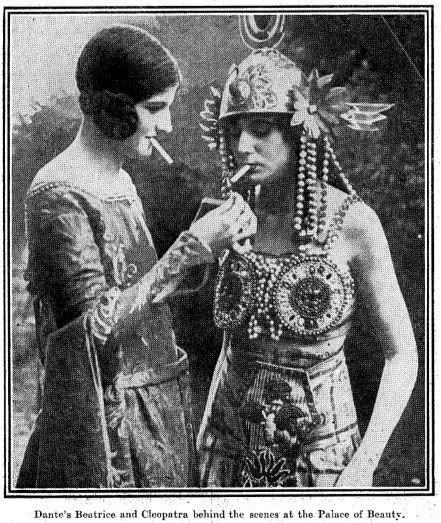
However, post war Ethel continued to star on stage and screen.  Possibly a reflection of Ethel's stardom was her employment in the Pears' Palace of Beauty at the 1924 British Empire Exhibition.  Ethel was Cleopatra in a tableau of some of the most beautiful women in history, which included Dante's Beatrice, Helen of Troy and, puzzlingly, Millais' Bubbles...

Ida Mowbray as 'Bubbles', apparently

The Pears' Beauties worked 7 hour shifts in a 14 hour day, splitting the role with another actress.  It was a very glamorous affair, as can be seen in this image of Cleopatra and Beatrice having a crafty fag between performances...
However, the cost of living an actress's lifestyle and raising a daughter on her own took their toll on Ethel, and in 1924 she was declared bankrupt with debts of £200, which was mostly dressmakers' bills.  She only earned £5 per week as Cleopatra and had a mere £2 in savings.  Still, again she bounced back with what would become her greatest hit and a stage sensation...

The Ghost Train by Arnold Ridley

In 1927, Ethel took to role of Julia Price in Arnold Ridley's The Ghost Train (Arnold Ridley was Godfrey in Dad's Army and the great-uncle of Daisy Ridley, Rey in Star Wars). This was not a new play, having been debuted in 1925 but the special effect of the train rumbling through the theatre was enough to electrify and terrify the audience. One man saw it three times attempting to see how they got a whole train into the theatre.  Once more Ethel was playing a thoroughly bad lot (sorry, spoiler alert) but one of her joys in life was playing a wicked women who managed to win the audience's sympathy by her performance.  The Ghost Train undoubtedly made her a star.  It also saw the debut of June Waller, her daughter, playing one of the minor roles.  

Many plays followed, including The Lonely House in 1930, noteworthy as the cast also included a young actor called Bertram Dix. He was only a couple of years younger than June, but it was Ethel who caught his eye.  While she continued to appear in movies and some stage work, the couple moved to Hendon and there opened a hairdressing salon and hat shop. Yes, that was a twist I was not expecting either. Despite claiming in later interviews that she had taken time away from showbiz to run the salon, Ethel still appeared in films such as The Man Outside in 1933, which can be watched on Amazon Prime...

This classic of cinema must have the poshest criminals in history and some exceptionally wooden acting, but obviously Ethel is marvellous as the spinster Aunt Georgina, complete with monocle...

Ferocious Aunt Georgina, telling off bad actors

I was somewhat surprised by Ethel's hair, properly short from the 1920s and I wonder if that was the work of Bertram Dix.  According to a 1934 newspaper article on the couple's salon, Dix was a hair artist and specialist in waves.  He had brought his experience in theatrical and film hairdressing to the establishment at 7 Greyhound Hill, Hendon.  Joining him in the venture was Ethel, there to give women beauty advice including which hats to wear with their new, beautifully waved hair.  As the report stated 'The hats are marked by impressive distinction and originality yet they are available at exceedingly moderate prices'. I do enjoy a moderately priced hat.

The interior of the salon was decorated with Ethel's paintings and drawings, just too small in the newspaper photograph to be able to see what they were like.  The couple had originally intended to open their place in the West End of London but Hendon was seen to have more charm, and I'm guessing less overheads.  

This business lasted until 1938 when the couple returned to the stage once more in Poison Pen, selling the business.  Then the war came, and the couple hastily wed, buying a cottage in Somerset.  Dix went to fight in North Africa, while Ethel remained at home, becoming patroness of the Ebbor Players, a local theatrical group.  She awaited the return of another husband, but when he returned in 1944, he no longer wanted to be married to her.

Ethel and Dix divorced in 1946, and Ethel carried on touring, starring in The Silver Cord in 1947 as it toured the south coast.  She moved to Sussex, but found that in old age her career began to stall.  In a letter to The Stage magazine in 1950, she reported the plight of older actors - 'The agents, bless them, are far too busy exploiting the youngsters to be bothered with us, and, save for a few exceptions, we're all out of work.'  She suggested that manager should form a company of 'old timers', with no-one under 60 - 'There are many old actresses of petite stature, who, with the help of wigs etc, would give excellent performances as youngsters' she wrote, rather optimistically. She also complained that younger actors didn't talk loudly enough.  Bless her.

Ethel died in the Cavendish Nursing Home, Bognor Regis on 12 September 1951, a couple of months shy of 71.  Her obituary in The Stage listed her art school training, her Shakespearean glory days and her three tours of Australia.  It also shaved a couple of years off her age.  I'm sure she would have been delighted.  I also hope that she would be pleased to know that I'm going to keep researching her because she is absolutely fascinating.  After all, we game old birds should stick together...

If you have any information about possible paintings or drawings by Ethel, please drop me a line at stonellwalker@googlemail.com.


Sunday, 16 December 2018

Sunday 16th December: Christina Spartali

Ah, Sunday!  Despite having to go and find some bathroom tiles today, I have the luxury of spending the day finding a long and happily-lived woman who had a jolly and fulfilled life and did a bit of modelling.  

Or I could bring you Christina Spartali...

Christina Spartali (1868) Julia Margaret Cameron
The surname will no doubt be familiar to everyone, and Christina was of course sister of Marie, artist and fellow victim of Julia Margaret Cameron.  When writing Girl Gang I did wonder why, when Marie Spartali and her cousins all became involved in the art world, why Christina didn't.  What did Christina do?

Christina Spartali (March 1868) Julia Margaret Cameron
Christina was born on 19th May 1846, younger sister of Marie who was 2 years older.  Her parents were Michael, a Greek merchant and his wife Euphrosyne, and in the 1851 census, Christina and Marie are listed as being born in Tottenham, probably at Page Green where the family were living.  She was followed (shortly after the census) by younger brother Demetrius (1851-1894), then Eustratius (1854-1933) and finally by sister Euphrosyne or Effie (1880-1935).  Holidays were taken on the Isle of Wight at the family's other home (the one with the vineyard) and it was there, in her mid-20s, that Christina fell under the lens of Mrs Cameron.  However, unlike the proliferation of Marie Spartali photographs, only a few of Christina seem to have been taken, which makes you wonder if she didn't find the process interesting or didn't enjoy modelling, both of which are raised in her most famous modelling job...

Rose and Gold: The Princess from the Land of Porcelain (1863-5) James Abbot McNeill Whistler
Begun possibly as a portrait of Christina, her father refused to buy it when it was finished, but Whistler exhibited it as a portrait of 'Miss S-' knowing that the viewers would be able to recognise Christina.  As I wrote in this post about Rosa Corder, Whistler was not the most humane artist to pose for and his treatment of Christina was no better, making her stand for hours on end while he painted and repainted the same piece of canvas. Marie Spartali told Whistler biographers Elizabeth Robins Pennell and Joseph Pennell that her sister posed for hours in a semi-darkened room until she became ill (possibly from peritonitis).  Another model stepped in to model the gown while Christina recovered and Whistler would visit her as she convalesced to draw her face. As this experience pre-dates the photographs by Mrs Cameron, it is possible to see why Christina would not be overly keen to do anymore modelling.

Portrait of a young woman, possibly Christina Spartali (c.1860s) Frederick Shields
The Spartali parents were very concerned with possible suitors for their daughters, or rather keeping them away.  It is very well documented that they did not approve of William Stillman when Marie married him, but even the wealthy and titled Count Eduard Joseph Cahen D'Anvers, a Jewish banker from Belgium, was not good enough for their daughter.  He ran the family business head office in Paris, and it was there that he and Christina eloped in December of 1868.  He had been given the title of Marquis di Torre Alfina, so Christina found herself Countess Cahen d'Anvers, society hostess in Paris.  In the British newspaper there are a flurry of interested pieces about how society in Paris conducted itself and Christina, at their house at the Bergeries entertained for the summer season.  When the French parliament went into recess, a comite de permanence (the once who got to stay behind and make sure nothing happened) were amused by what the Yorkshire Post  referred to as 'Parliamentary belles', which included Christina.

Portrait of a Lady, possibly the Artist's Sister (nd) Marie Spartali Stillman
It is uncertain when or why Christina started to use chloral.  Dante Gabriel Rossetti's habit was allegedly started via William Stillman, so possibly it was from her brother-in-law that Christina first acquired the pain killer, but she sadly fell victim to its addictive qualities.  Marie Stillman was sent out to Paris to help her sister, who was prone to illness (possibly due to the chloral) and according to Angela Thirlwell's excellent book on Ford Madox Brown, Marie found her brother-in-law lacklustre company.  Possibly, boredom drove  Christina's addiction, possibly the acknowledgement that she had escaped over-protective parents only to find herself in a highly gilded cage, far away from friends and family.

Christina Spartali (1868) Julia Margaret Cameron
Poor Christina's life now seems a little devoid of detail, all we have are the parties she held and the few pictures she posed for, unhappily.  A son, Rudolfo was born, possibly around 1871, when Christina was so ill that a reconciliation with her parents occurred.  I am grateful to David Elliott for including a little more about her in his biography of the Stillmans, if it is only to do with her final years.  In 1880, the Spartali's cousin Aglaia Coronio wrote to Rossetti asking if he had that Christina was seeking a divorce from 'that horrible little Jew, her husband' to which Rossetti (who also wasn't a fan) replied 'I should judge it high time'.  However, that divorce was not to be and the entertaining continued until 1884 when Christina died.  Most sources list her death as from 'unexplained' causes, and William Michael Rossetti referred to it being of a 'cataleptical' nature.  While there was a rumour that she had died in childbirth, Elliott's account tells of an overdose (accidental or otherwise) of chloral, discreetly covered up by family and friends.  Her body was brought home and buried at the Greek Cemetery in West Norwood, reunited with her family again.

Interestingly, while reading the details in the newspapers of Count Eduardo's will after his death in 1894, he left money to his sister-in-law, which leads me to wonder if they mean Marie Stillman.  If so, he obviously had a better opinion of her then she had of him.

See you tomorrow.

Wednesday, 5 December 2018

Tuesday 5th December - Constance Gilchrist

It struck me this morning that by writing about 24 women this month I'm doing the same level of work I did while writing Pre-Raphaelite Girl Gang.  Mind you, with my book I was talking about women like Elizabeth Siddal and Fanny Cornforth, women who were very well known to me.  The aim of this Blogvent is to talk about lesser-known women, women who don't get talked about as often.  Women like Connie Gilchrist.

Who is Connie Gilchrist? Hang on, I know a joke about that...


I remember Judge James Pickles' ignorance of who the Beatles were being used to mock people in authority who were felt to lack any sort of relateable knowledge.  What I didn't realise was that the original of this was Lord Chief Justice John Coleridge who asked the question 'who is Connie Gilchrist?', a phrase used to undermine those who sit in judgement.  It was a ridiculous question because at that time, Miss Constance Gilchrist was enormously famous.  She was the rope-skipping Gaiety Girl, the artists model who was beaten by her mother, and the girl who married the Earl.  Who could possibly not know who Connie Gilchrist is?

Connie Gilchrist, 1870s

Constance McDonald Gilchrist came into the world on 23rd January 1863.  Her father was a Scottish mechanic called David, who had married Matilda in 1852.  Matilda was an artists model and so it seem unsurprising that she would take her daughter with her when she went to pose.

The Music Lesson (1884) Frederic Leighton
Above is Connie, reportedly with her mother, who was posing for Leighton at this time.  Leighton also used her for Little Fatima at around age 6, and all of the chorus of girls in Daphnephoria, at 11 years old...

Daphnephoria (1876) Frederic Leighton
Detail of the above with a chorus of little Connies...
She posed for Frank Holl at 4 years old, and when she was 10, she was the model for his illustrations for W S Gilbert's  'Little Mim', which had a tight deadline resulting in long hours of work for the artist and model.  

Illustration from 'Little Mim' (1875)
 After hours of posing she often had to be held up by Mr and Mrs Holl at the end of a sitting.  Holl's daughter loved having another child to play with, especially one as fun-loving as Connie.  However, Connie wasn't like other children because not only did her mother take her modelling, her parents had also placed her on the stage where she danced all the evening and half of the night.  She was then taken home and washed ready for the next day's posing.  One morning, Connie had to be taken to an artist's studio in a dreadful state as her mother had whipped her for refusing to have her hair washed at 11 o'clock the night before.  If we are to be more generous than Matilda Gilchrist deserved, it could be argued that her mother's intensity was learned from years in the modelling business, years that were definitely finite.  Matilda posed for Whistler and, as if to prove this theory right, he moved on to the daughter.

Tilda Gilchrist James McNeill Whistler


Harmony in Yellow and Gold (1876-7) James McNeill Whistler
Connie Gilchrist was best known as the skipping-rope dancer at the Gaiety Theatre, immortalised by Whistler.  She was described in this painting in The Morning Post of 1921 : 'The painting shows her in the act of skipping, with her fair, small-featured, babyish face, light wavy hair, and straight, slight boylike figure. She is wearing a short gold tunic, high fawn boots, and fawn stockings. The background is pale gold, against which glow the red handles of the skipping ropes, the only touches of bright colour in the portrait.'  It was very popular, declared the painting of the year and sold to an American collection.  Reading between the lines, the role of a 'dancer' in the theatre was not even as respectable (reputationally speaking) as that of actress, because there was not the great art of Shakespeare to defend yourself with.  However, Connie's slenderness and child-like looks seem to have held back commentators on that score for a while.  In fact, it was this very quality that drew another admirer to her.

Connie Gilchrist (1870s) Elliott and Fry
On a visit to the theatre, Lewis Carroll saw a play acted entirely by children - 'The harlequin was a little girl named Gilchrist, one of the most beautiful children, in face and figure, that I have ever seen.  I must get an opportunity of photographing her.'  A month later, Carroll sent Matilda a letter offering to send Connie a copy of Alice's Adventures in Wonderland and wrote acrostic poems for her.  When he finally got to meet her, he declared her the 'most gloriously beautiful child' - 'One would like to do a 100 photographs of her', although it remains doubtful if he ever even managed one.  In July of the same year, still mad about the girl, Lewis Carroll stopped by the Westminster Aquarium to see Connie do her act and then take her to the Royal Academy to see some paintings (possibly even some she appeared in). The relationship cooled and Carroll moved his affections to other children and when he saw Connie doing her skipping rope dance again the following autumn, he recorded in his diary that she was losing her beauty.  She was 13 years old.

Connie Gilchrist, 1880s
Not everyone was a fan of little Connie.  The London Express of 1879 wrote 'Miss Connie Gilchrist's education being probably as limited as her apparel, she would doubtless need to be told that the 'Gold Girl' [the informal title of Whistler's painting] is a libel on her personal appearance.' One other charming soul remarked that if any 'patient at Worcester' behaved and dressed like Connie did on stage, they would be put in a cage for life.  The comments seem to be more about Whistler and his choice of a scantily clad child as subject, but it is Connie who named and shamed at 14 years old.

Connie Gilchrist 1870s
Connie Gilchrist performed in popular pantomimes at the Adelphi Theatre and Myers' Circus Company in Paris, and even did some straight acting, at which she was not in the same league as Ellen Terry but pleased her audiences.  She played Maid Marion in Litle Robin Hood (1882), and Anne in Blue Beard (1883).  She still posed for Leighton, seemingly never aging, but if her life was as hectic and hard-working as it seems, it's hardly surprising she remained such a wisp.

Study; at a Reading Desk (1877) Frederic Leighton
Had this been the amount of Constance Gilchrist's life, I'd be quite sad for her.  Yes, she was well-known and much in demand, however at what price?  If you are whipping your child in order for her to fulfil your dreams of stardom then you missed a parenting meeting.  However, her stardom brought a rather prestigious admirer to her door.  In the newspapers of 1892, rumours abounded about whether Miss Connie Gilchrist was about to be led to the alter by none other than the Earl of Orkney.  Edward Walter Fitzmaurice was a year younger than the actress, but the couple found much in common including Miss Gilchrist's apparent love of hunting, shooting and fishing leading one newspaper to declare her 'a Diana among hunters'. The Earl was young and not very well known in society.  He had lost both parents and elder brother in the decade before, and so, at the age of 25, found himself an Earl and in need of a wife (as Jane Austen would say).  

Tea break, 1875
The couple were married in the summer of 1892 in front of a small group of friends and family.  By this point, both of Connie's parents had died and so she was given away by the Duke of Beaufort.  After a quiet Wedding Breakfast, the couple left to honeymoon in Minehead.  I went on holiday there once, I caught crabs.  The trick is to use bacon.

After that, as The Stage of 1946 reported at the time of her death, 'she settled down to a quiet country life with her dogs and horses'.  I think, to be honest, that the amount of work she had done in the first 25 years of her life meant that she was allowed to relax for the next 50.  However, what Connie Gilchrist's story tells us is that it is easy to see child stars with rose-tinted specs without comprehension how much work that child has to put in, even without an abusive parent.  Those beautiful, perfect little girls on Leighton's canvases hide a little girl who had to be held up at the end of sittings because of exhaustion and still the media felt entitled to cast aspersions upon her character and intelligence, whilst still merrily watching her skip away her youth for their entertainment.  Better still to remember her as The Stage summed her up in 1946 - 'She had a grace and charm of personality worthy of the happiest tribute from any quarter.'

See you tomorrow.

Friday, 3 August 2012

Marie, Full of Grace...

I have to admit that one of my favourite Rossetti pictures doesn't involve Fanny Cornforth.  Please don't tell her.  In fact, it doesn't even involve Alexa Wilding.  It is this one...


A Vision of Fiammetta (1878) D G Rossetti
It's just so very orange-y.  Okay, I admit that's not a very intellectual reason for loving something, so I'll cover by saying that the apple blossoms are exquisite and their promise of renewal is countered by the fact that Fiammetta is dead and this is a final vision of her.  It is temptation and denial, it is body and spirit, and it is not Alexa Wilding, no matter how much it looks like her.  It's a lovely woman called Marie Spartali Stillman.


Starting out when Marie was merely Spartali, she was a member of the powerful Greek community in London, with people such as Maria Zambaco and Constantine Ionides.  She was the daughter of Michael Spartali, and import-export merchant, who had been born in Greece, and Marie was born in Middlesex in 1843.  She had an equally beautiful sister, Christina, who modeled for Whistler in this rather lovely image...


Christina Spartali
La Princess (1865) J A M Whistler


The family had a house in London, on Clapham Common, called The Shrubbery, with views over Chelsea, and they summered on the Isle of Wight where Daddy Spartali grew grapes.  How marvellous.


From 1864-70 she trained under Ford Madox Brown, developing into an artist of obvious Pre-Raphaelite leanings...


The Lady Prays - Desire (1867)
It was while she was learning her craft that Brown became infatuated by her.  When I first read that, I thought I had read wrong because that is exactly what happened with Maria Zambaco and Ned Burne-Jones, but apparently it was the rules.  You teach a nice Greek girl, you have to become obsessed by her beauty.


Mariana (1867)
Mind you, her pictures are rather lovely.  Her sole female figures in wistful poses are typical of the period, but are reminiscent of Rossetti, with the watercolour romance of his earlier work.  Mind you, where Rossetti's women often just seem to exist to be looked at, there is a more dynamic aesthetic behind some of Marie Spartali's work.  Take the emotional Antigone...


Antigone (1871)
The picture conjures a splendidly bleak feeling, quite isolated and desperate.  When Rossetti heard she was training with Brown, he sent word to his old friend, insisting  "I just hear Miss Spartali is to be your pupil. I hear too that she is one and the same with a marvellous beauty of whom I have heard much talk. So box her up and don’t let fellows see her, as I mean to have first shy at her in the way of sitting."   Gosh, Rossetti, you smoothy.  I think Old Brown actually fancied having a 'shy' at her, but Rossetti used her as one of his regular models from the late 1860s onwards...


The Bower Meadow D G Rossetti
She was used as a bookend for Alexa in not only The Bower Meadow but also the reimagining of Dante's Dream, where she holds the other end of the canopy over the dead Beatrice.


Dante's Dream at the Time of the Death of Beatrice (1871) D G Rossetti
The lovely Miss Spartali is on the left, or is it right?  Hang on....


Chalk Sketch of Marie Spartali (1870) D G Rossetti
Right, she's on the right.  I think.  Ho hum, anyway, also of note in the picture is a certain Mr William Stillman, playing the part of Dante.  It is uncertain whether Miss Spartali and Mr Stillman had met before this picture, but Marie fell in love with William, an American widower.  Her family were against it, but the couple married in 1871.


William Stillman D G Rossetti
Sensible girl that she was, she modelled for other people too, posing for Burne-Jones (The Mill and possibly The Beguiling of Merlin) and countless images by Julia Margaret Cameron...


Marie Spartali (1868) Julia Margaret Cameron
William's job as a foreign correspondent saw the family move to Italy and travel in America, where she painted and exhibited on the east coast.  Despite the unsettled nature of her family life, she was a regular contributor to The Grosvenor Gallery and its successor The New Gallery, but although her work was popular, it didn't seem to sell in the shows.  


Love Sonnets (1894)
When she died, she left a note with her Will that it seemed odd to leave a Will when she had nothing of great interest to leave.  Today, however her works are numbered in some of the great Pre-Raphaelite collections in the world and her body of work is valued at many millions of pounds.  In her obituary in The Times, in 1927, it was written 'With the great triad of those early and now remote days, Mrs Rossetti, Lady Burne-Jones, and Mrs Morris, she was almost a fourth, and of the two latter was a lifelong friend.'  She was known as a talent and a beauty, in fact Swinburne described her thus: 'She is so beautiful that I want to sit down and cry!' which I think counts as a fairly good compliment.  People often want to cry after meeting me, but I think that might be different...


Her work was included in the 1998 Pre-Raphaelite Women Artists exhibition in Manchester, and I have read her described as the best of the female Pre-Raphaelite painters.  It does seem that she was described as such, a true Pre-Raphaelite, from the first, possibly because of her connection to the founders of the brotherhood and the circle as a whole.  


St George (1892)
She continued to paint in the style, producing beautiful works through the turn of the century and beyond, through motherhood, bereavement and endless travel finally settling in London with one of her step-daughters.  Her friendship with Georgie Burne-Jones and Jane Morris shows how she was regarded by the circle, and Samuel Bancroft Jnr wrote to Fanny Cornforth that he had met Marie Stillman (who Fanny claimed to know).


Kelmscott Manor (1905)


Stillman's daughter from his first marriage, Lisa, became an artist, and Marie's own daughter Euphrosyne (Effie) became an artist and sculptress too...
Portrait of Effie (1876)
Arnold Toynbee (1893) Euphrosyne Stillman
Her son Michael was an architect and settled in America, where it seems her art was taken slightly more seriously as retrospectives were held in 1908 and 1982.  Maybe one could be held in this country soon in light of the rather marvellous exhibition of Eleanor Fortescue Brickdale that is exciting us this year.  In any case, it's rather splendid to see her work, which I feel gives a glimpse of what Elizabeth Siddal's work may have been had she lived.  Marie is a Pre-Raphaelite heroine and a powerhouse of art and I look forward to seeing her profile raised when Pre-Raphaelitism becomes all the rage this Autumn...