Showing posts with label Edwardian. Show all posts

Wednesday, 7 May 2025

Fake Nudes

This is a grumpy post, so strap in. It all began by an innocent flick through a 1907 copy of The Green Room Book looking for info on Ethel Warwick.  What I came across left me astonished and extremely depressed.  It also led me down a rabbit hole.  Let's pause for a moment, and consider the following women - what do Halle Berry, Christina Hendricks, Blake Lively and Taylor Swift all have in common?

Miss Taylor Swift and Cat, real photo

They, and many other actresses/celebrities/schoolgirls/women have all had to speak out and deny fake nude photographs generated by AI. Taylor Swift's fake nudes recently went viral on X, which doesn't surprise me at all as it is a cursed cesspit, but she is just one of a multitude of victims, albeit one with enough money and influence, if not to stop it, then raise awareness of the crime against her. This is a disgusting modern crime, or at least that was what I thought.  Then I met Gertie Millar...


Gertrude Millar was born in February 1879 in West Yorkshire, daughter of an engine fitter and a weaver, employed in the local fabric trade. Gertie, as she became known, was somewhere in the midst of around seven children, but became a child star in the Northern Theatre musical scene, moving from the Manchester theatres down to London by the early 1890s.  She toured the provinces with plays, pantomimes and all sorts of variety theatre fare, becoming one of the most popular, most photographed actresses of her generation.


The point about her status as one of the most photographed is relevant, as Gertie seems to have become famous just as the craze for theatrical photograph collecting reached its peak. As I have written about in regards to the gorgeous Lewis Waller and Audrey Roper's collection, young women especially (but not exclusively) spent a sizable amount of money on the suddenly freely available postcards of their favourite stars, and there was almost a rush to see how many images of certain stars could be produced.  I must admit I now have an absolute weakness for buying these images as some of them are beautiful little works of art, but if you were dedicated to people like Gertie or Zena Dare, you would go out of your way to collect as many different photographs as you could.  I have noted on the backs of some I have bought, the original owner has written where they saw that actor or actress last, or a friend has sent it to them saying 'I don't think you have this one!' As my daughter says, they seem to be the original Pokemon.  You can't just have one Gertie Millar, you have to catch them all!

Gertie was an absolute super star in the modern sense.  In 1902, she married composer Lionel Monckton who wrote the scores of many of her musicals. In 1905, a besotted fan shot himself in her house. She was wholesome and beautiful, a little scandalous (she showed her ankles while in pantomime!) but always good fun and professional and the nation loved her.


From what I can gather the photograph publishers would pay an actor or actress for a sitting, then the publisher would have the rights to that image, and it would be up to them to sell as many as they could.  The smarter star worked out that in the early 1900s boom in this industry, you should be charging the publisher an absolute premium as they were about to make a small fortune out of your face. The idea of copyrighting your likeness or having control over these promotional images was not yet formed, but one court case changed the way that stars, especially female stars viewed the industry. 

If you were a publisher who could make a fortune out of an image of a famous, beautiful young woman, why spend money on new images when you could make your own? 

Also, is there any sort of image of a young, beautiful woman that might sell particularly well? What might tempt the untapped market of men to buy images of actresses?

Hmmm, let me think...


It all started quite innocently, with the slight changing of one image to another. Gertie Millar is seen as possibly Miss Muffet, shaking her finger at a naughty spider. It seems to be one of a series (as they often are, all products of the same photo-shoot, making as much money from one session) and in other images Gertie is either dancing or being afraid (although with a smile) but the one we need here is where she is shaking her finger. It is what is described as a 'novelty image,' an impossible, amusing photograph, altered to be humorous. This might have been to do with one of her pantomimes but might just have been a cute image. There are any number of things like this - women popping from crackers...

It's either a very large cracker or a very small actress...

...emerging from Easter Eggs...

It would have been embarrassing if we had boiled Gabrielle Ray...

Maybe you just want your name written in actresses' faces?


As you can see, things moved swiftly from images of a person, or of a scene/character in a play to more unique, unusual images.  However, what if the images were not what you, the subject, wanted and felt that were detrimental to how you were seen by the public? This is where Gertie Millar came in.  Remember the picture of her with the spider?  How about this one...?


In 1905, Gertie noticed that there were images circulating that she had not been aware of.  Starting with the image of her with the baby, she was sent other images that she had not even sat for.  While she did not take great exception to the image with the baby (it is offensive because of the connotation and the way it was subsequently spoken about, but also it is just Gertie shaking her finger at a small child rather than a spider), there were others where Gertie's head had been put on the body of another woman, and you will be unsurprised to hear that woman was rather flimsily dressed.  They all were released by R Dunn and Co, publishers at 63 Barbican in London.  Ralph Dunn had made a business in the production of all sorts of photographic images, obviously moving into the celebrity postcards because of the money to be made, and many of the more novelty ones I found were registered to them, so they were obviously skilled at image manipulation, or rather weren't afraid to create an image when one was needed. However, Gertie felt that Dunn had done her reputational damage and so she sued him.

There was a short paragraph in The Green Room from 1907, under the title "FAKED" PHOTOGRAPHS which stated: 

'Miss Gertie Millar aired a real grievance in the Court of Chancery in June last, when counsel appeared on her behalf, and asked for an injunction to restrain Messrs. R. Dunn and Co. from publishing postcards on the back of which appeared photographs representing her in a nightdress, and in other different costumes none too abundant.'

Obviously, the term 'none too abundant' caught my eye as that really could only mean one thing, they had made fake images of her with her kit off.  Gertie, appearing as Mrs Lionel Monckton, began the case in April of 1906 but had to wait until the beginning of 1907 to have it heard in court. The press coverage at the start should have given us a warning of what was to follow, as the Bristol Magpie set the tone in a short piece in April 1906:

'Gertie Millar recently tried to restrain a certain firm from publishing picture post cards, representing her in a night dress - not of course that the actress wanted to be exhibited without the gown in question, but because she thought the costume a bit too light and airy, of course it was very naughty of Messrs Dunn to do it but it is to be hoped that Gertie's garment will in future find less display on public postcards, such a sight should only be reserved for the pillow and the bolster.'

Let's start with exactly why this bothers me so much - the use of 'naughty' and the hint that the night dress was Gertie's, that she had accidentally posed in it and now was trying to take back the image, or that she would be better off without it. All of that set the stage (as it were) for a court case that not only argued that as a public figure, Gertie's body was public property, but also a very loud undertone that if women didn't want to be seen in very little clothing, then they shouldn't go around being naked under their clothes. It's the same reasoning that reduces the seriousness of when a girl's nude photograph is passed around.

Exhibit A

Viv Gardner included the images in the marvellous chapter 'Defending the Body, Defending the Self' of Stage Women 1900-50 but I bought my copies of various faked images off eBay for around £1, which is sobering. In the April hearing in 1906 with Mr Justice Warrington presiding, Mr Whateley (on behalf of Gertie) applied of an injunction to restrain R. Dunn & Co from issuing the postcards bearing the alleged images of Gertie in a nightdress, as Circe (wearing very little) and emerging from an eggshell.  Whateley stated that the photographs had been created by placing Gertie's head on another woman's body.  Stunningly, Ralph Dunn agreed that yes, that was exactly what they had done and said he wouldn't make any more. That was easy, wasn't it?  Whateley said that Gertie would be seeking damages for them making the fake pictures.  That's when the trouble started.

Queen Victoria Receiving the News of her Accession (1880) Henry Tanworth Wells

The Portsmouth Evening News reported on the trial that started in January 1907 under Justice Darling, a frankly atrocious human being and obviously ironically named. Gertie's contention was that by showing her semi-nude, or even in her night attire, it would lead the public to think she was 'an indelicate, immodest and vulgar woman.'  She particularly objected to the one in her nightdress and the one where she was emerging from an egg as they were 'very vulgar, and she also objected to them because they were not pretty.' Now, we come to the problem as the newspaper reported that the last statement received laughter. In fact, the whole of the court case was played like a musical hall skit with Justice Darling assuming himself to be the star comic turn. When Gertie was cross-examined, it was put to her that she had been in a play where she had sung a song about a bathing suit and in The Orchid where she sang a song about pyjamas, therefore why would she object to being pictured in said garments.  Furthermore, because she objected to the nightdress, the defendant's council asked if Gertie knew of a painting depicting Queen Victoria receiving an Archbishop and the Lord Chamberlain in her nightdress on the night she ascended to the throne? Gertie replied 'Oh, that was before my time.' (laughter)

Gertie in The New Aladdin

Dunn's main defence was that actresses wore nightdresses on the stage, even Lady Macbeth and Juliet wore night gowns in the plays, even though Gertie pointed out she had never done it herself. It was pointed out that Gertie was currently appearing in the pantomime The New Aladdin playing the Principal Boy in knee breeches and high boots.  She had also appeared as a costermonger, dressed as a man. What is the problem of her being pictured in more feminine attire? She had also actually appeared with an egg for The Orchid in April 1905...


In the contested image (I think it is this one I pinched from eBay), Gertie is seen crawling from an egg...


You can see 'R. Dunn' written on the bottom left side even though the image had been taken from a photograph by Bassano.  To our modern eyes, Gertie is adequately dressed in both of these images by Dunn - the image of her as Circe or a Sea Maiden, depending on who is talking about it, is slightly more risque and hard to find, but she is still covered up with gauze - but as Gertie summed up, she felt she should have the right to choose what way she should be presented to the public in photographs. This is not a painting, this is a photograph which people believed, especially in this period.  No, the public are not going to believe she exploded from a cracker or somehow cloned her face into the name ETHEL, but when it seems a straightforward image of the woman crawling from a giant prop egg, or holding a candle, then it seems like a real image that Gertie posed for and approved.

The Somnambulist (1871) John Everett Millais

The questioning was relentless - when shown other images of women crawling from Easter eggs, Gertie said she knew of them - they were eggs with beauties inside. The defending counsel swiftly said 'but you are not one of them?' and Gertie replied 'No, I am not among the beauties' (much laughter). Gertie appeared in furs at the court, a brown on the first day and an ermine on the second, which was noted. It was asked if she knew that her postcards sold for 2 pennies, which she knew.  She was asked if she knew that Dunn sold his made-up cards for a penny, which she did not know. She was asked if she would appear in a nightdress on stage, in for example in the opera La Sonnabula or as Lady Macbeth and Gertie said she probably would if the role required it. When asked what she wanted, Gertie simply said that she wanted people to know that it wasn't her in the postcards. She was asked if she wanted compensation, she said that was for the jury to decide. The woman in furs had said she not only wanted to stop the man making money from his postcards but also refused to let her postcards be a penny, an affordable sum.

Gertie Millar, well, part of her...

The argument became one of imaginary rings of big publishers, all banding together to run the little man out of the business because he had dared to publish photographs at an affordable price.  Despite the reiteration that Gertie just wanted them to not fake her image, Dunn said he was only giving the public what they wanted. The jury found him innocent in only 10 minutes.

However sneering the papers were before the verdict, they soon changed their tune because Gertie was not wrong to believe she was valued by her public.  She published a very dignified letter in the newspapers on 4th February, a few days after the verdict, to thank the people who had reached out to her and conceded she would not be appealing the verdict. The jury had told her she was wrong to bring the action, but the public had told her she was right to feel defamed by a fictitious photograph. I particularly enjoyed G K Chesterton's rebuttal of the whole case in the Illustrated London News where he rightly points out all kinds of fictitious images can be created in paintings, but photography is believed to be true and real.  When Gertie said that people seeing the image of her wrapped in gauze by a riverbank or appearing in her nightie would think it was true. Chesterton went further and said the argumentative nature of the case was ridiculous when the crime was openly admitted to - if a coal-heaver was assaulted, he would not be expected to argue the ethics of assault in court. Even the Law Journal got involved, criticising the behaviour of Justice Darling. Gertie's counsel, Mr Foote KC did not stand a chance against the main-character-energy of that judge, going out of his way to state outright that Gertie was no better than she ought to be. The way he tried to imply she thought herself better than the Queen made a mockery of her as everyone knew she was just a working-class lass who sang funny songs for a living, sometimes in trousers where you can clearly see she has two legs. 

Within the month Lionel Monckton had written Gertie a new song to perform entitled 'My Photographic Girl' about the whole affair. Good for them. However, that was not the end of the affair, and, for a moment, the can was open and the worms were everywhere. Look what else I found on eBay...


Actresses flooded to the newspapers with their own stories in support of Gertie. Miss Marie Corelli was refused an injunction against a photographic publisher who faked some of her images. Miss Denise Orme's image was altered, her evening dress painted out and a see-through gown put in its place. Edna May had found countless images of herself crawling from seashells and eggs and in a variety of costumes and she had to complain to the publishers, although she feared millions of copies were already in circulation. Constance Collier said she had to be careful, and her own publishers were vigilant, but the verdict frightened her. Camille Clifford quite rightly saw there was no limit of what could be done with her head on another's shoulders. Olive May thought it was potentially ruinous for a young actress who would not be hired if she was thought to be the sort who posed in the nude. Anonymous actresses reported knowing their images were being faked but not wanting to be the sort of girl who causes trouble as that too would ruin your career.  All sounds very familiar, doesn't it? As the image of Carrie Moore above shows, the practice was widespread, and the actresses all wisely feared but didn't explicitly say 'where will it end?' and now we know. Tellingly, I have not found any reports of male performers being faked in this way. Whilst I don't doubt these days both sexes are probably victims of those who wish to fake images, I'm willing to bet the majority (by probably a mile) are still women.

Truth magazine published their own exasperation in the verdict, and added a poem which sums up the situation we are in now, so I will finish with that:

I thought it hard her face they matched
With form suggesting too much leg;
I thought it hard they showed her hatched
Just lately from an Easter Egg.

I thought it hard they stuck her head
Upon a trunk in nightdress clad;
And yet - so judge and jury said - 
No legal remedy she had.

If that's the law, I'm much afraid
That I, one day, my face will find
On someone else's frame displayed,
Clad only in a - never mind - 

Or even worse in nothing dight
(For where the limit can you draw?)
And yet I'll not have any right
To stop their game - if that's the Law.

Sunday, 8 November 2020

Straight Outta Hendon...

I hope you are all coping in the current uncertain situation and keeping well and reasonably sane.  I have always been someone who uses the fact I can become absolutely obsessed by a subject to stave off stress.  It's distraction, I know, but when the stressful thing is beyond your control then it probably serves me better to research the heck out of a subject than to worry about whether I have enough bread flour or if I will catch the 'Rona by going to get some more.  Anyway, all that comes to explain how I came to meet and fall in love with Ethel Warwick...

Ethel Warwick (1924) Bassano Ltd

Hang on, what am I doing with a twentieth century muse? Gorgeous as she is, isn't Ethel a bit out of my timeline? Well, normally I'd agree, but you see this is also Ethel...

The Lament for Icarus (1898) Herbert Draper

There she is, lamenting the rather gorgeous Icarus. So, how did that girl go on to be an internationally successful actress, friend of Sarah Bernhardt, twice married, hat designer and a successful artist in her own right? And why don't we remember her now? When I started looking, all I could find was a lovely essay on her by Simon Toll in the British Art Journal, but I wanted more. I read the following exchange in an interview with her:

"It was Whistler who, when Miss Warwick told him that she intended to go on the stage, asked why she chose such a life. "For the honour and glory of it," the girl replied and the great man growled out: "Isn't it honour and glory enough that you have sat for me?" "

Blimey, how could I resist? Let's go back to the beginning...

Ethel Maud Warwick was born in Hendon on 13 October 1880.  She nudged her birthday down by a few years as she got older, which is understandable in her subsequent line of work (if anyone asks, I was born in the late 1990s and not 1973 as my lying birth certificate would have it).  However, some researchers have raised their eyebrows at the difference in a few years if you take into account that she posed nude for artists in her mid to late teens.  Knock four years off 17 and it makes people uncomfortable, but we'll come to that in a minute.  Ethel's father, Francis, was a Railway Station Master, and Ethel was Francis and his wife Emma's third daughter, after Amy and Emma Junior (also known as Emily).  Ethel would be followed by two boys Francis and Herbert.  By the 1891 census, the family had moved further into north London, to Lismore Road in Kentish Town.  As a girl, Ethel recalled later, she was keen on art and her parents sent her to the Polytechnic to study, followed by the Camden School of Art under Francis Black, RBA. Somehow in the mid 1890s, Ethel came to the attention of Herbert Draper.  It is suggested that he saw her in the street, but I think possibly its more likely that they became connected through the art school scene.  Anyway, the upshot was that she posed for this...

The Sea Maiden (1894) Herbert Draper

 Okay, so we have to give Draper a bit of artistic license because that is not a 14 year old nude Ethel (for reasons I'll come to) but you now see why it's important to acknowledge she was 14 and not younger when she posed for this (even though even that gives us pause these days).  Anyway, Draper wasn't the only artist who took a fancy to Ethel as a model.  She also posed for Philip Wilson Steer...

Hydrangeas (1901) Philip Wilson Steer

Not to mention James Abbott McNeill Whistler...

Ethel Warwick Holding an Apple (c.1900) James Abbott McNeill Whistler

But my favourite of her artists, and the reason I met Ethel, was John William Godward...

Ethel (1898) John William Godward

This painting is in the Russell-Cotes Art Gallery and I've always loved it because I have a soft spot for Godward, and this is totally unlike his normal output, which is more like this...

Study of Miss Ethel Warwick (1898) John William Godward

The idea behind the first Godward image is possibly a picture of Ethel as she arrived to pose for Godward, and that he was so fond of her, he painted her like that too. Looking at Ethel in the second image, you can see how her likeness can possibly be seen in an awful lot of Godward's art or at least her dreamy beauty lends itself to Godward's vision of drape-y classical loveliness.  By 1898 Ethel was acting as a model at art school, seemingly as much as she was being a pupil. As well as Steer, Draper, Whistler and Godward, she also appeared at the Camera Club in Charing Cross Road for the Punch cartoonist Edward Linley Sambourne...

Ethel Warwick 1 August 1900 (1900) Edward Linley Sambourne

 Honestly, given a lot of the images taken by Sambourne, this could have been a lot worse, and there are far more naked pictures of Ethel by him. However, it was while posing in a tableau for Solomon J Solomon that Ethel was spotted by Herbert Beerbohm Tree who thought looks like hers should permanently go on the stage. He had arranged a theatrical review, including the tableau (that also involved other famous women such as Elinor Glynn) for a charity performance at the beginning of the Boer War.  By the time she posed for Sambourne in the above image, Ethel was already planning on leaving her modelling behind her.  After 9 months of instruction at Henry Neville's acting school, she debuted on stage on 25 July 1900 at the Grande Theatre Fulham under the management of Neville in The Corsican Brothers. As the curtain rose, Ethel recalled that her nerve failed her, but Neville patted her on the back and whispered 'Remember your first line'.  That first line was 'Courage! Courage!' and so, with courage, Ethel embarked on her new career...

Day and the Dawn Star (1905) Herbert Draper

 That's not to say she didn't combine her professions for a little longer; Steer's Hydrangeas was in 1901 and Draper's Day and the Dawn Star was in 1905, but much to the disappointment of her artists, Ethel had fallen in love with the theatre. Having said that, the theatre had fallen very much in love with Ethel and so the offers of work came in.  The actor-manager Herbert Beerbohm Tree gave her work because he liked the way she walked.  He gave her a bit part in Herod at His  Majesty's Theatre in the Haymarket.  It was just a single line part but she understudied the role of Judith, only to arrive at the theatre one evening to be told she would be on stage in the bigger role with only a quarter of an hour to prepare.

Ethel in Captain Kettle (1902)
 
In 1903, after success in plays such as The Gay Lord Quex and Captain Kettle, she joined Frank Benson's Shakespeare company, playing Portia and Juliet to great acclaim.  However, despite leaving modelling behind, Ethel had not abandoned art, far from it.  It was entirely her intention to be an actress/artist and an interview with her in 1904 pictured her as both a serious artist and actress...

Miss Ethel Warwick at her Canvas (1904)

 Here is where you might be able to help me - does anyone know of any of Ethel's paintings?  I've searched online, and despite her many interviews mentioning how internationally successful she is as an artist, I've yet to find an image by her.  This is not helped by the fact that Ethel Herrick Warwick (1881-1961) was also an artist and so there are paintings which might be Ethel Maud Warwick's work but mis-attributed online subsequently because of Ethel Herrick Warwick's relative fame in comparison.  Anyway, on with the theatre!

Young Ethel, on the brink of Theatrical Superstardom!

The turning point arguably was the offer from Florence West to appear in Vilma.  Florence was married to major acting celebrity Lewis Waller and a star in her own right.  Excuse me while I show you a gratuitous image of the gorgeous Mr Waller...

Good Lord, I should say so...
 
It was through Florence that Ethel met Edmund Lewis Waller, son of the acting family and not a bad looker himself (although not a patch on his father, in my humble opinion)...
 

In 1906, Ethel got the chance to tour South Africa with William Haviland's company, appearing as Ariel in The Tempest.  Edmund Waller was also part of the troop and the couple married while on tour, returning as a golden couple of stage, with Ethel's place ensured within stage royalty.  As a wedding present, Florence West gave her new daughter in law the rights to star in the play Zsazsa, a role that Florence had epitomised and that Ethel had briefly understudied.

Ethel Warwick in 1907 publicity photographs

In June of 1907, the couple had their first and only child, June Belle Florence Waller, but Ethel continued to work and promote herself, as La Giaconda in the play of the same title by D'Annunzio, starring as an artist's model, in 1907, then in The Merry Widow  in 1908. When she appeared in The Volcano in 1908, The Morning Post described it as so exciting it was 'the next best thing to being at the foot of Mount Versuvius during an eruption' which is quite a claim.

Ethel as Milady in The Three Musketeers

In 1911, Ethel appeared to much acclaim in The Three Musketeers as the infamous Milady.  The newspaper reviewers seemed to get themselves in a right lather over one scene where D'Artagnan pulled the shoulder of Ethel's frock down revealing her fleur-de-lys mark on her 'lily white arm'.  The scene was so scandalous that Ethel went out and got publicity cards taken, shoulder out.  Saucy minx. 

Well, quite.

Ethel showed a level of canniness when it came to attention grabbing roles. In 1912 she appeared in the revival of Woman and Wine at the New Prince's Theatre.  Her performance as the villainness of the play was described by one reviewer as 'very beautiful and very, very lurid'.  The climax of the play (if you excuse the phrase) involved Ethel and another actress removing their bodices and fighting to the death with knives.  Lawks, no wonder it was popular.

1912 was a monumental year for Ethel for a number of reasons.  She became manager of her own theatre, the Queen's Theatre, and starred in Zsazsa.  It was also the year that Florence West, Ethel's mother in law who had given her the play as a present, died, aged only 53.  Zsazsa  struggled with reviewers, possibly because it had not been long since the last revival, possibly because of changing tastes in the theatre.  Ethel's performance however was never in question.  Sarah Bernhardt, who was starring in The Loves of Elizabeth, Queen of England at the Colliseum, came and saw Ethel perform and raved about how good it was.  She sent Ethel a present, a copy of her birthday book, inscribed 'To the delicious artist, Ethel Warwick, with my deepest affection.'

From Ben Hur 1912

What should have been a glorious year was actually the beginning of an unlucky spell for Ethel.  In November of 1912, Florence Waller, Ethel's mother-in-law, died aged only 53. Edmund also became ill and was taken to hospital in January 1913. When he was released in March, he left England to join his father in America on the last leg of a tour.  A short piece in the paper reported that Ethel's production of a new play had been postponed due to her own ill health, but in actuality, she had become concerned with the whereabouts of her husband.  When Lewis Waller returned in early April, Edmund was not with him.  He had gone to Australia.  Taking pity on his daughter-in-law, Waller gave Ethel the address and she wrote begging Edmund to return.  He replied thus:

"Dear Ethel,

                    Just a line to say I received your letter, and its extraordinary contents amused me.

I have no intention of returning to you ever and consider you are quite capable of supplying yourself with any amount of homes.

                                Yours truly,

                                                EDMUND WALLER"

Ethel pursued Edmund out in Australia, getting acting jobs in order to plead with her husband to return, going as far as to file for a 'restitution of conjugal rights', but Edmund was having none of it.  On her return, Ethel was left with no other choice but to file for divorce.

The beautiful Gabrielle Ray

Actually, unluckiness in love was nothing unusual for stage actresses in 1913.  This rather splendid article tells of the beautiful Gabrielle Ray who ended her marriage after barely a year in 1913 when her husband strayed.  The hiatus in her career, although brief, was enough to hamper her from achieving the heights she had before her wedding.  Another actress, Maudi Darrell, a girl from the Gaiety Theatre, married Ian Bullough, a mill owner from Scotland.  She died a year later in 1910 from complications after appendicitis.  

Lily Elsie married Ian Bullough

 A year later Bullough married actress Lily Elsie who became ill in the same manner as her predecessor, within a year of marriage, in 1912.  I'm saying nothing...

So, newly divorced or at least separated from her errant husband (the divorce was finalised in 1915) there was no stopping Ethel from kick-starting her career.  She toured the south coast with Cap and Bells and Stolen Fruit and was greeted with far more enthusiasm in the provinces rather than trying to please the jaded Metropolitan elite, who had actually booed her in Sylvia Greer.  Her performance as Josephine in A Royal Divorce was considered a career best and this led to her first appearance in the movies in the 1916 film The Bigamist, with the fabulously named Hayden Coffin.  The plot consisted of a drunkard who abandoned his wife, married a rich girl, took a mistress, stole a legacy and killed his first wife, all in four reels!

Ethel combined stage and screen, gaining both fame and admiration for her performances.  1918 proved a troubling year with both the death of her brother, Francis, in the war and a court case which saw Ethel take a friend to court for stealing one of her fur coats, merrily reported in the gossip columns of the newspapers.  Ethel had become so synonymous with 'bad girl' roles that when one of her dressmakers finally came to see her play, she demanded Ethel pay her outstanding bill on the spot, so convincing was the performances.

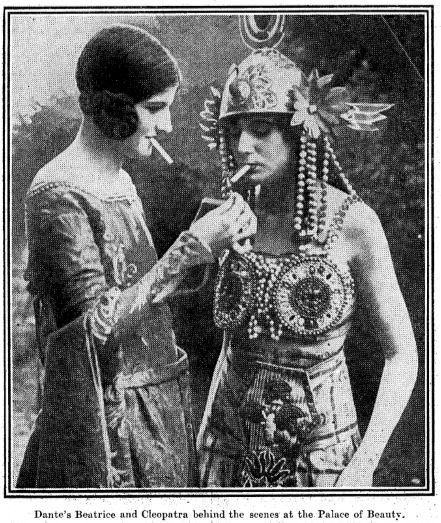
However, post war Ethel continued to star on stage and screen.  Possibly a reflection of Ethel's stardom was her employment in the Pears' Palace of Beauty at the 1924 British Empire Exhibition.  Ethel was Cleopatra in a tableau of some of the most beautiful women in history, which included Dante's Beatrice, Helen of Troy and, puzzlingly, Millais' Bubbles...

Ida Mowbray as 'Bubbles', apparently

The Pears' Beauties worked 7 hour shifts in a 14 hour day, splitting the role with another actress.  It was a very glamorous affair, as can be seen in this image of Cleopatra and Beatrice having a crafty fag between performances...

However, the cost of living an actress's lifestyle and raising a daughter on her own took their toll on Ethel, and in 1924 she was declared bankrupt with debts of £200, which was mostly dressmakers' bills.  She only earned £5 per week as Cleopatra and had a mere £2 in savings.  Still, again she bounced back with what would become her greatest hit and a stage sensation...

The Ghost Train by Arnold Ridley

In 1927, Ethel took to role of Julia Price in Arnold Ridley's The Ghost Train (Arnold Ridley was Godfrey in Dad's Army and the great-uncle of Daisy Ridley, Rey in Star Wars). This was not a new play, having been debuted in 1925 but the special effect of the train rumbling through the theatre was enough to electrify and terrify the audience. One man saw it three times attempting to see how they got a whole train into the theatre.  Once more Ethel was playing a thoroughly bad lot (sorry, spoiler alert) but one of her joys in life was playing a wicked women who managed to win the audience's sympathy by her performance.  The Ghost Train undoubtedly made her a star.  It also saw the debut of June Waller, her daughter, playing one of the minor roles.  

Many plays followed, including The Lonely House in 1930, noteworthy as the cast also included a young actor called Bertram Dix. He was only a couple of years younger than June, but it was Ethel who caught his eye.  While she continued to appear in movies and some stage work, the couple moved to Hendon and there opened a hairdressing salon and hat shop. Yes, that was a twist I was not expecting either. Despite claiming in later interviews that she had taken time away from showbiz to run the salon, Ethel still appeared in films such as The Man Outside in 1933, which can be watched on Amazon Prime...

This classic of cinema must have the poshest criminals in history and some exceptionally wooden acting, but obviously Ethel is marvellous as the spinster Aunt Georgina, complete with monocle...

Ferocious Aunt Georgina, telling off bad actors

I was somewhat surprised by Ethel's hair, properly short from the 1920s and I wonder if that was the work of Bertram Dix.  According to a 1934 newspaper article on the couple's salon, Dix was a hair artist and specialist in waves.  He had brought his experience in theatrical and film hairdressing to the establishment at 7 Greyhound Hill, Hendon.  Joining him in the venture was Ethel, there to give women beauty advice including which hats to wear with their new, beautifully waved hair.  As the report stated 'The hats are marked by impressive distinction and originality yet they are available at exceedingly moderate prices'. I do enjoy a moderately priced hat.

The interior of the salon was decorated with Ethel's paintings and drawings, just too small in the newspaper photograph to be able to see what they were like.  The couple had originally intended to open their place in the West End of London but Hendon was seen to have more charm, and I'm guessing less overheads.  

This business lasted until 1938 when the couple returned to the stage once more in Poison Pen, selling the business.  Then the war came, and the couple hastily wed, buying a cottage in Somerset.  Dix went to fight in North Africa, while Ethel remained at home, becoming patroness of the Ebbor Players, a local theatrical group.  She awaited the return of another husband, but when he returned in 1944, he no longer wanted to be married to her.

Ethel and Dix divorced in 1946, and Ethel carried on touring, starring in The Silver Cord in 1947 as it toured the south coast.  She moved to Sussex, but found that in old age her career began to stall.  In a letter to The Stage magazine in 1950, she reported the plight of older actors - 'The agents, bless them, are far too busy exploiting the youngsters to be bothered with us, and, save for a few exceptions, we're all out of work.'  She suggested that manager should form a company of 'old timers', with no-one under 60 - 'There are many old actresses of petite stature, who, with the help of wigs etc, would give excellent performances as youngsters' she wrote, rather optimistically. She also complained that younger actors didn't talk loudly enough.  Bless her.

Ethel died in the Cavendish Nursing Home, Bognor Regis on 12 September 1951, a couple of months shy of 71.  Her obituary in The Stage listed her art school training, her Shakespearean glory days and her three tours of Australia.  It also shaved a couple of years off her age.  I'm sure she would have been delighted.  I also hope that she would be pleased to know that I'm going to keep researching her because she is absolutely fascinating.  After all, we game old birds should stick together...

If you have any information about possible paintings or drawings by Ethel, please drop me a line at stonellwalker@googlemail.com.


Sunday, 21 June 2015

A Well-Connected Woman of Photographs

Welcome to my 500th blog post! When I reached 400 I wrote a piece on Julia Margaret Cameron's model (and my current obsession) Mary Hillier, so it's rather a coincidence that 100 posts later I am back talking about early photography.  Or rather, I suppose it isn't, as my current novel features a Victorian photographer so I am rather interested in the subject.  Anyway, today's piece is about a photographer who knew Julia Margaret Cameron and also acted as model for another rather infamous photographer of the age.  Today's subject is Sarah Angelina Acland, the First Lady of Colour Photography...

,
Theodore, Sarah and Harry Acland (1856) Charles Dodgson
When Sarah Angelina Acland (Or 'Angie' as she preferred) was 7 years old, she and her brothers sat for an Oxford photographer named Charles Lutwidge Dodgson.  They missed out on being his first group of children photographed, that honour going to their friends the Liddell girls.  They were the children of Henry Wentworth Acland, Regius Professor of Medicine, and lived among the artistic and famous in Oxford.  Miss Acland remembered Rossetti and gang painting the murals in the Union and occasionally giving her his palette. Ruskin stayed with them in their home and it was when Julia Margaret Cameron was paying visit to him that Miss Acland met the woman who would influence her later career.  Ruskin did not admire Mrs Cameron's work and Miss Acland remembered Julia exclaiming 'John Ruskin, you are not worthy of photographs!'  When Sarah Acland took up photography she at least managed something that Julia did not, photographing Ruskin.

John Ruskin (1893)
Miss Acland's interest in art resulted in her parents encouraging her to take lessons from Ruskin to whom she grew very close.  In 1870, their relationship became such a concern to her parents that he was moved out by her father, but she continued to see him and became for all intents and purpose his secretary.

Photography in Oxford was a growing occupation with its implication in science, art appreciation, and travel.  Angie's father assembled an album of photographs at home and offered encouragement to the upcoming photographers in their circle, including Charles Dodgson.

Kodak No. 3 (c.1890)
For her 42nd birthday, Miss Acland was given a Kodak No.3 camera by her father which must have been the ubiquitous present to give to the bored middle-aged woman in your life (really, I'm 42, I'd love one).  She began her career, specialising in portraits of the ready-made assembly of the great and the good of Oxford.  In 1899 she was described in Amateur Photographer as 'a lady amateur photographer who has applied herself chiefly to portraiture with quite extraordinary success.'

Miss M A Hope (1894)
Mary Agnes Hope was Miss Acland's god-daughter and one of her most frequent sitters.  In a photograph that reminds me very much of George Charles Beresford's image of Virginia Woolf from almost a decade later, it is obvious that taking a 'likeness' of Miss Hope is not the primary reason for the photograph.  The elegance of her profile, the interesting detail on the back of her blouse have more attention than what she looks like.


Miss Denniston (1895)
Gertrude Denniston was the Lady Superintendent of the Acland Nursing Home (named after Miss Acland's mother) and her closest friend outside her family. She is posed next to the incredible zoomorphic chimney piece in the Nursing Home, which has the Acland motto carved into it - 'There is no place like home'. The animals are utterly astonishing and make quite an impact in the picture.  I'd like to think that a couple of them are wombats...


Mrs Peard (left) and Miss F. M. Peard (right) (1893)
Mrs Peard, a naval widow and her daughter were photographed while Miss Acland was overwintering in Devon. Frances Mary Peard was a novelist, author of 15 books and is presumably posed reading one, but I love the vaguely cheeky expression on her mother's face that shows marvellous spirit in the 88 year old's face.

The reason that Sarah Angelina Acland is so important in the history of photography is not just for her skill but also for her pioneering work with colour.  In 1899 she began experiments in colour by photographing a scene through 3 different filters (red, green and blue) then combining the images. This moved onto to a slightly more refined method of a screen of parallel red, green and blue lines providing composite images such as this beautiful image of poppies...

Oxford Garden (1905)
The invention of the Autochrome process in 1907 that sealed Sarah Angelina Acland's reputation as a pioneer. By this point, she had already given four lectures on colour photography but with the advent of Autochrome things became a lot simpler.  If I understand it, instead of having three separate plates to combine and make the colour, you stain potato starch the three colours and spread them over the glass plate in turn, then add your emulsion (which in this case is panchromatic).  When you put your glass plate in the camera, instead of facing the emulsion to the lens (like I did with wet collodion), you turn the glass plate so that the image will pass through your coloured potato starch layers before getting 'stuck' on the sensitive emulsion.  Ta da!

A Portrait Outdoors (1907)
I think that the marvellous thing about Autochrome is that the image is made out of tiny points of intense colour, so things like the red of the geraniums really hit you. A Portrait Outdoors shows Miss Acland's goddaughter Mary Agnes Brinton (nee Hope) on the steps of Clevedon House, Oxford.  The image was awarded the red rosette (on the top left hand corner) in the 1908 Oxford Camera Club exhibition.

Spoiled Autochrome Plate (left) and digitally restored (right)
These two plates are the earliest colour pictures of John Everett Millais' infamous portrait of Ruskin, hanging in Miss Acland's house in Oxford c.1913-17.  The left is the spoiled plate where the green dye had spread and affected the finished colour balance.  On the right is a digital restoration to show how it should look.  The picture above the Ruskin portrait, by the way, is We Are Seven by Elizabeth Siddal.

The Poor Thing (1911)
The above pictures were taken in Gibraltar where Miss Acland stayed with her brother, William, who was Admiral Superintendent of the Gibraltar dockyard. The picture on the left is an Autochrome whilst the right is a Dufay Dioptichrome plate, an attempt to make colours more 'true' and less extreme, by passing the light through a geometric filter screen which was finer and sometimes separate from the plate. The difference is marked as the colour in the Autochrome plate is more vibrant, especially the red/green contrast.

Companions (1910)
This is a self portrait of Sarah Angelina Acland and the blur at her feet is her dog, Chum, taken in the garden of her home in Oxford.  The Autochrome process required a long exposure time which means Chum becomes a fluffy blur.

Self Portrait (1928)
This is the last known self portrait of Miss Acland, taken two years before her death, in her Oxford home. At her death, notices appeared in the British Journal of Photography and The Times praising her use of colour and her excellent skills in portraiture.  Her collection of negatives, prints and transparencies were eventually bequeathed to the Bodleian Library and her equipment to the Museum of the History of Science, where in the 1980s the collection was reconciled. The most beautiful catalogue of her work, written by Giles Hudson is where I got the above pictures and information from.  I cannot recommend it enough and it can be purchased from here (UK) and here (USA) and at a second hand bookshop of your choice, no doubt.  I thoroughly recommend it.  It would be lovely if, on this 200th Anniversary of Julia Margaret Cameron's birth we can also raise the profile of another pioneer of the photographic arts who derived so much inspiration from her. 

Flora (1910)