Showing posts with label Effie Gray. Show all posts

Wednesday, 31 December 2014

Wives and Other Martyrs

In 1851, John Everett Millais painted the bridal portrait of possibly the archetypal perfect Victorian wife.  She was Emily Andrews, and her face is a frozen moment of attentive bliss.  She is neat, sweet and waiting.  Her husband, the poet Coventry Patmore, wrote that 'a rapture of submission lifts her life into celestial rest' for her in her role of wife and this is her face...

Mrs Coventry Patmore (1851)  J E Millais
Modestly and naturally adorned, the only piece of frippery is a raspberry ribbon.  Compared with John Brett's image of her five years later, Millais managed to capture the image of Coventry Patmore's 'Angel in the House' as well as the inspiration for it.  Emily looks at us directly, but there is no challenge, there is just trust and waiting. Brett makes her look dignified and somewhat seductive but detached, Millias makes her look patiently interested in her adored audience.

Mrs Coventry Patmore (1856) John Brett
What Millias seemed to comprehend was that when it came to painting a wife it was not only a perceived social ideal that was required but also the notions of the husband, the primary audience. How did this impact on the portrayal of his own wife and furthermore, how did it affect his portrayal of wives as characters in his scenes?

Effie Ruskin (1853) J E Millais
 Of course when Millais started to paint the woman who was to be his wife, she was already someone else's wife.  It is easy to buy into the story that his pictures of her are tinged with longing and unrequited adoration, but what strikes me most about the Glenfinlas series is an adoption of domesticity, of insertion into an intimate sphere.  Naturally, Effie appears in the pictures performing wifely duties as Millais was at the time staying within their home, but he was only a visitor and she was performing the duties, albeit on the surface, for another man.  Again, Millais uses pink and flowers to adorn this perfect woman in an otherwise darkened scene.  In Millais eyes, the wife is the light in the darkness, the darkness in this case her marriage, her husband.

Effie Millais (1873-4)
The Highland Lassie (1854)
When Millais painted her again in 1873, it had been almost twenty years of wedded bliss since the picture before, and this would be his last portrait of her.  She is direct in her gaze still, and much is made of her commanding finger resting on the cover of the Cornhill Magazine.  She is pointing to the picture of a thresher, possibly hinting at how she felt life had treated her in order to get her to such a comfortable position.  Sitting with a fat cushion at her back, she is a woman, formidable and completely detached from the almost 'little girl' image of twenty years before.  Compared to The Highland Lassie, she is a woman of experience, which holds some irony if you think that in 1854 she was at the tail end of a tumultuous early life including the death of most of her siblings and the disaster of her marriage.  Twenty years of peace had given her eight children and a husband who understood her, but also insomnia and the knowledge that her position in society would never be what it should be.

If Millais managed to infuse his portraits of Effie with such depth of feeling, it is unsurprising that his paintings where she acts as a model treated her with similar levels of respect.  In The Order of Release 1746, she is the barefoot deliverance for a Jacobite soldier, a stoic point of rest for man and child.  The cloaking that drapes her gives her a goddess appearance that holds her apart from the tartan and ginger-haired man and child, but her hold on the pair, whilst delivering the titular order, ties her to them.  She is woman as heroine, who has succeeded on a small scale to free a Scottish man from English tyranny.

The Order of Release 1746 (1852-3)
It is unsurprising that within the three years between meeting Effie and marrying her, Millais would return again and again to the subject of marriage and the effect of the wrong husband on a wife.  In pen and ink sketches, Millais explored the subject of marital folly for a private audience of himself and his family.

Married for Rank (1853)
Within a series, reminiscent of Hogarth's Marriage-a-la-Mode of the previous century, Millais' Married for... sketches reflected how he saw the ills of society driving people into unhappy marriage.  In Married for Rank, the couple are bowed to, but not liked, the young woman on the arm of a wizened old man.  She is proud and dripping with jewels.  She displays her ring to the young wounded officer to her right, who touches it and looks at her sadly.  It is an unusual piece as Millais lays the blame firmly at the woman's feet.  The old man doesn't look unpleasant or evil, unlike the arrogance in the head-tilt of the woman.  In Married for Money a companion piece, it is a spurned woman who is forced to watch the one she loves on the arm of another.  Although not alone in his depiction of a regrettable marriage, it is a subject not readily considered exactly what Millais made of the motivation of the object of his affections in her marriage to Ruskin.

A Ghost Appearing at a Wedding Ceremony (1853-4)
As with Speak! Speak! (1894), the subject of the above sketch is the undying nature of love, but with the more negative connotations.  In the later painting, a man is held accountable in his bed by the vision of his bride, possibly hinting that he had been sexually unfaithful to his deceased wife, where as the woman in the earlier sketch is held accountable before God.  If Millais is exploring the theme of everlasting, eternal attachment to another, this was an unfortunate, if unsurprising moment to have such beliefs.  As his intended attempted to free herself from one husband, the young artist hints that people can never be freed, however much they wish it.

The Race Meeting (1853)

Retribution (1854)
Possibly less surprising are the pictures of women suffering due to the follies of their husbands.  In The Race Meeting the wife dissolves in tears of shame as her drunken wretch of a husband is finally caught by the bookies. In an irony of a crucified man, the husband spreads his arms innocently as the carriage is literally besieged.  In his hat is a 'Derby doll', a little figure worn at the races, who echoes his martyred form while its twin sits in a wine glass unable to escape.  In the corner, hidden in shadow, a child sucks on a chicken leg, unable to comprehend or control her greed.  The man is that child, uncomprehending in the face of his excesses or his comeuppance.

Retribution's husband has at least the grace to look ashamed when faced with his wrong-doing.  The seated woman has just married the gentleman, their discarded hats and flowers beside them, when they are brought face-to-face with his first wife and two children.  One wife points to the ring of her predecessor as the woman pleads with her husband to be acknowledged.  This husband has managed to ruin two wives, a fate that Effie Millais fought when she intervened with Rose La Touche's mother.  In Millais' world, husbands have the power of destruction, and women are the unsuspecting victims.

Married for Love (1853)
Untarnished love existed, for all the pitfalls and horror of the social constraints and aspirations.  The adoration between curate and his wife is expressed in their eye contact, their touch.  He writes on the Trinity, which could also refer to husband, wife and child.  The map behind her is the British Isles, the globe is in the foreground but the couple exist for each other and their domestic space, even the church is removed from them, suggesting that the truest expression of God is through their good and authentic love.  It is possible to see the domestic portraits of Effie in this scene, the Angel in the house which Millais fervently wished was his own.  When finally the couple were united, his penultimate picture of his new wife, and the last in which she would be a model rather than the subject, showed her in the centre of the home.

Peace Concluded 1856 (1856)
Painted in the year of the birth of their first child, a year after their marriage, Peace Concluded 1856 showed a contemporary home, and a scene of domestic peace and security.  The wounded soldier reads of the peace in the Crimean as he holds his halo-haired wife.  The daughter in the left holds a dove and watched the audience with an expectant face.  Finally, marriage could mean the end of hostilities and the security within the loving home.  Just as his first image of Effie as the Jacobite wife lifted her beyond the role to a goddess of release, then his last painting she 'acted' in shows her as the Madonna of the home, endless in her landscape of red velvet skirt and there to cradle her beleaguered husband. If Millais had felt tired and wounded by the fight to get his bride, he could finally find peace in the arms of his love.


Happy New Year, readers of The Kissed Mouth and I wish you all a merry night and a bright end to 2014.  I'll see you all next year....

Sunday, 14 September 2014

Coming Soon to a Cinema Near You...

You know how it is - you're minding your own business on a Friday afternoon, posting a picture of a wombat, making plans for the weekend, and then this happens...


Yes, finally a release date, a poster and a trailer for the much-anticipated, long-awaited film about Effie Gray and her ill-fated relationship with John Ruskin. Having waited what seems like forever for the film to be released, suffering many delays and deferrals and watching as Emma Thompson, writer and star, fought valiantly through the courts, finally it will be here in October.  So why aren't I delighted?

Effie Gray Thomas Richmond
For starters, of course I am looking forward to seeing the film.  It's about the Pre-Raphaelites, for goodness sake, and so it would be churlish and counterproductive of me to not want to see a film about the thing I love.  It is also jam-packed with splendid acting talent and comes to us from the hands of Emma Thompson who is marvellous in everything she does.  I'm sure I will enjoy it because on that score I enjoyed Desperate Romantics.  Nice costumes, everyone acting their socks off, all splendid.  I'm also sure the story will be gripping.  Mind you, that might be the problem...

Dakota Fanning as Effie, and I want her gloves.

Sometimes the problem with a really good story is that it tells you more about the audience than the people involved in the story.  What we know for sure, for absolute certain, is that John Ruskin married Euphemia Gray and then five years later their marriage was annulled on the grounds of non-consummation.  They both agree (separately) that the reason that the relationship was not consummated was because Ruskin found her 'person' disgusting.  Nothing to do with public hair, menstruation, little girls, little boys, big boys or anything.  Therefore I trust that Emma Thompson has not got a scene in the film where Effie disrobes on her wedding night only for Ruskin to start screaming 'LADY PARTS! LADY PARTS! THE HORROR!' (much in the same way that I trusted that Fanny Cornforth wouldn't be cracking walnuts with her teeth in Desperate Romantics)...

Dakota Fanning and Greg Wise as Mr and Mrs Ruskin
Another universally acknowledged 'fact' is that she was around 9 years old and he was 107.  Well, again, does make a lot of sense because he liked little girls didn't he?  And all Victorian men preferred infant wives who were merely decorative or playthings for their disgusting lusts etc etc.  Actually at the time of the marriage Effie was 20 (or nearly so) and Ruskin was nine years older.  Greg Wise, a marvellous, talented actor, is around twenty years older than the part he is playing.  He is basically playing the older, more familiar Ruskin: beardy old Victorian who looks grumpy all the time.  Even lovely Tom Hollander was over 40 when he played Ruskin in Desperate Romantics.  Why are we unable to see a younger actor take the role?  Would it make it too complicated for audiences to see, for example, Rupert Friend, rather handsome and age-appropriate as Ruskin?  It certainly isn't as punchy a story - two adults marry without knowing each other properly and find out they drastically don't get along.  The husband refuses to have sex with a woman who wasn't what he believed she was.  Woman is left alone with nothing to do trapped in unhappy marriage.  They get marriage annulled.  I'm not sure I'd go and see a film about that.  However, is it okay to always assume the woman is always the victim?  Does there need to be a clear-cut 'victim' and 'culprit' in every situation?

The Victorians, much like us, love to apportion blame and back in the good old days all the blame would obviously be heaped on the woman.  That is rubbish for all involved and so I don't blame Team Effie to want some payback, after all in order to get the marriage annulled she had to go through some god-awful tests and risk utter ruin for something that wasn't her fault really.  But then I'm not convinced it was Ruskin's fault either.  However, for ever more it has become his fault, eternally the fault of the old, weird, gay pedophile who could not bare his wife's pubic hair.  That is some hatchet job.

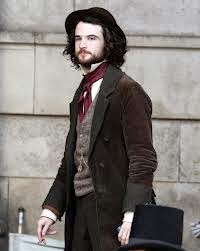
Tom Sturridge as Millais
Also, what seemed to enrage others on Friday (I was too busy wailing over the age of Ruskin) was that Millais looks exactly like an identi-kit Rossetti, all Byronic and moody.  On a side note, the actor Tom Sturridge is exactly the right age to play Ruskin.  Oh, the irony!

Look, you don't need me to tell you to go and see it, it will be wonderful entertainment and no doubt a feast for the eyes.  I'd love to see more Pre-Raphaelite films, so let's make this one a success as I'm sure it will be.  However, you are all smart people who read and question accepted biography, don't forget to remind people that the film is just entertainment.  After all, the last time I saw Fanny Cornforth on screen, she was a nut spitting, illiterate cockney prostitute...

Oh yes, Ophelia on the poster?  Really?

Effie Gray is out in the UK in October and you can have a look at the trailer here.

Friday, 3 January 2014

Book Review of 'Marriage of Inconvience' by Robert Brownell

I have to admit to a fairly typical curiosity when I heard there would be a new biography about the Ruskin marriage, especially as it promised new information.  Coming hot on the heels (well, actually now preceding it) of the new film about the sorry affair, I really wanted to know what on earth went on.  It's all common knowledge that she was the victim and him the heartless weirdo.  Apparently.  Enter Robert Brownell's new book...


I have previously said that I have doubts about the accepted version of events (I may even be described as Team Ruskin).  I didn't like the way that things were assumed about the man from very little evidence and the words of interested parties.  This rang rather true of my involvement with Fanny Cornforth (that well-known illiterate cockney prostitute) and so have always wanted to know more.  Just the most cursory of fact-checking can dispel the 'fact' that he was a weird old man marrying an innocent child - She was 20, he was 29.  The casting of Greg Wise as Ruskin in the new film makes me cover my eyes in horror.  As gorgeous as Mr Wise is, he is a gentleman in his late 40s, almost 20 years older than the man he's playing and he looks like they have added a few more years too with his make up.  Imagine the difference in casting someone like Rupert Friend or Orlando Bloom (actually both too old, how about Robert Pattinson?  He's 28, so near enough.  R-Patz for Ruskin!  Lawks, imagine that cinema queue...), someone younger, nearer Effie's age, that would even the stakes a little.  In fact, that's the point of the book.  Imagine if Ruskin wasn't the worldly man of age, imagine he was just a romantic idiot.  What then?

Ruskin, kicking back.
I won't give away too much because I really want you to read the book but I will tell you this: Philip Larkin was right when he said 'They f- you up, your mum and dad'.  What a sorry mess.  It is wise to take all biography as being biased, but, my Lord, it is hard to see the good side of the behaviour of Mr and Mrs Ruskin and Mr and Mrs Gray.  One side seem to be scheming, the other side, over-protective idiots.  Money, money, everything flowing back to money.  If anything I wanted to slap a great many people, including Ruskin, for not seeing exactly how awful people can be when they are desperate.  The Ruskins didn't want their son to die of a tubercular broken heart, the Grays wanted their pretty, flirty daughter to keep them out of the poor house.  No-one asked too many questions and a lot of people complained that they didn't get a fair share of what wasn't theirs to start with.


A Highland Lass (Effie Ruskin) (1853) J E Millais
Things I didn't know were that Millais and Effie knew each other before her marriage and that the Ruskins had some sort of agreement that they would abstain from sex until Effie's 25th birthday (because Ruskin wanted to complete his books and didn't want babies all over the place).  It would be easy to look on Effie as a little bit less than the innocent victim, due to her behaviour with all her many admirers, but then you could understand her seeking attention elsewhere is she wasn't getting it at home.  I found her rather callous attitude to the news that duels had been fought over her when they travelled abroad to be disconcerting, but I think it typifies her silliness, how utterly remote from real life she was, they both were.  That brings me to the wedding night...

The Ruskins looking jolly....
I can never decide if it's a modern obsession or if it's eternal to wonder why John Ruskin did not consummate his marriage.  We seem to automatically take it as a big flashing sign of his weirdness.  It shapes our opinion of him.  It almost doesn't matter why he didn't, although in my time I have heard the following reasons - he didn't like body hair, she was having her period, he was gay, he liked little girls, and so on.  I had never heard that they had an agreement.  I have to admit it makes sense if the idea was to ensure there were no babies and they weren't the only ones.  Mind you, Brownell goes further and brings forth the piece of evidence that usually backs up the idea that Ruskin was a weirdo.  In a letter to her father in 1854, Effie revealed that Ruskin told her that 'he had imagined women were quite different to what he saw I was, and that the reason he did not make me his Wife was that he was disgusted with my person the first evening 10th April.'  That is usually taken to mean that Ruskin thought Effie would look like a marble statue, that her body hair (gasp!) was so repellent that he could not bring himself to look at her.  Taking this statement as fact, what if Ruskin used the word 'person' to mean not the body, but the personality.  Read the book before you judge him for this horrible statement because after 535 pages, I'm not wild about any of their persons either.

So now we wait for the film which is due in the Spring.  I would very much urge you to read the book beforehand because I am guessing from the casting that Mr Wise's grey sideburns will mean he is playing old Ruskin rather than hot Ruskin.  Not that I don't think old Ruskin was hot.  Oh dear, I better move on.  Make your own mind up and as always, my dear friends, question everything that is assumed.

Marriage of Inconvenience can be purchased here (UK) or at your local bookshop.