Showing posts with label Lewis Carroll. Show all posts

Tuesday, 16 July 2019

Looking for Mrs Donkin's Cook

It is no secret that I love knowing the identities and lives of models.  Often, the lives of the models surpasses that of the artist in terms of ups and downs, joy and tragedy, and I think that if we are to admire a work of art then it is good manners to acknowledge the people who created it both in front of and behind the canvas.  However, you and I both know that the path to finding the identity of certain sitters is rarely a smooth one and today's post is the tale of Two Alices, two Greek cooks and a Professor of Astronomy...

Oenone (1870) Julia Margaret Cameron
Reprinted in many of Julia Margaret Cameron's biographies is the story of how Mrs Cameron found the model for her 1870 photograph Oenone.  Mrs Cameron was walking the 'High' in Oxford when she came face to face with a beautiful young woman.  She immediately asked the blushing young lady to come and model for her, which is very Rossettian of her.  As it transpired, the young lady was 'Mrs Donkin's cook', so permission was sought from Mrs Donkin and granted, and Mrs Donkin's cook was whisked away to feature in not only Oenone, but also Rebecca (twice) and A Greek Ianthe.  What is not recorded is her name, so off to the research cave!

Alice Emily Donkin (c.1866) Lewis Carroll
If I am facing a lot of research, there is no finer ally than a slightly unusual surname. 'Donkin' is not bad at all, especially when you narrow down that Mrs Donkin had to be rich enough to employ a cook.  As it turns out there was really only the one load of Donkins in Oxford at that moment.  William Fishburn Donkin (1814-1869) was an astronomer and mathematician, and held the post of Savilian Professor of Astronomy at Oxford.  He had married Harriett Hawtrey in 1844 and had five sons, and one daughter named Alice Emily.  I include her middle name as this is Oxford and we are never short of Alices, as you will see.  The Donkin family, unsurprisingly, knew Lewis Carroll (possibly via mathematics and pretty daughters) and so young Alice Emily appears in a couple of Carroll's photographs, as does her equally lovely cousin Alice Jane...

Alice Jane and Alice Emily Donkin (c.1867) Lewis Carroll
Possibly it should have been pointed out to the good people of Oxford and the environs that there are other names in the world, but here we have two Alices.  Alice Jane, niece of Professor Donkin (daughter of his brother Edward), also had her photograph taken by Lewis Carroll, possibly whilst staying with her cousin...

The Elopment (c.1862) Lewis Carroll
It's this sort of photograph that makes people uneasy, Mr Carroll - here we have the eleven year old Alice Jane, making off down a rope ladder to marry her beloved.  As it turns out, when Alice Jane did finally marry, less than a decade after this image, it was to Lewis Carroll's brother, Wilfred Dodgson, who was quite a bit her senior, but probably not in Victorian terms, let's move on swiftly...

Portrait of an Unknown Girl (1920) Alice Emily Donkin
Alice Emily never married and was an artist of some considerable and charming talent.  You can still find her pictures at auction and very lovely they are too, but I'm a sucker for between the wars portraiture.  However, none of this helps find Mrs Donkin's cook!

Rebecca (1870) Julia Margaret Cameron
Despite my rambling, we can be fairly certain that this is the Donkin household that Julia Margaret Cameron inquired to.  Taking the age of the model in the photographs to be around 20-ish, then it is unlikely she would have been employed in the 1861 census, and in fact the Donkins are a little illusive, what with Professor's ill health, which took them overseas for rest cures.  However, it would be almost definite that, as the photographs were taken in 1870, the cook would be there in the 1871 census.  Unless something awful happened. Or in fact had already happened shortly beforehand.

Professor Donkin died in November of 1869.  The household that Cameron therefore visited would have been in mourning.  Furthermore, had their house been tied to Professor Donkin's job then it would have been in the process of moving and dispersal.  By that time, the children of the Donkin family were all grown and some had households of their own.  By the time of the 1871 census, Mrs Donkin and the unmarried children were staying with her brother in Berkshire.  So what became of her cook?

A Greek Ianthe (1870) Julia Margaret Cameron
I had hoped that maybe one of the children had taken the cook into their household, but none of that mapped out.  In theory then she was one of the countless cooks, working in the Oxford area.  Or maybe she had moved away, moved back to her family? Such is the lot of unmarried, unknown, working class women in history.  Then I noticed that Julia Margaret Cameron, in her whimsical way, had labelled the Oenone photograph with another title, that of A Greek Ianthe.  Looking at our girl I wondered if she could be Greek.  Were there any Greek cooks in Oxford in 1871?  Yes, two, in the same house.

Brightwell Park, demolished in 1948
Elizabeth Phillips of Brightwell Baldwin near Oxford, was a widow of some considerable means.  In 1871, she had 10 servants including a footman, a coachman and two kitchen maids, both Greek.  Mary Maton born in 1852, hailed from Greece, as did Maria Nuom, born in 1851.  The census returner seemed to struggle as he listed Mary as from 'Mestley' and Maria from 'Mannington' or something which was a scrawled version of what he heard.  Could either Mary or Maria be Oenone?  Possibly.  Sadly, nothing is known of either girl before or after the census, and it could be that their surnames don't bear much relevance to what their actual surnames were, such is the hazard of census returns. 

The whole episode brings home to me the peril of women in history, as if we didn't know by now.  Mrs Donkin left her household on the death of her husband, and any hope I had that she would settle back down with her Greek cook in her old age was stuffed when she died in 1876.  Mind you, Mrs Donkin left records as a wealthy, married mother.  There are people to remember her.  Alice Emily and Alice Jane likewise survive because of money.  Alice Emily's artistic career might not have been groundbreaking, but it leaves a trail to follow.  Alice Jane married into a well-known family and had children, all of which makes her eminently find-able. In the photographs of them they are named as they are important, they are the subject of a picture. Mary or Maria, if it is them, have no such advantages.  No name is recorded save that of 'Mrs Donkin's Cook'.  I am taking a leap by grasping the Greek connection, but we know Mrs Cameron liked to add a biographical slant, and had a sympathy/empathy with people from foreign lands, so I don't think it is there by accident.  What became of either girl is currently a mystery, but just acknowledging that mystery is a start. 

Friday, 2 March 2018

Review: Victorian Giants

I love the National Portrait Gallery.  I don't think I have ever been to an exhibition there that I didn't adore or that they didn't do exceptionally well.  I still have really fond memories of the Millais Portraits exhibition they did many years ago.  They also do really good catalogues.  Anyway, enough of this swooning - to business! or rather, here is my review of the Victorian Giants exhibition that opened yesterday and runs until 20th May...


I was lucky enough to be invited to the press review and so spent time on Wednesday up in snowy London seeing how you could bring together the careers of Julia Margaret Cameron, Lewis Carroll, Oscar Rejlander and Clementina Hawarden, all pioneers in 'art photography' in the middle of the 19th century.  As we have discussed before, I have come across the work of all of them, but only written about Cameron, Carroll and Rejlander.  My knowledge of Hawarden was limited to 'she was a bit posh and did girls in sunlit rooms, like an arty Victorian version of Flowers in the Attic'.  I was delighted to learn more...

Clementina Maude (1862-3) Clementina Hawarden
Short-lived Scottish aristo, Lady Clementina Hawarden didn't (in my mind, anyhow) seem to have a great deal in common with, for example, Lewis Carroll, but the genius of this exhibition is that they  not only show who bought whose photographs, but also put images together so you end up going 'Oh, I see...'

Kate Terry as Andromeda (1865) Lewis Carroll
There are rather a lot of 'oh, I see' moments in the show, not only with what they show, but also if you bring your own knowledge to bear on what you see.  Hawarden's captive girls, caught by privilege and isolated by their gender, are clearly reflected in images of captive princesses, offered up as sacrifice.  

Lord Elcho and Son (1860) Oscar Rejlander

Detail of Tennyson and son, from a photograph of the Marshall Family (1857) Lewis Carroll
The very dignified image of Lord Elcho and his little poppet of a son reminded me of that weird image of Tennyson looking very wary with Hallam on his knee, taken by Lewis Carroll.  They couldn't be more different in tone even though it is essentially the same image.  You begin to learn about the person behind the camera by what they think is okay to show in front of it.  I really think Carroll lacked the ability to distinguish emotional responses in his subjects because there are moments where you wonder why he chose that picture, that expression or response from his subject, but that also is what makes him an interesting chap, if a little controversial.

Alice Liddell (1870) Lewis Carroll
If you were hoping for a discussion about Carroll's motivation in his photography of children, this is not the exhibition for you, but then I'm guessing we're all grown ups and don't need that.  In fact, I found the NPG have done much to reintegrate Carroll's work into the mainstream and when seen in the context of others, he doesn't seem so weird. So when you take this...
The Beggar Maid (1858) Lewis Carroll
in the same breath as this...

Beggar Boy (1862) Oscar Rejlander
It just seems part of the same 'poverty as art' theme, whilst being equal parts conscience-raising and distasteful is not sexual.  Even when Carroll is being a bit 'dodgy', seen within the context of what others were doing, it loses some of its impact, for example...

Xie Kitchin Asleep on a Sofa (1873) Lewis Carroll

Charlotte Norman (1863) Oscar Rejlander
It's all about context and what the others were doing at the same time.  I suppose, if I had a criticism, then Hawarden, with her beautiful girl-butterflies trapped in one room, shows the least range and doesn't participate in the sharing of subjects to the same extent the others do.  It's wonderful to see Lewis Carroll's images of Tennyson beside Rejlander's and Cameron's, not to mention the sharing of John Herschel and Charles Darwin between photographers.  When grouped like that you can enjoy the precision of Carroll, the dream-like qualities of Cameron and Rejlander's depth and wit.  Actually for me, Oscar Rejlander came out of this as a bit of a star.  Carroll lacks humour in his work but Rejlander has it in buckets, often straying into absurdity but always very well done.  He can also match Cameron for sheer beauty which made the part of the gallery with their photographs together an utter delight.

Unidentified Woman (1863-6) Oscar Rejlander
Mountain Nymph, Sweet Liberty (1866) Julia Margaret Cameron
So in conclusion, this is gorgeous.  The way all four photographers moved in and out of each others lives is fascinating and Oscar Rejlander should be a national Swede-y hero for what he has brought to our photography heritage.  Boobs, for one thing.

Female Draped Artist Study (1857) Oscar Rejlander
Since the NPG acquired the Rejlander album last year, this exhibition has always been on the cards and in a way I wish they had done a one-man show but it is a wonderful blend of the familiar and the obscure, the great and the nude of Victorian society and I can't recommend it enough.  I'll end on my favourite image, which looks like a 1940s movie poster...

John and Minnie Constable, Looking into the Fire, All Hallow's Eve (1860-6)
God bless you, Rejlander, that's delicious.

Victorian Giants: The Birth of Art Photography is on until May and further information can be found here.

Sunday, 30 October 2016

If They Are So Clever, Why Are They Dead?

I warn you now, this is a rambling post borne out of a week of thought.  I can't promise you any answers but possibly writing out the happenings of the last week here might make a bit of sense of it for me at least...

'Dear Ms Walker, be so good as to kindly burn in Hell...'

In the middle of the night last weekend, I was the recipient of several messages complaining about one of my posts.  The person who tried to leave angry comments on the blog found themselves thwarted by my comment approval system and therefore the comments left got angrier and angrier.  They claim I lied, that I had made things up that I was slandering (or is it libeling?) the artist in question.  Now, you should know by now that I spend an awful lot of time and effort researching my work and actually I hadn't written anything particularly revelatory.  Anyone could have read the same on many different websites or in the probate records in question.  However, the complainant claimed to be a descendant of the artist and felt very strongly that the incidents in the artist's life were untrue, damaging and hurtful.

Me, after receiving criticism
This isn't the first time I have come across some one who feels very passionately about their interest and unfortunately it is not the first time that I have received very nasty and threatening emails because I have written something that someone who regards themselves as the expert doesn't agree with.  I stand by my research and can only imagine that the websites I read in my preparation were braver than I in defying my correspondent.  As the person in question seemed so enraged by my work and as I had no wish to ever hear from the party ever again and I'm a massive coward, I took down my post.  Then I started thinking about the things we say about dead celebrities...

Jane Morris as La Pia, the unhappy wife of an awful husband.  Because she was.  Apparently.

Should the truth always trump discretion?  My knee-jerk reaction is obviously to say yes, truth will out and helps us understand people and their motivations.  However, pause for a moment to imagine a future when everything in your life is revealed.  Would you want that? Would you agree that moments of regret you hold secret should be brought forth as evidence to something or other?  Even things you don't regret but just don't have any relevance to what you do, what would you feel about that? Maybe we should follow Roland Barthes, literary theorist, and divorce author/artist from their work (see Death of the Author).  What effect does our biographical reading of art and literature have on our understanding of those that make it and how far should we go?

Rossetti's cartoon of the thieving elephant for Fanny, nicknamed 'Elephant'...

Back in 2011 I wrote a blogpost on the myths surrounding Fanny Cornforth.  For years people had been writing that Fanny was an illiterate, thieving, lying prostitute.  Turns out most, if not all, of those things are not true, or at least not the full truth.  Furthermore, for the most part people talking about Fanny Cornforth were actually talking about Dante Gabriel Rossetti.  Her character was a reflection on his; what difference can be seen between his choice to love a lying, illiterate prostitute or his loving a country woman who was just a bit tenacious in her love? Also, while we're on the subject, what should we read in to the fact she died in an asylum?

Ophelia (1851-2) John Everett Millais

I have lost count of how many times I have winced when someone casually states that Elizabeth Siddal killed herself.  She may have killed herself but equally she may have just taken the drugs by accident.  What's the difference? Our reading of suicidal Siddal plays well with our image of her as Ophelia, it fits the narrative of a doomed heroine. Is it wrong of us to hold Elizabeth Siddal up as a martyr for women who love too much, who are consumed by their art and become  a victim of their own passion.  If that strikes a chord within us, is it wrong to find solace, to find kinship with someone who we make a connection with?  Is there harm in seeing an aspect of ourselves in another? Undoubtedly Elizabeth Siddal was unhappy, was caused unhappiness by an uncaring and careless husband and found an outlet in her art and poetry.  Arguably those moments of unhappiness probably led to thoughts of death. The problem becomes when that is all we see of her and she is reduced to the woman in the bath tub.

Lewis Carroll and Alice Liddell.  Sort of.
What about when investigation becomes speculation? The above photograph is quite common on the internet and is a complete fake (and not a very good one) but seeing as we are constantly told that Lewis Carroll was a pedophile, this photograph fits the narrative. It completely colours our response to his work and makes everything tainted.  What evidence do we have that it is true?  None.  We have a man who was socially awkward, who could communicate well with children and had a collecting mania for images of little girls. That's not the only Lewis Carroll rumour that irritates me...

Alice in Wonderland poster, 1967
Apparently, Alice in Wonderland is all about drugs.  It took the clever folks of the 1960s to realise this and for ever more you can't mention Alice without some wise soul saying 'Of course they were all on drugs.' Well, no. Well, maybe some of them.  But not Lewis Carroll because he was too busy staring improperly at little girls.  Apparently.

John Ruskin in a lady's garden. My apologies.

And don't get me started on John Ruskin.

So maybe my angered correspondent was correct, saying that personal details are not up for discussion because no-one can ever see in the darkness of another's soul, let alone one who has been dead for a century.  It does seem to lead to some very spurious lines of inquiry and dead ends, not to mention distracting from the genius that brought these people to our attention in the first place.  

Fanny Cornforth (1907)
However, without a bit of digging, it would be impossible to right the wrongs done to people in the past.  Fanny would forever be the illiterate thieving tart that her accusers decided she was which is deeply unfair.  Something that really seemed to bother my own personal critic was that I had said that one person in her story had died in an asylum (listed in his probate record) and that another had killed herself (listed in subsequent newspaper reports).  For my critic there seemed to be a stigma about both things, where as I attached no judgement to either.  Suicide is such a complex issue (even when it seems straightforward) that it would be impossible to say why someone would do it let alone be stupid enough to blame them for their action.  As for asylums, I think we would all agree that actually being mad would put you in a minority in a Victorian asylum, but if the person had problems with mental illness I'd hardly be the first person to throw stones.

Fact/Fiction/Opinion - take your pick...
So, in rambling conclusion, biographical research and speculation are both essential and unnecessary.  I'm glad we cleared that up.  Seriously, it's an unwinnable fight because it both casts light and confusion on your subject.  Not only that, for some people certain facts are unpalatable because of their own personal feelings. I think it is salient to consider how speculation, however well-founded and well-intentioned, can offend and no matter how long ago your subject passed away there will be people who feel passionately about the sanctity of the subject.  When your subject is long-dead, it seems easy for us to speculate on their sexuality, criminality or insanity because they are hardly likely to take issue and prove us wrong. However in this hyper-connected world where people can find you at the touch of a button, there will always be someone who will take issue if they don't like you saying that Dickens wore a dress every Sunday or Tennyson was a founder member of Black Lace.

Be sure of your facts, be confident of your work, but remember that people, both dead and alive, deserve respect and understanding.

Friday, 27 May 2016

Review: Alice Through The Looking Glass

As you know, I am a big fan of Alice in Wonderland by Lewis Carroll.  When Disney made the first of the new Alice films a couple of years ago I was delighted.  Until I saw it.  Then I was puzzled.  I could not understand why they would call the film Alice in Wonderland when it was not the book and more to the point I was worried people would think that was the story Carroll wrote rather than read the book itself.  Anyway, I got over myself and now am okay with it.  Well, sort of because I still don't understand Johnny Depp's random Scottish accent or the dance at the end. Anyway, when they announced they were making Alice Through the Looking Glass I was obviously curious...


So, today being the 27th May, we took ourselves off to the local multiplex and here is my review...

Alice Through the Looking Glass illustration by John Tenniel
Firstly, a summary - We join Alice as she is captaining a ship through rocky seas pursued by pirates. Back in London she returns home (in trousers and without a hat, but I'm coping with that in my own way) and her mother informs her that in her absence things have been going somewhat wrong. Time is moving on and things are not improving for the family but Alice is convinced that she, a trouser-clad female ships captain can only succeed in Victorian society. Hmmmm...

The Hatter, still a touch mad (and Scottish)
I don't think it's much of a spoiler to say that it does not go well and Alice takes refuge in Wonderland once more, seeking out her old friends only to find that things are not going any better there.  Hatter is fading fast and the only thing that can save him is a reversal in time, but Time himself is not about to let some funny dressed girl mess about with his cogs.  Also, Alice is not the only one who wants to turn back time...

Is Time a Thief and a Friend to No-one?
Anyway, much high jinks and revelations ensue, including an explanation about the size of a certain person's head.  We race from past to present, from London to the seas of Time via an asylum, to discover what is true and what isn't.  Like the first film, the visual experience is astonishing, each part of Wonderland gloriously rendered and filled with characters, some new, some very familiar...

Off with their heads!
In order to enjoy Alice Through the Looking Glass you have to let go of any thought that it is related to the book.  Both of the new films are beautiful, funny, and exciting and are an intriguing use of the characters and the idea of Wonderland. The special effects are very special and everyone is acting their socks off.  Some bits are genuinely moving beyond what you would expect and you will leave happy.  However, the purist in me is sad that the point of the books is missed - Alice doesn't belong in Wonderland, she is constantly puzzled and contradicting everything and everyone.  It is not meant to make sense or make her feel at home.  I have always suspected Carroll was making a point about how he felt in the normal world, how he never felt he could fit in nor understand what everyone else considered 'normal life'.  It is absolutely Alice's feeling of utter bewilderment shared with us as the reader which is Carroll's way of showing us what his life is like.  Looking Glass has been interpreted as a very pointed attack by Carroll at being excluded from the society in Freshwater (Red Queen being Cameron, the White King being Tennyson etc) which I find deliciously true.  Carroll writes what it is like to be an outsider and it's a shame that isn't translated onto the screen.

Terrifying Chess!
In conclusion, if you liked the first one, you'll like this one and there is much to like.  Helena Bonham Carter once more proves why she is a national treasure and the bits in Victorian London are full of actors who will leave you saying 'Oh it's her/him...'  There are enough references to the original books to cheer you up if you are sad about the deviations and hopefully it will draw people to the original source material.  All in all a jolly couple of hours and an escape from all the politics which can only be a good thing.

Alice Through the Looking Glass is available nationwide from today.


Saturday, 5 March 2016

Lewis Carroll: Photography on the Move Q&A with Lindsay Smith

I had the pleasure of meeting Lindsay Smith last year at the Julia Margaret Cameron conference in Portsmouth.  She was the chair of the panel I was on and then gave a fascinating paper on Lewis Carroll and photography, which made me very eager to read her book.


Lewis Carroll (Charles Lutwidge Dodgson) (1863) Oscar Rejlander
Lindsay's focus is on Carroll's travels, both real and internal, recording and viewing the world as it was and as he wanted it.  Through Carroll and his photographs, Lindsay explores the man, the collector and the outsider, forever trying to see, understand and be part of his work. It's too easy to see Carroll's photographs as proof of modern opinion against him, and reading Lewis Carroll: Photography on the Move, you are reminded not only of the difference in how photographs of children were once viewed, but also how collecting may have been a greater passion than the subjects.

I must admit to a fascination with Carroll's relationship with Tennyson and Julia Margaret Cameron, and his attempts to become part of the community in Freshwater, but Lindsay's book takes us from Oxford through England and even as far as Russia.  What was he searching for and did he ever find it? One thing is for sure, Carroll's photographs are beautiful, outstanding quality and the ones in the book are beautifully chosen.

I was lucky enough to ask Lindsay a few questions about her new book...

Q. Do you think Lewis Carroll is hunting for something in his photographs? Do you think he knew what he was looking for when he traveled around or was it just an compulsive need to collect? 
Farringford from the Field (1864)
It is interesting to question whether Carroll was ‘hunting for something’.  I believe photographs function for him as complex forms of attachment to people and places.  As I attempt to show in the book, to contemplate a photograph is to activate memory in ways that Carroll found fascinating. As he arranges sittings, and buys photographs on his travels, there is certainly a sense in which, according to the impulse of the collector, each acquisition generates the desire for another to add to the set.

Q. When I read Alice in Wonderland I always assume Alice is Lewis Carroll, trying to make sense of the adult world. Do you think his photographs were an escape from real life or an attempt to capture it? 
Yes, I think that Carroll’s photographs allow him to inhabit other worlds as do his books for children. I don’t read them so much as an escape from the real world as a desire to capture his fascination for particular aspects of it that he relished. Photographs also preserved experiences, such as the theatre, that Carroll felt guilt at taking pleasure in.  As a technology of capture photography represented more than a hobby for Carroll. He enjoyed its conceptual possibilities, temporal peculiarities, its implications for memory and prophecy. But he also treasured photographs as material objects for their unique attachment to the subjects they represented whether that be a child or a particular place.

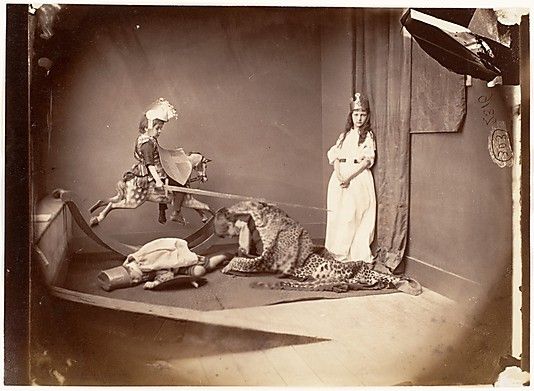
Saint George and the Dragon (1875)
Photographs functioned for Carroll as keepsakes and souvenirs, as in evident on his trip to Russia, and as they continue to do for travelers today snapping on their camera phones. But photographs also conveyed to him the physical closeness and presence of an individual in the manner of a signature, - hence Carroll’s practice of including the signatures of sitters in his albums. I regard photography for Carroll as part of a larger visual aesthetic fuelled by travel and enjoyment of even the most banal entertainments. This is why I consider some of those photographs he had taken at William Kent’s studio in Eastbourne. They demonstrate that Carroll remained invested in the medium during the 1880s even when, as far as we know, he was no longer taking photographs with his own camera.

Q. Lewis Carroll's relationship with the Tennyson family fascinates me - do you think he wants a father/child relationship with Tennyson or was it just hero worship?
 
Alfred Tennyson (1857)
Carroll’s relationship to Tennyson is a complex one. He clearly admired Tennyson’s poetry but he also made a nuisance of himself in wanting to photograph the poet. Carroll was not alone, however, in his pursuit of Tennyson for photography. One only has to think of Julia Margaret Cameron and the lengths to which she allegedly went to get Alfred to sit for her camera. Yet Carroll over stepped the mark on several occasions.  One that I mention in the book is his suggestion in 1872 of speech therapists for Lionel Tennyson. The poet appears to have taken offence at Carroll’s suggestion of such therapy for his son. Having considered the debilitating effects such ‘hesitancy ‘ had had upon him and upon his sisters, I believe Carroll wrote to Tennyson because he empathised with Lionel.

Hallam and Lionel Tennyson with Julia Marshall (1857)
In an earlier occasion in 1857, having taken photographs of Tennyson and his family in the Lake District, Carroll received a letter from Emily Tennyson ‘begging’ him to destroy the photographs he had taken of her and her husband, and including a professional portrait of the poet by the photographer Mayall. Tennyson was sensitive about his photographic portraits becoming available to the public and, since Carroll liked to make copies of his portraits for friends, it appears Tennyson was worried that he might distribute copies. Carroll’s visits to Freshwater indicate to me that he wanted to feel part of the incredible literary and artistic set that frequented that western part of the Isle of Wight. Yet, he remained somewhat marginal to it.  In my paper at the recent Portsmouth Julia Margaret Cameron bicentenary conference, I showed that Rose Franklin, a previously unidentified child model of Cameron, was first photographed by Carroll. What this occasion demonstrated was that Cameron’s subsequent interest in photographing the child most probably came from seeing copies of Carroll’s photographs of her in Freshwater.


Q. Do you think his name will ever lose its stigma? Do you think there should be a club for misunderstood Victorian men - he and Ruskin could be founder members...
Xie Kitchin as 'Tea Merchant' 'On Duty' (1873)
The question of ‘stigma’ is a difficult one.  As a nineteenth century scholar I am frustrated by the transhistorical ways in which people discuss sexuality, desire, perversion and paedophilia in the period– as if we can simply unproblematically apply a term, or current understanding of it, to the Victorians.  I found the film Effie Gray based on Suzanne Cooper’s biography disappointing in this respect. Although it succeeded in telling Effie Gray’s story, which was really important, it made no attempt to shed light on the infamous wedding night and instead presented Ruskin melodramatically slamming the door with a look of horror on having seen his wife’s naked body. Lost was an opportunity to attempt to understand in a nuanced way the well-known non-consummation of the marriage. In presenting Ruskin in sensational terms as a cruel sexual deviant no pressure was put on the accepted version of this notorious Victorian story

Relatedly, there exists an assumption that photographs can reveal particular practices and that they function as transparent, easy to read documents on the past. Indeed, people make assumptions about nineteenth century photographs in ways they would not dream of doing about paintings, drawings or engravings. This has to do with the indexical nature of the photographic image of course, that the person or object photographed was present at the point of taking, whereas for a painting they need not have been present to the painter during its production. It is however a simplistic distinction. For it bypasses the complex issues that come to bear when taking and looking at photographs in the Victorian period when the invention had not yet established a determinate relationship to other methods of representation. At the time that Carroll encountered it, photography was a novel medium and all aspects of its status and its relationship to other media were under debate.

Q. Do you have a favourite photograph of his?
The Tennysons and the Marshalls (1857)
It is difficult for me to single out a photograph but I have long been fond of Carroll’s The Tennysons and the Marshall’s (p. 181) taken at Monk Coniston Park in the Lake District in 1857. As I say in Chapter 5 of the book, it represents a rare portrait in Carroll’s photography of a father and infant son and conveys the intimacy between Tennyson and the young Hallam cradled in his lap. For me this tableau conveys the quality of touch that the medium is able to arrest along with memory that, as I explain, becomes here a form of prophecy. The intimacy between poet and his son is highlighted by contrast with the more formal arrangement of Marshall, his wife and daughter. It is a rare ‘domestic’ photograph of Tennyson and very different from those picturing him as revered laureate.

Ella Chlora Monier-Williams and a Younger Brother (1866)
For similar reasons, Ella Chlora-Monier Williams and a Younger Brother 1866 (p. 110) is a favourite photograph of mine and rarely reproduced.  In it Carroll has captured the closeness between the siblings and as I’ve suggested in the book he has arrested the contingent, the fleeting moment, as they pose concentrating on the dolls they hold. There is something deeply moving about the ways in which both of these photographs situate their child subjects.


Many thanks to Lindsay for answering my questions and I can thoroughly recommend Lewis Carroll: Photography on the Move which is  informative, entertaining and a joy to read. The photographs are reproduced in lovely quality and many of them are unfamiliar.  It certainly does give a new and refreshingly unscandalised examination of this intriguing Victorian photographer...

Lindsay's book is available from here (UK) or here (USA) or through all good bookshops.

Thursday, 22 October 2015

Book Review: The Looking Glass House

I am in the very pleasant position of having a bevy of books on my desk to review, so I ought to crack on with it before my own is out!  Today, I bring you a familiar tale from an unfamiliar viewpoint…


The Looking Glass House has a very unique selling point to recommend it. The author, Vanessa Tait, is the great-granddaughter of Alice Liddell, the inspiration for Alice in Wonderland, and she presents us with the story of Lewis Carroll’s friendship and then desertion by the Liddell family, but from the viewpoint of the governess, Mary Prickett.
 
Mary Prickett (unknown photographer)
If you have been following the fashions in Carroll-interpretation then you will be familiar with the notion that instead of desiring the formidable girl-queen Alice, it was actually the ever-present Miss Prickett that Carroll was paying court to, but with most things to do with the ever elusive Reverend Charles Dodgson, nothing is clear-cut.  In Tait’s story, she presents us with a governess, surely one of the loneliest jobs in Victorian England, in a city full of riches, all of which are denied her.  Into her life comes the gentle, unusual bachelor, Dodgson, who deplores the rough physicalities of life, who captures the pure wonder of beauty and who also captures Miss Prickett’s eye.  What could possibly go wrong?
 
The Liddell sisters, Edith, Ina and Alice (1858) Lewis Carroll
The book itself is beautifully presented.  I am a sucker for book design and the positive/negative silhouettes and references to Wonderland on the cover are nicely judged. The characters of Wonderland are sneaked in to the cover and the text both obviously and surreptitiously, such as with touches like the ‘Fat-Ten-U’ medicine that Mary considers to plump her figure.
 
Alice as the Beggar Maid awaiting her King Cophetua (1858) Lewis Carroll
The character of Alice is probably one thing that will draw readers to the book.  What exactly was going on there?  And will we ever know? The problem I have with the whole Dodgson and Alice affair is that is almost impossible to look at it in an unbiased manner now as so much information and presumption has happened in the last 150 years.  I suspect the advent of the internet, not to mention photoshop has not helped matters one little bit, causing things like this to happen…

Take this photograph of Lewis Carroll...
Add this photograph, presumably a father and daughter
And together with the 'Alice' from the Sisters picture above,
Hey presto, call Project Yew Tree....
Whenever I discuss Alice Liddell with people, perfectly intelligent, rational people, you will get at least one person who will throw up their hands and declare Dodgson was a paedophile.  It is a very easy step to take given his desire to ‘collect’ little girls in photographs, some of which are utterly unpalatable to our modern eyes.  The thing I found refreshing about Tait’s book is that this whole situation is not only handled within the narrative without our modern assumption, and also the facts, such as we know them, are covered in a postscript at the end, covering the author’s family history.  You would think Tait would attempt to portray her family in the most favourable light but it seems an honest telling of a little girl’s caprice, a mother’s folly and a man at odds with society, getting things wrong.  Re-reading Alice in Wonderland as an adult (which I periodically do) it is actually tempting to see Dodgson as Alice, seeing society as nonsensical and dangerous, full of terror and humour and unfathomable mysteries which could get him into trouble.
 
Grace Weld as Red Riding Hood (1857) Lewis Carroll
The image is referenced in the novel
I really enjoyed The Looking Glass House and have no hesitation to recommend it to you.  Even though to most of us, the outcome is already known, by using Mary Prickett, Tait allows us to see everything, all the familiar stories, from a different viewpoint.  Like fictional Alice, Mary seems to struggle to negotiate the fantastical society where you could equally meet a queen as a dead swan and have to automatically know how to react to each.  I found her handling of the everso-easy-to-judge Dodgson to be both sympathetic yet honest and Alice, who is easy to be typecast as either a victim or a monster, is shown for what she is, just a little girl. Add to your Christmas list or sneak onto your Kindle, either way, this is pleasurable reading for a Victorianist at Christmas.

The Look Glass House is available to buy now from Amazon UK (here), to preorder USA (here) or at a bookshop near you...