Sunday, 8 November 2020

Straight Outta Hendon...

I hope you are all coping in the current uncertain situation and keeping well and reasonably sane.  I have always been someone who uses the fact I can become absolutely obsessed by a subject to stave off stress.  It's distraction, I know, but when the stressful thing is beyond your control then it probably serves me better to research the heck out of a subject than to worry about whether I have enough bread flour or if I will catch the 'Rona by going to get some more.  Anyway, all that comes to explain how I came to meet and fall in love with Ethel Warwick...

Ethel Warwick (1924) Bassano Ltd

Hang on, what am I doing with a twentieth century muse? Gorgeous as she is, isn't Ethel a bit out of my timeline? Well, normally I'd agree, but you see this is also Ethel...

The Lament for Icarus (1898) Herbert Draper

There she is, lamenting the rather gorgeous Icarus. So, how did that girl go on to be an internationally successful actress, friend of Sarah Bernhardt, twice married, hat designer and a successful artist in her own right? And why don't we remember her now? When I started looking, all I could find was a lovely essay on her by Simon Toll in the British Art Journal, but I wanted more. I read the following exchange in an interview with her:

"It was Whistler who, when Miss Warwick told him that she intended to go on the stage, asked why she chose such a life. "For the honour and glory of it," the girl replied and the great man growled out: "Isn't it honour and glory enough that you have sat for me?" "

Blimey, how could I resist? Let's go back to the beginning...

Ethel Maud Warwick was born in Hendon on 13 October 1880.  She nudged her birthday down by a few years as she got older, which is understandable in her subsequent line of work (if anyone asks, I was born in the late 1990s and not 1973 as my lying birth certificate would have it).  However, some researchers have raised their eyebrows at the difference in a few years if you take into account that she posed nude for artists in her mid to late teens.  Knock four years off 17 and it makes people uncomfortable, but we'll come to that in a minute.  Ethel's father, Francis, was a Railway Station Master, and Ethel was Francis and his wife Emma's third daughter, after Amy and Emma Junior (also known as Emily).  Ethel would be followed by two boys Francis and Herbert.  By the 1891 census, the family had moved further into north London, to Lismore Road in Kentish Town.  As a girl, Ethel recalled later, she was keen on art and her parents sent her to the Polytechnic to study, followed by the Camden School of Art under Francis Black, RBA. Somehow in the mid 1890s, Ethel came to the attention of Herbert Draper.  It is suggested that he saw her in the street, but I think possibly its more likely that they became connected through the art school scene.  Anyway, the upshot was that she posed for this...

The Sea Maiden (1894) Herbert Draper

 Okay, so we have to give Draper a bit of artistic license because that is not a 14 year old nude Ethel (for reasons I'll come to) but you now see why it's important to acknowledge she was 14 and not younger when she posed for this (even though even that gives us pause these days).  Anyway, Draper wasn't the only artist who took a fancy to Ethel as a model.  She also posed for Philip Wilson Steer...

Hydrangeas (1901) Philip Wilson Steer

Not to mention James Abbott McNeill Whistler...

Ethel Warwick Holding an Apple (c.1900) James Abbott McNeill Whistler

But my favourite of her artists, and the reason I met Ethel, was John William Godward...

Ethel (1898) John William Godward

This painting is in the Russell-Cotes Art Gallery and I've always loved it because I have a soft spot for Godward, and this is totally unlike his normal output, which is more like this...

Study of Miss Ethel Warwick (1898) John William Godward

The idea behind the first Godward image is possibly a picture of Ethel as she arrived to pose for Godward, and that he was so fond of her, he painted her like that too. Looking at Ethel in the second image, you can see how her likeness can possibly be seen in an awful lot of Godward's art or at least her dreamy beauty lends itself to Godward's vision of drape-y classical loveliness.  By 1898 Ethel was acting as a model at art school, seemingly as much as she was being a pupil. As well as Steer, Draper, Whistler and Godward, she also appeared at the Camera Club in Charing Cross Road for the Punch cartoonist Edward Linley Sambourne...

Ethel Warwick 1 August 1900 (1900) Edward Linley Sambourne

 Honestly, given a lot of the images taken by Sambourne, this could have been a lot worse, and there are far more naked pictures of Ethel by him. However, it was while posing in a tableau for Solomon J Solomon that Ethel was spotted by Herbert Beerbohm Tree who thought looks like hers should permanently go on the stage. He had arranged a theatrical review, including the tableau (that also involved other famous women such as Elinor Glynn) for a charity performance at the beginning of the Boer War.  By the time she posed for Sambourne in the above image, Ethel was already planning on leaving her modelling behind her.  After 9 months of instruction at Henry Neville's acting school, she debuted on stage on 25 July 1900 at the Grande Theatre Fulham under the management of Neville in The Corsican Brothers. As the curtain rose, Ethel recalled that her nerve failed her, but Neville patted her on the back and whispered 'Remember your first line'.  That first line was 'Courage! Courage!' and so, with courage, Ethel embarked on her new career...

Day and the Dawn Star (1905) Herbert Draper

 That's not to say she didn't combine her professions for a little longer; Steer's Hydrangeas was in 1901 and Draper's Day and the Dawn Star was in 1905, but much to the disappointment of her artists, Ethel had fallen in love with the theatre. Having said that, the theatre had fallen very much in love with Ethel and so the offers of work came in.  The actor-manager Herbert Beerbohm Tree gave her work because he liked the way she walked.  He gave her a bit part in Herod at His  Majesty's Theatre in the Haymarket.  It was just a single line part but she understudied the role of Judith, only to arrive at the theatre one evening to be told she would be on stage in the bigger role with only a quarter of an hour to prepare.

Ethel in Captain Kettle (1902)
 
In 1903, after success in plays such as The Gay Lord Quex and Captain Kettle, she joined Frank Benson's Shakespeare company, playing Portia and Juliet to great acclaim.  However, despite leaving modelling behind, Ethel had not abandoned art, far from it.  It was entirely her intention to be an actress/artist and an interview with her in 1904 pictured her as both a serious artist and actress...

Miss Ethel Warwick at her Canvas (1904)

 Here is where you might be able to help me - does anyone know of any of Ethel's paintings?  I've searched online, and despite her many interviews mentioning how internationally successful she is as an artist, I've yet to find an image by her.  This is not helped by the fact that Ethel Herrick Warwick (1881-1961) was also an artist and so there are paintings which might be Ethel Maud Warwick's work but mis-attributed online subsequently because of Ethel Herrick Warwick's relative fame in comparison.  Anyway, on with the theatre!

Young Ethel, on the brink of Theatrical Superstardom!

The turning point arguably was the offer from Florence West to appear in Vilma.  Florence was married to major acting celebrity Lewis Waller and a star in her own right.  Excuse me while I show you a gratuitous image of the gorgeous Mr Waller...

Good Lord, I should say so...
 
It was through Florence that Ethel met Edmund Lewis Waller, son of the acting family and not a bad looker himself (although not a patch on his father, in my humble opinion)...
 

In 1906, Ethel got the chance to tour South Africa with William Haviland's company, appearing as Ariel in The Tempest.  Edmund Waller was also part of the troop and the couple married while on tour, returning as a golden couple of stage, with Ethel's place ensured within stage royalty.  As a wedding present, Florence West gave her new daughter in law the rights to star in the play Zsazsa, a role that Florence had epitomised and that Ethel had briefly understudied.

Ethel Warwick in 1907 publicity photographs

In June of 1907, the couple had their first and only child, June Belle Florence Waller, but Ethel continued to work and promote herself, as La Giaconda in the play of the same title by D'Annunzio, starring as an artist's model, in 1907, then in The Merry Widow  in 1908. When she appeared in The Volcano in 1908, The Morning Post described it as so exciting it was 'the next best thing to being at the foot of Mount Versuvius during an eruption' which is quite a claim.

Ethel as Milady in The Three Musketeers

In 1911, Ethel appeared to much acclaim in The Three Musketeers as the infamous Milady.  The newspaper reviewers seemed to get themselves in a right lather over one scene where D'Artagnan pulled the shoulder of Ethel's frock down revealing her fleur-de-lys mark on her 'lily white arm'.  The scene was so scandalous that Ethel went out and got publicity cards taken, shoulder out.  Saucy minx. 

Well, quite.

Ethel showed a level of canniness when it came to attention grabbing roles. In 1912 she appeared in the revival of Woman and Wine at the New Prince's Theatre.  Her performance as the villainness of the play was described by one reviewer as 'very beautiful and very, very lurid'.  The climax of the play (if you excuse the phrase) involved Ethel and another actress removing their bodices and fighting to the death with knives.  Lawks, no wonder it was popular.

1912 was a monumental year for Ethel for a number of reasons.  She became manager of her own theatre, the Queen's Theatre, and starred in Zsazsa.  It was also the year that Florence West, Ethel's mother in law who had given her the play as a present, died, aged only 53.  Zsazsa  struggled with reviewers, possibly because it had not been long since the last revival, possibly because of changing tastes in the theatre.  Ethel's performance however was never in question.  Sarah Bernhardt, who was starring in The Loves of Elizabeth, Queen of England at the Colliseum, came and saw Ethel perform and raved about how good it was.  She sent Ethel a present, a copy of her birthday book, inscribed 'To the delicious artist, Ethel Warwick, with my deepest affection.'

From Ben Hur 1912

What should have been a glorious year was actually the beginning of an unlucky spell for Ethel.  In November of 1912, Florence Waller, Ethel's mother-in-law, died aged only 53. Edmund also became ill and was taken to hospital in January 1913. When he was released in March, he left England to join his father in America on the last leg of a tour.  A short piece in the paper reported that Ethel's production of a new play had been postponed due to her own ill health, but in actuality, she had become concerned with the whereabouts of her husband.  When Lewis Waller returned in early April, Edmund was not with him.  He had gone to Australia.  Taking pity on his daughter-in-law, Waller gave Ethel the address and she wrote begging Edmund to return.  He replied thus:

"Dear Ethel,

                    Just a line to say I received your letter, and its extraordinary contents amused me.

I have no intention of returning to you ever and consider you are quite capable of supplying yourself with any amount of homes.

                                Yours truly,

                                                EDMUND WALLER"

Ethel pursued Edmund out in Australia, getting acting jobs in order to plead with her husband to return, going as far as to file for a 'restitution of conjugal rights', but Edmund was having none of it.  On her return, Ethel was left with no other choice but to file for divorce.

The beautiful Gabrielle Ray

Actually, unluckiness in love was nothing unusual for stage actresses in 1913.  This rather splendid article tells of the beautiful Gabrielle Ray who ended her marriage after barely a year in 1913 when her husband strayed.  The hiatus in her career, although brief, was enough to hamper her from achieving the heights she had before her wedding.  Another actress, Maudi Darrell, a girl from the Gaiety Theatre, married Ian Bullough, a mill owner from Scotland.  She died a year later in 1910 from complications after appendicitis.  

Lily Elsie married Ian Bullough

 A year later Bullough married actress Lily Elsie who became ill in the same manner as her predecessor, within a year of marriage, in 1912.  I'm saying nothing...

So, newly divorced or at least separated from her errant husband (the divorce was finalised in 1915) there was no stopping Ethel from kick-starting her career.  She toured the south coast with Cap and Bells and Stolen Fruit and was greeted with far more enthusiasm in the provinces rather than trying to please the jaded Metropolitan elite, who had actually booed her in Sylvia Greer.  Her performance as Josephine in A Royal Divorce was considered a career best and this led to her first appearance in the movies in the 1916 film The Bigamist, with the fabulously named Hayden Coffin.  The plot consisted of a drunkard who abandoned his wife, married a rich girl, took a mistress, stole a legacy and killed his first wife, all in four reels!

Ethel combined stage and screen, gaining both fame and admiration for her performances.  1918 proved a troubling year with both the death of her brother, Francis, in the war and a court case which saw Ethel take a friend to court for stealing one of her fur coats, merrily reported in the gossip columns of the newspapers.  Ethel had become so synonymous with 'bad girl' roles that when one of her dressmakers finally came to see her play, she demanded Ethel pay her outstanding bill on the spot, so convincing was the performances.

However, post war Ethel continued to star on stage and screen.  Possibly a reflection of Ethel's stardom was her employment in the Pears' Palace of Beauty at the 1924 British Empire Exhibition.  Ethel was Cleopatra in a tableau of some of the most beautiful women in history, which included Dante's Beatrice, Helen of Troy and, puzzlingly, Millais' Bubbles...

Ida Mowbray as 'Bubbles', apparently

The Pears' Beauties worked 7 hour shifts in a 14 hour day, splitting the role with another actress.  It was a very glamorous affair, as can be seen in this image of Cleopatra and Beatrice having a crafty fag between performances...
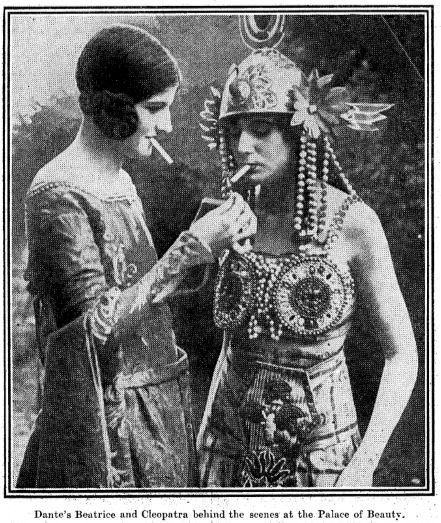
However, the cost of living an actress's lifestyle and raising a daughter on her own took their toll on Ethel, and in 1924 she was declared bankrupt with debts of £200, which was mostly dressmakers' bills.  She only earned £5 per week as Cleopatra and had a mere £2 in savings.  Still, again she bounced back with what would become her greatest hit and a stage sensation...

The Ghost Train by Arnold Ridley

In 1927, Ethel took to role of Julia Price in Arnold Ridley's The Ghost Train (Arnold Ridley was Godfrey in Dad's Army and the great-uncle of Daisy Ridley, Rey in Star Wars). This was not a new play, having been debuted in 1925 but the special effect of the train rumbling through the theatre was enough to electrify and terrify the audience. One man saw it three times attempting to see how they got a whole train into the theatre.  Once more Ethel was playing a thoroughly bad lot (sorry, spoiler alert) but one of her joys in life was playing a wicked women who managed to win the audience's sympathy by her performance.  The Ghost Train undoubtedly made her a star.  It also saw the debut of June Waller, her daughter, playing one of the minor roles.  

Many plays followed, including The Lonely House in 1930, noteworthy as the cast also included a young actor called Bertram Dix. He was only a couple of years younger than June, but it was Ethel who caught his eye.  While she continued to appear in movies and some stage work, the couple moved to Hendon and there opened a hairdressing salon and hat shop. Yes, that was a twist I was not expecting either. Despite claiming in later interviews that she had taken time away from showbiz to run the salon, Ethel still appeared in films such as The Man Outside in 1933, which can be watched on Amazon Prime...

This classic of cinema must have the poshest criminals in history and some exceptionally wooden acting, but obviously Ethel is marvellous as the spinster Aunt Georgina, complete with monocle...

Ferocious Aunt Georgina, telling off bad actors

I was somewhat surprised by Ethel's hair, properly short from the 1920s and I wonder if that was the work of Bertram Dix.  According to a 1934 newspaper article on the couple's salon, Dix was a hair artist and specialist in waves.  He had brought his experience in theatrical and film hairdressing to the establishment at 7 Greyhound Hill, Hendon.  Joining him in the venture was Ethel, there to give women beauty advice including which hats to wear with their new, beautifully waved hair.  As the report stated 'The hats are marked by impressive distinction and originality yet they are available at exceedingly moderate prices'. I do enjoy a moderately priced hat.

The interior of the salon was decorated with Ethel's paintings and drawings, just too small in the newspaper photograph to be able to see what they were like.  The couple had originally intended to open their place in the West End of London but Hendon was seen to have more charm, and I'm guessing less overheads.  

This business lasted until 1938 when the couple returned to the stage once more in Poison Pen, selling the business.  Then the war came, and the couple hastily wed, buying a cottage in Somerset.  Dix went to fight in North Africa, while Ethel remained at home, becoming patroness of the Ebbor Players, a local theatrical group.  She awaited the return of another husband, but when he returned in 1944, he no longer wanted to be married to her.

Ethel and Dix divorced in 1946, and Ethel carried on touring, starring in The Silver Cord in 1947 as it toured the south coast.  She moved to Sussex, but found that in old age her career began to stall.  In a letter to The Stage magazine in 1950, she reported the plight of older actors - 'The agents, bless them, are far too busy exploiting the youngsters to be bothered with us, and, save for a few exceptions, we're all out of work.'  She suggested that manager should form a company of 'old timers', with no-one under 60 - 'There are many old actresses of petite stature, who, with the help of wigs etc, would give excellent performances as youngsters' she wrote, rather optimistically. She also complained that younger actors didn't talk loudly enough.  Bless her.

Ethel died in the Cavendish Nursing Home, Bognor Regis on 12 September 1951, a couple of months shy of 71.  Her obituary in The Stage listed her art school training, her Shakespearean glory days and her three tours of Australia.  It also shaved a couple of years off her age.  I'm sure she would have been delighted.  I also hope that she would be pleased to know that I'm going to keep researching her because she is absolutely fascinating.  After all, we game old birds should stick together...

If you have any information about possible paintings or drawings by Ethel, please drop me a line at stonellwalker@googlemail.com.


Monday, 12 October 2020

Review: Portrait of a Muse

As the nights grow longer, I always like having a whopper of a book to read. Better still, I received a chunky biography of Frances Graham, daughter of Pre-Raphaelite patron William Graham and model for Edward Burne-Jones. Hers was a name that was familiar, so I was eager to learn more... 


Frances Graham, later Lady Horner, seems to have lived a pretty full life.  Not only that, she wrote her own autobiography.  As someone who routinely writes about women of this era, I can't imagine the utter luxury of writing about someone who recorded their own version of events! The best I've ever got was Julia Margaret Cameron's extreme brief Annals.  Mind you, the fact that Frances wrote and published her own memories as Time Remembered (1933) should tell you the level of privilege you are looking at.  This is the story of a woman of comparative wealth and position, not to mention a fair amount of influence.  From her early years as her father's right-hand girl in the art world, to her life as a free-spirited wife and later a mother and grandmother, this is quite a story.  Not only that, it tells the story of how Pre-Raphaelite art travelled from the 19th to the 20th century in taste and some of the many reasons it fell from grace, an aspect which I found fascinating.

The Golden Stairs (1880) Edward Burne-Jones

The beginning of this book is very much concerned with Edward Burne-Jones' relationship with Frances and it is not comfortable reading. 'You haunt me everywhere ... I haven't a corner of my life or my thoughts where you are not,' he wrote to her, and Andrew Gailey, author of this biography, declares Burne-Jones the love of her life.  Despite the technicality that the age of consent was much lower during Frances' teenage years (thereby excusing Burne-Jones of any hint of paedophilia) and Burne-Jones other dalliances, I still found his attention and her attitude towards him more troublesome than I expected.  Small things, like finding visits to Burne-Jones' home much 'nicer' when Georgie was not home, and her peers (and no doubt his) knowing that Frances Graham had 'Burne-Jones at her feet', does give one pause.

Frances Graham (1879) Edward Burne-Jones

There is a very interesting discussion of what makes a 'muse'.  The claim in this book is that Frances Graham is Burne-Jones most important and beloved muse, but never his sexual partner.  There is a very interesting note, quoting Germaine Greer - 

'Physical congress with one's muse is hardly possible, because her role is to penetrate the mind rather than to have her body penetrated.  Dante never laid a hand on Beatrice, nor Petrarch on Laura. Gustav Klimt's "life-long companion," Emilie Floge, the younger sister of his sister-in-law, almost certainly died a virgin.' (note 89, p.388)

Deary me, I want to unpack that, not least because actually in the text, Gailey shows many examples of artists and muses that get very physical indeed.  I suppose the tension is that how much of a claim do we believe if the artist and muse never have sex, which is terribly basic and also impossible to prove either way.  I'm completely fine with an artist and his model never seeing each other naked - no-one can fail to see that Rossetti was inspired by Alexa Wilding - but it is hard to argue that Burne-Jones was all consumed by Frances, beyond all others, without any hint of anything else.  Also, that claim is very problematic for other reasons because you are referring to something that is a one-way street, and often something that says more about the artist than the muse. There has been some very interesting discussions surrounding 'muse-hood' in the wake of things like the 'Pre-Raphaelite Sisters' exhibition.  How much can we claim that inspiration is a two-way street, and can it ever be influenced or controlled by the subject of the obsession?  Also, with Frances and Burne-Jones, we are talking about a very young woman (if we are not comfortable using the word 'child').  Burne-Jones's attitude to Frances and her recorded response is a very salutary lesson in grooming, for want of a better word.  The attention the older artist lavishes on the girl is inappropriate, but I would not say that she is the only beneficiary of this attention.  That's a very busy Golden Staircase, after all.


The piano painted by Burne-Jones for Frances Graham (1879-1880)

 The Golden Stairs is possibly the most famous of Burne-Jones's paintings of his daughter's friends, and Frances Graham is there at the bottom of the stairs with the cymbals.  The painting is often seen as melancholic, with the girls descending from their pinnacle of wonderfulness (and youth) before going out into the big wide world and marriage. Frances was one of those girls who marriages that Burne-Jones bewailed, along with his own daughter and others of her friends.  The narrative then moves Frances into the privileged group of the Souls (who you might know from this post).  Her freedom within this group is both enviable and surprising - despite phrases like 'incarceration that is motherhood' (okay then) and her marriage to John 'Jack' Horner, Frances seems to have spent a large amount of time away from her family, some of it on a boat with another chap.  Marvellous.  


Frances Graham Horner's tapestry at the church in Mells

Actually, I found the passages about Frances' attitude towards her daughters Katherine and Cecily even more bothersome than the Burne-Jones business, although he does crop up again.  There is an interesting claim at the beginning of Chapter 28 - 'Frances proved a more enthusiastic mother than many of her generation.' Now, I don't know if that is a shocking indictment of the horrible upbringing of children born in the 1880s and 90s, or a rather rose-tinted view of how Frances got on, I'm not sure but I didn't see any great triumphs of parenthood.  However, Frances' attitude towards her daughters is difficult to read.  Her praise of the pretty one, Cecily, as opposed to Katherine, the clever one, is trouble waiting to happen.  Again, Frances gives us a narrative of this, so it is difficult to feel this is purely authorial judgement.  Indeed, Gailey seems to want to excuse her of some of the more cringe-worthy comments and behaviour.  It is possible that she is no worse than her contemporaries but heavens, you can see the issues of the children signposted loudly through the attitude of the parents.  Also, a reappearance of Burne-Jones left me speechless - on hearing that John Singer Sargent had painted Cecily, he raged, stating Cecily 'is mine - who was made to fulfil a dream of mine and who is my vindication.' Lordy.

Edward Horner's memorial at the church in Mells

As Frances grows older she doesn't seem to develop insight or any sense of irony.  At the perceived loss of her looks to age, she bemoaned how 'men both married and single, no longer quite young, delight in the society of girls.' Now, come on Frances, wasn't that exactly what you benefited from as a youth? Personally, I loved the chapters where Frances is annoyed by the younger generation, including her own children.  An aspect that struck me was, as she grew older, how Frances' behaviour contrasted with Georgie Burne-Jones - when it came to the Boer War, Georgie's loudly anti-war attitude won her no friends, however Frances is portrayed as a 'political muse', getting involved and raising money for the war.  More tragic yet is the First World War and the devastation delivered to her children's generation.  I found that I was reading about a woman overtaken by events, age and an era that vanished, but possibly that is the fate of all of us as we age.

Frances Graham (1869) D G Rossetti

I have to admit that, to my surprise, I did not like Frances Graham after reading this book.  That is possibly not a concern for you, dear readers, and not at all necessary, but I found it a bit of a novelty to actively dislike the subject of a book quite so much.  The margins of the book are littered with notes such as 'For goodness sake' and 'Really??!!' at some of Frances' comments and remembrances.  That said I think it is to the utter credit of the author that I continued reading and enjoying the story.  This is a hefty romp of a book through fascinating country, filled with the most interesting people.  It is traditionally written and obviously meticulously researched to the point that you feel you are being told it by the people involved rather than through a third party.  Oddly, I was reminded rather of young people today who are horrifically embarrassed by what they have written on social media five years beforehand, in that because all the people in this book are 'important' all things they ever said or wrote was remembered and recorded, both good and utterly appalling.  There is no escaping embarrassing and cringe-worthy comments.  Also, someone should have had a definite word with Burne-Jones, that's for sure.  He does not come out of this well.

If you need a good read this autumn, this is a must.  It's satisfyingly weighty, engagingly written and beautifully illustrated, so gives you a lovely reason to stay safely at home. Portrait of a Muse: Frances Graham, Edward Burne-Jones and the Pre-Raphaelite Dream by Andrew Gailey is published by Wilmington Square Books and available from all good booksellers in November.

Thursday, 20 August 2020

Constant Craving

 As I await the publication of my new book (on the 10th September, see this previous post for information) I have been admiring other photographers, like the tart I am, and I was struck by this photograph...

Veiled Profile (1900) Emile Joachim Constant Puyo

...which reminded me, for obvious reasons, of this photograph....

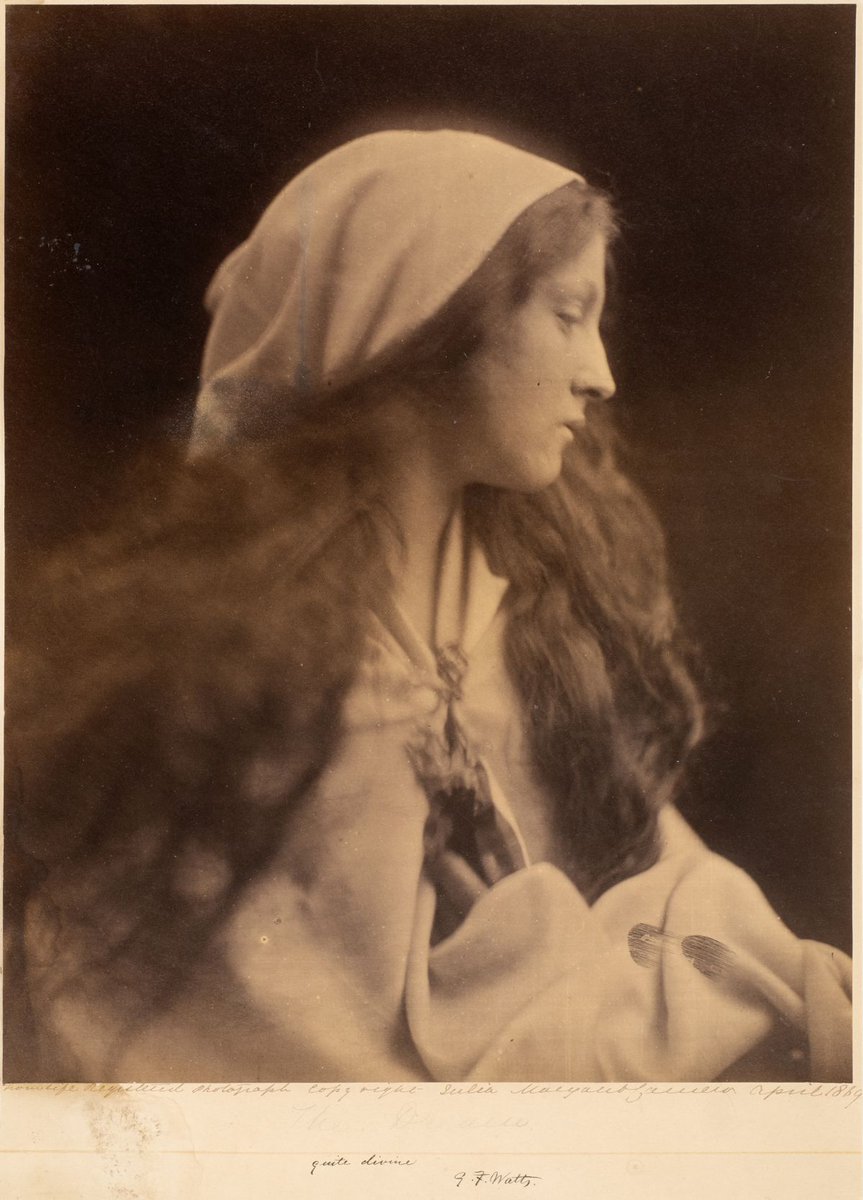
The Angel at the Sepulchre (1869-70) Julia Margaret Cameron

I immediately wanted to know more about the creator of the first image, and what I found were some of the most incredible images which I will now share with you.

Montmartre (c.1906)

(I have to admit this one has a definite perfume of Clementina Hawarden, but that might be the 'balconied-femininity' of it all, but I digress...)

Emile Joachim Constant Puyo, more commonly just referred to as Constant Puyo, or sometimes appallingly anglicized to 'Charles' Puyo (much as Jacques Tissot became 'James'), was born in 1857 in the north-western town of Morlaix in Brittany.  He came from a rather distinguished, middle-class family; his father Edmond was a painter and amateur archaeologist, not to mention mayor of the town between 1871 and 1878 and founder of the town museum.  His uncle Ã‰douard Puyo was a designer and painter and his other uncle Ã‰douard Corbière (I bet Christmas was fun in that house - 'Pass the sprouts Uncle Ã‰douard, no, the other Uncle Ã‰douard') was a maritime writer, author of Le Négrier (1832).  My favourite of Puyo's relatives has to be Tristan Corbière, doomed poet and possessor of both consumption and a mighty fine mustache...

Tristan Corbière, moments before coughing and then tragically dying

I went through a Baudelaire phase, so he's right up my street.  

Anyway, Constant Puyo was a lot less tragically romantic and a lot more alive than his relatives.  No doubt inspired by his father, young Constant loved to draw and paint, training at the local Polytechnic before joining the army.  He served as an artillery officer in what one writer referred to as the 'revenge army' following the French defeat in the Franco-Prussian war of 1870-71. He rose to the rank of Commandant,  and was in charge of a squadron at the School of Artillery at La Fère. All of this left very little time for sketching and Commandant Puyo went in search of a new medium, a quicker medium, in order to capture his images.  He found photography.

Woman Drawing From a Bust (c.1900)

To start with, he photographed friends, family, street scenes, and when he was posted to North Africa, he took photographs of his travels, but all this seemed rather 'documentary' and pedestrian to him, not art. With his posting back to the General Staff in Paris in the late 1880s he began to work on a more pictorial, artistic manner of photography.  

Nude Against the Light (1906)

He helped form the French Salon of Photography in 1894 with his friend and collaborator Robert Demachy, with whom he wrote Notes sur la photographie artistique in 1896.  He not only took photographs, using optical blurring via 'artists' lenses' and the development of gum bichromate and oil transfer, he also wrote at length and passionately on what could be achieved in this new mode of photography.

Summer (c.1900)

He was admitted to The Brotherhood of the Linked Ring in 1896, a British photographic society similarly dedicated to promoting the 'art' of photography.  Strangely enough, I already knew about the Linked Ring because I am a fan of William Smedley-Aston...

Mrs Patrick Campbell reading the Kelmscott Chaucer (1904) William Smedley-Aston

...and I'm a massive fan of his gorgeous wife, artist and model Irene Smedley-Aston...

Irene Smedley-Aston (c.1900) William Smedley-Aston

Good heavens!  Anyway, I digress.  Puyo is most known as a proponent of  Pictorialism, where a seemingly naturalistic scene is manipulated to heightened effect. That way an image is created rather than simply recorded, much like any other work of 'traditional' art.  I particularly like his use of light, in that sort of chiaroscura effect, which is very effective in works such as Mis-en-scene...

Mis-en-scene (c.1900)

He used a combination of natural light and a magnesium flash to create very dramatic 'night' images that capture these alabaster women frozen in a moment of time, theatrically staged and immortalised.

Sacred Song (c.1915)

He retired from the army in 1902 to devote himself to photography.  However, the First World War brought him back into service and he found himself assigned to railway management as he headed towards his sixtieth birthday.  By 1921, despite the fall in popularity of Pictorialism, Puyo found himself the President of the photographic French Salon in Paris until 1926, then he retired back to Morlaix.  He continued to photograph, sending work to a exhibition in Chicago in the summer of 1933, entitled 'A Century of Progress'.  He became ill shortly afterwards and died in the autumn of the same year.  His grave can be found in the graveyard at Saint Martin des Champs, near Morlaix, beside Ã‰douard and Tristan Corbière.  

Sleep (1897)

If you fancy seeing more of Constant Puyo's work, then, quite rightly, the museum in his home town has a wonderful collection. I'll see you on the ferry....


Friday, 7 August 2020

Coming Soon - Light and Love...

We're a month away from the launch of my new book Light and Love and so I thought I'd tell you about it.  Also, I have a very special offer from my publisher. Anyway, here's my lovely new book...

Light and Love: The Extraordinary Developments of Julia Margaret ...


As you can see it's called Light and Love: The Extraordinary Developments of Julia Margaret Cameron and Mary Hillier and it is a biography of a relationship.  I wanted to write something about both Mary and Julia for a few years now but when I started to write about them I realised what I wanted to explore was how each woman influenced and affected the other, and how the result of that relationship was the wonderful photographs by Julia of Mary.  So, this is the journey of a friendship and how the relationship between two people can create extraordinary works of art.

Julia Margaret Cameron - Maud [Mary Hillier], 1875 | Flickr
Maud (1875) Julia Margaret Cameron

The book is in three parts, much like the stages of wet collodion photography.  The first part of the book is like the preparation of the glass plate, and all the things that need to happen in order to be ready to create something amazing.  I have written about Julia's journey towards becoming a photographer, her upbringing in India and travels to Africa and Europe.  I find her choice of friends fascinating, how she purposefully befriends educated men who helped her become more than just a colonial wife and hostess. Julia's path goes far beyond what is expected of her and is inspiring. I love how people found her baffling, adorable, infuriating and overwhelming in equal measures.  She is also a woman who does not hide her emotions, especially about those she loves.  In an era when women were meant to keep everything in check, her flurries of love and enthusiasm are astonishing and touching.

JULIA MARGARET CAMERON (1815–1879) | Mary of Bethany (Mary Hillier ...
Mary of Bethany (1865) Julia Margaret Cameron

Part two reflects the taking of the image, the patience and chance at play in capturing a picture on your glass plate.  In this part, Mary and Julia begin their journey in photography.  Through Mary, Julia was able to find her ideal and express her notions of beauty, piety and harmony.  Through Julia, Mary was able to learn the science of photography and become a celebrity who met princes and poets. The relationship between one woman who had travelled the world and the other, over thirty years younger, who had only known one rural village, brings the most incredible images that still move and electrify us today.  This duality appears in memoirs of their contemporaries and I was surprised to read accounts that talk not only of Julia but of her muse and the strange thrill of seeing this 'angel' serving up the dinner at Dimbola Lodge.

JULIA MARGARET CAMERON (1815-1879) | 2nd Version of Study after ...
Study after the Elgin Marbles (1867) Julia Margaret Cameron

Part three follows Mary after the departure of Julia to Ceylon.  How does a former muse deal with life after the departure of the artist they inspired?  I have often wondered about the lives of the models I research.  It's hard to think how much the process of art changes your expectations of life, and how the existence of the immortal 'you' changes how others act around you.  Also, I have written about Mary's family, her children and her expectations for them which I believe were changed by her experiences at Dimbola.  Whether or not she got her wishes, you'll have to read to find out.

Dominic Winter on Twitter: "The Dream, 1869 A fine and signed ...
The Dream (1869) Julia Margaret Cameron

This book is the result of many years of research, archives, meeting people, looking at photographs, taking photographs, breathing in chemicals and reading more books than I can remember.  It's also been an exploration of what relationships mean to us, what they bring in terms of inspiration, both in life and art.  If lockdown has taught me anything, it is that relationships with people that inspire you are vital to existence.  I can't wait for you to read my new book and discover this remarkable relationship for yourselves.  To that end, the smashing people at Unicorn have a special offer for you.  If you preorder Light and Love with them from now until 9 September you can have a signed copy for an extra-special price...


Everyone deserves a bit of light and a whole lot of love right now, so visit Unicorn and use the code 'LIGHT' to get it for a tenner.

Thanks as always go to the wonderful team at Unicorn for making this such a beautiful book and I look forward sharing it with you.

Tuesday, 9 June 2020

Review: Barely Clare - The Little-Known Life of Clare Mackail

You might have guessed by now I love to research the lives of little-known women and equally love to read about other people's work to uncover the lives of those who have been neglected by historians.  Often the story of the search is as fascinating as what is uncovered.  That was absolutely the case with Nigel Daly's The Lost Pre-Raphaelite and I have the delight in recommending a new book to you today that delivers just such a dual narrative - Barely Clare: The Little-Known Life of Clare Mackail by Tim McGee...


For those that don't know (and I think a major point of the book is that people just don't know), Clare Mackail was the granddaughter of Edward Burne-Jones, and daughter of Margaret Burne-Jones.  She was the third child, listed normally as sister of Angela Thirkell (popular novelist with her own Wikipedia page) and Denis Mackail (popular novelist with his own Wikipedia page).  Clare has not got her own Wikipedia page and in fact, you might not know she even existed while reading theirs.

Georgiana Burne-Jones and Clare Mackail (c.1900) Emery Walker
I really loved this book for a couple of reasons.  Firstly, it's easy to read and an absolute joy.  I read it in one sitting because you are being told a story and you really care about what happens.  Also, that story is brilliantly set up with the premise that everyone thinks Clare had a boring life or is surprised that she even existed.  It's the sort of set up you know will be merrily knocked down by the end. Also, the text is interspersed with what other biographers have said about Clare, if they have bothered to mention her at all.  It's not good.  One even refers to her as 'simple'.  Lawks.

Clare Mackail obviously did not have an extraordinary life, well maybe not 'obviously' as it is possible for a woman of enormous talent and accomplishment to be utterly overlooked, but what she managed to achieve (or at least what Tim found, more may yet come to light) is still extremely interesting.  I especially loved her involvement with the Holst family and the performance of his music.  Also, the sections about Ralph Vaughan Williams are fascinating.  She moved in important circles and was involved in British music to a level that should get a mention when histories are being written.  Her turn to spiritualism and alternative worship is also a genuinely enthralling side of the Second World War that I have never considered or really been aware of and now feel I want to know more. That's the mark of a great book as far as I'm concerned.

The Thirkell children, l-r Clare, Denis and Angela

The problem with researching little-known women is that there can often be little known, which sounds obvious but people only tend to remember or note down what (or who) they consider to be important.  Tim has done a brilliant job finding the threads and creating a picture of a life with them.  The story of his own travels and discoveries is marvellous - I especially loved his journey to find the house Clare lived in, which not only tells you about the place and the house, but everything you need to know about the author, who is exactly the sort of person you'd want to go on an adventure to find a lost house with.


Even if we weren't all in lockdown, you definitely would have time to read this, and as we are all in need of smashing things to read right now, I have no hesitation in recommending this joyous little book to you.  It won't break the bank, it will tell you loads of things you will not have known before and will add extra layers to things you do know. I'm sure you can get the book through your normal channels but here are the links to Amazon UK and USA as well.