Saturday, 21 March 2020

Book Review: Nelly Erichsen, A Hidden Life

Well, here we are, all on lock-down and so there is no better time to get some reading done.  With this in mind, here is a review of a new biography sent to me recently.  You've probably not heard of the subject, and she is definitely worth our attention.  Ladies and Gentlemen, may I introduce you to Nelly Erichsen, A Hidden Life...


Nelly's life actually reminded me of a few other of my favourite Victorian artists, and it was interesting to see how her life and experiences differed and where her life took her, for better and worse.

Her father was an ambitious Scandinavian named Hermann Gustav Ericksen who came over from Denmark in 1848.  He settled in Newcastle Upon Tyne, in Byker (home of the lovely Grove).  As a motivated and talented young man, he was soon involved in the new business of telegraph and was involved in the laying of cables between Northumberland and Denmark.  In 1854 he married Ane (or Anna as she was known) who was from the wealthy Danish 'Suhr' family.  Their family swiftly grew...


The Ericksen family, with Nelly sat next to her mother on the bench
Nelly was the fourth child, and third daughter, born  in 1862.  When she was 8, Hermann had the opportunity to move to London and so the family relocated to Tooting in South London to one of the leafy suburbs that the middle-classes flocked to in the ever-increasing capital.  Although she was home educated, like all good middle-class daughters, Nelly showed an aptitude and enthusiasm for art.  In 1880, Nelly gained entry to the Royal Academy school.  This reminded me very much of Eleanor Fortescue Brickdale, who had to wait until she had grown-up before getting the chance of education in an institution.  I wonder how this affected these girls who had led quite sheltered, but perversely focused experience of education to suddenly be part of a class, not the sole focus of a teachers attention.

Golden Hair (no date)
In 1883, Nelly was one of the 64 signers of a letter in protest that the Royal Academy did not allow young ladies to attend life classes.  Despite this inequality, Nelly did rather well at the RA, winning a silver medal for a 'Drawing of a Head from Life'.  She was the only female prize winner in 1884 out of 18, which draws attention to how the lack of parity in the system at that time impacted the women's chance to advance.

 A Hard Day's Labour (no date)
I particularly enjoyed the chapter covering the 'extra woman' problem of the 1890s, when it was noted (by the sort of people who worry about these sorts of things) that there were more women than men.  I was relieved to hear that although this sort of thing is very concerning, the male brain is 5oz heavier than the female brain, therefore there was actually more man-brain than woman-brain, by the pound.  Reason would therefore prevail. Well, thank goodness for that!  However, it did mean that it was not a certainty that your lovely middle-class daughter was guaranteed a husband, so you had better educate her because no man would be along to take her off your hands...

The Old Synagogue from The Story of Prague (1907) Count Lutzow
Luckily, Nelly was  rather talented and resourceful, so rather like Brickdale, she turned her hand to book illustration, such as the above image from The Story of Prague (1907), starting with We Four (1881) by Mrs Reginald Bray.  Nelly travelled in Europe and continued to exhibit widely with Royal Society of British Artists and the Society of Women Artists.

Going Home (no date)
A very enjoyable section was about Nelly's interactions with George Bernard Shaw.  He was a tad git-weasel-ish on the whole, whatever you think of his writing.  It seems that while he was not getting married to May Morris, he was also not getting married to one of Nelly's friends, Bertha Newcombe, whilst pursuing Nelly.  Nelly, being smart to his sort, made sure she had a friend over whenever Shaw invited himself round for tea, much to Shaw's dismay.  Really, when I get my time machine, GBS's name has been added to the list of people who I need to visit and have a bit of a chat with.  For heaven's sake.

The Magic Crystal (no date)
The biography is stuffed full of lovely images which is brilliant as it is hard to find illustrations of Nelly's work online, certainly not of the same quality as appear in A Hidden Life.  Nelly's art has a lot in common with both Pre-Raphaelite works, in such pieces as The Magic Crystal, and a sort of realist/idealist rural school in works like The Orchard...

The Orchard (no date)
Sadly Nelly did not have the long and successful life she possibly deserved.  Remaining unmarried meant she continued to work, unfettered by a husband, but the First World War intervened and she travelled with friends to help refugees in Bagni di Lucca in Italy, establishing a school for children displaced by war.  When the Spanish flu hit the region in 1918, Nelly was one of the casualties, just as the Armistice was called. She died at only 55 years old.


This is a charming book, full of detail and interest.  Nelly's story is fascinating and typical in part of many of the young women of her age, educated and independent, in a fast-changing world.  She was not only a thoroughly modern woman, but responsible for some interesting images of these bright and brave young ladies, taking on the expectations of society and achieving so much.

Nelly Erichsen, A Hidden Life by Sarah Harkness is available now from Encanta Publishing, from Amazon (UK) and selected bookshops.

Wednesday, 18 March 2020

The Brief, Bright Star of Percy Bulcock


Today's post is about a new obsession of mine, the new man in my life.  It's not often I end up writing about men, but I've absolutely fallen in love with today's subject and he has a marvellously tragic life so here we go.  Say hello to the wonderful Percy Bulcock...


 When Percy Bulcock died in 1914 (sorry, spoiler alert), the local newspapers chorused their desperate sadness of the loss of such a bright and promising young man. He was called ‘exceptionally gifted’ by the Burnley Express, a man whose work was characterised by its ‘perfect neatness’. Even though he was barely at the end of his own studies, he had managed to create a wealth of beautiful art and inspire his students, for whom he was ‘held in esteem both for his personal and his artistic qualities’.  To Percy, a man renowned for his modesty, that fact he has been lost in time would have possibly seemed only right, but it is time that his Pre-Raphaelite inspired art is celebrated once more and that Percy Bulcock assumes his position as one of the most beautiful illustrators of the early twentieth century. Behold the majesty of his work...

Illustration from A Dream of Fair Women (1902)
 He was born the second son of John Bulcock from Burnley in Lancashire.  Despite a humble background in farming, John Bulcock had gained an apprenticeship to a printer and developed a love of the classics and astronomy. Like his elder brother Charles, Percy dreamed of becoming an artist.  The family were not privileged and there were many little Bulcocks to support, so Percy and Charles attended their local school, moving on to the Burnley School of Art, which was run in connection with the Mechanics Institute.  He was remembered as an artist in his soul, even as a boy, with talent flowing to his fingertips.  Whilst there, it was this talent and sheer hard work that brought in a fair amount of prize money, including several Queen’s Prizes and gold medals for high marks .  Finally in 1898 he was awarded a scholarship for a total of 8 years at the Royal Academy of Art in London, a far cry from Burnley and its cotton mills, where Percy’s siblings worked.

Design for Armorial Stained Glass Window, Old Bailey, London (1902-6)

It was in London that Percy was taught by Professor Gerald Edward Moira, a famous muralist, and Percy arrived just at the moment Professor Moira needed a talented lad to assist with the decoration of some of London’s best known and prestigious buildings.  

Ceiling Decoration in the Board Room , Lloyd's Register, London (1900)
In 1900 they painted ceiling murals in the Board Room of the Lloyd’s Register new building in Fenchurch Street, London.  A year later, they painted murals on the ceiling of the United Kingdom Temperance and General Provident Institution offices.  Possibly Percy’s most impressive work could be seen in the lunettes at the Central Criminal Court, better known as the Old Bailey.   

Justice, Lunette in the Central Criminal Court (Old Bailey), London (1902-6)
The current building, with the golden figure of Justice on the dome, was decorated throughout by Moira and Percy with both murals and stained glass, which was then opened by King Edward VII in 1907.
 

During this time Percy also cultivated his exquisite illustration style.  Aged only 22, Percy provided a delicate frontispiece for Kathleen Haydn Green’s Twelve Allegories (1901).  The popularity of this led to further commissions from the young art student. Channeling the spirit of Dante Gabriel Rossetti, his contribution to the ‘Flowers of Parnassus’ series of poetry books were moody, pouting maidens with great swirls of hair.   

 
A Dream of Fair Women (1902)

A Dream of Fair Women (1902)
 
A Dream of Fair Women (1902)

Firstly in 1902, he illustrated Alfred Lord Tennyson’s A Dream of Fair Women, followed by 1904’s The Blessed Damozel where Percy’s illustrations conjured Jane Morris in all her sorrowful, dark-eyed glory.

The Blessed Damozel (1904)
 
The Blessed Damozel (1904)
In 1907, Percy returned to Burnley, wishing not only to settle down but also to inspire a generation of young men like himself to produce great art.  He married Dinah Isabella Benson, a servant for a manufacturer of cotton bobbins used in the mills.  The couple settled in Aigburth, a suburb of Liverpool, where Percy became Design Master at the Liverpool Art School, where many years later John Lennon would attend.   

The New Year (c.1901)
Their house, a small, mid-terrace red-brick family home, had wide bay windows and attractive fireplaces, perfect for the couple’s young son, John, born in the June of 1911.  Percy, driven to work hard to provide for his young family, won a Daily Mail competition to design a medal for the 1911 Colonial Exhibition, and took on commissions for banners for the Pageant of Liverpool.  He also won a trophy for designing a stained-glass window for Pittsburgh,  He also continued to sell his art, all while teaching.

Cyril Goldie, Scholar and Deer (no date)
His ambition as an artist never made him turn his back on inspiring young artists and designers.  In early 1914 he decided to move his family to the south coast of England when he applied to become the headmaster of the Hastings School of Art.  An extremely rainy March, even by English standards, had led to a chilly April and Percy developed the flu which within a week became full pneumonia and he died, aged only 36.   

Knight illustration from the Pall Mall Magazine (1901)
His sudden and tragic death hit the local art scene hard.  In the outpourings of grief in the local newspaper, it was felt that with the loss of this blessed son of Burnley had gone beautiful art and a great example to any young man born in the humble industrial mill town in the north of England.  As the Burnley Express wrote in his obituary Percy showed what could be accomplished by a ‘Burnley lad’ who was ‘full of grit and determination’.  The Liverpool Academy exhibition in June 1914, the Lord Mayor opened a special room showing a collection of 70 of Percy’s tempera, watercolour and etching work.   

Ganymede (1909)
This moved to the Townley Museum in Burnley, in the Mechanic’s Institute which had been so instrumental in Percy’s first steps as an artist.  The works were offered for sale in order to support newly widowed Dinah and baby John, who must have been comforted by the warm words in the press about Percy.   

The people of Burnley should be proud, the Burnley Express declared, that they produced such a man who at only 36 was capable of such a versatile and talented man – ‘only thirty-six years of age; he must have been a genius’.


Thursday, 16 January 2020

A Mother of a Mystery...

As many of you will know, I am currently writing a biography of Julia Margaret Cameron and her maid Mary Hillier, due out in September (more on that another time) but whilst gathering lots of lovely illustrations, I came across this image...

Portrait of Adeline Pattle-de l'Etang, the mother of the Photographer (1874) Julia Margaret Cameron
What a smashing photo of Julia Margaret Cameron's mum!  Such elegance and grace, and having been born around 1793, she isn't looking bad for 81.  Mind you, she had the benefit of being dead for the previous 29 years, which would account for how well-preserved she looked...

Adeline in happier, more alive times...
So, here's the thing - this can't really be her, unless the big twist in my new book is that JMC's mum was a zombie or a vampire (sorry, she wasn't), so who on earth is this then? Adeline Pattle (nee de L'Etang) died on the journey back from Calcutta with the body of her husband.  Both she and her husband James Pattle were buried in St Giles' Church, Camberwell, in 1845.  However, Julia Margaret Cameron had a sister called Adeline - aha!  so it must be her!  An understandable mistake, the sister of the photographer, rather than the mother etc etc.  Problem is that Adeline Maria Pattle, daughter of Adeline de L'Etang Pattle, born 1812, died in 1836.  Rats, so it's not her either.  As every other person in the Pattle family was called Adeline, Virginia or Maria, I had a shufty through all of them and was damned if I could find anyone else who was even vaguely likely, called Adeline.  Okay, so how did we end up in this pickle?


Written below the photograph, in Cameron's own hand, is this little message which is the root of the confusion.  It reads 'My gift to her beloved mother'.  Obviously, the people who owned this before the Rijks Museum (who now own the image) assumed that it was a portrait of Adeline Pattle, by JMC, that her daughter, Julia, had given to her as a gift.  However, that doesn't quite scan, because surely in that case she would have written 'My gift to my beloved mother'.  Whose mother is it then? Who is this woman?

Julia Margaret Cameron (1870) Henry Herschel Hay Cameron
 So, my first thought was 'Is it actually JMC herself?  Is this a self portrait?'  It is definitely a photo by Julia Margaret Cameron, and looking at the woman, I feel she is a Pattle, there is a bit of a resemblance, but could it possibly be Julia?  We have a few photos of Julia, most famously this snap by HHH Cameron, her son, which is only four years before the 'mother' picture.  I also wondered if JMC was dressed to look like her mother, as all the draped lace is rather old fashioned and unlike what you would expect from what JMC normally wore - she was more silks and velvets.  Actually, it looked more like this image of Anne Thackeray...

Anne Thackeray (1870) Julia Margaret Cameron
But, on the whole, JMC did not tend to take photographs of older women.  Famously, she was supposed to have made some disparaging remark about any woman over the age of twenty or something, and yet continued to take images of beardy old chaps.  Well, it is true that her aesthetic muse seemed to spark on young women of her staff or family, whereas her portraits of the great and good tended to be older men, mainly because that's what great and good looked like in mid Victorian Britain.  Don't blame me because the patriarchy got all the good photos.  Anyway, there is the odd older woman in JMC piccies, who sneak in because they are family, for example...

Maria 'Mia' Jackson (1872-5) Julia Margaret Cameron
Okay, so Pattle sister Mia has to be a suspect, as she has the same lace-y headdress thing (I want to say 'mantilla' but I think that's something else) and she is in possession of the Pattle looks, so it could well be her, but a bit like JMC, her hair looks rather straight in this picture, whereas the woman in the 'mother' image has a crimp-y touch, but it all depends on the day, the hairstyle etc I suppose.  There are stories of how Julia liked to wash the hair of her beardy old chaps to make it all fluffy, like this one...

Sir John Herschel (1875) Julia Margaret Cameron
So very fluffy. But I digress, and this remains a mystery because Mrs Cameron did not leave us any clue apart from the face.  All we can speculate upon is that this is either a photograph of a woman intended to be given to the mother, who is much beloved - 'My gift (of this lovely photograph of your daughter) to her beloved mother' or it is a gift for someone who Julia owes a lot to, so she repays that by taking a photograph of the friends mother - 'My gift (which I can never repay to this female friend so have chosen to bestow this upon her nearest and dearest) to her beloved mother'.  So this is my most outlandish suggestion...

Mary Hillier (1868) Julia Margaret Cameron
Highly unlikely, but I wondered if it was Mary Hillier's mum.  Mrs Cameron was not above dressing people up, so the clothes the older woman is wearing might well be out of the Cameron dressing-up box.  As Mary and her sister Sophia both modelled for Mrs Cameron's photographs, and Mary was an special model and muse for her, I wouldn't put it past Julia to drag in another member of the family.  Julia also had slightly lax guidelines on the age of local people in her photographs, with the occasional older woman creeping in, but I think Julia's prejudice against older women has been somewhat over-played anyway.  I also wondered about the possible double meaning of the word 'mother'.  Mary Hillier had been playing 'mother' in Julia's photographs for over a decade by this point, despite being a teenager when she started.  She is, in the photographs of Julia Margaret Cameron, the 'beloved mother', so I wondered if that photograph had been taken as a gift to Mary, 'the beloved Mother' of Mary's mother.  

It's only a theory and I have nothing to back it up.  More than likely, unless someone recognises her, this particular lady will remain a mystery. Or a zombie! Probably just a mystery.

Sunday, 5 January 2020

Venus in your Garden

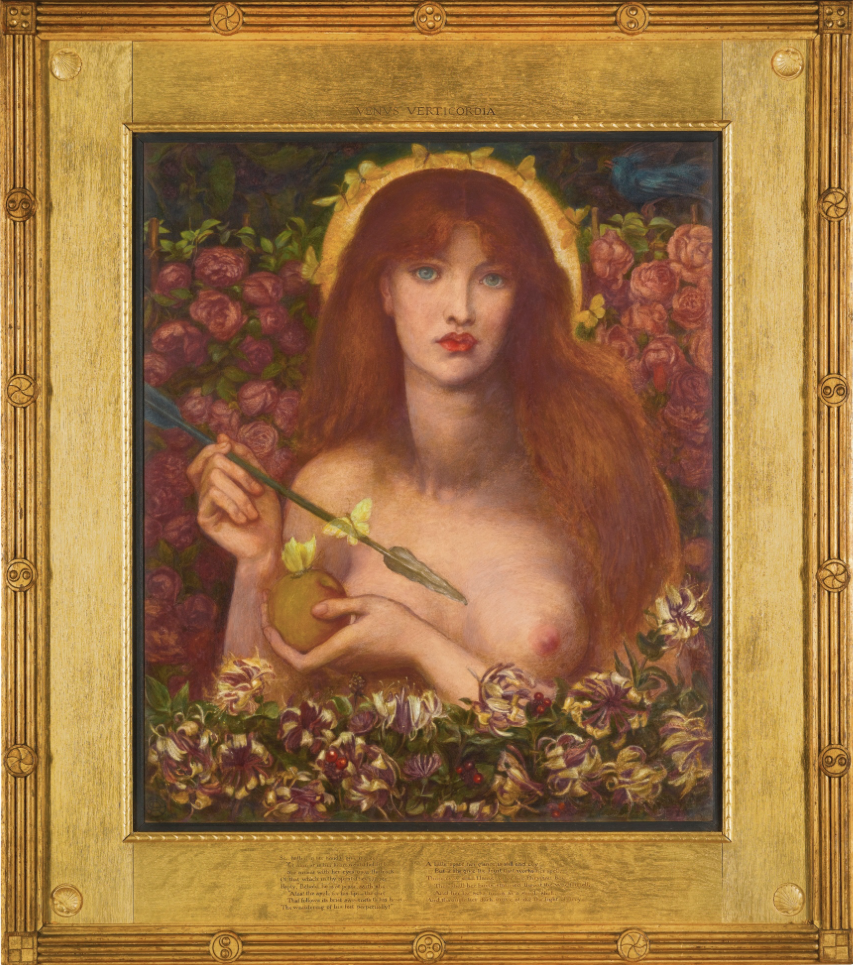
Excuse the brief, rambling nature of this post but it's just a thought that I wanted to write down and as you're here, I'll tell you.  Yesterday, I was having a very lovely look around the Beyond the Brotherhood show in Southampton with some lovely friends, and we found ourselves stood in front of this beauty...

Venus Verticordia (1864-8) Dante Gabriel Rossetti
Yes, yes, all very lovely.  Now, the problem I have with this image, which I liked so much I used it on the front of my novel about Alexa Wilding, is that it is hard to get a decent reproduction of it, and secondly, you just end up looking at Alexa and her assets because she is so very luminous, which means you often don't give a massive amount of thought to all the other bits and pieces in the picture. That might well just be me, because it seems rude not to stare at her boob, especially as she is going to the trouble of pointing at it and everything.  Anyway, I was stood to one side of the painting yesterday, talking about how Rossetti scraped out the face to add Alexa and the suchlike, when I was attracted to the blue bird in the corner.  Now, obviously I had seen the bird before, I'm not that boob-obsessed (not quite) and in fact it is one of my favourite bits as the blue adds a spark of something that contrasts with the pinky-russet of the piece, highlighting her eyes.  Anyway, what I had not really clocked before was what the bird was sitting on. It's a trellis, although, in this reproduction, you'd be hard pressed to see it.  Hang on...
Bird! (Also present but not pictured, boob)
Okay, that is not very helpful, but you can just about see that the blue bird is clinging to the struts of a trellis that the roses are climbing up.  In the chalk version from 1863-8, it has moved...

Weird ghost bird over right shoulder...
But in the watercolour replica of 1868, it is where it should be...

Smashing frame!
And in fact a little bit easier to see...


All this rambling is because the friends we were with asked what the significance of the bird was.  Well, blue birds are a symbol of fertility, renewal, birth, possibly there to contrast with the butterflies that symbolise the fleetingness of life in a whole 'circle of life' thing without having to bother Elton John.  However, something about that bird seemed familiar...

Trellis (1864) William Morris
Hang about, I thought, that reminds me of Trellis!  Why had I never noticed that before?! Trellis is probably my favourite William Morris print (don't tell Strawberry Thief) and his first design.  Legend has it that it was inspired by the trellis work in the gardens at the Red House.  Look at the date, right there at the inception of Venus Verticordia and the little flying insects that look somewhat like tiny butterflies.  A couple of Philip Webb's blue birds (Morris couldn't do birds so got his friend to do them) look awfully like the blue bird in the corner of Venus Verticordia. Hmmm...

So what can we surmise from this? Possibly nothing other than it is a co-incidence, or that Rossetti and Morris discussed the design and Rossetti included it as an homage to his friend.  Or pinched it because it was a nice touch and he was a bit blurry on boundaries when it came to pinching stuff or wives. The fact that both Trellis and Venus concern rose covered trellises, even though Rossetti's is somewhat more overblown (show off) makes me suspect that it isn't a simple co-incidence. The scandalous novelist in me wants to read far more, obviously, and suggest that by 1865 when Venus was in full swing, Rossetti was falling back into love with Morris' wife and by including the Trellis bird in the canvas he was signalling that she had 'turned his heart' like Venus. 

What it probably should tell us is that you should never, ever, let Rossetti anywhere near your trellis, but I think we knew that already...