Friday, 27 October 2017

I'll Be There For You...

I don't intentionally begin every post with a confession but for the second time in a row, here we go: I'm a bit rubbish when it comes to friendships.  By this I mean that I massively overestimate how attached other people are to me and have in the past mistaken acquaintances, colleagues and random strangers for friends.  I have some absolutely marvellous friends (hello if you are reading this), who I count myself fortunate to have, but I obviously have a problem recognising, distinguishing and generally getting friendship right. So, as always, I turned to Victorian art for wisdom and to help me get this whole business of friendship straight...

A Friend in Need John Robertson Reid
I'm not sure this counts, as he isn't so much a friend, more of an errant child whose hat has fallen off.  Mind you, there is a suspicious boy lurking off to the right who might have given the crying boy a snowball to the face and so what our 'friend' really needs is to use the woman as a human shield.  Charming.

Playmates (1866) Arthur Boyd Houghton
Do you have to be friends with the person you play with?  No sniggering at the back.  I remember being left, pre-school, to play with some decidedly unfriendly children by my mother, including one girl whose idea of fun was to see how many times she could bite me before I made it back to the sitting room.  The dog looks fairly hacked off as he is about to get little girl feet shoved into him at any point and then the other one will start banging that damn drum again...

The Fair Friend (1840) Charles Baxter
Well, I'm sure she is a very good friend indeed to sit still and be painted.  Do you think artists make an effort to befriend attractive people, just in case they are short of a model?  I'm guessing it's from the quote from Shakespeare - 'To me, fair friend, you can never be old, For as you were when first your eye I ey'd, Such seems your beauty still.' (Sonnet 104).  That's a splendid sentiment and very true, that those we know and love the longest remain like they were when you first met them.  One of my oldest friends has a little sister who I still think of as being about five years old, but then I remember she is the same age as my husband...

Best Friends (1908) John George Brown
So far, no real images of people being friends to solve the whole conundrum for me.  Hang on though, here's an image of 'best friends'! It's the special friendship between this little boy and his best mate, Bob the dog-faced boy.  Okay, I suspect Bob is actually a big fat terrier.  As the owner of a big fat terrier, I agree, they are very friendly...

True Friends (1900) John George Brown
I wonder if John George Brown was making some sort of comment on the relationship between boot-blacks and their dogs, maybe making a poignant statement about the vulnerability of child-workers.  Maybe Brown just really liked terriers...

His Only Friend (1871) Briton Riviere
Actually, Brown is not the only one to see that man's, well, boy's best friend is a dog.  They have so much in common - both are a big ragged, neither has shoes.  Rather than a terrier, Riviere has gone with a mongrel, the least posh of all dogs. Nowadays it would be given a made up name like a cockerpoo or a jaffie and cost a fortune.  We have a 'jaffa-whip', which is a cross between a jack russell, a staffie and a whippet. Behold the majestic beast!


Okay, so I made 'jaffa-whip' up. Blossom is a proper mongrel, whose mum was a posh Jack Russell from Windsor, who got out one night and brought home trouble if you know what I mean.  She is our Battersea Dogs Home girl and is indeed one of my best friends.  She puts up with me typing all the time, balancing books on her if she is on my lap and being asked art history questions.  I put up with her wind.  It's a fairly equal relationship.

His Only Friend (1875) John Dollman
How bad is his music if he is locked up in stocks and only the dog likes him?  Flipping heck, that's harsh.  Also, if he has been locked up for bad busking, why have they left him his lute?  Don't encourage him! The dog is there saying 'Go on, do Stairway to Heaven! They'll love it...' Maybe that dog isn't his friend after all.  Friends don't let friends play bad lute in public.

Cronies (1884) Buckley Ousey
I was a little puzzled by the title of this painting to start with as 'crony' doesn't tend to have cuddly overtones these days, but I now know it originally comes from the Greek khronios meaning 'long-lasting' so just refers to an old friend.  This leads me on to wonder if it is the couple chatting outside that are the 'cronies' rather than the little girl and her dog, neither of whom look as if they have been around that long.  As the child and dog are closer to us then it seems to imply they are the friends who will be friends forever, or maybe it is saying that when they grow up, they will be two old women gossiping over the back fence.  Not sure how that works when one of them is a dog.

Staunch Friends (1859) William Frederick Yeames
Just to come over all Grey Gardens, there is no better friend than a staunch friend, obviously.  At least this one is not a dog and is pretty much a person, albeit a hairy one. I've worked with less competent people than a monkey in a hat, in fact some co-workers have left me wondering if they would be able to place a hat on their head successfully seeing as they mistake arse for elbow so often. I once worked with someone whose only discernible work-skill was the ability to see through glass. Sorry, I'm just jealous of Yeames' positive work relationship.  Mind you, do colleagues actually count as friends?  This one has got me in trouble a few times. I think I have learned it is possible to be friends with colleagues but colleagues should never automatically be counted as friends, especially in working hours.  Unless they are monkeys.  Monkeys are always your friends.  Just look at BJ McKay and his best friend Bear, who was a monkey, not a bear.  I am digressing, and apart from monkeys and dogs, I am no closer to finding out about friends...

An Old Friend Failing (1880) Haynes King
So is her teapot broken or is it empty? I'm guessing it has a hole in it, which is indeed a serious matter in this country.  No-one likes an incontinent teapot, very embarrassing indeed. I can understand her distress because I hang on to pieces of cookware far longer than I should because of sentimental attachment.  I have a massive plastic fork thing, for stirring sauces and stir-fries, and the handle is three-parts melted patches, but I hang onto it because it has served me well over the last seventeen years and I will not abandon it now. Not many of the people I know would catch fire for me accidentally while making a spagetti bolognaise.  That's proper devotion.

So I guess that is my problem when it comes to friendship: I know where I am with animals and inanimate objects, but people are a mystery and leave me in a right old pickle.  Victorian art seems to back me up on this.  I can find plenty of pictures of rivalry and romance but friendship that isn't dog or cookware-based is a bit thin on the ground.  Maybe that's the point, maybe it's not just me who doesn't know how to do the friendship thing in an appropriate and sufficient manner.  For now then I will just be grateful for the smashing friends that I have managed to hang on to and I fully endorse the Victorian ideal of a fat terrier as your friend...

Blossom and me

Monday, 23 October 2017

Mary Hodgkinson, Super-Model

I have a confession to make.  In my last two talks about 'Pre-Raphaelite Women', I managed to miss someone out.  This is a shocking oversight on my behalf but I put it down to the fact that she was one of Millais' models and I always get a bit nervous about talking about Effie Millais and stay away from him, on the whole.  Anyway, I shall put that right immediately in this little post, which is all about that world-famous Victorian super-model Mary Hodgkinson...

Mary Hodgkinson (1843) John Everett Millais
Okay, I might be over-hyping her a little, but I do feel guilty about missing her out and you are bound to recognise her when I show you where she crops up.  Anyway, firstly, a little background - Once upon a time in Somerset, there was a man called Henry Coward.  He was originally from Hampshire (a couple of counties over on the south coast of England) and so when his first wife died, he seems to have moved back east and married a woman called Ann Evamy, in a small village called Nursling, just outside Southampton.  Nowadays of course, Nursling village is not 'just outside Southampton', it's pretty much part of the massive sprawl of the city which is really rather wide, from the New Forest on one side to tapping on the door of Portsmouth on the other.  

Southampton in the 19th century
Henry and Ann Coward were in charge of the Baths and Long Rooms in Southampton.  The Long Rooms were apparently quite the place to be seen in Regency Southampton, and there were some charming rules that had to be followed: Gentlemen had to leave their swords at the door, no boots are to be worn on Tuesday, Thursday or Saturday evenings, and dancing in coloured gloves is strictly prohibited! Sensible stuff, I'm sure you will agree.  When Henry moved to Southampton, he brought with him the only child from his first marriage, Mary Ann.

Meanwhile, Ann Evamy Coward's sister Mary had done even better for herself.  Keep up as it gets a bit tangle-y here: Mary Evamy married a very respectable Southampton draper, Enoch Hodgkinson, and they had a daughter who only lived a matter of days, but then two sons, Clement, an engineer who worked all over the world and had a 40 year celebrated career in surveying and engineering, and Henry, a rather less exciting Chemist, who set up his own business in Kensington.  Much like Henry Coward, Mary Evamy married twice and after Enoch died in 1820 (a month before his last son was born), Mary did the thing young, somewhat wealthy widows are apt to do - she married a musician from Jersey...

John William Millais (in fancy dress) (1870)
Mary and her new husband, John William Millais set up home in a brand new development, Portland Street in Southampton, which had been created by Mary and Ann's father, Richard Evamy.  Mary and John Millais had five children, two of whom died in infancy and so the couple lived with the three surviving children and her two sons from her first marriage.  By all accounts all the step siblings were close, and Henry, the Chemist got on very well with the baby of the family, John Everett Millais...

Self Portrait (1847) John Everett Millais
Now we're getting somewhere!  Righty-ho, so Henry the Chemist married his sort-of-step-cousin, Mary Ann Coward, which must have been a bit awkward at family Christmases until everyone worked out they weren't blood relatives, so it's all fine.  As we all know, when the Pre-Raphaelite Brotherhood started painting they used friends and family as their models and Millais wasn't any different.  As you can see at the beginning of this post, Millais drew his step-brother's fiancee just before their marriage and when he was looking for models for the modest Isabella, he didn't have to look very far...

Isabella (1849)
There, on the right of the picture, being handed a deeply symbolic orange (the best sort of orange) is Millais' step-cousin-sister-in-law, Mary.  By the way, that's what the average family dinner in Southampton looks like, in case you were wondering.

Detail of the sketch of Isabella
It also struck me that Millais made Isabelle a very quiet figure, filled with small gestures of empathy and kindness, as opposed to her chair-swinging, nut-cracking mentalist of a brother, opposite her. Both Isabella and her brother are doing the same things - they are both having contact with the dog and eating, and the brother's haphazard violence (I don't like the chances of the dog under his chair) and excessive movement are the opposite of her self-contained gentleness.  It's interesting to see the changes in the figure of Isabella from the sketch to the oil painting - instead of two thin plaits, Millais has given her one, bound rope of hair which gives an impression of how restrained and contained the girl is but also speaks of strength.  She might be gentle but she is indeed strong.

Christ in the House of his Parents (1850)
It seems unsurprising then that John Everett Millais would call upon his step-cousin-sister-in-law again when looking for a model for another stoical, gentle woman, the Virgin Mary, in his all-new canvas, Christ in the House of his Parents.  She obviously had a face that could express the foreshadowing of a massive tragedy.

Mary Millias (Millais' Mum) (1869) William Millais

It is said that the face of the Virgin is actually Millais' mother, Mary, and she does seem to have the same pained expression in the painting of her from 1869, but the figure is generally acknowledge to be that of Mary Hodgkinson.  I wonder how she took the delightful commentary by Dickens...? And I quote from 'Household Words' June 1850:

"...a hideous, wry-necked, blubbering, red-haired boy in a nightgown, 
who appears to have received a poke playing in an adjacent gutter, 
and to be holding it up for the contemplation of a kneeling woman, 
so horrible in her ugliness that (supposing it were possible for any human 
creature to exist for a moment with that dislocated throat) she would stand out 
from the rest of the company as a monster in the vilest cabaret in France 
or in the lowest gin-shop in England."

I've been called some things in my time but ugly-gin-shop-freak is quite an insult.  Oddly enough, I don't think Mary bothered modelling for her step-cousin-brother-in-law again, living a fairly long and comfortable life in Kensington, dying aged 79 with a probate of £13,000, which is not bad at all.  One rather interesting things I read as a footnote to Mary's story was in the newspaper in 1923.  Mrs George Wright, was interviewed by the papers about her time as cook for Mr Henry Hodgkinson, Chemist, of Lower Phillimore Gardens, Kensington.  After the gin-shop-freak business, Millais and Dickens actually became friends, and when John Millais went round to his step-brother's for dinner, he took his new bestie, Charlie Dickens with him.  Mrs Wright remembered cooking for the novelist - "I used to cook him a perfectly plain dinner - just soup, fish, generally a chicken, and sweets." (The Courier, 26 December 1923).

I hope Mary sneezed on his pudding.

Wednesday, 11 October 2017

The Mystery of the Dark Lady

I like finding out interesting stories to do with paintings and so was delighted to come across the subject of today's post.  As you will know, the long-suffering Mr Walker is curator at the Russell-Cotes Art Gallery and Museum, home to this painting...

The Fortune Teller, 'Beware of a Dark Lady'  (1940) Frank Cadogan Cowper
As you will know from my previous post on Cowper, the artist was a Pre-Raphaelite follower, whose career reached into the middle of the twentieth century, when he seemingly continued to use the same style.  If you asked people to date The Fortune Teller, more likely they would guess Victorian rather than Second World War.  It is a very odd picture for many reasons, but I find it rather compelling, not least because of the implied tension between the two women (even if blondie is unaware of it) and the overwhelming detail of that ivy hedge.  Anyway, I didn't think any more about it until Mr Walker asked me to read a letter...

Frank Cadogan Cowper (1932) Bassano Ltd
Cowper first exhibited at the Royal Academy in 1899 at the tender age of 22, so by 1940, he'd been showing his paintings there for around two-thirds of his life.  The Royal Academy exhibition of 1940 is often referred to as 'the Blitz Exhibition', owing to the fact that it occurred during the bombardment of London in the Second World War.  According to the Yorkshire Post of the 4th May 1940, Cowper's 'Fortune Teller' was a highlight in the 'brighter' show and describes it thus: 'It shows two fashionably dressed young women, a blonde and a brunette, seated in a garden, and a gypsy is telling the fair one: "Beware of a dark lady". The look on the dark one's face suggests some ground for the warning.'  On Sunday 5th May, Andrew W. Arnold of Tunbridge Wells, a notable collector of art and friend of Cowper, was one of the 30 or 40 people who braved the bombs to see the exhibition. 

The Russell-Cotes Art Gallery rather liked the look of the painting and were about to ask for the loan of it but it had already been sold. Mr Arnold bought the painting, and a decade later offered it to the Russell-Cotes Art Gallery for their collection.  He was by this point in his 90s and possibly knew his time was limited so this might have been the reason to break up his collection.  Some of his paintings, 'modern pictures', seems to have been part of a Christie's sale in 1949 (catalogue reference 1949:22).  He did not place the Cowper picture in the sale, maybe because he was so attached to it.  The painting was offered first to Bristol Art Gallery, but they turned it down, so it was offered to Bournemouth, with some items of furniture, and it was that correspondence I ended up reading.

Mr Arnold gave a thousand guineas for the piece, which is around £40,000 in today's money, a fairly substantial amount for such a curious work of art, but Mr Arnold had a special reason for wanting the picture...


As Mr Arnold said in his letter 'Modern pictures are so awful that in recent years I have never gone [to the RA exhibition]  unless Mr Cadogan-Cowper tells me that he...had pictures in it.'  Well, there's a man after my own heart.  Not only that but he goes on: 'I shall be 92 next month and it is more than 60 years ago that I and the two girls in the picture had glorious fun at Brighton and Eastbourne.'  

Mr Arnold, NOW you have my attention...

 Mr Arnold is therefore describing people he met in the 1880s-90s, not some young, war-time girls that caught his eye.  He describes the dark haired woman as being 'very clever and had a beautiful contralto voice' (thank you Helen for being able to read this bit).  The blonde girl was nicknamed 'the golden butterfly', which is a wonderfully evocative name, and he had seen her again, after the First World War - 'She was a widow when I last saw her 30 years ago, her husband was a Colonel in the Royal Artillery.'  There is no hint as to when the husband had died, but given that the girls would have been around the age of Mr Arnold, therefore born in the 1860s, I'm guessing her husband could well have died outside conflict, being possibly too old to have died in the Great War.

Also in the file was a letter from Frank Cadogan Cowper, about the painting which offers a few other details. He reports that The Fortune Teller was declared 'painting of the year' and likened to the Pre-Raphaelites in the press, and that when the Academy closed its exhibition, it transferred down to Eastbourne Art Gallery to be part of their summer exhibition, in the town where Mr Arnold had 'glorious fun' with the models!

So, the puzzle I am left with is this - Mr Arnold was very attached to this painting and donated it to a gallery rather than sell it, even though it had cost him a fortune.  He obviously had fond memories of the models in the painting but here is the question: he remembers running around with them in 1890, before Cowper had really started to paint professionally, but the painting of them was not exhibited until 1940.  

When and how did Frank Cadogan Cowper paint that picture?

The Ugly Duckling (1950)

There is much to recommend it being a painting from 1940: firstly, you are not exactly allowed to drag any old picture out of your attic and shove it on display as your picture of the year, and that would also beg the question of why Cowper hadn't displayed it over the intervening 50 years.  Also, the dresses, although worn with bonnets, are quite modern and much like ones worn by the various young women whose portraits Cowper painted in later years. However, the women were of an age with Cowper, so had he met them when young?  Had he made sketches of them and brought out those sketches when considering this work, sixty years later?  It's even not out of the question that Mr Arnold had photographs of the women he obviously remembered with such fondness and as he was friends with Cowper, maybe the artist had used the photographs as inspiration.  I want to know more!

Sadly, unless anyone has information about the Golden Butterfly and her beautiful-voiced friend, it will remain something of a tantalizing mystery...

Monday, 11 September 2017

If Hope Were Not, Heart Should Break

Recently I was discussing next year's Burne-Jones exhibition at the Tate on Facebook and I said I hoped that they would talk about Fanny Cornforth.  It's not that I'm Fanny obsessed (okay, my life is almost entirely Fanny-centric), but I have always been fascinated how Fanny and Ned got together in the first place. In this post I wrote a few years back, I talked about how Ned and Fanny have always been one of art's odd couples because they didn't seem to match, aesthetically speaking.  Then again, I have always loved this picture...

Hope (1862) Edward Burne-Jones
It is one of Burne-Jones' most lovely, if unfinished, paintings, and I have always regretted we couldn't see the rest of the image.  What was the vision of her? What made Fanny personify 'Hope' for the artist and what did that vision entail?  Come to think of it, Burne-Jones spent a lot of time thinking about hope.  What was Burne-Jones hoping for?

If Hope Were Not, Heart Should Break (1890s)
The quote comes either from a Stuart clergyman, Thomas Fuller, or a thirteenth century proverb, but the meaning is obvious - don't give up, things will get better etc etc, but also possibly more than that.  Hope is essential for living, it is hope that keeps us going.  It is an acknowledgement of the power of nil desperandum.  I began to wonder if there was a connection between the images of Hope and the times in which they were painted.  Did Burne-Jones acknowledge his need for hope at certain times and the paintings were material manifestations of these feelings, or was it just a subject he liked? And what does all that have to do with an unfinished painting of Fanny Cornforth?

Hope (1896) 
This Hope (1896) was painted towards the end of Burne-Jones' life, and was commissioned by Mrs George Marston Whitin of Whitinsville, Massachusetts. She wanted dancing girls but the artist needed Hope.  His best friend, William Morris, had just died and that had dealt a severe blow to him and his work.  He offered Mrs George Marston  Whitin a painting of a figure reaching up to the heavens, despite the bars that obscure her view. It was at this point he needed to reach up, despite being shackled to the sadness of life.

Windows at St Margaret's Church, Hopton-on-Sea
The 1896 oil painting was a copy of an early watercolour from 1871, which had served as a draft for a stained glass window.  1871 was during a personally disastrous period for the artist and his family, much of which was self-inflicted.  In Georgiana Burne-Jones' diary the period 1868-71 are simply recorded as 'Heart, thou and I here, sad and alone', as her husband conducted a destructive affair with Maria Zambaco.  Even though the climax of the affair had been in 1869, with the attempted suicide of Zambaco in the street while Burne-Jones clung to her, Zambaco's image haunted the artist's work and no doubt caused much tension and pain within the marriage.  No wonder Burne-Jones needed some optimism that it would all blow over.

Spes, Hope in Prison (1874)
However, the 1870s were not kind to Burne-Jones.  The fact he felt the need to do another version of Hope (although some argue that this one was painted mostly by his studio assistants) may indicate that the need for Hope during a period of 'imprisonment' within a situation.  As we covered in this post, the critics were unkind to Burne-Jones for many reasons in the 1870s and while recovering his personal life, his professional life was under attack.  He obviously needed intervention by Spes, the Goddess of Hope. So, returning to the first picture, what 'hope' did Burne-Jones need in 1861? His son Philip had been born, he was doing well, his friends were all married and expecting children and the firm of Morris, Marshall, Faulkner & Co had opened for business.  No doubt he was busy but it doesn't exactly sound like desperate times.  Then again, maybe it wasn't him who needed hope...

Merlin and Nimue (1861) Edward Burne-Jones
When Rossetti married Elizabeth Siddal in 1860, he allegedly swore off all models except his beautiful wife.  This was a terrible blow to Fanny Cornforth, who had been living a jolly life as his mistress and muse.  In George Price Boyce's diary we are left in no doubt how seriously Fanny took her relationship with Rossetti - she worried about how Rossetti perceived the time she spent with Boyce and she became bedridden with grief when Rossetti married Elizabeth.  She had lost her lover and her income at one fell swoop, but oddly it was Burne-Jones who provided her with work, using her as the beautiful but shifty Nimue and a firey-orange-clad Venus in Laus Veneris.  He also started the abandoned oil entitled Hope, possibly because by the time he worked on it, Mrs Rossetti had died and Fanny had been reunited with her erstwhile and damaged beloved.  She was definitely in need of hope, in need of the reassurance that all would get better, but aside from the whistful face, very little else of the oil painting was clear, and I had always wondered what the finished picture was going to look like.  

Bocca Baciata (1859) Dante Gabriel Rossetti
Rewinding back a few years to the high-days of Fanny and Rossetti (and Boyce)'s affair, the painting Bocca Baciata had encompassed all the sexual freedom that their lives had consisted of.  Fanny was loved by these two men who found her beautiful and untainted by their physical devotion to her.  She is temptation, as shown by the apple; she is luxury, expressed by the jewellery and the glorious expanse of hair. I have wondered over her expression in the past, as she looks slightly distracted as if she is aware that her time in the spotlight is finite.  The marigold she holds is a member of the calendula family, meaning 'little clock' possibly indicating the passing of time, emphasized by the butterfly on the apple. Maybe there is a case for changing the famous poem to 'Gather ye marigolds while you can...'

Viridis of Milan (1861)
In many ways, it is unsurprising that when Burne-Jones came to use Fanny as a model he envisaged her in similar ways as his friend had done.  Fanny provided a nice counterpoint to his angelic images of Georgiana from this time, and there are shades of slight threat to paintings such as Viridis of Milan,  where she portrays a woman from history, whose father was so bad the Pope preached a crusade against him.  Maybe that explains Viridis' 'what's he done now?' expression...

Anyway, it's not a big leap from Bocca Baciata to Viridis of Milan and then to this gouache painting of Hope...

Hope (1861-2) 

Hope (1862)
Seen together these canvases are obviously related and the rest of the unfinished oil can be transposed across from the gouache.  In her hand she holds an orb with the inscription 'If hope were not, heart should break', and the dark jacket revealing the white underclothes beneath seems to be inspired by Bocca Baciata.  Unlike some of Burne-Jones' other images of Fanny, there seems to be kindness here, a sympathy for her situation where she was truly helpless.  All the threat of power that exist in his other images of her is absent and Fanny is just a woman literally holding onto hope and waiting.  Unlike his later figures of Hope, Fanny doesn't reach up, or seem to be imprisoned, she just sits there with her little handful of hope, waiting for the call from her beloved.  

Maybe the reason Burne-Jones never finished the oil is because the call came, but at another's expense.

Saturday, 26 August 2017

Rococo Loco!

As some of you that read this blog will know, I also have a bit of a fetish for the eighteenth century.  In both my degree and masters with the glorious Open University, I studied the art, architecture, literature, music and politics of eighteenth century Europe.  I also make a delicious capezzoli di venere.  Nom nom nom. Anyway, some of my favourite Victorian art is based on eighteenth century scenes, filled with massive dresses, heaving bosoms and marital entanglements.  Hurrah all round!

Rejected Addresses (1876) Charles Lidderdale
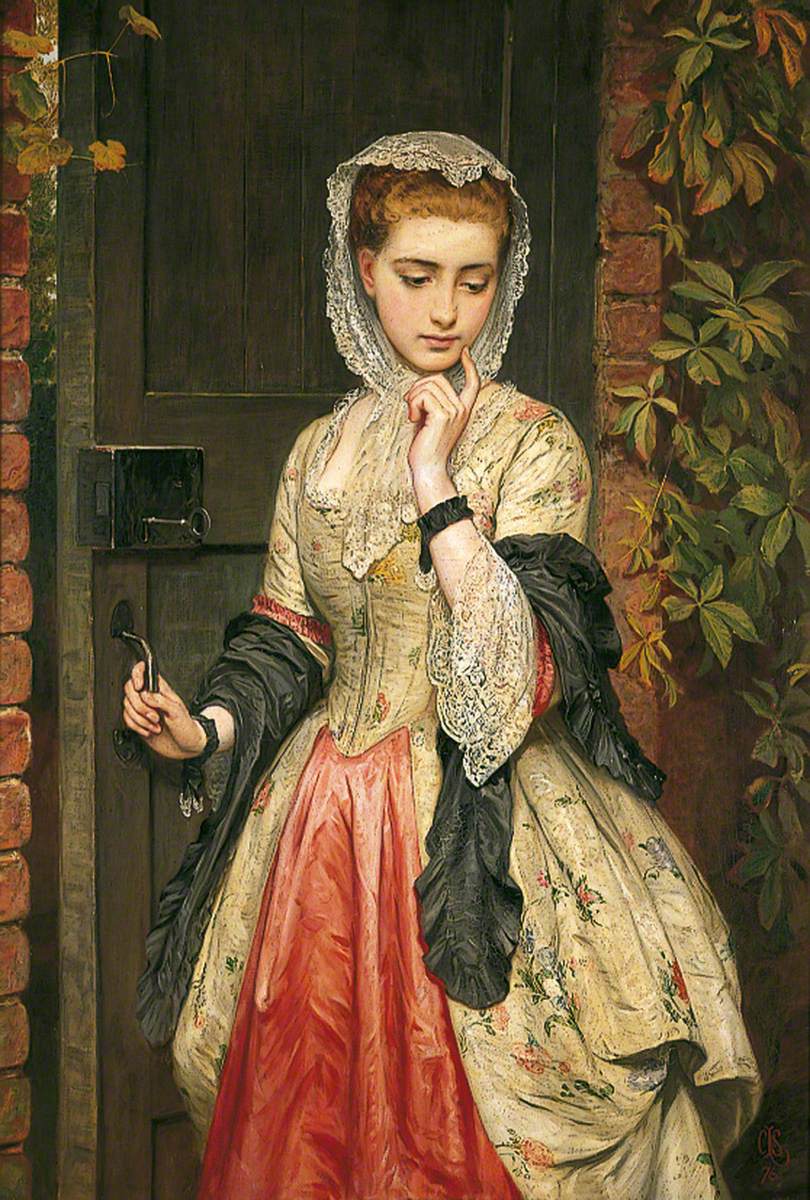
No wonder the Victorians loved the Georgians; the century before got to indulge (and overindulge) in things that were frowned upon in the time of good Queen Vicky.  Plus, the fabrics were wonderful and there was a sense of romance in the air at all times.  Take our lady in the painting above.  She's been well and truly snubbed by some bastard.  You take some time to think, my darling, and you'll realise that he didn't deserve you and you are well out of that.  Plus, with those hip pads you'd never fit through his gate.

The Trysting Place (1878) Charles Lidderdale
Here we are again, waiting for our beloved to turn up.  Take my advice and give him 5 minutes, tops. If he doesn't turn up by then, he's just not into you.  Have a bit of self respect, no matter how hot he is. I do wonder if a big silk dress is the ideal outfit for wandering around woodland looking for a good tryst.  I hope she's wearing wellies underneath...

A Tangle (1897) Francis Muschamp
Of course, the Victorian idea of Georgian life wasn't just filled with bitter jiltings.  There was plenty of lovely courtships too, including this charming pair who are having japes whilst winding some yarn.  That is a patient man indeed and she should marry him immediately because any man who will sit still for that long is a keeper.  Also, look how shiny his outfit is.  I think she likes him as he got the chair on the furry rug.  He's in there.

Harmony (1879) Jean Carolus
These three sisters all sing together beautifully and I'm sure will not be elbowing each other out of the way for the chap with the violin.  Something the Victorians attribute to the Georgians is a love of music and there are many scenes of girls singing, dancing and generally being lovely and accomplished. Georgian women are the best.

The Minuet (1892) Elizabeth Stanhope Forbes
Everybody dance now! And start them young!  Perhaps the Victorians thought Georgian women were far better behaved (which is optimistic of them), rather than those pesky suffragettes and women with their own thoughts.  Look at those nice Georgian ladies, why can't you be more like them?  They do dancing, waiting for feckless lovers, and sing a bit. That's proper girl business.

The Rehersal (1886) Edmund Blair Leighton
Is it just me or do neither of these two look particularly happy about playing the song?  Often the Victorians took the opportunity to  equate musical duets with lovers, but in the case of this unlikely pair, they don't look too thrilled.

The Singing Lesson by Arturo Ricci
Take The Singing Lesson by Arturo Ricci; that couple is definitely in love and singing something romantic to each other.  In fact all of Ricci's Georgian paintings are a cavalcade of Rococo interiors packed with jolly, satin clad lovelies who are all filled with the romance of being strictly corsetted...

Rococo Interior by Circle of  Arturo Ricci
For the Victorians who had rules and boundaries, the perceived freedom of the previous century seemed carefree and beautiful.  The fact that there are some attractive manly ankles on show can't have hurt either.  It was only when I watched Pride and Prejudice on the BBC that I learnt how men changed from knee breeches and stockings to boring trousers.  Looking at the interior above it's all bright colours and smiles.  Those Georgians are so jolly, but then it's all fun and games until someone cuts a king's head off. The French just ruined it for everyone, t'uh.

The Picnic (no date) Edwin Blair Leighton
See, this is far calmer and less likely to end in revolution.  No-one gets regicidal with a cheese scone in their hand.  Trust Blair Leighton to find the calm, sweet side of the previous century.

Market Day (1900) Edmund Blair Leighton
Artistically, he often gets left behind, but The Other Leighton carved a very decided path for himself with his warm paintings of innocent life.  These two ladies are taking flowers to market and this handy chap is rowing them.  Now, he might be their brother or he might have his eye on one of them.  Maybe the narrative of this one is that the ladies are competing for the man with the muscly forearms and shortly there will be a discreet splash and only one lady will be left in the boat.  However, the way Blair Leighton plays it is innocent and respectable.

The Golden Train (1891) Edmund Blair Leighton
There is a certain amount of fetishistic treatment of the clothing in these paintings.  It's not like the Victorians didn't have beautiful clothing but maybe the impractical elements of the women's clothes emphasise desirable feminine helplessness.  You won't be riding bicycles in that frock, let alone trying to get the vote or other such nonsense.  If you have any sense, you will sit still and look pretty.  Why would you want to do anything more in a dress that beautiful?  Anyway, thinking gives you wrinkles.  Sit still and enjoy your dress...

The Clumsy Suitor by Francis Muschamp
One thing that is a safe bet for a big-dressed lady is that true love will prevail, even if he is a tad uncoordinated.  This poor chap is knocking everything over with his enormous sword (not a euphemism), much to the amusement of the young lady.  She obviously likes a man with an unwieldy weapon.  Moving on.

Cut off with a Shilling (1885) Edmund Blair Leighton
What the Victorians sought out in these paintings was obviously an idea of themselves.  This is where they came from, their forefathers, the scandal-ridden, pleasure-loving dancers who transformed into a nation that defeated Napoleon and embraced the rules and boundaries of the Victorian age. In images like Cut off with a Shilling they show the caprices of the Georgians, but that scene could have come from any Dickens novel.  The Georgian age might have also had the rosy glow that all previous ages tend to have - look at the way the Victorians are often shown to us, without the disease, prejudice and questionable hygiene that is no doubt true.  To the Victorians, the previous age might have represented a more stable social order.  If you were a nouveau riche type, buying a nice painting for your brand new house, then you would seek to align yourself with one of those rich Georgian men who had always been the ruling class, who had knowledge, money and power.  The Victorian social order must have felt like shifting sands at time, with money raising people up or dumping them down, like a see-saw. 

The End of the Journey (c.1870) Philip Richard Morris
When the Victorians paint other periods they are obviously talking about themselves.  That is a quality they very much share with our modern times in that respect.  I wonder if other periods were guilty of this?  The people in the past are so glamorous, beautiful, romantic and brave. The women are gentle and waiting for your proposal, however long it might take.  The men are courtly, suave, strong of arm and long of sword. By buying the art you buy into the ideals, the myth and say 'this is my world, this is how I want life to be'.  It's no different to people liking period dramas now, wishing life could be that elegant and polite.  History paintings have certain outcomes, we are the living proof of how things turned out.  Maybe by looking back we are not facing our own paintings, our own lives that have far less certain outcomes.  We can only hope that future generations look at us and find us beautiful.