Tuesday, 5 December 2017

Tuesday 5th December: The Annunciation (again) (again)

Okay, yes, it's another annunciation, but really, when the pictures are this gorgeous you can't get annunciated (I'm going with that word) enough.  Today, we have one by Edward Burne-Jones...


Annunciation (1857) Edward Burne-Jones
Actually, not just one, because I bet you weren't expecting it to be that one, were you? Turns out Edward Burne-Jones did a whole bevy of annunciations of all shapes and sizes.  This is possibly his earliest, from 1857, like a dark stained-glass window. The faces really stand out but otherwise things are confused as both Mary and the Angel seem to blend with the nature around them.

Annuciation (1857-61)
This is far clearer - Mary appears to be strangling a dove while being approached by an angel who seems to be challenging her to a game of holy conkers.  Moving on...

Annunciation Triptych (1861)
Back to the dark palette, Burne-Jones created a triptych, with beautiful ivory figures in delicate, dark bronze drapery.  I love the little silver tips on the wings, although the halo looks a little like she's wearing a space helmet.  I've never thought about halos in depth before.  Are they made of light, like something illuminating?  Or is it acceptable that they are made like glass, like a prism? Burne-Jones' 1861 angel's halo seems to distort the drape behind it, like you are looking through someone else's glasses.

The Annunciation (1876-9)
Okay, so here we are at the most famous of Burne-Jones' annunciations. I wrote about this painting and the reaction to it here, and it is the most surprisingly controversial painting I have ever seen.  It's so pale and beige-y you wouldn't guess critics would get so excited about toes, and yet there is no accounting for weirdness of people.  So why did Burne-Jones return to the subject over and over again?  I wonder if there is any connection between how young Georgiana Burne-Jones was when they married and how much he felt she was changed by having their children.  The Virgin Mary certainly had her life altered (and not always for the best) by having her child when she was arguably far too young and innocent to be expected to cope with the responsibility of a normal child, let alone a holy one.  Yet that's how it all happened, so maybe there is Burne-Jones' own residual anxiety at the sudden pressures of adulthood in his timorous Virgins. Twelve years ago I was in labour (32 hours, thank you for asking) and I have to admit no-one ever really feels ready to be a parent because the responsibility is too huge to comprehend by any sane person.  And that's without lobbing an angel in to the mix.  All you can do is hope you are a kind enough person to raise a kind person.  The rest will sort itself out.

See you tomorrow.

Monday, 4 December 2017

Monday 4th December: Annunciation (again)

I promise there will be a break from these endless annunciations soon, after all this isn't just annunciation-vent.  However, I am rather fascinated by the variations in how artists see the moment that our little Virgin Mary is annunciated.  Is that a word?  You know what I mean...

Annunciation (1900) Phoebe Traquair
Here we have a very jolly annunciation from Arts and Crafts High Priestess, Phoebe Traquair.  I like how Mary and the angel seem to be dancing almost, but there is an edge of unwillingness and force.  Look how the angel has hold of Mary's head and both of her hands are caught in his.  Also, no-one is smiling, contrasting with how light and bright the colours are.  I wonder if Mary's pretty bow is referencing her Virgin state - she is still an unopened parcel, if you excuse the expression.

Triptych: Motherhood (1902)

Despite being best know for her role in the Arts and Crafts movement in Scotland, Phoebe Anna Traquair (1852-1936) was born in County Dublin.  She studied  art at the School of Design of the Royal Dublin Society, and married paleontologist Ramsey Traquair, moving to Edinburgh to settle.  Her work, often spiritual, varies from tapestry to murals, book illustrations and metalwork, all jewel-like and beautiful.

Phoebe Traquair's illustration of Elizabeth Barrett Browning's Sonnets from the Portugese
She produced hundreds of pieces of art in her life, including wonderful church murals (including one I visited here) and her volume of work shows the breadth of her talent and flexibility of her vision. I like the tension in her Mary and the Angel which is less about meekly accepting the will of God and more having events unexpectedly thrust upon you, no matter how beautiful it is all meant to be.

See you tomorrow...

Sunday, 3 December 2017

Sunday 3rd December: The Annunciation

I hope you are warm and comfy wherever you are.  As it is the first Sunday in Advent, I seem to remember there was a special service in church, getting out the candle and singing Christmas carols legitimately.  Meanwhile in Blogvent, we are wearing extra warm jimjams and prising open the next door on our advent calendar.  Adjust your hot water bottle and let's get on with it...

The Annunciation (1894) Frederic Shields
This is a very Victorian annunciation, right down to the rather girly looking angel.  Some Victorians had no truck with the whole notion of male angels, let alone gender fluid celestial entities.  We all know that Gabriel was a gorgeous blonde woman, apparently.  Also, we're having none of that womb-pointing business here.  I remember being about 7 and having to sing 'Offspring of a virgin's womb' whilst (a) not knowing what a womb was and (b) thinking it sounded a bit grim and gooey anyway.  Yes, no-one needs to be pointing to or mentioning wombs, thank you very much.  Also, no-one in the Bible had feet, it seems.

Man Harkens to the Appeal of Conscience (no date)
It's not like Shields can't do feet, although they are a little clumsy looking in this one.  Mind you, feet are probably hard to do so if you got the chance to hide them under a big dress, I wouldn't blame you.  Frederic Shields (1833-1911) is probably best known to you as an associate of the Rossetti family.  He drew the portrait of the dead Rossetti, and designed two stained glass windows at Birchington on Sea, overlooking Rossetti's grave.

Charger (1890s)
He was a deeply religious man who created many religious illustrations, window designs and designs for church murals.  He also explored slightly more playful subjects, such as frolicking mermaids in this very lovely arts and crafts charger.  He also designed the cover for the 1880 edition of Alexander Gilchrist's Life of William Blake (1863) after Gilchrist died and the project was taken over by his widow with the help of the Rossetti brothers. Shields appears to have been a really multi-talented chap indeed who deserves to be remembered more for the breadth of his work rather than who he hung out with.

 Well, that's today done.  Snuggle back under your blanket and I'll see you tomorrow...

Saturday, 2 December 2017

Saturday 2nd December: The Annunciation

First weekend of Blogvent!  Okay, so it's only been one day but December does seem quite alarmingly short, especially as my daughter has her birthday this month too.  We need to start writing cards these weekend and posting overseas stuff. Yikes.  Let's crack on!

The Annunciation (1892) Arthur Hacker
Oh, I know, we all love a nice bit of Arthur Hacker (1858-1919) and his smashingly gorgeous paintings.  This one is no exception.  We have a pale wisp of a Virgin Mary collecting water in a garden.  Fluttering down from heaven and whispering in her ear is the lily-waving angel. That is a very pointy lily, a bit like a biblical cupid's arrow.  Mary looks a tad distracted, I suppose the idea is that the angel is invisible and she can only hear the faint whisper.  Lesson number one is don't surprise anyone by a well - startled virgins tend to topple down them.

Persephone (no date)
Hacker studied art in Paris and although he is often called a Pre-Raphaelite follower, it's due to his subject matter rather than realism.  There is something delicious about the creamy perfection of his figures and he is a painter who enjoys doing a lady, if you excuse the phrase.  Even the very modest Mary is wrapped in diaphanous layers that are as revealing as they are concealing.

The Temptation of Sir Percival (c.1894)
The reason I loved Hacker is the inadvertently hilarious The Temptation of Sir Percival, or as I like to think of it - 'No I won't share my packed lunch!'  By the standard of Hacker's other women, Mary is a slight little thing, childlike and timid.  He normally likes a big-bottomed wench in a jolly frock, and rightly so. By contrast, his little Mary has a vulnerability that makes you think she really isn't ready for all that celestial whispering.  According to the Tate website, under x-ray, they could make out another figure in the background, another woman at the well.  However, I think her isolation makes the image stronger.  In this picture Mary is being chosen for something that will isolate her, for better or worse, for the rest of her life. 

Well, that's a jolly note to end on.  See you tomorrow...

Friday, 1 December 2017

Friday 1st December: The Annunciation

Well, it's that time again!  Welcome to Blogvent 2017, and this year's theme will be images of the Virgin Mary.  When I announced this to my 11 year old daughter, she looked at me quizzically and said 'What's a Virgin? I don't think I've met any...' which is a damning indictment of our neighbourhood.  As far as Lily-Rose was concerned 'Virgin' is a broadband provider but she knows better now.  I'm sure she'll come back with more questions when she's had a think about it...

Anyway, let's crack on with VirginVent!  And let's never refer to it as 'VirginVent' ever again as that seems somehow very wrong.

The Annunciation (1887) George Hitchcock
Here we have Mary, pottering about in the lilies, awaiting being taken by surprise by some chap with wings.  She is as tall and stately as the lilies, her cloudy-coloured gown topped by her white headdress, echoing the flowers.  The scarf around her head seems to be a bit like a halo, white and diaphanous. She is as pure and lovely as the flowers, highlighting her specialness, her otherness.  It's unusual to see the annunciation without an angel.  Maybe the angel is implied in the flowers, which all reach sort of womb-height.  Then again he might be hiding behind the hedge.  We do love a hedge-lurker, especially a holy hedge-lurker.

Calypso (c.1906)
George Hitchcock (1850-1913) is not someone we've met here very often.  An American by birth, his heart seems to have been in Europe and he worked in Paris and the Netherlands, where he lived for many years. He seems to have drawn some inspiration from Pre-Raphaelite art, for example I find an echo of Rossetti's lilies in his annunciation works, and also in works like Pandora.

Pandora (c.1895)
He has a very delicate palette, each of his beautiful paintings powdery and gentle.  This also wasn't the only time he painted the Virgin Mary, as seen in The Blessed Mother...

The Blessed Mother (1892)
I can't think of a nicer way to start our blogvent, and look forward to the next few weeks and lots of halos, wings and babies. And absolutely shed-loads of lilies.

See you tomorrow!

Monday, 13 November 2017

A Chat With Gordon Giltrap and Review of The Last of England

I love when marvellous, unexpected things come in to my life and that is just what happened to me when I was last in Birmingham for the Pre-Raphaelite Society AGM.  I nipped into the Birmingham Art Gallery shop and picked up what I thought at first was a calendar, but turned out to be something much more magical. I bought it immediately...


Available to buy on both CD and vinyl (obviously I bought vinyl, and it's orange vinyl to boot!), this album is inspired by Pre-Raphaelite art works, from the title track, though April Love, Work and The Light of the World.  I was familiar with Gordon's work beforehand, but for those who have not yet had the pleasure, his work is beautiful instrumental pieces, with his guitar telling sound-stories which perfectly match the paintings and the mood of the album.  From the rolling tide of 'The Last of England', and the lazy wamth of 'All the Days in May', through the unexpected strength and industry of 'Work'.

Gordon Giltrap

I love Gordon's music as it is so distinctive and beautiful, and this is a brilliant album, bringing a further dimension to the paintings, an interpretation though emotion rather than words.  I think the title track is my favourite but 'Work' really caught my imagination too with the sound of the workmen, striking stone and metal. The album has the romanticism and wistfulness you would expect from music inspired by Pre-Raphaelite art but there is more than that here.  I definitely recommend this as your Pre-Raphaelite soundtrack for the winter, especially if you need the comfort of beauty and gentleness in the rather rough present.  Add to your Christmas list now or better yet, buy a copy for yourself.

I was doubly fortunate enough to get in touch with Gordon and he answered some questions for me...


Q. When did you first discover the Pre-Raphaelites?

It was all down to my wife Hilary who had been an admirer of their work for many years, and showed me shortly after we had met a beautiful book from a Pre Raphaelite exhibitions she had attended. I instantly fell in love with those beautiful other worldly images, and when I saw the Holman Hunt "Light if the World" I recognised it from my childhood. That very image hung in my grandmother’s cottage, so in fact I grew up with that haunting image, never truly knowing anything about it.  It was like a home-coming for me when I saw these paintings and felt drawn to compose  pieces inspired by them, very much in the same way as Visionary way back in 1975. 


Q. I interviewed Robin Lawrie about his book illustrations for Tennyson in the 1960s and he said he saw a 'movement' of 1960s/70s Pre-Raphaelite musicians.  Would you identify with this?  

In many ways yes, in relation to the Blake inspired Visionary album mentioned earlier where powerful images (I keep using that word) completely captivated me and in some way obsessed me and drove me passionately to compose a suite of tunes, but in Blake's case it was a mixture of poetry and paintings, once again with an other-worldly spiritual feel to them, but of course that was exactly what the great man was all about.


Q. Did you always want to write music around Pre-Raphaelite art?  Could it be seen as a (somewhat delayed) sequel to 'Visionary' (after the art of William Blake)?

No, because I'm a relative later comer to the movement. I think in many ways with the new album it feels like a full circle from the mid-seventies to the present day, so maybe it could be described as a somewhat late sequel. In 1981 I released an album inspired by the illustrations of Alan Aldridge with The Peacock Party album, but I feel it pales somewhat in the light of this latest album, but then it would do, wouldn't it? And how marvellous to have one of the greatest images in English art as my album cover. It doesn't get any better than that, does it? I'm delighted it has had a vinyl release to truly show off the painting. I think a number of folk have bought it even without having a turntable on which to play it, and  just having it as a piece of art is enough for them, and indeed why not?


Q. How did you choose the paintings you wrote pieces for?  Were there paintings you would have liked to include? (I'm obviously angling for another album as I loved this one so much)

I simply chose paintings I could relate to like The Light of the World and Work with it's obviously busy, forward motion of honest labour and the street scene. The title track is so evocative and a gift for any composer to be inspired by, with the promise of a sea voyage and the underlying trepidation on the faces of the young couple. I don't think there are any other images that grabbed me as much as the ones I chose. Chatterton of course is such a tragic story and a challenge to try and capture musically that silent scene of death.

The Death of Chatterton (1856) Henry Wallis
Q. Why orange vinyl?  And also thank you for orange vinyl, I got stupidly over-excited by it because I am old enough that coloured vinyl is massively exciting...

Pete Bonner from the record company chose the colour which matched a colour in the Millais painting.


Q. If you had to pick one, what is your favourite Pre-Raphaelite painting?

I love so many of them, but I guess it has to The Last of England. My second choice would be The Light of the World.

The Last of England (1855) Ford Madox Brown


On a personal note, it is a small miracle that this album exists, because before getting ill in 2015,I had decided not to make any more albums, because I felt I had sort of said all I needed to say musically, but it was whilst recovering from my first lot of surgery that a thought occurred to me that I had already had an early incarnation of some of these pieces that formed part of an album I did with Rick Wakeman released about seven years ago. I felt then that the pieces deserved far more work than was put into them at the time.

 I approached my dear friend and collaborator Paul Ward about coming on board and helping me to realise this dream of an album that stretches back to 1987 when I first started work on the suite, and now all these years on it exists. I'm truly humbled by the response the music has received, which I guess at its heart has a resonance of truth about it and for that I'm very grateful.

I thank you so much Kirsty for asking me to do this interview,it has been a privilege.

As a final note I want to thank my lovely wife Hilary for her constant support and inspiration without whom much of this music of mine would not exist, and it was due to her diligence and determination that The Birmingham Museum and Art Gallery has it gracing their gift shop!
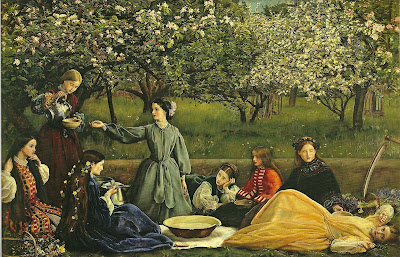
Spring (1859) John Everett Millais
Many, many thanks to Gordon and Hilary for their time and patience, and for making such a gorgeous album that I can't recommend enough.  Pop into BMAG if you are close enough but if not, it is available on Amazon.

Sunday, 5 November 2017

Review: May Morris, Art and Life

The sound you can hear is my cheering. At last, May Morris has her own exhibition and has moved out of her father's shadow and is now seen as a person in her own right!  When I heard that the William Morris Gallery at Walthamstow was holding a May exhibition I was delighted.  I contributed to the crowd-funding, which is a new and exciting way of helping a gallery get an exhibition off the ground.  Never underestimate how much peril our non-national museums face in times of austerity and so anything we can do to help them get money, we should.  Anyway, I got the most beautiful tote bag for my efforts! To the exhibition!


I was very excited to get to see the exhibition, so when I was in London at the end of October I saw both this and The Pre-Raphaelites and Van Eyke at the National.  Now, the National exhibition was all very nice but it was the May Morris that really caught my attention so I would rather send you up to Walthamstow...

May Morris, 1909
Jan Marsh (in whom we trust) has done amazing work over the years championing May Morris' work, and I have her 1986 biographer of May and Jane Morris, which informed much of my research into Miss Lobb.  There was also a May Morris exhibition in 1989 (which I also have the slender catalogue for, by Helen Sloan) but May has hardly been given the prominence that some of her male counterparts have, and her work is normally mentioned within the context of her father.  How wonderful therefore that May gets a high profile exhibition and her achievements can be seen both in the context of her father's work, but also beyond.

Maids of Honour, c.1890s
First of all, can I mention the exhibition is FREE. That's right, FREE.  I think we asked the nice man on the desk twice if he was serious.  After having the pennies shaken from our pockets at the National Gallery for the Van Eyke exhibition, Miss Holman and I could not quite comprehend how we were not charged to see May Morris, which is so majestic it is spread over two floors.  For those that know the gallery, it fills the temporary gallery next to the cafe and then two packed rooms on the first floor.

Embroidered Cloak, 1897
The exhibition covers May's work from wallpaper to jewellery, embroidery and clothing.  Her 'seasons' panels are apparently the most expensive ever commissioned by Morris and Co in that period, and are breathtakingly beautiful. Her work is present in huge pieces down to tiny drawings, and if I have a complaint it was that we needed more room to view it all as it was quite busy the day we went and it is such a beautiful collection we ended up doing the 'exhibition shuffle'.  Mind you, that happens to us in so many wonderful exhibitions and should be a mark of just how wonderful it is.

May and Lobb

I was delighted to see Miss Lobb there in all her glory, as May's personal life is covered.  Her valentine to George Bernard Shaw is both lovely and sad, her marriage to Henry Halliday Sparling is a bit unfortunate and finally to Lobb, with whom she had some jolly jaunts and generally far more fun than with the other two.  Unlike her Mum, May's personal life doesn't overshadow her professional accomplishment but acts as a bit of background, which is fair enough.  I feel the words 'mystic betrothal' should be a lesson to us all.
Majestic catalogue...
The catalogue is an absolute joy, by the way. Over the next couple of weeks I'll be suggesting things that you might want to get for yourself for Christmas, and this is one of them.  The National Gallery's slim catalogue for their exhibition is nice, but the May Morris catalogue is massive and brilliant and you need it in your life.  I'm afraid I bought mine from Amazon about a month before I saw the exhibition because I couldn't wait and it is around the same price as the National one.  Bargain.

Spring and Summer panel, 1895-1900

I can't recommend this exhibition enough because May Morris has been sidelined for long enough and its about time we pay her the respect we give to William Morris, because her achievements are remarkable.  And her visit to Iceland was far more jolly.

The exhibition is on until the end of January and has its own website.  And it's FREE.