Wednesday, 20 December 2023

Wednesday 20th December - Constance E. Plimpton Smith (1858-1938)

 Today has been very frustrating and I almost gave up several times, but I have persevered for all the good it will do us. I have one very sad illustration and a lot of loose ends, but I think that might be the story with a lot of the women who appeared on the walls of the Royal Academy never to be seen again.  Our victim today exhibited there from 1884 to around 1900.  Not only that, after she married, she and her artist husband submitted joint paintings to the Royal Academy, which must have been a novelty.  Say hello to Constance E. Plimpton...

I warn you now, there will be a lot of 'I think' and 'as far as I can see' in this post as Constance has been, by far, my most slippery character so far, which is ridiculous; for some facts I'm rock solid.  I know for a fact that she was born in the summer of 1858, the year after her brother Richard was born. I think (here we go) that the 'E' in her name is Eliza, after her mother, her father being William (1817-1891) a corn and seed merchant (like his father before him).  Her brother Richard became Assistant Professor of Chemistry at University College London. The family lived on Lansdowne Road in Lambeth for many years, and Constance was first seen here in the 1861 census.  In 1863, Eliza died, leaving her husband with Richard and Constance, although by 1871 William's sister Martha has joined the household and would remain there until her death in 1882.  

Constance doesn't list any occupation in the census in 1881, but by 1884 she is exhibiting, firstly with the Royal Institute of Painters in Watercolour, where she showed two works - "There is but one / with whom she has heart to be gay / She is weary of dance and play" and Lillie.  The first is based on Tennyson's poem Maud, and I'm guessing the second is a portrait. As we will see, Constance was quite the fan of Tennyson, and so if we knew what her art looked like, we could judge whether or not she could join the Neo-Pre-Raphaelites.

1885 brought the Royal Academy and a portrait of Ada, daughter of T Sweet Esq.  She missed 1886 at the RA but returned in 1887 with Study of a Head and "Into that wondrous track of dreams again," another piece based on Tennyson, this time A Dream of Fair Women. Sadly, 1888 saw the very un-Tennysonian Two Pets, but she was back with Alfred in 1889 with "A rosebud set round with little wilful thorns" from The Princess.

In 1890, Building News reviewed the Royal Society of British Artists at Suffolk Street, saying '"Poppy" by Constance E. Plimpton is a clever sketch of a girl's head, full of expression and character.'  Constance also showed three paintings at the Royal Academy, Hugh Stannus Esq, On the Terrace and A Blue Study. In addition to the portrait of Stannus, who might be Hugh Hutton Stannus, the architect, she also submitted two portraits to the RA of 1891 - Mildred, daughter of Ingress Bell (possibly Edward Ingress Bell, another architect) and Molly. It also saw the death of her father, leaving her alone at 23 Lansdowne Road in Lambeth, but not for long. A few months later, she married a fellow artist, John Henry Smith.

1892 was a bit of an interesting year for Constance.  She had three pictures at the Royal Academy, Playtime, two children playing with a kitten and ball, which appeared as a line drawing in The Queen in a review of RA pictures by ladies...


Why have colour when you could have rope-y black and white?  Anyway, Constance also had "Sweet lips, whereon perpetually did reign the Summer calm of golden charity"  from 'Isabel' by Tennyson, and The Audience painted with John Henry Smith.  Well, where did he come from and could you submit paintings as a duo? Benezit is about as much help as you are going to get on John Henry Smith in that he was a painter in the nineteenth century (thanks Benezit, you spoil me) but other sources have him starting his career in the 1850s, so we can guess that he was at least 20 years Constance's senior. Also, searching through census records for the right John Smith is possibly the most hopeless thing you can do. He moved into Lansdowne Road where the couple remained for the rest of the decade. Constance also got another mention in The Queen; they covered the Royal Society of British Artists Winter exhibition, writing 'Miss Constance E Plimpton exhibits an effective painting, both in colour and character in "A Japanese Study."'

In the 1893 Royal Academy exhibition, Constance and John exhibited another joint piece Idle Summer Time and she exhibited alone Sweet Violets, Morning Frolics, and "He is but a landscape painter and a village maiden she," which isn't some sort of autobiographical cry for help but yet another Tennyson piece. The couple also had a daughter, announced in the newspapers - 'July 20, a daughter to Mrs Constance E Plimpton Smith - Eagle's Nest, Clapham Common.' - I think 'Eagle's Nest' is Eagle's House which looks very fancy indeed.

In 1895, Constance's work appeared at an exhibition in Canning Town which had been Percy Alden's dream to bring fine art to the workers. The catalogue had the Ruskin quote 'Life without industry is guilt, and industry without art is brutality' written on the cover.  Constance misses a few Royal Academies until 1897, by which point the family had moved out of London to Greyshott near Haslemere in Surrey. This is reflected in her RA piece Surrey Broom-Maker. She also entered Drawing Room Pets. She also appeared in the Society of Haslemere Artists exhibition - 'women's work holds a creditable place in the exhibition. "An Old Inhabitant" by Mrs Constance E Smith is an interesting and powerful study of a woman's head, the lines in the face telling their tale of a life of toil and care. "Friendly Footsteps" by the same artist is in quite another vein.' (as reported in the Surrey Advertiser)

The family moved to the charmingly named Kit-Cat Cottage in Greyshott in 1899.  Constance only appeared at a few more RAs - in 1898 she showed Quiet Moments and a portrait of Catherine, the daughter of fellow artist Anderson Wells.  In 1899, she submitted one more portrait, Mrs C E Corry Lowry, then finally, in 1900, she showed A Silver King.

That is pretty much all the information I have.  She died on 25 May 1938 - John had died somewhen between 1900 and 1938 but a vast amount of people named John Smith had died in Surrey in that time and today I sadly don't have the wherewithal to go through them all (although I do love that sort of thing).  I also cannot quite fathom the name of her daughter or what became of her. It seems a terrible shame for a woman who did so well and had quite an impressive exhibition record, but the only image by her is that sketchy impression in the Queen. Hers is possibly the sorriest record we will see this month and it is worrying that we are just losing people, but in age of digital technology there is hope.  This is a plea to all collections, both public and private - put your collections on-line, even if you feel more comfortable with a watermark on your pictures.  We will know where the pictures are, whether Constance Eliza Plimpton-Smith was a Neo-Pre-Raphaelite or just a Tennyson junkie and where her works are in readiness for her retrospective. 

Tuesday, 19 December 2023

Tuesday 19th December - Isabel Frances Douton (1858-1924)

Today, I am off to Cadbury World, so I am beginning this at 4.30am and who knows what time I will finish it but I can guarantee you that I will be full of chocolate and probably feeling a bit sick.  I can't wait.  For today's subject, I am profoundly grateful to SRadcliffe53 on Ancestry for making their records on Isabel Frances Douton publicly accessible, especially the will, which is a corker. So, let's meet Isabel...

Portrait of a Girl (undated)

There is not very much written about Isabel, and I suspect that is the curse of the miniature striking again. In this day and age, a book on miniature painters would be splendid as you could blow the images up next to a life-size picture.  I'd buy that, it sounds gorgeous.  I don't think exhibitions are completely out of the question - you wouldn't need a big room, after all. You'd maybe need a lot of magnifying glasses...

Isabel Frances Douton was born in Biggleswade (excellent name for a place) in the summer of 1858 to Charles (1821-1900) and Anne (1825-1896).  Charles was the vicar of Biggleswade, which has to be the title of a book and if not, should be. They had married in 1852 and Isabel was the fourth of six children, surrounded by George (1853-1924), Mary (1855-1926), Robert (1856-1918), Charles Jnr (1860-1899) and finally Anna (1864-1890). I find it interesting that Charles and Robert are sent away to school, but George remains at home in the 1871.  George and Charles both became school teachers, while Robert joined the Merchant Navy had adventures overseas and was buried at sea near Egypt.

Miniature of a Girl (undated)

As Isabel is in neither my trusty Dictionary of Women Artists by Chris Petteys or Dictionary of British Art, Vol IV Victorian Painters by Christopher Wood (so big, you could repel attackers with them) so my details of her education is a little thin. She attended the Cheltenham School of Art, but, by a mention in the newspapers in 1895, she has magically become a 'Birmingham artist.' By this point, the family has moved to Cheltenham, and Charles had become the Curate of St Stephens, which is very nice too. Isabel is recorded with having no profession in the 1891 census, and I will not stop being hacked off when middle class girls don't confess to having aspirations in 1890.

The Cheltenham Chronicle were the first to mention her in 1891 when Isabel achieved 1st class excellent in freehand, 1st class in model drawing, 1st class excellent in perspective, 1st class in outline from cast, 1st class in shading from solid, 1st class in shading from ornament, and a whole host more.  In 1892, at the Cheltenham School of Art meeting and prize giving, Isabel is awarded a prize for her 'shading from ornament.' She went on to exhibit with the Cheltenham Fine Art Society in 1895 where she had no less than five pieces, but the Cheltenham Chronicle particularly like the group of three children Ruth, Geoffrey and Phyllis.  The Bath Chronicle and Weekly Gazette praised her excellent work. She was back at the Cheltenham Fine Art Society in 1896 with a 'very effective pastel portrait' but she would have to wait until 1904 before she reached the Royal Academy.

Part of why I was interested in Isabel is her solid RA record which contrasts with how obscure she is.  As I said above, this might be miniature-ist prejudice but there are certainly artists who have done less who get more attention. In 1901, with both of her parents dead, Isabel had moved to Hammersmith where she would remain for her artistic career.  She is listed as 'living on own means' - for goodness sake - in the census, and has a servant.  She appeared at the Royal Academy in 1904 with a portrait of Mildred, Daughter of  Rev. F H Bolingbroke (a portrait of her neice) but received no reviews for that nor for her RA 1905 piece Miss Taverner. She also appeared at the Fine Art Society exhibition with Stella, 'a graceful sketch' according to the Morning Post.

Mildred Bolingbroke (1882-1970) (1904)

1906 was a busy year for Isabel.  She had A Bonnie Wee Bairn at the Royal Academy (nothing in the papers for that). Isabel still exhibited in the Cheltenham and County Fine Art Society exhibition and won the first prize for a professional miniature, which was £1 1s.  The Cheltenham Looker-On paper reported 'The first prize for professionals has been gained by Miss Douton. Her portrait of a child is executed with painstaking care, and leaves nothing to be desired.' Her miniatures were also praised as 'very artistic' by the Liverpool Daily Post when they appeared in a special exhibition by the Royal Society of Miniature Painters at the Liverpool Autumn exhibition.

By this point, Isabel seems to have become a regular fixture at the Royal Society of Miniature Painters exhibitions, showing pieces of 'distinctive style' in 1907 and studies that 'derive charm from their light-handed grace of treatment' in 1908, both mentioned in the Morning Post. As the Globe said, reviewing her work in the Royal Society of Miniature Painters exhibition in 1908, 'good things come from Isabel F Douton.'

Isabel's work also appeared at the Irish International Exhibition in 1907, lending two miniatures, Baby Richard and Dear Lady Disdain to the art section. She missed the 1907 RA but returned in 1908 with Queen of my Heart and in 1909 with A Little Maid from School (possibly inspired by the Mikado).  Her 1910 RA portrait was of her brother Robert's daughter Isabel (1894-1975), although that family were on the other side of the world in Australia.  I wonder if it was the result of a visit (which would be a massive journey to do for a visit) or possible a photograph. 1911's RA saw Isabel exhibit Rough et Noir, but again, to no press coverage.

Mrs Duncan Baille (c.1913)

If it wasn't for the Queen magazine, I think I might have despaired that Isabel would get any more mentions but they start a column reviewing the Royal Society of Miniature Painters exhibitions and we do at least get some comment on Isabel's work and the occasional ropey image, like the above. On her miniature of Mrs Duncan Baille, the Queen wrote that it was a 'good example of the charm and vividness with which a head can be painted in little when no attempt is made to "prettify." A likeness may be pleasing or otherwise but it is the first requisite of a portrait, large or small, and when, as in this case, it is the former [pleasing] that is all that is wanted.'

Isabel's work was mentioned in Cyril Davenport's 1913 book entitled Miniatures, Ancient and Modern. In the Royal Academy in 1914, Isabel had two miniatures, Chloe and Susan and in the Royal Society of Miniature Painters exhibition of the same year she had Robert, son of Douglas King Esq, which was praised as being a worthy example of a looser style of painting. She continued to exhibit at the RA with La Jeunesse and Doris (1915), Prunella, Blonde Cendree and  Valerie (1916), Benjamin (1917), Tommy, son of Lieutenant Colonel C. Evill DSO (1918) a portrait of Charles Ariel Evill's son Thomas Hayward Evill (1911-1967), Miss Grace Sweet (1919) and finally The Maid I Love and Guinevere in 1924.

Miniature of a Child (undated)

Isabel died in 1925, leaving her brother George her china, his wife two miniatures of her choosing, her sister Mary a miniature mounted in a locket, her cousin Elizabeth two books and two miniatures, plus other bequests among nieces, nephews and friends. In a wonderfully macabre move, the second item in her will reads 'Having all my life suffered from fear of premature burial I earnestly request my Executors to employ a surgeon to sever an artery in my body before it is placed in a coffin and I direct them to pay such surgeon a fee of Ten guineas for so doing.' I am in awe.

Today we have learned again how miniature painting was a lady's world and you shouldn't expect any publicity.  Isabel also followed the path of being a celebrated local artist before heading for London, so that the people back home will root for you, for a while at least. I doubt she will be our last lady on that path.

Monday, 18 December 2023

Monday 18th December - Lilian Yeend King (1883-?)

 I love artistic relationships - I've done a fair bit of work on husband and wives who both paint, but I think there is also a fair amount to say about children who follow in their parent's artistic footsteps. One of my favourite things to say as I walk past Meredith Frampton's Portrait of a Young Woman in the Tate is 'his mum, the artist, made that frock.'  Already in this Blogvent we have seen some families all painting together, but I knew that Winifred Sandys was an artist already.  I had no idea the Yeend King had an artist daughter (or for that matter, a first name).  Say hello to Lilian Frances Hatton Yeend King...

Now, that is a lot of names and I'm still hazy on a death date as we will see, Lilian's life got a bit complicated.  However, I am fascinated by father-daughter artistic combinations, so we'll have to see what comes up in the next 12 hours. Let's start with Dad, as to be honest, not enough is known about him either, which is a great start...

Yeend King

Three Score Years and Ten (1886) Yeend King

Henry John Yeend King (1855-1924) has over 50 artworks on ArtUK (the website of all oil paintings and other artworks held publicly in the UK). I've used the above painting by him a few times over the years and it is very popular at the Russell-Cotes where it lives (and why I know it so well).  Embarrassingly, I always thought the poor man's name was Yeend King (first name Yeend, last name King) but he has other names, but shockingly no Wikipedia page.  He married Edith Lilian Atkinson in June 1881.  Over the next year they must have been living in Paris, because Lilian was born there on 13 September 1882, but they have returned by the time their son Walter Eustice is born in 1885. Lilian appears to have been sent to Clare House School in Margate - this was purportedly a boy's boarding school but it seems to have an awful lot of girls there too. There was apparently a sister school - Claremont - so possibly the pupils could move been the two sometimes.

Tender Thoughts (undated)

Lilian attended Heatherley's School of Art, which seems to have been a popular choice at this time and there appears to be a wider scope and possibly a more relaxed attitude to lady artists than some schools, even that close to the turn of the century.  In 1901, she is back living with her parents at 103 Finchley Road in Hampstead, together with their boarder, fellow painter Haynes King.  Haynes King does have a Wikipedia page but it unhelpfully doesn't tell me if Haynes is living with the family because he is a relation or because he knows Yeend King through work.  More to the point, when Haynes King walked in front of a train in 1904, the inquest referred to Yeend King as his landlord, not naming him or mentioning the shared profession. Yeend King was quite a famous name, not as famous as poor Haynes King, but it does seem odd that the link is not made, especially as Haynes had been living with the family for over a decade. 

I can't find any mention of Lilian's pictures before the 1906 Hampstead Art Society exhibition, where the Morning Post mentioned her 'praiseworthy work' which hung with her father's charming sketch. That was a busy year from Lilian as in the October she married Edwin George Fraenkl, a law/divinity student from Dundee.  Edwin's father Victor had come to Scotland from Germany around 1867 after marrying Maria, where his four children were born. In 1901 Edwin was living in a boarding house in London, his occupation listed as 'Undergraduate', so I can only guess that he and Lilian had friends in common or that he just really liked art. Either way, the couple gave the All Souls Church in Hampstead a special lectern Bible in 1905 then married there at the end of 1906.

Village View (undated)

The couple moved with Edwin's role as he became the senior curate of St Mary's, The Butts in Warwick.  In the 1911 census, Lilian is recorded as an 'artist', and somehow the couple has become the Hatton-Fraenkls which is an exciting combination of their name.  Lilian began to exhibit with her married name in brackets afterwards, such as at the exhibition of watercolours she held in St Mary's Hall, Warwick in 1912. The Warwick and Warwickshire Advertiser reviewed it as a 'most charming little exhibition of water colours' and pointed out that Lilian was 'the most gifted daughter of the well-known great artist Yeend King ... Mrs Hatton-Fraenkl, fortunately, has inherited many of her father's excellent qualities as an artist.'  The piece is wonderfully gushing - 'As one enters the room, one is struck with a wonderful blaze of pure and rich colouring - alas so lacking in many of our so-called "Artists of Modern Times." The exhibition richly deserves a visit.'

At some point the couple change their everso-German surname from Fraenkl to 'Freemantle,' I'm guessing because of the Great War.  I know one of Mary Hiller's (model for Julia Margaret Cameron) daughter married a German chap and they anglicized their surname around the same time. This makes tracking Lilian even more exciting because she is under Yeend King, Fraenkl and Freemantle at overlapping and random moments in time. In 1915, Lilian's brother Walter Eustice died in Kent, although I have no other information.  He was 30 so it might have been war related, there was a hospital for wounded soldier shipped back there, but equally, he could have had a heart attack while on holiday. Around the same time, Lilian seems to have moved home and started divorce proceedings against Edwin. Frustratingly, I can't find their paperwork (as I love a look at who did what) but in the 1939 census, Lilian lists her marital status as 'divorced'.  

Young Water Maiden (undated)

Despite (or possibly because of) the return home, her artistic career took new steps into the Royal Academy. The Marylebone Mercury reported that Yeend King had 2 rural landscapes in the 1919 RA and Lilian exhibited a portrait study of her mother. 

I had to chuckle because Lilian's other (and last) appearance at the RA was at the notorious 1921 exhibition which one newspaper dubbed 'The Revolution at the Royal Academy' - 'Well known Artists Excluded for Cubists and Vorticists' (the horror!) There were no problem-pictures from John Collier, no 'sweet delicacies' from Yeend King, and no 'sensitive works' of Mr Harrington Mann.  Despite all this 'merciless slaughter', Lilian Yeend King exhibited a portrait of her brother, Eustace, which was neither Cubist or Vorticist.

Beyond the Royal Academy, Lilian had other exhibitions.  In 1923, she appeared with 3 paintings at the New Society of Artists at the Suffolk Street Galleries.  Her father died in 1924, causing the Daily Mirror to write 'he was an amusing companion and a loyal friend' and a loss to Bohemian London. I think it was around that time that Lilian and her mother moved out of London, down to West Wittering in Sussex. There her mother died in 1931, and Lilian moved into Rosary Gate, becoming a mainstay in the West Wittering Art Scene.  The Chichester Observer praised her work in the 1935 exhibition, saying she had the gift 'to make every picture complete in every detail - not merely a sketch.' She also hosted an exhibition in the church hall in 1938, causing the West Sussex Gazette to report that there was 'nothing of the high-brow or the obscurantist about them. They are happy selections from here and there in her own area.' They really appreciated her 'bits of beauty' as they stood as memorials to a coastline they felt was vanishing.

Girl at the Well (undated)

In the 1939 census, Lilian Freemantle, watercolour artist is recorded at Rosary Gate.  In the notes next to her record it seems to imply she was an ambulance driver for the western area, which also tells us she could drive. The last record I can find for her is a 1948 exhibition in the West Wittering Memorial Hall, where they showed a range of landscapes by local artists, as well as a fancy-dress parade.  If more art exhibitions came with a fancy-dress parade, think how jolly the Royal Academy would be.

I can't find her death details, which is driving me mad.  An interesting, if slightly mad suggestion I have had is that she died in London as 'Lilian Frances King' in 1987, at the very grand old age of 104.  That is slightly bonkers, but that lady did leave over £100K so who knows.

I think the whole Yeend King family need a renaissance and some sort of father-daughter exhibition needs to happen.  Her work is very much influenced by her father, as I think Winifred Sandys was influenced by Frederick, but just think of a Father-Daughter exhibition to see who followed the family path and who rebelled.  

Obviously, we'd have a fancy-dress parade as part of it.

Sunday, 17 December 2023

Sunday 17th December - Adah Knight (1864-1953)

Goodness, we only have a week left of this nonsense and I feel we have spent time with some pretty awesome women so let's see who our last week brings!

Oh, I was filled with such hubris this morning as I started on my search for Miss Adah Knight and immediately found this (admittedly rather grainy) image...


Hello Adah! How lovely to sort of see you. I then found that she had appeared in around 30 years worth of Royal Academies, so images won't be too much of a problem, right? Ummm...

Okay, so this post is going to be a little light on images as so far I have found three images and two of those are merely an 'attributed to' which is not a good sign. Honestly the third one is a bit dodgy too. Luckily, I can find a goodly amount of mentions in the newspapers so away we go on a rather sparsely illustrated life of Miss Adah Emily Gompertz Knight...

Gypsy Flower Seller (?undated)

Adah was the last child born to John (1824-1900) and Esther (1823-1888) in Gloucester. John was a coal, slate and lime merchant and Adah was preceded by Rosina (1849-1921), Frances (1851-1931), Hester (1857-1898), Edith (1858-1904) and Georgina (1858-1951).  The family lived close to the docks on Bristol Road which seems to have been cleared of older buildings unless they really did live next door to Burger King.

According to the Bournemouth Echo, Adah studied under Herkomer so I guess that means she either studied at Bushey or Slade, followed by a spell in Paris, learning from Pascale Dagnan-Bouveret. She returned to the Gloucester School of Art and we see her first newspaper appearance in a piece from 1889 about the Gloucester School of Art's exhibition of works. Adah was praised for her 'admirably executed girl's head.' As a young woman starting her artistic career, she became the secretary to a committee to raise money in order to keep a set of John Trivett Nettleship paintings in Gloucester permanently.  They had been hanging in the Corn Exchange for two years and they needed to raise £1000 to keep them. All those that were able to help were encouraged to send a guinea to Miss Adah Knight at the Glevum Studios, but I can't see if it happened and the Corn Exchange was demolished before the Second World War.

In 1892, Adah appeared in a Gloucester exhibition again linked to the art school.  She exhibited a quarter-length life size portrait of one of her sisters.  A year later, Gloucester was all abuzz - 'We are glad to state that Miss Adah Knight has two pictures in the Royal Academy this year. They are, moreover, admirably hung.' The two pieces in question were Lessons and A Little Girl and the address she gave was 2 Beaufort Gardens (which also might be the same as 2 Beaufort Buildings which was their address in the 1891 census.) Her pictures, described as 'dainty' in the Gloucester Journal, were word-drawn for the readers - Lessons was hung low down in the left-hand corner of Gallery VII. It showed a little boy and girl hard at work on their studies on opposite sides of a table.  The details such as the girl's pinafore and the dog-eared pages of the book were admired and it was decided to be 'artistic, in a quiet, unpresuming way.'  The second, A Little Girl was a black and white study of a youthful head, reported as 'clever.'

The year later and Adah was back at the RA, with two more black and white studies - Hester, the head of a girl, possibly her sister, and Dreamlands 'a face on which sleep has exercised its potent spell,' according to the Western Daily Press. She missed the 1895 RA, instead exhibiting locally, but she was back in 1896 with four pictures, hung on the line (which is very important.) Her picture A Game of Chess was described in the Bristol Times and Mirror as 'as an old fashioned interior ... correct and shows signs of care.' Another small drawing, Daphne was also admired by the Gloucester Journal, as were two portraits, one of Mrs Tom Morris and the other entitled merely Portrait of a Lady. The Gloucestershire Chronicle announced 'The citizens generally are naturally proud of Miss Adah Knight's success. Anyone who has seen her pictures can readily understand the real merit of her paintings; they are conscientious works of art. They are imbued with that touch of realism which makes all paintings charming to the spectator and admired by the art connoisseurs.'

Portrait of a Gentleman of Learning (undated) attributed to Adah

1897 brought more success and yet more love from the local press. The Gloucester Citizen wrote 'The Gloucester public will be pleased to learn that among the pictures which have been successful in obtaining a place in the Royal Academy this year is one entitled "Memories" by Miss Adah Knight, the talented daughter of our old and respected fellow citizen Mr John Knight.' She missed the 1898 exhibition, but returned in 1899 with four more works, this time miniatures - A Little Child,  Pansey, The Bishop of Gloucester and Mrs Albert Stephens, which the Gloucester Journal called 'delicious'.

The turn of the century saw the death of John Knight, which was big news in Gloucester and many of the reports of the funeral mentioned Adah's career.  She exhibited one portrait at the RA that year, of Miss Cox, which the Gloucester Journal reported was 'executed with the felicity which makes all the work of this local pupil of the renowned Herkomer.' She was also elected a member of the Society of Miniature Painters.

Blenheim Towers, Boscombe

While there was no RA for Adah in 1901, she painted the portraits of Lord and Lady Furness to mark their silver wedding anniversary.  She returned to the RA in 1902 with a miniature entitled Daffodils, and at the Society of Miniature Painters, she exhibited The Nurse. She would return to the RA in 1905 but in the meantime she left her hometown of Gloucester and moved to the seaside, down to Blenheim Towers in Boscombe, on the east side of Bournemouth.  This resulted in the piece in the Bournemouth Graphic when she appeared at the annual exhibition of the Bournemouth Art Society.  She was back at the RA in 1905 with Dreams, which still made the news in Gloucester. 

It is interesting how Gloucester never seemed to lose its love for Adah and it still had full reports of her RA successes, such as in 1906 which she appeared again with two miniatures Phenie and Miss Hester Hallowes.  She also gave a painting to a friend who married back in Gloucester in the summer. In 1908 she had another couple of miniatures in the RA exhibition, Joan and "She Hath Two Eyes So Soft and Brown - Take Care!' from the poem by Longfellow. I am particularly disappointed to not have a picture of the latter miniature as the poem is a sulky masterpiece about a chap who is scared of ladies, which is fair enough because we are so scary.

Adah's miniature Eleanore was a well-deserved inclusion in the 1910, according to the Hampshire Observer. Shockingly, there was no news coverage of her 1911 miniature at the RA, Elizabeth, and only one mention of her 1912 entry Gabrielle Desart. The Hampshire Observer were complimentary - 'a clever little picture in which rich purple tones are handled with dexterity.' No mention again for the two entries in 1914, Memories and The Black Hat.  In fact, her art does not get another mention until after the war, the only mention being the fact that she gave a brooch at the wedding of Miss Christine Stephens in Cheltenham.  I wondered if she was the daughter of Mrs Albert Stephens from 1899.

Into the roaring '20s and the mentions get noticeably less in the newspapers. Her 1921 piece, The Pink Feather had no mention, but her 1922 miniatures Pamela and Portrait of a Lady garnered a mention in the Gentlewoman's review of the RA.  Similarly, in 1923 there was no great fanfare, just an acknowledgement she had been at the RA with Adrienne in the Hampshire Advertiser.  1924's miniature of Katherine was noted in the West Sussex Gazette, the 1926 entry fairing about the same. Her 1927 RA piece Spring was ignored in favour of her piece in the Bournemouth Art Club exhibition.  For 1928 at the Royal Academy, the Swanage Times and Directory listed her works Fantasy and her portrait of the late Reverend J F Tooke-Hallowes MA as appearing for what would be her last time.

Needlework (undated) attributed to Adah

By this point Adah was 64 and most of her family had died. Rosina, who she lived with in Bournemouth, had died in 1921.  Sister Frances died in 1931, and Adah followed in 1933, leaving Georgina as the last Knight standing, inheriting £1670 from Adah.

The lessons from today must be that what a local artist lacks in images, they make up for in regional enthusiasm.  The Gloucestershire newspapers did a wonderful job in cheerleading for Adah right from the start of her career and even after she had moved away. When you are in a place where an artist at the RA is a novelty, that artist becomes headline news and every year is something to celebrate.  Adah did much better on this front than some of my arguably more successful ladies who lived in London. After Sibyl and her sculpture, I wonder if a miniature exhibition is also something that museums would shy away from. ArtUK do not do miniatures, which limits our access to them and I would argue there is a feminist dimension to that as an awful lot of women did miniatures. Mr Walker pointed out the problems with holding miniature exhibitions - how do you display them, you'd need loads - even though he does try and include them where he can.  The Victorian and Edwardian periods seem to be an absolute goldmine for their production by women.  Maybe if we took miniatures seriously, Adah would have her time again, and this time not just in Gloucester.

Saturday, 16 December 2023

Saturday 16th December - Sibyl Barlow (1897-1933)

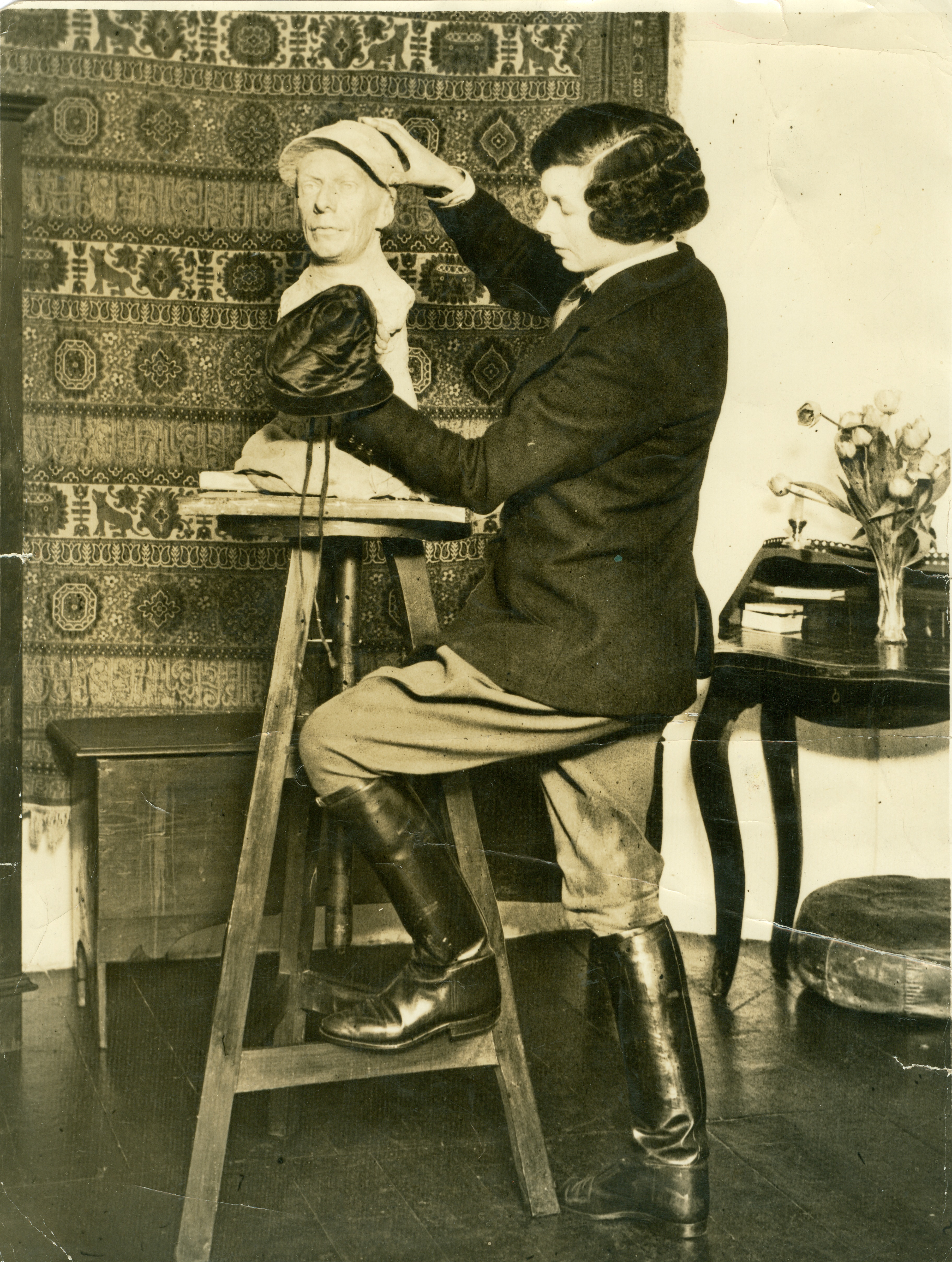
 My husband, the blessed Mr Walker, is very supportive of what I do, even with the resultant book piles and general chaos. He casually said 'I have a lady for you,' (which in our house is not as dodgy a suggestion as it sounds) 'but I don't suppose you are doing sculptors...'

Now, he right in that I don't normally tackle sculpture, which is terrible of me but also a reflection on how little space sculpture is given in traditional art history teaching.  It's like you need to take a completely separate course for that, like it doesn't really count as 'art.' In a way, sculpture can be seen as a metaphor for women in the arts, sort of seen as the same thing but not thought of when listing important artists. A sort of add on.

Anyway, to cut a long story short, say hello to Sibyl Barlow....


Now, you can't tell because you are reading this on the internet, but I also do all my work in riding gear and great big boots.  It's only sensible.

I know I was going to talk about Victorian lady artists this Blogvent and Sibyl was born in 1897, but she still counts as a Victorian (just) so she's being let in, and also she really didn't live that long so give the poor woman a break. Also, we are not going to get into what counts as Victorian art right now, let's save that for Christmas Eve when we've all had a sherry.

Sow (undated)

I warn you now that there is not a lot on Sibyl, but that leads me to a ponder on sculpture and its coverage as I have already ranted.  Add to this that Sibyl was short-lived but we have a heroic Great War death and an appalling divorce to get through, so I think we'll be okay for content. Back to the beginning...

Tiger Mask (undated)

Sibyl Margaret Lancashire Barlow was born on 17th May 1897, the 3rd of 4 siblings.  Her parents Alexander Kay Barlow (1855-1928) and Sophia Matilda (1862-1952) married in 1890 up in Lancashire, so I wondered if that was a clue to Sibyl's middle name, shared by her younger brother John (1899-1917).  Her two older siblings Joyce (1891-1966) and Alex (1893-1968) shared the middle name Lancaster, like the bomber.  I always look to see if it has links to the mother's maiden name but as Sophia's parents were recent immigrants from the Netherlands, it seems unlikely.  Maybe they really like Lancashire, and why not?

The two eldest siblings were born in Essex, then in 1896 the Barlows moved to Wivenhoe Hall.  I am eternally grateful to the creators of the history of Wivenhoe page, not least for this photo...

Alexander Barlow in the traditional Victorian minimalist interior of Wivenhoe Hall

The family stayed at Wivenhoe until 1927, so a vast amount of Sibyl's life (and that of her family) was spent in Essex.  This gave Sibyl access to London schools, although it is slightly mysterious where she went. Chris Pettey's ever-useful Dictionary of Women Artists says she studied in the Dresden Art Academy and in London. In a later newspaper article, it also suggests she attended the Southampton School of Art when her family moved there at the end of the 1920s.

Group of Three Farm Horses (undated)

It is obvious from the little information we have on Sibyl that she loved horses and rode in an almost professional capacity. I was reminded of Rosa Corder and her love of animals, without the troublesome sexy overtones.  Sibyl was all about the ponies. I'm not sure when she went to Dresden but before she did, there were a couple of family catastrophes,,,

Ring Master and Rearing Horse (undated)

You know how I am with scandal and tragedy, I absolutely love it.  If we start with the 1911 census, the Barlow family are in Wivenhoe with their 5 servants (including a page).  Joyce, aged 19, Sibyl, 14 and John, 12 have no occupation, but Alex was at Cambridge where he was an undergraduate. On 2nd February 1915, Joyce married Arthur Haines, but their honeymoon period was just that, because 2 weeks later the marriage went entirely sour when Arthur turned out to be a drinker and someone who enjoyed 'unnatural acts'. Joyce put up with it until May when she packed up and went back to Wivenhoe Hall.  Arthur seems to have backed up his awful behaviour with abuse, and while drunk, threatened Joyce with a drawn sword. She applied for a divorce that Autumn.

Sybil riding one of her models

If that wasn't enough, with the advent of the Great War, Alex joined the Royal Engineers.  I have to admit, when I saw how old he was, I was very concerned, but he wasn't the one I should have worried about.  John was only 15 when war was declared, but his enthusiasm seemed palpable.  He immediately joined the Essex Cyclist Corp as a despatch rider.  At 16, still too young to enlist but fascinated with the new technology of aeroplanes, John got his pilot's licence at the Bournemouth aviation school and went to work in the Wells Aviation Factory.  The moment he turned 18, he got his commission with the Royal Flying Corp and received his month's training.  One whole month, blimey.  After fighting in Messines and other battles he was shot down and killed, six months after getting his wings. He was 19 years old.

Sybil would have been 21 when John died and in theory pursuing her training as a sculptor.  Whether she was that way inclined or not, her chances of marrying were not great after all the men died.  You can see why she dedicated her life to horses. By 1926 she had started exhibiting, in time for the family's move to Southampton.  At the Royal Academy, she showed Bulger, a bronze statuette and Crossing the Flood Ford, a statuette group.  She also exhibited with the Society of Sculptors, Painters and Gravers, the Royal Scottish Academy and the Salon de la Societe des Artistes Français up until 1929.

Sibyl and her bust of jockey Freddie Fox, 1931

In 1930, Sybil appeared at the Southampton Art Society's 44th annual show at the art gallery. Alongside P. Wilson Steer's Digging for Bait, Shoreham, there was a 'splendidly modelled group of horses by Sibyl Barlow who studied at the local art school.'  Finally, at the 1931 Royal Academy exhibition, Sibyl exhibited her head of Freddie Fox, Champion Jockey.  The Birmingham Mail described the piece as a beautiful bronze bust, and the Sheffield Daily Telegraph felt the piece would attract many people, not just those who appreciate art. The Belfast Newsletter were taken with how well Sibyl had captured his thoughtful and whimsical expression, but also, because of how busy Fox was, she had to complete it with very few sittings.

Calf (undated)

There seems to have been no notice of Sibyl's death in January 1933.  Less than two years before, she had been the toast of the Royal Academy, but I wonder if it was the subject rather than her that caused the interest. Her father had died at the end of the 1920s and so she left her money, over £6K, to her mother. It is thanks to Sophia that we have the beautiful images in this post as when she died in 1952, she left these pieces to the Russell-Cotes Art Gallery.  The three cart horses were out recently in support of the Lucy Kemp-Welch exhibition earlier this year.

Nude Study (undated)

I think there a couple of issues at work here - firstly, our idea of fine art is very 2D.  Very few people can name sculptures let alone sculptors beyond Michelangelo's David. It's just not the first thing mentioned when we talk about art.  Also, exhibitions that are sculptural are very few - I absolutely loved Sculpture Victorious at the Tate in 2015 but I can't think of another purely sculptural exhibition I have ever been too.  Mr Walker also pointed out that lending and borrowing sculpture is a damn sight harder than a painting.  Our appreciation of sculpture is really hampered by the fact that day to day, we see art either on a screen or in a book.  That's not the best way to appreciate something that is 3D.  Maybe virtual reality is waiting for sculpture. All this goes to explain why sculptors don't, on the whole, get to be the stars that painters do.  However, I'm guessing we all see far more sculpture in real life, every day, than we do fine art. How many statues (contested though they are) do we walk by without knowing who they were created by? That is sometimes the reason that they are preserved, even though the figure is now reviled. My sister-in-law is descended from the models lending their forms to some of the wonderful figures decorating the buildings of London, including Selfridges, but how many of us look up and see exactly how gorgeous they are? Sculpture works much harder on a daily basis to make our world a little more beautiful, so I think we now owe it and the people who create it a bit more love.


Friday, 15 December 2023

Friday 15th December - Mary Lightbody Gow (1851-1929)

 As we get to the end of the second week, I have decided to pick a lady who has a brilliant middle name. We are also going to be visiting a family of artists again. I see patterns emerging (well, maybe not the awesome middle name bit) and so we better get on with meeting the marvellous Mary Lightbody Gow...


Oh yes, we are spoiled today as I have a photograph of our lady artist. Mary L Gow was so well known in her own life time she appeared in an article that also featured people like Louise Jopling and Laura Alma Tadema, whom she even did a portrait of, look!

Lady Alma-Tadema (undated)

But I'm getting ahead of myself.  With a brother and father in the same business, you would think that Mary would not get forgotten but then who has recently seen an exhibition that involved either James Gow (1821-1886) or Andrew Carrick Gow  (1848-1920)? The Victorian period is lucky to have so much media surrounding it, especially by the end of the century, but that can only tell us how many of these bright, popular artists are just lost in their pages.

A Kiss Goodnight (1884)

James Gow married Jane Carrick in their native Lanarkshire in Scotland in 1845.  By the time their eldest son Charles arrived around a year later, the couple had relocated to London.  They were living in Islington and by the looks of it, two of Jane's brothers had come with them, with Robert Carrick (1920-1905) listed as an artist, like James Gow, and Alex Carrick (1831-1895) listed as a lithographer. James and Jane's next son Andrew Carrick Gow was born in 1848, followed by Mary Lightbody Gow on Christmas Day 1851, taking her middle name from her maternal grandmother's maiden name. James Jnr followed next, then Jane Carrick Gow, named after her mother in 1856.  Neither Jane senior or junior survived past the end of summer, leaving James with four small children.

Harmony (undated)

By 1861, the children were all in school and the family still live in St Pancras, but moved to Bloomsbury in 1864 when James remarried, this time to a governess, Elizabeth Ann Worth.  I wonder if it was her influence that led to Mary being recorded as a governess in the 1871 census, but she must have been studying art by that point, both at the London School of Art and Heatherleys (founded in 1845)...

Two students at Heatherley's School of Art, drawing from the antique

The arrive of a step-mother, also resulted in two more Gow siblings, Elizabeth (1866-1924) and Edith (1868-1932), The 1870s brought the Royal Academy, and in 1873, Mary exhibited Card Castles in the same exhibition as her father and brother Andrew. This was followed the year after by A Box at the Pantomime and A New Acquaintance. Neither exhibition scored Mary any mentions, with only a couple for her father and brother. Her first mention seems to have comes from the Art Journal in 1875 - 'The Institute of Water-Colour painters has added three women to its membership, they are Mary Gow, Marian Chase and Miss Coleman.' The picture she had submitted to gain membership was Enid's Wedding Morning and fully justified her membership, according to reports.

The Blue Shawl (1911)

Mary did not submit another picture to the RA (or at least, didn't have one accepted) until 1880, but in the meantime she was busy with water-colours. The Art Journal reported on a 'more than ordinarily interesting' exhibition of the Institute of Painters in Water-Colour which included 'admirable examples' of her work. A small painting she exhibited was 'extremely competent,' according to the Magazine of Art and did 'credit to the artist and her family.' The Art Journal also noted a painting called Convalescent where a little girl with a doll was being read to by a friend, which the magazine considered 'clever, but needs attention to texture and colour.' She also drew attention for her work Children's Garden Party where the newspaper claimed she did 'well with both people and trees.'

Fairy Tales (1880)

1880 saw Mary's painting Fairy Tales at the Royal Academy, which was described as the 'completest example of her work' that the Evening Mail could remember. They judged it full of childish charm. Also in 1880, Mary exhibited 'an agreeable portrait group of children' at the Institute of Painters in Water-Colour, which was mentioned in the Pall Mall Gazette. The Daily News was not quite so enthused, criticising the over-crowding of objects in the piece but admitting that 'the little girl is pretty with her abundant chevelure.' That's hair, by the way. T'uh, critics.

An Invitation (1881)

1881 saw the Gow family living at a new address in Fitzroy Square after James Gow had been widowed again. At home were Andrew, Mary, James jnr, Elizabeth and Edith, together with three servants. Mary's painting at the Institute of Painters in Water-Colour, An Invitation caused the London Evening Standard to report that it was 'creditable for ease of posture and glow of colour' and the Manchester Courier praised it saying it 'shows a great improvement on her former works.'

The Godmother (1883)

1882's work Something Interesting showed children reading storybooks again and the Art Journal described it as 'a good little canvas.' Continuing the pretty domestic scenes, her 1883 work The Godmother was described in the Magazine of Art as 'especially pleasing,'  She continued her good spell with works in the Grosvenor Gallery exhibition, where most of the pieces were described by the Magazine of Art as 'below average', but it was noted that Mary had submitted some good drawings.

Afternoon Tea in Regent Street (1885)

Her final appearance at the Royal Academy seems to be 1885 and Tea Time which could possibly be the same as Afternoon Tea in Regent Street. Whilst not a very regular contributor to the RA, as opposed to the water-colour societies, I wondered if her withdrawal and the death of her father around the same time were connected. I don't know her reasoning for not appearing at the RA - maybe it was intentional, maybe she couldn't get accepted - but the newspapers mention her water-colour societies works far more than any appearance at the RA, so maybe she just didn't see the point in chasing the RA as opposed to other galleries such as the Grosvenor or the Dudley. 

The Willow Pattern Plate (1886)

Mary's work The Willow Pattern Plate, shown at the Royal Institute, shows a mother using a willow pattern plate as a story book, telling her daughter the story behind the design. The Magazine of Art reported that the 'composition, design, and colours are so good that although the subject is a trite one, the picture avoids sentimentality.' She also appeared at Messr Cassell's Black and White exhibition at the Memorial Hall, Farringdon Street alongside Alice Havers and was one of the plates in the Christmas edition of The Graphic.

By the 1891 census, the siblings are down to Andrew, listed as a 'Royal Academician', Mary, merely an 'artist', Elizabeth and Edith, together with their servants at 15 Grove End Road. Her appearances in the newspapers and art magazines continued with mentions of her regular appearances at the Black and White exhibitions, likening her to Louis-Maurice Boutet de Monvel, a French water-colourist who had a similar style in works such as this one...

The Pupils of Mademoiselle Genseigne (undated) Louis-Maurice Boutet de Monvel

Fair Rosamund's Bower (undated) Mary L Gow

It was added that her work was 'well-nigh too dainty' which I'm not sure if that is praise or criticism. 1896 seems to have been a busy year for Mary in the newspapers, appearing at the New Gallery in a sea of Symbolists where her pictures The Sampler and An Interlude would 'appeal to everyone with an eye for delicate colour and a feeling for simple sentiment.' Meanwhile, her appearance at the Royal Institute of Painters in Water-Colour with A Portrait Sketch assured the reader 'that the author of those extraordinarily dainty things in the New Gallery can be very vigorous and offhand when necessary.' 

In 1897, the Berlin Photographic Company published a photogravure of Mary's painting Your Majesty...

Your Majesty (1897)

The moment illustrated was the early morning call paid on Princess Victoria by the Archbishop of Canterbury and the Lord Chamberlain to announce the death of King William and her accession to the throne. The London Evening Standard described the scene thus - 'The girlish Queen, loosely and hastily arrayed in deference to their summons, receives the intimation of her august destiny, and its tremendous responsibilities with the simplicity and youthful inexperience that was her charm then, and with the dignity that sixty years have but heightened and sustained.'

By the end of Queen Victoria's reign, Mary had become a member of the female art establishment, cemented by pieces like Arthur Fish's article in 1901.  Fish wrote 'Miss Gow's delightfully delicate drawings are always a feature of the exhibitions of the Royal Institute of Painters in Water-Colour ... As an illustrator she has few equals.'

Sydney Prior Hall (1890s)

In 1906, aged 54, Mary married fellow artist Sydney Prior Hall, who was also the child of an artist (animal painter Harry Hall).  He was a widow, his first wife dying over a decade before and his work echoed Mary's, including black and white illustrations, which he did for Tom Brown's School Days in 1885.  Mary's own illustration work appeared in books such as William Wordsworth's We Are Seven...

We Are Seven (1889)

In terms of her later art, I think one of the most touching images she painted came from 1914 entitled The Gow Brothers...

The Gow Brothers (1914)

This one baffled me to start with - was it meant to be her own brothers Charles, James and Andrew? Or was it James's sons, Andrew (1887-1978), James (1890-1929) and Roderick (1893-1916).  I'm going to plump for the second option as all three boys were old enough to go off to war, poor Roderick dying in the Battle of Jutland. If I was feeling fanciful, I would suggest this is a couple of years after its 1914 date, as the youngest child in the image is seperated from his brothers, as he would be by death.

Royal Academician Andrew died in 1920, followed in 1923 by James.  Mary lost Sydney in 1922, then she and Charles both died in 1929, Charles in March and Mary on 27th May. In her probate, she left everything, all £28K, to her half-sister Edith.

We only have nine more days of Blogvent to go and I think we can see very strong patterns forming about what it means to be a female painter in the last decades of the nineteenth century, what damage or benefit there is in having a father or brother in the art world, what opinions, prejudices and expectations your predominently male audience and critics are going to have and how any woman can breakthrough all that and make her mark. We'll see how the rest of the Blogvent ladies do...