Sunday, 22 May 2011

The Lego Ophelia

Words cannot express how much I love this!


This splendid image is from http://www.flickr.com/photos/balakov/4487356456/ and the work of the genius, Balakov.  Best of all, you can buy a print of it from www.redbubble.com/people/balakov/art/4934172-ophelia.

When I saw it, I laughed so much I hurt myself.
More!  I want more!

Thursday, 19 May 2011

Going, Going, Gone


I was attempting to explain Narrative Art to Mr Walker the other morning.  I sat there clutching Narrative Art by Julia Thomas and explained the notion of a painting with a back story, possibly not explicit from the title.  A fairly straight forward concept, but it can be anything from a single question of religious exploration in The Doubt: Can these Dry Bones Live? (1855) by Henry Bowler, to the more complicated multi-narrative of William Frith’s epic Derby Day (1856-8).  Anyway, I was flicking through the book as I talked and came across one of my favourite perverse paintings, Too Late (1858) by William Windus.  


It is such a melodramatic scene, and the central premise is that the man has arrived ‘too late’ to marry his former sweetheart as she is now consumptive.  However, a lot is left unexplained, or rather left to the audience to decide.  Who is the other woman in purple?  Who is the little girl?  Why is there a windmill in the background?  OK, so the last point isn’t particularly relevant, but you get the idea.

The pair of women have always struck me as odd.  Why does the healthy one kiss the sick one?  What is the healthy woman’s relationship with the man?  Or the child?  The common explanation is that the two women are possibly sisters or friends and the healthy one ran off with her sister/friend’s beloved, maybe after he got the consumptive woman pregnant, hence the child.  There’s an episode of Jeremy Kyle waiting to happen.

Broken Vows (1857) Philip Calderon
While looking at this picture I was suddenly struck by something.  Looking again at the two women, I had the impression that the sick woman was clutching her side, much like the woman in Philip Calderon’s Broken Vows, demonstrating how her heart was broken, or that she had been wounded by his infidelity. However, in Too Late, it isn’t the betrayed woman's arm, despite the sleeve ending in that horrible pallid green colour, it’s the healthy woman’s sleeve.  Or is it?

What if there weren’t two women in the picture, or even three if you count the little girl, but only one?  Humour me...

If we accept the standard course of Victorian fictional love, what if the man and woman were childhood sweethearts?  The little girl could then stand for the woman as a child, staring in horror and disbelief at what her innocent love does to her. 

The little girl turns into a fine looking young woman who is betrayed somehow by her erstwhile suitor, and turns away from him, becoming in time the fragile, ill woman.  They morph together, the arm being a mark of the transition from one state (healthy) to another (dying), the colour draining from her dress as it seems to have done from her entire body.  The man covers his eyes in horror as he is confronted with not only his dying beloved but his childhood sweetheart and young lover too.

What did he do?  I think he made her wait. And wait. And wait.

While looking at the shiny hair of the child I was struck by how it reminded me of the woman in The Long Engagement (1853-55) and April Love (1855-56) by Arthur Hughes.  I brought up the image of The Long Engagement next to Too Late and made a very unlady-like noise.  Look at the purple dress and the purple cape, and the hair of the little girl and the women in the Hughes paintings.  What really startled me was the man had similar facial hair and could be the same man.

The Long Engagement
April Love
Hughes’ paintings follow a sort of narrative, if you read them in reverse order.  April Love shows a young woman experiencing the end of the first phase of love, her ‘April’ love, as she considers that her love will have to be more robust and mature if she is going to remain with her beloved forever.  He kisses her hand in the background, asking for forgiveness as she considers the rose petals, symbolising the fragility of love, and the ivy, symbolising loyalty and fidelity. As The Long Engagement seems to follow the same woman, now older, it can be supposed that what caused the argument was that her beloved was unable to marry her soon, hence their long engagement.  Again the woman considers the ivy as it covers her carved name, ‘Amy’, on the tree, while her dog emphasises the quality of loyalty.  My word, that dog’s hair is almost as glossy as hers. The quote that accompanied it, ‘For how might ever sweetness hav be known/ To hym that never tastyd bitternesse?’ intimates that the ‘bitterness’ of the long engagement will make the ‘sweetness’ of marriage all the more apparent.

My theory is that Windus was aware of these paintings and painted a third picture, completing the story in rather a bleak way. Instead of marrying her, the young man has left it too late to taste the sweetness.  The ivy still grows by the woman, all over her wall, but it has all been for nothing as she is dying.  Thomas suggests in Narrative Painting that the subject of being jilted by your fiancĂ© was in the public consciousness at this time through the litigation known as Breach of Promise and that any woman who had been engaged or involved with a man was seen as ‘soiled goods’ and therefore not touched by anyone else.  I think Windus maybe hinting that this is an unfair assumption, that his woman remained virginal and pure, but now only has death as her option.  Remember the windmill?  Well, it could be that the windmill symbolises her purity, as windmills sometimes were used to denote martyrs, I suppose because their sails made a cross.  That odd little windmill between the man and the woman could represent her imminent virginal death, a martyr for love and false belief in the man who was meant to love her.

I know it’s a leap, but you could read that Amy, standing in her little ivy-covered arbour seals her fate by agreeing to her long engagement with her childhood sweetheart, when the man either can't afford to or doesn’t intend to marry her at all. Windus used a quote from Tennyson’s Come Not, When I am Dead, which includes the line ‘Wed who thou wilt: but I am sick of time’. 

That sounds like a woman sick of a long engagement to me.

Tuesday, 17 May 2011

Fanny and Nuts: The portrayal of Fanny Cornforth in 'Desperate Romantics'

We all knew this day would come.  Ever since it was screened in the summer of 2009, there had to come a time when I talked about the portrayal of Fanny Cornforth in the BBC drama Desperate Romantics. It was either going to be at a therapy session or here, and this is cheaper.  Don’t mind me if I lie on the sofa while I’m telling you this.

Look, I’ve had some calming down time and I have to split this into different sections if I am to be fair.  I can’t just start shouting swear words and crying, that wouldn’t be constructive, so I would like to respond to the following things:

Fanny Cornforth in Desperate Romantics (the book) by Franny Moyle
Fanny Cornforth in Desperate Romantics (the television series) screenplay by Peter Bowker
Fanny Cornforth, as portrayed by Rebecca Davies in Desperate Romantics

When I first heard that there was to be a drama series based on the lives of the Pre-Raphaelite Brotherhood, I was delighted.  I even read the description of it as ‘Entourage with Easels’ with good humour, assuming that Telly Chaps had to spout such nonsense so that people who wouldn’t normally watch a drama about Victorian artists would tune in, if only to see Aiden Turner naked.  That obviously wasn’t why I tuned in. Ahem, moving on…

I was delighted to see an accompanying book which preceded the series (I had the impression that the book came after the series, not the other way round, which is false but how I understood the marketing), and found the choice of Frederick Sandys’ Love’s Shadow as its cover image interesting, seeing as he was never a member of the Brotherhood.  Then I gave myself a slap and told myself not to be so childish. However, the first thing I did was to see if Moyle had used my book in her research.  She had not (aren’t I presumptuous and a little bit vain?).  Then I checked how Fanny made her entrance into the Pre-Raphaelite circle.  Oh nuts….

I finally bought it in paperback, with the tv tie-in cover.  The account of Fanny is pretty much in line with Jan Marsh’s splendid account in The Pre-Raphaelite Sisterhood (1985), but not much more.  There is no account of Fanny without Rossetti, but it is debatable whether Desperate Romantics is the place for such an account.  Fanny story ends with the marvellously enigmatic ‘In 1905 Mrs Villiers sold anything of remaining value belonging to Fanny and moved her to Brighton, where she died.’ Really? Please elucidate…oh, don’t bother then. 

Despite my rampant bitterness, I’m not going to give Franny Moyle a hard time and I’ll tell you why.  Check out my monumentally bad reviews on Amazon – it’s easy to take something that someone has worked on for years and dismiss it.  Moyle obvious put a lot of effort gathering all the source material, a lot of work went into her book and it is a good read.  It doesn’t break new ground or tell me anything I don’t already know and it isn’t about Fanny outside her interaction with Rossetti.  Franny Moyle can rest easy, despite the nuts, which I will come to.  I don’t blame her for what followed, and if I get to meet her I will give her a copy of my book.

Oh dear, Peter Bowker needs to be taken to aside, though.  On one hand, I did laugh out loud a lot, the dialogue was very funny and it was never boring. Possibly the best line for me was when Fanny announced ‘Just because I work with my below decks, doesn’t mean I don’t have a heart!’ My God, I shouldn’t have called my book Stunner, I should have called it My Below Decks: The Fanny Cornforth Story.   However, and it is a giant ‘however’, by putting a cute little disclaimer at the beginning, you cannot get away with changing that many facts without making me need to sit in a darkened room and fan myself.

Let’s start with how we meet Fanny Cornforth.
One woman and her bag of nuts...
 
Fanny’s version of their meeting involved Rossetti grabbing her hair and asking her to sit for him where he drew her for the figure in Found.  Oh hang on, that kind of already happened in Episode One…

When the barmaid was propositioned by Rossetti in the first episode, I thought ‘Oh, interesting…well, Fanny did own a tavern later in life, possibly it’s a nod towards that,’ and Maisie McCoy did look vaguely right.  I loved the scene where Rossetti positions her and composes Found.
Hard luck deary, you ain't Fanny Cornforth
 
But no, in the credits she is listed as ‘Margaret’. I would have to wait until Episode Five before Fanny turned up…

Ten years I spent researching, following up comments and diaries and letters, and I thought that after all that no-one could credibly say that Fanny Cornforth cracked nuts between her teeth and spat them at Rossetti.  Seriously, please, it’s a metaphor.  It’s William Bell Scott’s mean little way of saying Fanny Cornforth is an animal. He wasn’t even there.  Lo and behold, in Episode Five, there she is, Fanny Cornforth spitting nut shells.  My screams could be heard all over southern England.

Mind you, had they used my research we would have been robbed of the lines ‘Do you make a habit of spitting?’ ‘Depends what I have in my mouth at the time, sir…’ Nice.

So, back to the nuts.  Rossetti by this point has abandoned Found and wants to paint her as ‘The Kissed Mouth’, Bocca Baciata (Mmm, great name for a blog).  Cue my favourite scene in the entire series.

Aidan Turner as Dante Gabriel Rossetti, Rebecca Davies as Fanny Cornforth

 
I have to admit that I didn’t really care about the plentiful, energetic and on occasions slightly terrifying sex, what really made me watch, rewind, and watch again was the scenes of them painting the works of art.  It was at this point I began to suspect someone in the team making Desperate Romantics had actually heard of the Pre-Raphaelites and liked their art.  While screen-capturing the images for this blog I just adored the Bocca Baciata scene, the attention paid to Fanny’s hand, the apple which she bites (oh, how symbolic…might have worked better if Rossetti hadn’t been portrayed as a giant whoremonger beforehand), and for a moment Aidan Turner was allowed to show that Rossetti wasn’t an irritating git all of the time.

Oh dear, no wonder it's The Kissed Mouth
Bocca Baciata
You understood the relationship between them, you were given 'artist and muse' and the playfulness that existed.  Interestingly, neither of them says anything for the scene, it’s unnecessary and frankly it’s a bit of a relief. Oh and there’s lots of sex, what a surprise.

Gabriel and Fanny
 
Fanny and George

When Fanny goes to look at how the picture is progressing, either by accident or design the pose is reminiscent of the portrait of George Boyce and Fanny.  I was very happy by this point.  Then they showed Bocca Baciata…
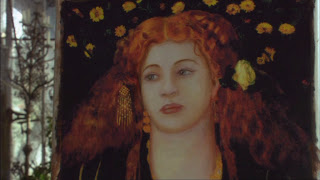
Bocca Baciata ?!
 Oh dear.  Could someone not just buy a copy of the original printed on canvas?  The copies of Ophelia and Holman Hunt’s works had been beautiful, but this was a little bit dreadful, and the worse bit is the ‘Rossetti mouth’, the most iconic part of a Rossetti female oil.  Mind you, I think the Beata Beatrix he does later is even worse…
 
Yikes.

Fanny is shown eating in almost all our dealings with her.  She is marvellously fleshy and eats with gay abandon, unlike any of the other women.  It is a bit of a hallmark of ‘Fanny Cornforth’, but possibly not an untruth.  Plus, it makes a pleasant change to see that amount of woman naked, although she was taking a hell of a risk as Rossetti appears to live in a greenhouse.

Naked, eating chicken, in a greenhouse.  How bohemian.
 
The relationship between Fanny and Rossetti did ring with a fair amount of truth.  Stripped of complicated facts and timelines, the basic point of their affair was that he wanted a woman who he could be with without responsibility and she provided that.  Rossetti comes across as a feckless idiot that people enable because he is very pretty. The assumption seems to have been that viewers would not be able to understand ‘charismatic’, so they used ‘saucy hotness’ instead, because your average Pre-Raphaelite art lover isn’t very bright, apparently.  Thanks for that.

The idea that Rossetti would invite Fanny to his wedding is unthinkable, but it did neatly allow you to see her reaction to being deserted by the man she was beginning to rely on, if not love.

Fanny (and pipe) at the wedding
 
I found her sadness at Rossetti’s ‘desertion’ of her touching, more down to the performance than the script, and, again, the idea that she would seek solace with Holman Hunt might be credible but felt a little opportunistic, as if Fanny was only about sex.  

Rebecca Davies
Here is the saving grace of Fanny in Desperate Romantics: Rebecca Davies.  Despite seeming to channel Catherine Tate, she makes Fanny more than just a tart with a heart, when the danger always was that she would come off as a second rate Annie Miller.  She is given very little to work with, the dialogue is mostly bordering on Carry On (I’m not saying that’s necessarily a bad thing), but she allows a dimension of both affection and hardness which make you understand her attraction and her survival.  Watching the series back, concentrating on her performance, I admire her subtlety when none was really expected from her, judging by the script. 

On the whole, I enjoyed watching Desperate Romantics more on repeat viewings than I did to start with as I already know which bits are going to make me livid and so I avert my eyes.  Instead I concentrate on seeing Millais paint Ophelia…

 
The splendidly cheeky Annie Miller, as portrayed by Jennie Jacques…


The scene when Rossetti paints Jane Morris in her blue dress…

 
Again, I think the person who had seen a Pre-Raphaelite painting before was on-set that day…


 And that marvellous scene where Aidan Turner stopped being a gittish sexpot for five minutes and got to be the artist that I adore, with the woman I spend an unhealthy amount of time thinking about.

The Love School (1975)
Yes, it is a wasted opportunity to show the complexity and beauty of a fascinating art movement which is insanely fashionable just now.  Yes, they might as well have just reshown The Love School from the 1970s, or at least released it on DVD. Yes, they went with basic rumour and shallow characterisation, leaving it up to the actors to fill in the gaps, but even though my fifteen years of Fanny Cornforth research (ten years to the book and five years since) were pretty much ignored, I can see that the series may have raised awareness of Fanny Cornforth, and, bar the nuts, the portrait of her did not do too much to damage her good name.

It’s not like I wrote a book about William Morris or Ned Burne-Jones…


Sunday, 15 May 2011

How Pussy Galore Awakened my Conscience


When you study Pre-Raphaelite Art at University, one of the first pictures you are shown is The Awakening Conscience by William Holman Hunt.  You will already know that I am fond of this painting, it is a marvellous blend of exquisite detail and unintentional humour, which is a winning combination in my book.  It is also the reason I nearly gave up on Pre-Raphaelite art history.  Let me explain…
The Awakening Conscience (1853-86) William Holman Hunt

When I first saw it as a young, innocent twenty year old, I thought it was dreamy.  I loved the delicate lace hearts around the bottom of her petticoat, the rich colours of the shawl wrapped around her hips, all that lovely hair and the determined look on her face.  Then I read a description:

‘The poor girl has been sitting with her seducer; some chance words of the song ‘Oft in the stilly night’ have struck upon the numbed places of her heart; she has started up in agony…’ (Ruskin’s letter in The Times)

Furthermore, the figure of the girl is described as ‘repentant’, ‘vulgar’ and ‘tragic’ and, my favourite, ‘hideously disturbing’ by the eventual owner Thomas Fairbairn. Looking at the fallen woman, I couldn’t see it.  She looked a bit surprised, but nothing outrageous.  I felt bad that I couldn’t understand what the fuss was about and that wasn’t my only problem.  I also had an issue with Annie Miller (and I wouldn’t be the first person to say that).

The most modern book I own that deals with The Awakening Conscience is Franny Moyle’s Desperate Romantics.  In glorious colour, the painting is shown (nice reproduction) with the following description: ‘Annie Miller was the obvious model for this picture, showing a prostitute on her fancy man’s lap.  When it first went on show, Annie proudly strutted like a peacock in front of it.’  Hang on, isn’t this also Annie Miller ?
Helen of Troy (1863) D G Rossetti
 
And this ?
Woman in Yellow (1863) D G Rossetti

Well, that looks nothing like Annie Miller, she can’t be both people.  But wait, possibly Rossetti portrayed her in a completely different way.  How about Millais' portrait of her?

Annie Miller (1854) J E Millais
 
Well, the hair is a similar colour, but I’m not seeing the similarity.  How about Hunt, did he use Annie for anything else ? Oh, here we go…


Il Dolce Far Niente (1859-66) William Holman Hunt

Well, that certainly does look like the woman in The Awakening Conscience.  While watching the television drama Desperate Romantics, Annie is clearly seen in front of the painting, not exactly strutting like a peacock, well not at this point.

Desperate Romantics (BBC)
 
So, my problem was this - how can the painting be of a woman mortified by her damnation, when, at worst, she looks like she’s just heard the ice-cream van outside, but not got any change?  Also, how can she be Annie Miller?

Enter my personal saviour, Diana Holman Hunt.


Good Lord, I wish I looked that fabulous, she’s like the Pussy Galore of Art History biographers.  Granddaughter of William Holman Hunt, Diana wrote the fabulous biography My Grandfather, His Wives and Loves – Any biography which contains the line ‘At this point I topped up my glass with gin’ (p.23) is a thing of beauty.   

She confirms that Annie Miller was indeed the model for The Awakening Conscience and Il Dolce Far Niente, both painted during Hunt and Miller’s relationship and engagement.  However, she goes on to explain the reason why neither picture resembles Annie.  If you consider it, why on earth would Hunt, after being betrayed and then blackmailed by a woman he loved, allow the face of his betrayer to adorn his pictures?  Admittedly, The Awakening Conscience wasn’t his idea to change.  Fairburn found the ‘tortured expression’ so horrific that he returned it to Hunt to change.  Hunt scraped back the face so much that, even in x-ray, no trace of the original face exists. That is excessive scraping in my opinion, done with extreme prejudice.  I’ve seen Venus Verticordia by Rossetti in x-ray and you can just about see the previous positions of scraped/repainted things, completely invisible in the finished canvas. Hunt obliterated Annie from this picture. 

Il Dolce Far Niente, although begun from Annie, was left incomplete, the face left until last and only completed in 1866, from Fanny Waugh, Hunt’s first wife and model for Isabella and the Pot of Basil.  Well, I now have another question – if our fallen woman is Fanny Waugh, like in Il Dolce Far Niente, and the painting was re-faced in 1857, how come Hunt didn’t meet Fanny until 1861? Oh, for goodness sake, Hunt…

Fanny Waugh c.1866
Annie Miller c.1860
  
Isabella and the Pot of Basil (1866-8)
I think it is most likely that both paintings have Annie’s hair, a red-gold mass of curls when freed, and an idealised face.  After all, the woman in The Awakening Conscience only vaguely resembles the model for Isabella, and to be honest the formal portrait of Fanny isn’t greatly like either picture, but its purpose is different.  Looking at the date range of The Awakening Conscience, Hunt had until the 1880s to alter the face to resemble his first wife or even his second wife, Edith Waugh, Fanny's sister.

I therefore have answers to my questions – the reason the fallen woman doesn’t look like the tortured description given of her when the painting was unveiled is because she was ‘cheered up’ so she didn’t put her owner off his dinner, and the reason she doesn’t look like Annie Miller is that she isn’t Annie Miller, well, not anymore.  What she is, however, is a cautionary tale to all Art Historians.  Don’t ever be afraid to say ‘Eh?  I don’t see it…’, because Diana Holman Hunt will be on hand to help you out.  

Because she is secretly one of The Avengers.


Saturday, 14 May 2011

Endless Knight


I have this theory about images of knights in art.  Every time I see a man in armour I think ‘OK, who’s dead?’  This may well be a little unfair of me to generalise, but I can’t help it and I shall explain why.

It all began with Sir Isumbras and the Ford.  Although not one of Millais' best efforts, I don’t mind the picture, and certain aspects of it are sublime.
Sir Isumbras and the Ford (1857) J E Millais
 
I especially like the way the light plays across the armour, golden and shining, looking almost like folded wings, as he transports the children across the water on his giant horse.  Yes, the horse is insanely large, but if you follow my theory, I will try and excuse that.

I know it comes from a story, but the very ‘St Christopher’ overtones begin to ring bells in my head.  Let’s be honest, any time crossing of water takes place, who doesn’t immediately think of the river Styx and death?  Although Sir Isumbras isn’t in a boat, that is an abnormally large horse he’s on.  You could say that Millais just made a mistake in his perspective, but this is Millais we are talking about, the man didn’t make mistakes without reasoning behind it.

If I was feeling cute I’d say that he was hinting at this interpretation with the bundle of sticks (Styx, get it?) behind the child’s back, but looking further, what exactly are those two nuns up to?  Reminds me of two other nuns in a Millais picture...

The Vale of Rest (1858-9) J E Millais
 
Who doesn’t love a grave-digging nun? It could be argued that they are a visual cue between the works, that he had the later work in mind when he produced Sir Isumbras.  The two nuns strolling along the river bank are off to dig the graves of the children who are being transported over to the other world by the holy knight.  Yes, it’s a bit of a jump, but what if knights symbolise death in paintings?  What if a knight was used as shorthand for dying, either covertly or overtly?  Take the following examples...

The Three Ravens (1868) Robert Bateman
 
This is such a beautiful picture.  I remember the first time I saw it, I thought ‘Ahhh, nice trees...hang about, there’s a dead chap!’  Three Ravens ?  How about calling it ‘He’s Dead!’ and it’s not the only example...
The Vale of Rest
The Happy Warrior


Sic Transit
 
To be honest, these three paintings by G F Watts may as well be titled 'Going', 'Going' and 'Gone'.  In the first painting, we have G F Watts as a knight, looking old and tired.  In the second picture, a knight is embraced by an angel as he dies during battle.  Finally, we have a dead body, but look at the helmet with its spray of peacock feathers.  I believe that the feathered helmet ties the first and last pictures together, drawing a narrative between a knight in search of peace and the end of his journey.  Sir Isumbras also carries peacock feathers.  Symbolism attached to peacocks includes the ability to see off evil spirits and incorruptibility after death, if not actual immortality.  It is true that we tend to view knights in a Christian frame, but the inclusion of peacock feathers could carry the symbolism further.  Maybe the knights could be seen as saints, incorruptible and holy.

We possibly have King Arthur to blame for this.  Imagery surrounding the Knights of the Round Table is filled with Holy Grail, death and immortality, and what is King Arthur if not a man in armour who lives forever?  Remind you of anyone?
It’s not unusual to see an angel, such as St Michael here, in battle dress, ready for a good-against-evil type scrap, not to mention people like Joan of Arc and St George who naturally appear in armour in the imagery that surrounds them. 

Consider for a moment the purpose of a knight:  It is to kill or be killed.  You don’t strap on armour to do a bit of gardening, you wear it for fighting.  The business of a man in armour is death, and I see the role of ‘courier of the dead’ as an extension of this.  Also, look at how old the knights in Sir Isumbras and The Vale of Peace are.  These are not young men, and they do not look particularly warlike any more.  They look tired, especially Watts’ knight, and seem to be marking time before they die.  I would argue that Sir Isumbras has no hope of that, now immortal, like a knight guarding the Grail, but the sort of immortality that comes with very specific service.  The role of a knight who isn’t in battle is to serve a Christian ideal, it seems, to be a ‘Christian soldier’, and by carrying the children over to ‘the other side’, he is fulfilling his role. 

I’m not saying it’s a foolproof argument, but I guarantee you’ll look at knight paintings slightly suspiciously from now on.  My work here is done....
From the poem A Sweet Lullaby (c.1915) Eleanor Fortescue Brickdale