Saturday, 21 December 2019

Saturday 21st December - Telegram

What a busy day!  I was catching up with my good friend and agent today, which was lovely, because there is nothing nicer than hearing the news from friends.  At Christmas, we get to catch up with so many people that we might not get to see throughout the year, via the Christmas card.  Some people however choose to update you in the fullest possible sense, via a round-robin.  Hmmm....

The Telegram (1894) Luisa Max-Ehrlerova
I'm sure the people who send round-robins mean them to be a lovely, life-affirming act of friendship, however, for the recipient, they can be very depressing.  It might be because in this country we are not always comfortable listing our achievements, let alone hearing a massive string of the achievements of others.  Look at the expression of the woman in today's picture - she has just read that her family friend's daughter is now taking grade 8 clarinet as well as competing at Olympic level in gymnastics and has recently won the Nobel prize for at least two things.  Our lass feels her greatest achievement this year is not killing her house plant.  She just reached the end of the first of eight pages of round-robin and that has been enough to make her reach for a pistol.  She hasn't even reached the bit about the Tuscan mini-break yet. I doubt she'll make it that far.

The Message (1890) Henry Scott Tuke
There is a rich artistic history of women getting crappy news by letter.  Mothers being informed of loved ones dying in wars, women being dumped by post.  You get the odd moment of a bloke learning of his wife's infidelity, most famously this one...

Past and Present, No.1 (1858) Augustus Leopold Egg
The letter in this case reads 'I saw your wife in Nandos with Gavin from Accounts.  They are definitely at it. Sincerely, A Friend', causing the wife to completely narf up the hand movements to YMCA, and divorce and destitution inevitably follow.  Of course there are many lovely paintings of love letters being exchanged and people getting thoroughly jolly letters but in art, the majority of news is bad.  Admittedly, not every lucky recipient of a tragic letter goes straight for the pistol - I mean, blimey, what on earth was in that letter?!  Egg's woman has just found out that she will be homeless and cast out to die in an alleyway and she's not reached for the pistol.  Let's not make a scene now, remember you're British.

Memories and Regrets (c.1874) Alfred Emile Stevens
Also, if you shoot yourself (or others) just because you get a sad letter, then you miss the opportunity of keeping that letter and wallowing in it again at a later date.  Just as we have many images of women getting miserable letters, we have even more images of them re-reading that letter at a later date in order to be miserable all over again. As we saw earlier in Sobvent, having a good grizzle over stuff that has already happened is almost a hobby of Victorian women.  Alfred Stevens brings us a reminiscing woman whose letter is so tragic her boobs have almost popped out of her corset.  That's the sign of a properly sad letter.  She has obviously sighed so deeply that her nipples almost got free.  Blimey, if you are going to reminisce, make sure you are wearing the correct underwear or else you leave yourself open to a whole raft of other issues. Get your grieving vest on before you even open that envelope. And before you open your Christmas cards, put all firearms and sharp objects away.  Just in case.

See you tomorrow.

Friday, 20 December 2019

Friday 20th December - Death of a Wombat

Today is the last day of term for a lot of people, so I hope you have a good one because it's not a particularly inspiring morning here.  It's chilly and wet and my sciatica has returned with a vengeance.  I seemed to remember asking Father Christmas for a pony, but instead he seems to have delivered a right good kicking to my lower back, left knee and ankle.  I know a fair number of you are sufferers too and so you have my warmest wishes today that your hot water bottle remains true.  Well, I have strawberry jam to make so I best crack on with today's tear-jerker and it is extremely timely, what with today being Friday...

Death of a Wombat (1869) Dante Gabriel Rossetti
The poem below the drawing reads:

I never reared a young Wombat
To glad me with his pin-hole eye,
But when he most was sweet & fat
And tail-less, he was sure to die!

Goodness me, where to start with Rossetti...? Let's start with Wombat Friday, which it is of course today.  I can't believe it was almost six years ago that I wrote this defense of #WombatFriday and the participation of the National Trust with the shenanigans.  I'm more than delighted to reveal that, come February, there will be more wombat fun-and-games at a certain art gallery by the sea, but I'll tell you more about that next year.  May I wish you a merry Wombat Friday, but for now let's return to the misery.

The marvellous Raine Szramski in wombat action...
Oh Rossetti, you massive mess. It's not hard to see how complicated the whole relationship with the wombat is, not least because he called the wombat Topsy, the nickname of his best friend, whose wife he was also in love with.  It is assumed that Rossetti named the wombat after Morris, and that is more likely than not, however it is the sentiment behind such a naming that is very much open to debate.  Did he do it to mock Morris as Rossetti had it away with his wife?  Unlikely, because firstly Rossetti absolutely loved the wombat and Morris, and also had so many horrible medical complications that he wasn't capable of having it away with anyone, well, not physically.  Undeniably, Rossetti's relationship with Jane was an affair but let's not bring everyone's down-belows into it.

Mrs Morris and Wombat (c.1869) D G Rossetti
I think Rossetti's love for the wombat reflected his love for Morris, but if we know anything about Rossetti, we know he was an extremely complicated man who took drugs, thus making himself even more complicated. There is a moment in the wonderful The Love School where Rossetti is being an absolute treasure to his assembled friends but then Morris recites a poem to much acclaim and you see Rossetti's face change.  Like a petty, jealous sibling you can see him deciding to take the next opportunity to remind everyone who is the most important.  I also don't think he was fool enough to not realise he was like this and spent a good part of his later life trapped in a personal hell of both being appalling to others and knowing how appalling he was, but unable to help it.
The Invalid - Cheyne Walk 1869 (2017) Walton Ford
Also, I read a very interesting interpretation of the wombat death in Poetical Remains: Poet's Graves, Bodies and Books in the Nineteenth Century by Samantha Matthews.  Matthews suggests that Topsy's death, due to Rossetti's neglect and incapability to care properly for it, was reflective of Elizabeth Siddal's demise and so when Rossetti launched into his elaborate and wholehearted grief at the death of Top, who he had only owned for a few months, it was not about the wombat, but about Siddal.  In the poem below the image, a parody of Lalla Rookh (1817) by Thomas Moore, he seems to infer that such a pleasing and delightful creature was certain to die because it knew him. Goodness me, it's all about you, isn't it Rossetti?

I spent some time yesterday talking about how it's a fine balance to like the creations of people who turn out to be disappointing or damn-right loathesome.  I find it hard to loathe Rossetti, despite him not being a particularly wonderful human being, because it is so easy to pity him.  Yes, he was a rubbish husband, a laughable friend, and did absolutely nothing to protect Fanny Cornforth from his family after his death, despite how much care she took of him, but I find him guilty of cowardice and thoughtlessness rather than callousness.  He is the sort of person who takes no responsibility for his mistakes and is just the victim of everything.  If you look at the composition of today's image, it is not the wombat who is dead centre, if you excuse the phrase, it's bloody Rossetti.  The death of the wombat is all about him.  He really is the pinnacle of what I refer to as 'The Theatre of Me' for which he expects us all to be his audience. How exhausting.

Goblin Market illustration (1862) D G Rossetti
Despite being comic and ridiculous, today's picture is really sad because it is typical of the tragedy of one man's life.  Did he learn anything from Top's death? Absolutely not.  He went on to drive William Morris out of the country with his demands on their friendship.  Did he learn anything from Siddal's death?  No, flap all, and in fact this picture is just over a month after he had her dug up for the poems.  Of course, at the time Rossetti's utter disintegration was happening in the privacy of his social circle, but now we pick through it publicly. You could fill a Sobvent with the tragedy of Rossetti, but I'm just giving him one day.

See you tomorrow...

Thursday, 19 December 2019

Thursday 19th December - The Death of Procris

Yesterday got a bit heavy, so I thought we'd have a break today with a straightforward death.  Hurrah!

The Death of Procris (1915) George Owen Wynne Apperley
We'll start with the image, as she looks a bit chilly.  Here we have the lovely Procris, and she has died in a pointless, perky and tragic manner.  She was the daughter of King Thingy of Athens and his lovely wife, Queen Whatsit.  Procris married Cephalus, a tricksy fellow, who goes off for 8 years to test his wife, then comes home in disguise to seduce her.  Well, he knows how to keep a marriage exciting and rather irritating.  None of that is particularly relevant to this image, though.  So Procris is convinced Cephalus is having an affair because he is out "hunting" so much.  One day she follows him and then jumps out of a bush in order to catch him with his lover.  Unfortunately, he really does just love hunting and accidentally shoots her because it is never wise to jump out at someone who is armed.

The Death of Procris by Piero di Cosimo (c.1468-1510)
Despite the difference in style and around 400 years, there are a lot of similarities between the version by Apperley and that by Piero di Cosimo, including the faithful hound, mourning at poor, nudey Procris' feet.   In Piero di Cosimo's version, a faun mourns for her, with his weird goaty legs.  I know, it's rude to stare at his little hoofy feet or fluffy ears, but there you go.  I really like his fluffy legs, they must be lovely and warm.  Anyhow, in Apperley's version, it is the trigger-happy husband who is regretting his life choices.  Now, I have a question - where are everyone's clothes? Do people normally go round hunting in the nude or surprising errant loved ones starkers?  It looks like quite clement weather in the earlier painting but in Apperley's version it looks a little chilly and grey.  I understand that if you want to sneak up on your husband, not having any clothes on might be an advantage because there would be no rustling or clumping shoes, but I feel that the drawbacks from crouching in a bush without your pants on might outweigh the benefits.

Self Portrait (c.1910)
I rather like Apperley's self portrait, it reminds me of Maxwell Armfield's young, fancy painting of himself.  He also makes me think of Aziraphale in Good Omens, and could definitely be played by a young Michael Sheen.  There is a very good page on him, again from a site about a location and the people connected to it.  In Apperley's case, it's Andalucia, and there is actually a statue to him in Granada.  This is all very different from his native Isle of Wight, but I suppose both places are nice and sunny, and popular in the summer with elderly British people who remember the 1950s very fondly.

Enriqueta (1923)

Apperley was expelled from art school, such a rebel, and left his first wife after becoming depressed after being found unfit for service in the First World War.  He left Britain for Spain, never to return.  His work available online is all very 'Sultry Spanish Lady', like the lovely Enriqueta here, which is nice but I actually prefer his fussy, young self portrait, being everso English and probably having crumpets for tea.  I like his scene of classical marital discord, but that landscape looks awfully uncomfortable to be crouching around on. It's okay for Procris, she's dead and can't complain about having all the rocks and twigs under her, but Cephalus has to be feeling that on his knees.  Serves him right, I guess, not least for going hunting naked.  Let that be a lesson to all of us.

See you tomorrow.
Wednesday, 18 December 2019

Wednesday 18th December - Never Morning Wore to Evening...

Well here we are, and today is the last day I am going in to work before Christmas.  The rest of the week will be filled with making jam and chocolate things and mince pies for presents.  I also have woken up really wanting sticky gingerbread.  This does not bode well for my waistline this festive season.  Ho hum, on with the abject misery...

'Never Morning Wore to Evening but Some Heart did Break' (1894) Walter Langley
Right, I am pulling out the big guns now as we only have a week to go so here we have one of the supreme masters of misery art.  Good Birmingham lad, Walter Langley is probably best known for his Newlyn work, bringing that crisp Cornish air into scenes of fishermen and women, often highlighting the hard work and hardship they endured.  The scholarships he earned as a young man enabled him to lift himself and his family into the comfortable Victorian middle-class but used his art to highlight the lives of the working class.  There is always that gorgeous clarity of light in his art, that does not detract from the gorgeous levels of despair.  Look at how the light plays on the placid sea behind the women, but something awful has occurred.

This is so serious, she's put down her knitting...
The title is from Tennyson's In Memoriam A.H.H., an entire poem  dedicated to wallowing in grief, that caught the mood of the nation and the Queen after Prince Albert died.  The verse that our title comes from reads thus:

That loss is common would not make
My own less bitter, rather more:
Too common! Never morning wore
To Evening but some heart did break.

The poem continues with a rather pertinent example:

O mother, praying God will save
Thy sailor, - while thy head is bow'd,
His heavy-shotted hammock-shroud
Drops in his vast and wandering grave.

That's the spirit! At first look I thought this was a woman concerned or despairing over her husband, but equally it could be a young son who has gone to sea and is really not coming back.  The section of the poem highlights the awful commonplaceness of grief and how knowing that we are all in this together is absolutely no damn comfort at all.  It is tempting to want to share with someone your own tale of grief when they have been bereaved but Tennyson tells you to shut your face.  It's one of the things I love about Tennyson at his best, he is absolutely as unlike a Victorian as you can imagine.  In In Memoriam he is many things, and selfish and nihilistic is unexpectedly one of them.  For Tennyson, grief is the eternal tension between the personal and the inevitable - what's the point of loving people if they and/or you are just going to die?  In fact, just in the time it took you to read that, someone somewhere has just had their world and heart utterly smashed by losing the person who is essential to them.

For He Will See Them On Tonight (1870) Julia Margaret Cameron
In Memoriam is a hard read as it speaks of the eternal joke of our blissful existence right up to the moment when it all goes horribly wrong.  In For He Will See Them On Tonight, Julia Margaret Cameron gives us an innocent picture of a woman making herself pretty for a lover, but the quote comes from In Memoriam and that woman's husband or lover is already dead and will not be coming home.  He's already drowned in a ford or fallen off his horse or died in yet another pointless Victorian manner and there she is almost trying to summon him home with her preparations. 'Nice try, Sister,' says God, 'But his time was up.  Soz.'

Going back to the painting, the placidity of nature behind the utter devastation of the women I think speaks to the feeling of the poem.  Nature or God or whatever you want to call it doesn't reward  or punish with death, it just is.  There is no comfort in grief, and I think that is what the older woman knows; you just have to endure and get on with it, not least because if we stopped to comfort every bereaved person, no-one would ever get anything done because every second of the day, someone is being bereaved. Saying that, you go ahead and handle your grief in whatever way you want because it is yours and no-one has a say in what or how much you feel.  Grief is a monumental thing because it is that moment that you realise that all that we are stops, sometimes unbelievably abruptly.

This is all unimaginably grim but look, if ever there was a reason to know you are loved and that life, when it doesn't suck, is fabulous, then this is it.  If you wake up and find that you are not the women in this picture today, then celebrate, be kind to yourself and others.  Tickle a puppy.  Eat something amazing.  Have a good laugh because tomorrow we might all perish miserably at sea.

See you tomorrow.  Probably.

Tuesday, 17 December 2019

Tuesday 17th December - A Random Shot

Flipping heck, I've got an awful one for you today, so I'll try and put off the inevitable for as long as I can.  So how are you all?  Well I hope, and not at all stressed by your Christmas shopping.  Personally, I am just trying not to eat too much food so that I still fit into my trousers come January...

Look, it's no good, we have to get on with it.  Brace!

A Random Shot (1848) Edwin Landseer
Rats.  Well, it's all gone wrong for Bambi, hasn't it?  This is all very grim and beautifully painted.  Obviously what we have here is a doe who has been killed and her little fawn trying to work out why Mummy is having a prolonged sit-down.  To be fair, I often have to have a prolonged sit-down and it's not because I've been callously gunned down in the sparkly snow, but because I've found the M&S food hall particularly gruelling. 

The Monarch of the Glen (1851)
Landseer is probably best known for this other massive, scotch-drinking deer who is very much alive and far less tragic.  As an animal painter and sculptor, he is also responsible for the lions in Trafalgar Square.  I find his work difficult as I am so familiar with it, it's easy to not realise how utterly breath-taking it is.  I suppose because we received it, especially post-1960s, as slightly kitsch, biscuit-tin-and-table-mat sort of art that we were bombarded with, especially in our grandparent's houses.  Although it is easy to anthropomorphize the emotions of some of Landseers animals, especially the sad dogs, we forget that Landseer is also responsible for reflecting the unbelievable majesty and borderline threat of nature, for example, these fellows...

Man Proposes, God Disposes (1864)
 I am slightly obsessed with polar bears and how terrifying they are.  I'm currently reading Dark Matter by Michelle Paver which is all polar exploration and terror.  Marvellous for this time of year.  Polar bears will eat you, make no mistake.  Mr Polar Bear thinks you are utterly delicious, which is oddly comforting on the days when you feel that no-one loves you.

Sorry, back to Bambi's Mum.  The title refers to a Walter Scott poem The Lord of the Isles, specifically Canto 5 v.18 

'-O! many a shaft at random sent, 
Finds mark the archer little meant! 
And many a word at random spoken, 
May sooth or wound a heart that's broken!' 

In the poem it refers to Ronald proving comfort to his page Amadine which sort of works but possibly not in the way he meant.  I suppose therefore Landseer is inferring that the hunter of the deer did not intend to kill the doe and in consequent probably kill off her fawn too.  Mind you, as we covered yesterday, hunting for funsies is massively stupid and especially if you want to split hairs about not wanting to kill one lot of animals over another.  In fact, I hope we have a repeat of yesterday's scene and just as the hunter comes over to have a bit of a lament over accidentally killing the wrong sort of deer, Bambi's mum jumps up and wrestles the hunter to the ground, delivering a right good mauling.  She then tag-teams in her friends the polar bears who have a few things to say about hunting for fun.  Bambi's Mum is thenceforth seen wearing a very fetching furry hat and no-one ever messes with her ever again, much like the end of Jon Klassen's marvellous  I Want My Hat Back (2011).  Now that is a damn fine book indeed.

See you tomorrow.

Monday, 16 December 2019

Monday 16th December - J P Inverarity Mauled by a Lioness

Blimey, we really are cracking on with the month as I am now in the last week of term and I still have a lot of Christmas cooking to do.  Mind you, I am never too busy to bring you a truly dismal picture for your entertainment and so here is today's delightful offering...

J P Inverarity Mauled by a Lioness, Somaliland  (1901) George Fiddes Watt
Okay, I have another entry into the 'what on earth were they thinking?' collection.  Do you know what would look great above the mantle piece in the dining room?  Some bloke getting mauled by a lady lion. It seemed a bit of a random thing, especially as the poor chap seemed to be a bit dead - I mean, his pith helmet has fallen off - so it seemed a weird way to embellish a landscape image. 

J P Inverarity (no date) Andrew M Penny
With a bit of digging, I found some very odd accounts of being mauled by a lion, which seemed a bit of a hobby for Victorian gentlemen.  I wondered if this portrait was him as well. Recounted in the delightful tome A Book of Man Eaters by Reginald George Burton, Inverarity's encounter is rather grisly, yet the chap survived.  Apparently 'he felt none of the dreamy stupor described by Livingstone' (p.58), but in fact it felt like a massive lion was biting him.  I'm calling Livingstone out on that one, because if you get mauled by something I bet it bloody hurts, or else they wouldn't call it 'mauling', they would call it 'spirited tickling'.

Charles Jamrach's tiger gives a passing boy a lovely cuddle

In fact, Mr Inverarity escaped by pretending to be dead and the lioness got bored and wandered off after a quick maul.  His arm took most of the mauling, as shown in the painting.  He also goes on to say that lions like eating porcupines, quills and all.  Blimey, I bet they like to catch a nice juicy, soft human - less indigestion.  According to another account in Indian Courts and Character (1931), Inverarity was out hunting and wounded the lioness, but left her to be retrieved by the Somali boys he had taken with him.  The lioness was having none of that and decided to see how much Mr Inverarity liked it, which apparently was not at all.

Honestly, I've never really understood hunting for fun, it seems eminently stupid, but I guess it's part of the whole 'domination of the natural world' thing that the Victorians were into, together with the entitled nonsense of Empire.  I'm glad the lioness gave him a right good mauling but I doubt to taught him anything, sadly.  Mind you, as far as I am concerned, whenever I see this painting I will always think 'Go on, Lady Lion, you bite that idiot's arm off, serves him right!'

See you tomorrow...

Sunday, 15 December 2019

Sunday 15th December - Burial of Lady Jane Swinburne

There are certain paintings that I end up thinking 'well, that's a tad niche', and today's painting is a case in point...

Burial of Lady Jane Swinburne (c.1896) Jane Adye Ram
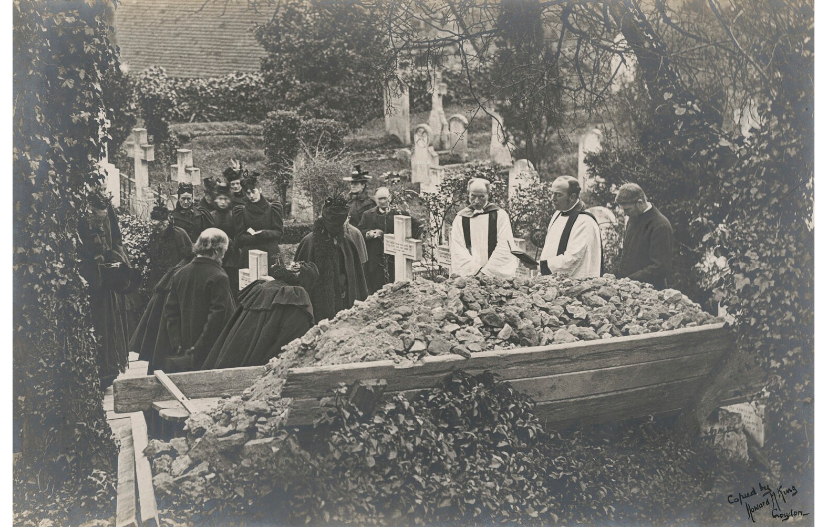
Well, in home decoration I always think that a nice big painting of a funeral is essential.  It's not just any funeral either but that of Lady Jane Swinburne!  Mother of Algernon Swinburne - poet, friend of Rossetti and champion of sliding down banisters nude - and daughter of the 3rd Earl of Ashburnham, she was undoubtedly an important woman, but I'm not sure some people in black and a big pile of dirt make for a charming painting.  That is a massive pile of dirt, and I respect the realism in showing the logistics of getting someone six foot under.  There are the slide-y boards of getting the spoil-heap back in again.  In fact, there is a photograph of the very same scene, if you fancied a closer look...

Burial of Lady Jane Henrietta Swinburne from the National Portrait Gallery
Here we are again and it is very much the same scene, leading me to believe that Ram used this 'official' photograph as the basis of her painting.  I really like the ivy growing around the back of the boards and up the walls on either side. Lady Jane Swinburne was a woman of accomplishment and intelligence, according to various sources, and she seems to have been concerned for the health and wellbeing of her wayward eldest son, Algernon.  According to his Dictionary of National Biography entry, Algernon's removal from society in 1879 for the sake of his health was done with his mother's approval.

Algernon Charles Swinburne (1862) D G Rossetti
Hang on then, are we to infer that the importance of the painting is not that Lady Jane Swinburne was important but that her son is a bit of a celebrity?  Well that's galling, especially if you also consider all the shenanigans he got up to.  I suppose in a way, Lady Jane would have felt she had done a good job in keeping her eldest child not only alive but also that he was so well-respected that a picture of him at a funeral was of interest to the nation.  

Close up on Swinburne and his sisters at the graveside
Mind you, I wonder if that is the reason that the burial itself is not more glamorized - if the dead person is not the point, then there is no reason to make the mechanics of getting a body six foot underground look any less muddy than it is.  What we should be looking at is actually the dignified, mourning figure of Swinburne, pretty much dead centre (if you excuse the expression), without his swirl of red hair (which had dropped out by 1896).  He is the point of the painting and I suppose his celebrity is what made the burial of his mother interesting to people.  I'm sure there were people at the time saying 'I'm a massive Swinburne fan, I even got the painting of him at his Mum's funeral.' Now, is it just me that finds that a bit, well, rude?  The poor woman is dead and it's her funeral, yet we've managed to make it all about Algernon. Isn't that just typical?  It's like the fact that I am 'Lily's Mum' most of the time and people are often quite surprised when they find out I do writing too. As a mum, I absolutely love being Lily's Mum, she's ace, but there are occasions when maybe it should be all about you rather than the person you have given birth to/married/been slightly connected to. Truthfully this painting should therefore be called  Burial of Algernon's Mum, You Know, the Famous Writer Who Did Some Dodgy Stuff, Him, Well, His Mum's Died.  I Know, Very Sad.   

Mind you, that's quite a lot to fit on a painting label...

See you tomorrow.