Monday, 25 April 2016

Kiss Me, I'm 5!

Well, look, this is getting ridiculous!  This nonsense has been going on now for five years and for some reason you lovely people have been good enough to humour me by keeping me company.  So, today The Kissed Mouth blog is half a decade old so here is my annual review of the year...

May 2015
I kicked off my year with posts on saucy Venus and people in disguise, but for the bank holiday I loved bringing you two posts on the Pre-Raphaelite beauty and everso well-connected May Prinsep.  I adore research that involves me ending up in graveyards and there was certainly lots of that as I visited churches and photographed memorial stones, together with showing you images of her from childhood to old age.  I'm thorough, I'll give you that.  Anyway, my favourite image has to be one of Julia Margaret Cameron's, if only for its stunning simplicity...

All Her Paths Are Peace (1866) Julia Margaret Cameron
June 2015
Into the summer and I reached my 500th blog post, which was all very exciting.  I got to talk to you about the amazing Sarah Ackland, pioneer of colour photography and creator of gorgeous pictures like this one, my pick of the month...

Flora (1910) Sarah Acland
I also talked about Julia Margaret Cameron rather a lot because it was her birthday so I did a couple of posts on the use of fabric and jewellery in her photographs, a subject that has continued to fascinate me and will crop up again in my upcoming book. I also got to do a bit of reviewing in June, reading a lovely book on Arts and Crafts stained glass and saw a film about Sherlock Holmes being my Dad.  Seriously, it's uncanny...

July 2015
Into the long, hot summer holiday and I gave a paper at the Julia Margaret Cameron conference in Portsmouth and met lots of smashing new people, I reviewed Marta Weiss' catalogue for the V&A exhibition on JMC and talked about a new play all about Rossetti's women that was up at the Edinburgh Festival.  I also raised blood-pressures with a naughty piece all about harems (steady now) and possible readings of The Lady of Shalott with reference to a horror film called It Follows.  The most fun I had all month was researching the controversy over this scandalous work of art.  Brace yourselves...

The Annunciation (1876-79) Edward Burne-Jones
The slanging match that erupted over the works of Burne-Jones exhibited at the 1879 Grosvenor Gallery exhibition is puzzling and funny now but must have left many people smarting as the establishment and the new crowd clashed over what was 'good taste' and who should dictate it. Looking at pictures like The Annuciation and the Pygmalion cycle it's hard to see why people reacted so badly but the very public scrap tells us much about the artistic scene and how much people had invested in it.

August 2015
I had the pleasure of talking to Victoria Olsen about Julia Margaret Cameron in August, as well as visiting the Richard Dadd exhibition at the Watts' Gallery.  They do such marvellous exhibitions at the Watts', I seem to be always looking forward to their next show.  Because it was the summer holidays, I was commuting by train rather than car and so felt inspired to write a piece about Victorian rail travel and how much more classy it seemed than barrelling about the south coast with only a bottle of pop and a Kindle to keep you sane.  I also explored Rossetti's dodgy reputation in the 20th century which was not as bad as you'd think but swiftly dwindled before the 1960s revival.  What gave me the most fun of the month was chasing after the lovely Annie Louisa Swynnerton, and finding her grave not far from where I work.  Her work is so gorgeous it was an absolute pleasure finding out more about the woman behind such works as this one...

Sense of Sight (1895) Annie Swynnerton
As you will probably know by now, I love finding the graves of artists and models and am currently after another one to show you at some point. I'm glad to know that I'm not alone in this pasttime and it is lovely to hear from you when you go and see the final resting place of someone we've talked about here.

September 2015
Into the autumn, I reviewed a couple more books - Ophelia's Muse and Red: The Natural History of the Redhead, which was all very Pre-Raphaelite-y.  I talked about Mary Watts' sister, the poet Christina Fraser Tytler, who posed for Julia Margaret Cameron.  Also in Cameron news, I brought you a little known story of how Mary Hillier stood up in court in the case of a silver spoon stolen from Dimbola Lodge.  In rather more personal posts, I talked about transforming yourself into a tree (should the need arise) and the horror that seems to be felt over aging and the ruination of muses. It was this month that I first showed you the last picture of Fanny Cornforth, which has to be my picture of the month.  Good old Fan...

Sarah Hughes, aka Fanny Cornforth (1907)
October 2015
I seem to have spent a lot of October at the cinema and reading as I reviewed Suffragette and Crimson Peak (both spankingly good films) and read The Looking Glass House all of which I enjoyed.  I talked about poor old Alfred, Lord Tennyson dying, and my weakness for man damsels expressed through images of Hylas and the Nymphs.

Hylas and the Nipples (1896) J W Waterhouse
Seriously, I'm a sturdy girl, I will rescue you and there will be no escape.  That sounded less threatening in my head...

November 2015
Well, looking at the posts I had a very busy November.  I went to Prague, which was lovely and full of Art Nouveau stuff. I reviewed a load of exhibitions including two Julia Margaret Cameron shows and one all about animals.  I brought you the sad story of Mary Kellaway, the third Mary in Julia Margaret Cameron's household. I also accepted my fate as the researcher who ends up in asylums, figuratively speaking.  Mind you, the biggest thing that happened to me in November was the launch of my new novel We Are Villains All...

Flipping heck! I wrote another book!  Huzzah!
Thanks to everyone who has read and reviewed my novel and please, if you enjoyed We Are Villains All, pop a review on Amazon or Goodreads.  You might just encourage someone else to read it and that in turn means I can afford more gin and stockings.

December 2015
December can only mean one thing, Blogvent, but last year we had Muffvent instead as apparently I'm not innuendo-filled enough.  I blame you lot, you saucepots.

Woman with a Muff (1912) Edward Okuń
She is not going to keep warm dressed like that... Moving on...

January 2016
Happy new year! I spent the month talking about Victorian images of Tudors, we saw the aftermath of attending a ball.  If we learnt anything it was that even if you are wearing a mask, it all still counts and will end in tears.  Honestly, I don't care what he promised you while you were waltzing, he was just after a fondle of your corset.  I also had a chat with you about Frank Cadogan Cowper, the Pre-Raphaelite who didn't let a little thing like the twentieth century stop him.  It was while I was looking for his grave in Cirencester that I found my image of the month...
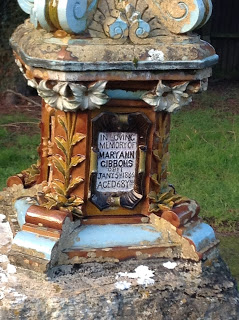

It was such a beautiful grave that I had to find out more and I brought you the story of a woman whose talented children honoured her with their art.  Obviously, as it's me we ended up in an asylum again, but when you read the story of Mary Ann Gibbons, I defy you not to be deeply touched.

February 2016
I saw a couple of lovely exhibitions in February, but really what February was about this year was our first chance to remember the day Fanny Cornforth died and so we had our first 'Fanny-versary' with a week of posts about Fanny, our perception of her and what she means in the whole Pre-Raphaelite story. My favourite post was one I've been meaning to do for ages, all about how I think Monna Vanna is secretly Fanny Cornforth...

Monna Vanna (1865) Dante Gabriel Rossetti
I saw Monna Vanna at the weekend when I visited the Pre-Raphaelite exhibition in Liverpool where she is hanging opposite Venus Verticordia.  Although both female figures are the typical Rossetti idealisation, you'd be hard-pressed to say that Alexa was definitely the model for both.  I'm so Fanny-centric, obviously I'll say that Monna Vanna is Fanny, but it is worth considering...

March 2016
March was a month of splendid books, with reviews on a new look at the photography of Lewis Carroll, the catalogue of the Liverpool exhibition, and a new Victorian novel by Robert Stephen Parry.  Oddly enough, it was five years ago, around the time I started this blog, that the Pre-Raphaelite Sisterhood website did a read-along with The Arrow Chest, Robert's other Victorian, Pre-Raphaelite-y novel which got me hooked on his work. Anyway, also in March I got to talk about the splendidly named Agnes Mangles, and I helped Dimbola with the identification of a plaque...

Mary Gilbert (c.1910-1919) Muriel Ida Perrin
An awful lot of work this year has been towards my new biography of Mary Hillier, maid and muse of Julia Margaret Cameron and I have had enormous fun discovering more and more details about the beautiful face of much of Cameron's work.

April 2016
Anyway, here we are in April and it's all gone quite Brontë this month what with it being Charlotte's 200th birthday.  I saw the gorgeous French bio-pic from the 70s with some of the most lovely hair you will ever see on screen.  I also saw the Marie Stillman exhibition at the Watts and told you all about the English Switzerland, but my image for this month has to be this...

Charlotte Brontë (c.1869-1895)William Bright Morris (after George Richmond)
I love a mystery and so when Mr Walker asked me to find out more about the Russell-Cotes copy of the George Richmond portrait of Charlotte Brontë, how could I refuse?  I love digging around to find the answer because the story of how Charlotte's publisher ended up with a copy of her portrait is proper Victorian romance, proving that very few things are  as straightforward as you'd think.  Actually, that's a pretty good summing up of what The Kissed Mouth blog is all about really.  While there are stories to be told, I'll be delighted to tell them and if you have the time, I'd be grateful for your company.

Hurrah, I'm five! Kisses all round!

Thursday, 21 April 2016

Charlotte Brontë, 21st April 1816

Happy Charlotte Brontë day!  Today marks the 200th anniversary of the birth of the author of Jane Eyre and to celebrate I bring you a bit of a mystery…
Charlotte Brontë (1850) George Richmond
You are more than likely all familiar with this image.  It is the portrait of Charlotte by George Richmond, done in chalk and dated 1850.  In George Richmond’s artist’s records there is an entry for the picture and his normal fee of 30 shillings, his standard charge for a head and shoulders portrait.  Whilst he recorded making duplicates of other portraits, there is only one Charlotte Brontë.  At least, by his hand...
Copy after George Richmond, painted on porcelain
 It was commissioned by George Smith, of Charlotte’s publisher Smith, Elder and Co, and given as a gift to Patrick Brontë, Charlotte’s father.  Charlotte died in 1855 and after Patrick Brontë died in 1861, the portrait went to Charlotte’s widower Arthur Nicholls, who had gone to live in Ireland with his second wife.  Story has it that the portrait fell on the second wife and it was given to the National Portrait Gallery.  Whether these two instances were connected I’ll leave it up to you to decide. Anyway, today's mystery is that in 1969 the Russell-Cotes bought at auction a pastel portrait of  Charlotte Brontë, signed George Richmond 1850 and it looks like this...
Charlotte Brontë (1850) George Richmond
or at least that is what they were told when they bought it.
Look familiar? Until the 1990s the picture was taken at its face value, that it was a copy of the Richmond picture, done by Richmond at around the same time as the original.  It was suggested that possibly it was the original Richmond picture but herein lies the keyword for today's post: provenance.  In the past I have identified works of art for various institutions and so when Mr Walker asked me to find out more about the Russell-Cotes' picture I was happy to take up the challenge but what you really need is a clear path of provenance.  The National Portrait Gallery undoubtedly have the original picture as their picture has a nice path from Charlotte Brontë to her father to her husband to her husband's second wife's head to the NPG.  Unless the pictures were swapped at any point, unless multiple copies were made and distributed for some unknown reason (and kept secret until now) then we can be fairly certain that the NPG own the official portrait of Charlotte Brontë done by George Richmond in June 1850.
The Brontë Sisters (1834) Branwell Brontë
Anne, Emily, (Branwell, scrubbed out) and Charlotte
Obviously it was not the first portrait of Charlotte, that honour goes within the family.  Possibly the most enduring image of the Brontë family is Branwell's portrait with his own image scraped out.  Much can be read into the insular, troubling image of the family, fragile from folds and huddled together in the darkness as they get scraped out one by one.  Sorry, my imagination was getting away from me there...
Charlotte Brontë Unknown artist
Nor is Richmond's portrait the only 'lone' picture of Charlotte, as the Brontë Parsonage also owns this offering.  A particularly doll-like Charlotte seems to be looking for someone, as does her dog.  Is it her own mortality slowly creeping upon her as she waits in her mourning clothes...?  Sorry, at it again.


I have a particular fondness for photographs of the Brontë Sisters, or Les Souers Brontë, as one of these is French (as these things tend to be).  Although they are lovely photographs, especially the top one, neither has any provenance at all or any compelling arguments other than 'wouldn't it be smashing if these were the Brontë Sisters?' The top photo is particularly gorgeous and dramatic and much has been made of the fact that the figure of 'Charlotte' on the left looks like her portrait but I'm sadly not at all convinced.  Gorgeous image tho'.  Look at the spaniel-shine on 'Anne's' hair on the right.  It's very staged, and if you told me that it was by Oscar Rejlander, I wouldn't be surprised.  As for the bottom image it's more like a family portrait of the 1840s or 50s but the women in the lower image look more like a mother and two daughters.
Miniature of Charlotte (1967) H Midgley-Dodding
So iconic is the Richmond image of Charlotte that she is instantly recognisable in the miniature done over 100 years after her death by the artist H. Midgley-Dodding.  Charlotte herself felt the portrait by Richmond looked more like her sister Emily, and wept when she saw it, but it is the accepted image of one of the most famous authors of the nineteenth century.  Most images after her death are derived from it, and they crop up as engravings in her books, like this one...

Charlotte Brontë (1873) Evert Duyckinick
Again, based on George Richmond's portrait
So, back to the Russell-Cotes' portrait. It entered the collection in 1969 and then was hanging in one of the galleries when it was spotted by a Brontë enthusiast in the early 1990s.  It was borrowed by the Brontë Parsonage for an exhibition in 1993 on the understanding that it was a copy of the original, but still by Richmond.  In a press cutting of the exhibition, from the Yorkshire Post, Jane Sellars, the Parsonage director was quoted as saying "We sent a photograph of it to an expert on the works of Richmond and he feels it is his work."  However, by the time the Parsonage returned the work to the Russell-Cotes, they had come to the conclusion it was more than likely a copy by an artist called William Bright Morris...

The William Bright Morris copy of George Richmond's portrait, dated 1909
Bright Morris (1844-1912) lived for a while in Capri and was a respected painter of landscapes and still life.  In 1909, he made a copy of the Richmond portrait which is now owned by Newnham College, Cambridge.  For obvious reasons, the 1909 Charlotte looks very much like the Russell-Cotes' Charlotte but most notably the signatures were the same, apart from on the Cambridge copy it read 'after George Richmond 1850'.  In the Russell-Cotes version, the 'after' is missing.  This seemed to be enough to say that Bright Morris must also have created another copy that made its way to a Bournemouth auction room in 1969.

The Brontë Sisters (apparently) by Edwin Landseer (apparently)
Sold at auction in 2012 (well, that bit is true)
Undoubtedly the signatures on both are very similar.  What I don't know is if they are both like Bright Morris' handwriting as he is not very well known these days and his work is not as widespread as would be convenient.  Anyway, I have found out that he also made a copy of the Richmond portrait earlier than 1909. In 1895, the Brontë Parsonage were planning an exhibition of the sisters' effects and George Smith offered to lend them original manuscripts of the novels and a copy of Charlotte's portrait by Richmond, 'painted by Mr Bright-Morris, specially for Mr Smith'.  Ah ha! So, there was another Bright Morris portrait painted before the 1909 one (which is clearly dated in the same handwriting that exists on both the Cambridge and the Bournemouth portraits).  Whilst that seems to clear one mystery it brings up another - why did George Smith want a copy of the portrait by William Bright Smith?  According to his correspondence with Charlotte Brontë, he already had one...
George Murray Smith (1901) John Collier
Charlotte and George Smith were very good friends, possibly more.  She first met him when she and Emily came to London to 'out' themselves as women to the publisher who had thought they were men.  George Smith was a handsome, amiable chap and he and Charlotte became good friends and so when Jane Eyre became popular and Richmond was commissioned to do the portrait, George Smith took the opportunity to get a personal copy done too.  In her letter to him of 27th July 1850, shortly after the Richmond portrait had been completed, Charlotte wrote to Smith thanking him for the portrait that had been sent to Patrick Brontë , the author's father.  She also went on to say
 'You thought inaccurately about the copy of the picture as far as my feelings are concerned, and yet you judged rightly on the whole; for it is my intention that the original drawing shall one day return to your hands.  As the production of a true artist it will always have a certain worth, independently of subject.'
So what do we derive from this?  Unfortunately we do not have George's original letter to her so we don't know if he had obtained the copy in 1850 or had intended to do so shortly after.  What seems apparent from Charlotte's letter is that he was intending to have the copy made by a respected artist, hence Charlotte's remark that it would be valuable despite being of her, bless her.  I think possibly that Smith was intending to have a copy done but the reassurance from Charlotte that he would eventually own the original made him delay his plan.  There is a letter from him to Ellen Nussey, a friend of Charlotte's, in 1869, stating that the museum in South Kensington (now the V&A) had managed to find out Charlotte's widower's address in Ireland in order to borrow the Richmond picture for an exhibition.  If Smith had indeed had a copy done in 1850 then it would have been easier for the museum to borrow his portrait than find out Mr Nicholl's and borrow the original.

1980 Famous Authoress stamp series by the Royal Mail
Again, based on the 1850 Richmond portrait
So what is the answer?  Well, as the auction house in Bournemouth could offer no provenance when requested in 1993, then we can't be certain but the narrative that seems to offer itself is that the Bournemouth Brontë  is probably George Smith's copy of Richmond's original.  We know from the 1895 newspaper article that he owned a Bright Morris copy, although without knowing more of Mr Bright Morris, we don't know when that copy was done.  As William Bright Morris was born in 1844, this backs up the idea that if he did George Smith's copy then it wasn't done in 1850.  I would even venture to suggest that if Smith is not in possession of a copy by 1869 (as suggested by the South Kensington Museum's use of the Richmond original), then it was done somewhen between 1869 and 1895, possibly prompted by the arrival of the original in London for the South Kensington exhibition.  If I had to guess, Smith got Bright Morris to copy the portrait around this date and then Bright Morris did a further copy of it in 1909 which resides in Cambridge.

So what is the lesson of today's post? Well, after 200 years, our love of the Brontë sisters is so strong that we long to know more and being such visual creatures we need to see them.  I think it is interesting that of late the alleged portraits of the Brontë sisters have been photographs, acknowledging a problem that Charlotte felt herself - paintings can often flatter or change the appearance to what we think a person should look like.  Looking at the progression of 'portraits' of Charlotte after the Richmond image they change small details making her look more romantic, putting a blush in her cheek, a book in her hand.  I think George Smith wanted a straight copy of Richmond's work which is why it would be tempting to think that Richmond himself made the copy.  As it is more likely another artist, presumably William Bright Morris, made the copy then the fact that it is so identical to the original (so much so that an expert felt it was by Richmond) tells us something about Smith and Charlotte.  Whilst Richmond's portrait might not have been an exact portrait of Charlotte, the picture was a moment in time, the capturing of a likeness of his dear friend of whom he was obviously very fond.  In making the copy, Smith is not only recapturing a good work of art but also the spirit of 1850 when the world had opened up to Charlotte Brontë  in a way that had been denied her and was ultimately not to be. In 1850,  after the deaths of her brother and two sisters Charlotte had been superficially freed from Haworth, travelling to London and beginning a new literary life.  As her happiness was not to last, it is unsurprising that Smith wanted to freeze her in 1850, the bright, young novelist with her whole life ahead of her.

Wednesday, 13 April 2016

Splendid Lecture at Leighton House - Special Offer!

You will remember that a month or so ago I reviewed the gorgeous exhibition that is currently on at Leighton House. Well, the splendid people at Leighton House have an evening lecture entitled The Day-Dream of Painting: the Purposes of Drawing in Victorian England...

Study of the Figure of Love from Dante's Dream D G Rossetti
Taking place on Thursday 21 April, independent art historian and curator Christopher Newall will explore the various purposes for which drawings were made in the Victorian period; from works that were to be seen and sold, to private meditations, personal to the artist. The Lecture starts at 7pm but there is chance from 6.15pm to look round the exhibition Pre-Raphaelites on Paper: Victorian Drawings from the Lanigan Collection.

King Pelles Daughter Bearing the Vessel of the Sangrael (1861) Frederick Sandys
Tickets are normally £15 but because we're all chums you can get in for £10, which includes entry to Leighton House Museum, complimentary drink (huzzah!) and entry to the lecture, obviously.

Enter promotional code SPECIAL10 when booking here.

If anyone asks, say Mrs Walker sent you and wink.

Monday, 11 April 2016

Movie night: Les Sœurs Brontë

Are you looking for suggestions for a film for this evening?  Looking for something to curl up in front of with some chocolate, a positive mental attitude and hopefully no sharp objects?  I think I have just the thing for you, as long as you are in a really happy mood.  If you are feeling a bit sad, don't say I didn't warn you.  May I offer you Les Sœurs Brontë...


There were rumours a few years back of a film version of the life of the Brontë sisters, staring Jonathan Rhys Meyers as Branwell and that lady off Dawson's Creek as one of the sisters, but that doesn't seem to have come to anything.  Other than a 1940s version of their life, Les Soeurs Brontë is the only cinematic attempt to bring the life of Emily, Anne and Charlotte (and Bramwell) Brontë to the screen.  As the sharper among you will have noticed, it is in your actual French but has English subtitles and so my dear friend Miss Holman (resting assassin and good for bail money) bought it for me for my birthday...

The Brontë Sisters, from the left Emily, Anne and Charlotte
(Isabelle Adjani, Isabelle Huppert, and Marie France Pisier)
Although it was released back in 1979, I have to admit the only bit that seemed dated to me were the credits, as once we are thrown in, it doesn't jar in the way that some period dramas do.  Mind you, if you consider Isabelle Adjani went on to film one of my favourite period dramas, La Reine Margot, maybe the French are just good at making period film that feel timeless.  No false eyelashes and inappropriate make up here.  Everything is absolutely beautiful.  And bleak.  Really, really bleak.

Isabelle Huppert as Anne 
Mia Wasikowska in Crimson Peak
Blimey, but everyone is everso lovely in the film, especially the ethereal Anne, who out of the three sisters could easily be overlooked as she didn't write either of the Brontë novels that people can immediately name.  I have the impression that del Toro must have been aware of Huppert's styling in the film when bringing Edith Cushing to the screen (in Crimson Peak) or conversely the stylist for Les Soeurs Brontë also really like Millais' The Bridesmaid.

Emily strides around the moors, having a good wuther...
The film opens with Branwell completing the famous portrait of the sisters and himself, and it becomes immediately obvious that the family exists in a restricted space, all huddled together while the darkness gathers (much like in the painting).  Emily pulls on trousers and scrambles over hill and dale, outraging elderly family members, but ultimately getting nowhere and returning to the parsonage. I particularly liked the scene where her sister shows her a beautiful wild rose which Emily spurns in favour of the holly, which will last longer.  Just to prove her point, she stomps all over the rose.  Nice.

Charlotte and Anne, writing among laundry...
We follow the sisters to Brussels, and to the home where Anne was the governess, but always back to Haworth, to the tiny parsonage which seems cold and quiet.  The sisters are often shot with their backs literally against a wall, their costume different from the people around them (most extreme example of this being the opera scene at the end of the film).  There are many scenes at night where the Brontës are crammed into the space carved for them by a guttering candle.  There is an ever pervasive feeling of confinement, difference, captivity.

'Would it kill you to help with the laundry, Emily?'
The Brontë sisters are dressed beautifully, like little dolls, their diminutive size emphasised by their frankly massive dog.  Branwell's descent into misery and failure is marvellously brought to screen by Pascal Greggory and his cheekbones.  He manages to combine all the self-indulgent moping, drinking and more drinking of Branwell without being irritating, even when he sets his bed on fire.  For heaven's sake.  His profound inability to get away from Haworth is played as a very obvious foreshadowing of the sister's fate in a way I had not considered, and his demise (come on, that's not a spoiler, surely?) sets up the final part of the film.  Possibly my favourite moment of the entire film, just for its sheer bleakness, has to be the sisters reading appalling reviews of Wuthering Heights out loud while Emily scrubs the scorch marks off Branwell's wall.  Stunningly gothic.

Emily and Branwell, pretty and doomed
So, you know how it's going to end, and it's not cheery, but Les Soeurs Brontë is absolutely beautiful. Using the portrait of the siblings and Branwell's subsequent alteration of it as a reflection of the comparative fortunes of the  family, this is a suffocating narrative of isolation, both intellectual and within society.  All they have is each other, and as the film suggests, that is both their strength and their downfall.  It makes Bright Star look like a gigglefest, so make sure you're feeling chipper when you watch it, but I can guarantee that you'll love it, if only for the proof that life is too short to do ironing...

Les Soeurs Brontë (1979) is available from shops and the interweb now.  Although mine was a French edition, the subtitles were easy to find.  

Friday, 8 April 2016

Review: Marie Spartali Stillman at the Watts Gallery

The last review of this week comes from one of the most eagerly awaited exhibitions of this year. Although I obviously relish the chance to go to large-scale Pre-Raphaelite blockbusters, you can't beat smaller single artist shows to help get you some insight into lesser known figures.  The Watts Gallery seem to excel in this sort of thing, bringing us Eleanor Fortescue Brickdale, Richard Dadd and now Marie Spartali Stillman, over from the Delaware Art Museum where the exhibition first showed.

Marie Spartali Stillman (1868) Julia Margaret Cameron
I first encountered Marie Spartali Stillman as a model for Rossetti, most notably in A Vision of Fiammetta (1878).  After the Pre-Raphaelite Women Artists exhibition of the mid 1990s I became aware of her as an painter, and in recent years I have met her again with her connection to Julia Margaret Cameron.  I suppose it was only a matter of time until we spent some quality time together, just her and me...

A Rose in Armida's Garden (1894) Marie Spartali Stillman
I have to admit that when I see Marie's works, my first thought is always of Elizabeth Siddal.  I wonder if, had she lived, her art would have resembled Marie's in subject and style. The Watts Gallery now gives us opportunity to view a collection of Marie's works together in one room, to admire her talents, not only in pretty Pre-Raphaelite subjects like A Rose in Armida's Garden but also in still life and landscape, both in intimate and grand scale.

The Enchanted Garden of Messer Ansaldo (1889) Marie Spartali Stillman
I am guessing this is a smaller show than what exhibited in Delaware as the Watts have used their lower temporary exhibition space only, rather than the two floors they usually fill, but none the less it is filled with romance and beauty.  There are familiar pieces such as The Enchanted Garden of Messer Ansaldo which is even more beautiful in real life (as these things often are).  The pattern on the coat of the rather Simeon Solomon-esque fellow on the right is especially noteworthy.

Roses with Palette Knife (undated) Marie Spartali Stillman
I have to admit I'm not normally a lover of still life, but Roses with Palette Knife is so vivid you could almost smell it.  It presents you with such a tightly packed space filled with colour, not unlike the exhibition itself.  It hangs in a trio of Marie's fruit and flower paintings filled with vibrant petals, soft feathers and juicy, glinting pomegranate seeds, the colours popping from darkened backgrounds.

Kelmscott Manor: Feeding Doves in Kitchen Yard (1904) Marie Spartali Stillman
 Another thing about Marie that has become apparent over the twenty years I have known her work is how ridiculously well connected she was.  She knew Fanny Cornforth, which came as a surprise, but then both were friends of Samuel Bancroft Jnr (whose collection is in the Delaware Art Museum).  Her watercolours of Kelmscott Manor are the result of visits to her friend Jane Morris.  Pupil of Ford Madox Brown and model for Julia Margaret Cameron, Marie switched between muse and artist, again a link to Elizabeth Siddal.  In a society that valued her primarily for her beauty (both Rossetti and Swinburne, among others, were very vocal on the subject), it is to her credit that she worked so hard to be taken seriously as an artist, if that isn't an odd thing to say.  This exhibition is a testament to a woman who painted poetry and brought the soft romance of the world of the imagination to life.  If you are able, go to the Watts and fall in love with her yourself.

Poetry in Beauty: The Pre-Raphaelite Art of Marie Spartali Stillman is on at the Watts Gallery until 5th June and further information is available here.  There is a splendid catalogue available which contains all the pictures and objects that were in the exhibition at Delaware, and is well worth the investment.

Thursday, 7 April 2016

Review: The Rise and Fall of the English Switzerland

Second review of the week, and I've been out and about visiting a new exhibition on the English Switzerland, something I did not know about before.  Not only that, there's a splendid catalogue that goes with it...


I first met Marion Dell at the Julia Margaret Cameron conference last summer and I reviewed her book on Julia Margaret Cameron, Anny Ritchie, Julia Jackson and Virginia Woolf here.  I was fascinated to here about her project on the English Switzerland, not least because it touched on the Surrey home of Alfred, Lord Tennyson, Aldworth, which is not far from Haslemere.  Having walked the countryside in that area I could see how people would think it brought health and happiness, but the Victorians are never ones to miss the opportunity at tourism...


The district, including places such as Hindhead and the Devil's Punch Bowl, marketed themselves on the clearness of the air in comparison with dirty London. To start with it was an idyll, rolling countryside and and a landscape captured by Turner.  It had a little local colour, a murder of a sailor so notorious that Charles Dickens popped it in a novel.  In 1851, a local aristo erected a stone Celtic cross on the site of the local gibbet where the murderers hung, but arguably this just brought the site to greater attention.  On display in the exhibition are little tourist souvenirs of the gibbet cross.  You have to love the Victorians.  Anyway, in 1859, everything changed with the arrival of the train to Haslemere...

Image from this very interesting website
For those of you who aren't locals, Haslemere is south of London, not that far, and so when The Illustrated London News showed images of the countryside and the wide open spaces you can imagine the attraction.  One of the first to travel south was the writer Anne Gilchrist, who moved to Guildford in Surrey in 1851, then to Brookbank Cottage between Hindhead and Haslemere in 1862.  She was visited by her London friends, the Rossetti brothers, George Eliot and the Tennyson family.  By 1868, Tennyson was beginning to consider his Isle of Wight house too exposed and the privacy of the countryside in Surrey proved a relief.

John Tyndall
John Tyndall, an expert alpine climber, was the first to call the area 'the English Switzerland' on account of the clear air.  He and his young, pretty wife moved to the area in 1883, and because of his recommendation hotels and attractions were able to market themselves on the health benefits, effective against that everso Victorian illness, consumption.  Easy to get to by train and without the cost implication of a trip to Switzerland, hotels such as the Hindhead Beacon (above) proved popular and fashionable.  Further celebrities flocked to the area, such as Grant Allen and Arthur Conan Doyle.  I have to include this picture...

Arthur Conan Doyle as a Viking for a party at Hindhead, 1898
Well, quite.  Into the twentieth century and expanded leisure time brought motor cars, cyclists and all sorts of tourists to the district, who in turn sent home picturesque postcards, but its popularity proved its downfall.  The building boom to accommodate the influx of people turned the exclusive retreat into a tourist trap.  When the celebrities like Tennyson died, no new ones moved there and it slipped out of fashion.  Mercifully, these days swathes of land are owned by the National Trust and so those who wish to have a taste of the Swiss life can still have views like this...

The Devil's Punch Bowl, Surrey
I can't recommend the catalogue and exhibition enough.  The exhibition is a room in the educational museum in Haslemere and holds a few artifacts, books and souvenirs, with beautiful wall panels telling the story.  You can then look out at the landscape that rolls away from the museum garden in rich greens under a jewel blue sky (well, it was the day I went).  No better illustration of the subject can be given than the landscape itself and so it is a fitting companion to the exhibition to be able to see what the attraction was.  While in Haslemere, you can also visit St Batholomew's church and see a gorgeous wall hanging and a window dedicated to Tennyson.

The tapestry, very Morris and Co,
from an antique postcard I bought at Haslemere Museum
The catalogue is gorgeously illustrated in full colour, including postcards, photographs and all the information you could possibly want.  Marion's text is enjoyable to read and packed with stories about the people who shaped the English Switzerland.  I loved finding out about this side of Victorian culture, about a beautiful part of the world and the lives of those who made it their home.  If you are interested in Victorian England, you'll love this, and if you can't make it to Haslemere, the book is a gem on its own.  However, if you are coming this way, maybe for the Marie Stillman at nearby Compton, stop by Haslemere and take in the exhibition too. Plus a visit brings added health benefits - how many exhibitions can offer that?

For further details of Haslemere Museum see their website here and contact them for a copy of the catalogue. You can also buy the catalogue from the Haslemere Bookshop.

Wednesday, 6 April 2016

Review: Julia Margaret Cameron's 'fancy subjects'

This is the first of three reviews I'll be posting this week, and I'm starting with a weighty, intelligent new book on Julia Margaret Cameron...


Along with her portraits of the great and the good, and her Madonna pieces, Julia Margaret Cameron created photographs which she called her 'fancy subjects', based on literature, mythology and parables.  While some of the pictures moved fluidly between her categories (a recognizable person could also be a personification of something), the 'fancy pieces' gave an unwitting insight into the creator's mind, opinions and prejudices.

Poor Jo Oscar Rejlander
By the 1850s, the term 'fancy picture' referred to isolated subjects in suspension of their activity, and were often overtly religious or sentimental, as in Cameron's early collaborator Oscar Rejlander's tear-jerking Poor Jo.  The pictures were traditionally genre pictures, theatrical, nostalgic or erotic, drawing on 18th century traditions of art.  It was into this Cameron brought her own vision.

Madonna and Two Children (1864) Julia Margaret Cameron
The most interesting aspect of this book is how it challenges us to grasp how controversial Cameron's works were (and often still are, if the context is realized).  Her many Madonna images featuring her housemaids, predominantly Mary Hillier, raise the question - is this an image of Mary or 'Mary'?  Does it matter whether we think we are looking at the mother of Christ or just a maid? What is the implication of us knowing the difference?  Although Cameron actively pursued (and captured) an image of Benjamin Jowett, the book discusses the tension between Jowett's religious writing and Cameron's use of religion, her tangible Christ child, her gender-bending St Johns.

Déjatch Alamayou and Basha Félika (Prince Alamayou and Captain Speedy) (1868) Julia Margaret Cameron
The book examines the Victorian identity and its relationship with Empire.  I don't think it is a coincidence that most people discussing Cameron's work tend to tread carefully around the subject as it is not one that reflects well on anyone, nineteenth century opinions being so different to what we consider acceptable today.  The chapters on Race, Tennyson's ideas of Nationalism and Marianne North in Ceylon tackle the questions of accepted prejudice and revealing allegiances that don't make pleasant reading, but all discussions of England's Empire are necessary in order to understand the context in which the works came into existence.  For example, this chap...

Edward John Eyre (1867) Julia Margaret Cameron
At first glance he blends into the mass of beardy Victorian chaps, but Edward Eyre was the erstwhile Governor of Jamaica, not afraid to quell the natives with questionable methods, but when he returned to England after the Jamaican Rebellion Cameron pursued him for her gallery of heroes.  In the 1868 exhibition, he hung beside Carlyle and Trollop.  Her friends, such as Tennyson, all subscribed to his defense as the hero of the Colonies and protector of English interests in the Empire.  What we are forced to consider is whether Cameron was naive enough to not look into the background of her friend's friends, the celebrity of the moment, or whether she also believed he was a good man doing good English work.  In the case of Captain Speedy and the orphaned prince of Abyssinia, world events landed on Cameron's doorstep with the arrival of Speedy and his charge on the Wight.  I'm not sure if Speedy's acquaintance with Cameron was gained because he was the brother-in-law of Mary Ryan (Speedy was married to Henry Stedman Cotton's sister) or through her force of personality, but Cameron took several images of the little Prince, Captain Speedy and their Abyssinian companion.  Whilst most of the images are typical Victorian Empire shots filled with native knick-knacks and trophies, Spear or Spare slides over into truly offensive role-play, as Speedy pins down the man who in previous shots had sat beside them as a friend.

And Enid Sang (1874) Julia Margaret Cameron
I especially enjoyed the chapter on Tennyson and nationalism, the use of Tennyson's poetry (Cameron's photographic re-imagining of it) to explore notions of nationhood and national identity.  The dream of an alternative, medieval utopia as given voice in Idylls of the King, found a physical presence in Cameron's 1874 large-scale photographic edition.  There is much discussion about the purposefully assertive, isolated female voice of the poem reflected in the single figure images, as above, and it is in these works I find most harmony between Tennyson's words and Cameron's pictures.

Young Woman, Ceylon (1875-9) Julia Margaret Cameron
When she returned to Ceylon in the 1870s, Cameron's subjects not only reflected her attitude to England's Empire but also featured the people at the sharp end of the Colony.  The book contrasts images such as the above with similar images of Mary Hillier in her Madonna garb and complex discourse ensues.  Often the last couple of years of Cameron's life and her sparse existent images are taken as separate from the Freshwater time but the question is whether it is right to segregate the images or too simplistic to read them together.  The image of a Ceylonese woman becomes loaded when it is considered that the creator is one of the ruling class, but I find it interesting to consider the young unnamed girl (isn't it interesting that she has no name?) and her position in comparison to the Freshwater servants. The inclusion of the 'western' Marianne North into the 'primitive' surroundings of the plantation brings further layers of meaning and confusion.  In the end Cameron's attitude to the natives of both islands draws out her attitude to the Empire, England and those who rule it.  It's not comfortable or easy reading but it raises many thought-provoking questions which places Cameron in context, for better or worse.

Marianne North (1877) Julia Margaret Cameron
To buy Julia Margaret Cameron's 'fancy subjects': Photographic allegories of Victorian identity and empire visit Amazon UK here or USA here (out in July) or order from a bookshop near you.