Saturday, 23 January 2016

The Man in High Collars

There is a distinct difference between Mr Walker and myself in matters of musical taste and more specifically the way we load up an MP3.  Mr Walker is an album person who will download an entire album irrespective of whether or not he likes all of the tracks whereas I am more a single song sort of person who flits hither and thither between artists, putting on only songs I really like.  The reason for divulging this trivia is that I can be a bit like that with art too.  Whilst I obviously love Rossetti and his work, I have a lot of time for some of the lurid, insane beauty of the works of Frank Cadogan Cowper...

Saint Francis of Assisi and the Heavenly Melody
Often called 'the last Pre-Raphaelite', Cowper lived into the second half of the 20th century to the point that his art is still in UK copyright.  You will certainly be familiar with many of the images that I will be using in the post because his work is often featured in discussion about the Pre-Raphaelites which is incredible if you think he was still alive at the centenary of the formation of the Brotherhood. So who was Frank Cadogan Cowper?

Frank Cadogan Cowper (1932) Bassano Ltd
Frank Cadogan Cowper was born 16 October 1877 in Wicken, Northamptonshire, where his maternal grandfather, Edward Cadogan, was the rector. His father, Frank Cowper, was the author of sailing books, both fact and fiction, and seemed to be away from home a fair amount, possibly in a boat (yet still managed to have six children) and doesn't appear on many census records after getting married.  Recorded as the 'head' of the household in the 1891 census onwards was Edith Eliza Cowper, mother to Frank and a novelist in her own right...

Sailing Tours by Frank Cowper
Edith Eliza (E E) Cowper, author of gripping stories for girls!
In one account of her early life it was stated that Frank Cadogan Cowper was raised Plymouth Brethren but I have not been able to find anything to back this up unfortunately.  What is certain is that young Frank was born into a fairly affluent household, to which he was the eldest of the six children born over eleven years.  He was sent to Cranleigh school, before heading for London and St John's Wood Art School followed by the school of the Royal Academy.  He exhibited at the RA for the first time in 1899 but made it big in 1901 with this picture...

An Aristocrat Answering the Summons to Execution, Paris 1791 (1901)
Although I find Cowper's work fascinating generally, I think he does two things very well: pattern and dogs.  The little dog in this picture is beautifully captured, but I adore the striped lining to the doomed aristo's coat.  There is a certain amount of bloody-minded bravado in that fop's manner that could be applied to Cowper, and his insistence in not bending to fashion, as we will see.

St Agnes in Prison Receiving from Heaven the 'Shining White Garment' (1905)
By the time Cowper started exhibiting, all but one of the Pre-Raphaelite Brotherhood were dead and their style and subject were only carried on by a few followers.  Cowper chose to echo both Rossetti and Millais with his work, notably in St Agnes, which bares interesting comparisions with Rossetti's Ecce Ancilla Domini!, of which Cowper also produced a copy (left).

I also list Millais as an influence because of the dogs that appear in some of Cowper's paintings.  I wonder if Cowper was a fan of Millais' Isabella  because some of the smooth coated, elegant hounds that crop up in paintings such as Mariana in the South bring me straight back to Millais' dogs...

Mariana in the South (1906)
The 'Pre-Raphaelite score' of Mariana in the South is quite high as it features a fish-eye mirror, Tennyson, a possible nod to Kate Bunce's Melody or maybe Rossetti's musical muses, the richly patterned interior and fabrics of William Morris' La Belle Iseult which also has a sleeping hound, and so on and so on.  When I get five minutes I'll invent Pre-Raphaelite top trumps, I promise. Another influence on Cowper was the American painter and Pre-Raphaelite sympathizer, Edwin Austin Abbey, with whom Cowper spent 6 months in his Gloucestershire home, Morgan Hall in Fairford...

The Penance of Eleanor, Duchess of Gloucester (1900) Edwin Austin Abbey
Abbey believed that black, white and red were the colours of truly great artists and it is interesting to speculate on whether that influenced Cowper's colour palate, but it is easy to see that whether or not Abbey played a great part in shaping Cowper's artistic vision, the two had a great deal in common with their subjects and style. However, even Abbey can't compete with the overblown bonkersness of something like Cowper's 1907 epic How the Devil, Disguised as a Vagrant Troupadour, Having been Entertained by some Charitable Nuns, Sang to them a Song of Love...

How the Devil... (1907)
The stained glass windows in the background are from Fairford church and the picture is a reworking of a  student picture of a Minstrel that Cowper showed at a St John's Wood Art School show.  An early sketch of the picture was so praised by the painter Onslow Ford that Cowper spent the next 15 years working it into a painting that demands even greater attention. Although he had been elected to Associateship of the Royal Water Colour Society in 1904, his election to ARA in 1907 was seen as a response to just how popular this picture was.  It was reported in the newspapers how crowds would stand before it in Gallery IV of the exhibition and it was very nearly the Chantry purchase of the year.  It was bought by Sir Joseph Beecham and sold on his death for 1,450 guineas (compared to The Beguiling of Merlin by Burne-Jones sold at the same sale for 2,600 guineas).

Lucretia Borgia Reigns in the Vatican in the Absence of Pope Alexander VI (1908-14)
 Cowper finally got his Chantry purchase in 1914, with a picture that was described in the press as an 'Academy Sensation'. He travelled to the Vatican to paint the room from life and copy the faces of the cardinals from portraits. The scene depicts a friar kissing Lucretia's shoe while two noblemen hold back her dress.  There's a monkey, some sort of pheasant and so much red that it makes your eyes hurt.

Erasmus and Thomas More Visit the Children of Henry VII at Greenwich (1910)
In 1910, Cowper took part in the mural scheme for the Houses of Parliament, along with other Pre-Raphaelite-ish Edwardians such as Byam Shaw. The little boy striking a manly pose in white tights is Henry VIII. The patterning of the clothing seems to be a repeated motif for Cowper and a rather easy way for the viewer to spot one of his works...

Four Queens Find Lancelot Sleeping (skirt!)
La Belle Dame Sans Merci (1926) (entire frock!)

Rapunzel (1900) (massive sleeve!)
Vanity (1919) (everything really!)
Also, he revisits subjects and titles, such as Vanity which he painted in both 1919 and in 1907...

Vanity (1907)
He also reused not only bold patterns, but memorable garments, such as this 'knotted' dress, possibly a reference to Burne-Jones' Sidonia Von Bork 1560 (and/or joint source material Portrait of a Woman (1531) by Giuilio Romano, possibly also used for the film Sleepy Hollow), which crops up again in Venetian Ladies Listening to the Serenade...

Venetian Ladies Listening to the Serenade
His adherence to Pre-Raphaelite sentiment and practices remained and can be seen in paintings such as Hamlet where he insisted on having a grave dug much to the alarm of his neighbours, in order to paint from nature.  In other paintings he seems to have lifted details from the Brotherhood and made them his own, such as the dove in Beata Beatrix becomes The Blue Bird and Millais' sheep from Christ in the House of his Parents peek over the hurdles behind Our Lady of the Fruits of the Earth.

Hamlet, the Churchyard Scene (1902)

The Blue Bird (1918)

Our Lady of the Fruits of the Earth (1917)
With the fall of fashion for Pre-Raphaelite pictures, Cowper became known as a portrait painter.  In his obituary in The Times they were judged as being 'confused' and the writer admitted 'it is difficult to speak with enthusiasm', even though his ability to paint was never in doubt.  Despite becoming an RA in 1934 on the death of George Spencer Watson he was reported as a portrait painter and not a fashionable one at that. The parade of debs in pink that filled a great part of his output from 1920 onwards are the stuff of greetings cards and are charming but certainly seem to lack the fire and colour palate of his previous works. In one rather harsh review of the RA exhibition in 1929 they were described as 'Cadogan Cowper's simpering ladies'...

Violet Miriam Clay, Lady Vernon (1920)

Elizabeth Witts (1954)
Occasionally he goes full-Rossetti and a massively patterned background takes over, which I think is why his obituary described his aims in these pictures as sometimes 'confused'...

Portrait of Lady Ledgard (1925)
Let's be honest, she just got in the way of him painting massive, stylised poppies.

Still, among these faintly awful portraits of posh flappers and post-war debs are still some canvases which defy explanation.  One of these, and possibly my husband's least favourite picture (because it gives him the creeps) is this gem from 1940...

The Fortune Teller, 'Beware of a Dark Lady' (1940)
 From the mutant ivy to the alarming fashion this is a giant 'what-were-you-thinking?' of a picture.  When it was given to the Russell-Cotes in 1950, the museum confidently proclaimed that it would likely 'prove one of the most popular in our permanent collection' and that it was proclaimed picture of the year at the RA in 1940.  Well, there was a war on.  For all it's faults, it is a humorous picture with our happy blonde heroine not noticing how shifty her friend is.  Again, note the use of bold fabric is brought in on the gypsy's skirt. I am campaigning at home to have this one back out on display as something as mad as this deserves to be seen again and I'll keep you informed of my progress...

Anyway, Cowper's twilight years were marked for me by one very special painting which had been a favourite of mine for a while before I realised it was by Cowper...

The Ugly Ducking (1950)
By 1950, Cowper had moved to live in the Cotswolds, possibly because of the time he had spent with Abbey almost half a century beforehand.  He spotted a beautiful young woman behind the make-up counter in Boots and asked to paint her.  The Ugly Duckling was the result and what lifts it for me is the cheery smile of the sitter and the humour of the title.  I was delighted to read that the sitter, Valerie Tarantolo, now in her seventies and still very glam, had been reunited with her portrait at Cheltenham Art Gallery, where it is a much-loved painting (you can read her story here).

Valerie (at 16) and Valerie (a few years later)
Cowper died 17 November 1958 at his home in Cirencester and is buried at the Chesterton Cemetery in the town. On his gravestone is carved 'Verily, Verily I say unto you, He that believeth on me hath everlasting life' (from John 6:47).  He might not be the first painter you think of, and his out-of-time Pre-Raphaelite blasts are often overwhelming and a tad peculiar, but one thing is for sure, enough of his work is so memorable that he is unlikely to be forgotten.

Frank Cadogan Cowper's grave in section 24 of Chesterton Cemetery

Detail of stone
The reason this post is called 'The Man in High Collars' is from his obituary which read 'There was little of the traditional artist in Cowper's appearance, and he is said to have worn the highest collars than any other man in the country'. Well, there you go then....

Saturday, 16 January 2016

A Short Post about a Nice Grave

Just a tiny post about a wonderful grave I saw this afternoon...


I was in Chesterton Cemetery in Cirencester, Gloucestershire, looking for an entirely different grave (which I'll tell you about next week) when I came across that wonderful grave shining in the wintery sunshine.  I took some photographs, looking not only at the whole 'marker' but also a mysterious plaque that read 'JG'.  I wanted to know more and after I posted them on my Facebook page, I wasn't the only one. So I had a bit of a metaphoric dig...


The grave is dedicated to Mary Ann Gibbons, who shuffled off this mortal coil on 5th January 1886 aged 68, so she was born in 1818.  There is a little extra 'tomb' on top of the plot which has this ceramic plaque on the side...


Unleash the historian!  Well, have a bit of tea first and a walnut whip, then unleash the historian!

So, armed with that small amount of information, two hours ago I leapt into action.  Turns out that Mary Ann Gibbons and I were bound to meet eventually as she had a bit of a secret hidden behind Victorian majolica lilies, but I'll come to that.  First of all, why was it all so ornate?

Mary Ann Lewis was born in 1818 to Samuel and Mary Lewis, in Lydiard Millicent, Wiltshire, not far from her eventual home in South Gloucestershire. She married James Gibbons (the 'JG' from the grave) in the early 1840s and they had 8 children between 1844 and 1860. James was from Kemble, a small village not far from Cirencester and home now to an airfield and a railway station, but not a great deal more.  James was in the building trade, as was his father before him and by 1881, he was listed as a master plasterer, employing one person.  It is unsurprising therefore that his sons would follow in the family tradition, but it is amazing how influential they would be.

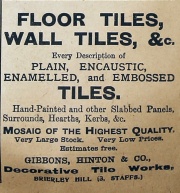
1908 advert
By the look of those wonderful lilies, there was some amazing craft involved in the grave.  Mary Ann's sons, Owen (1847-1911), Francis (1853-1918) and Arthur (1858-1917) were the artistic members of the family, moving the Brierley Hill in Staffordshire to create the most amazing art and tiles, often combining the two...

Tiles by Francis at the Brierley Hill Technical Institution
I owe a debt of thanks to The Brierley Hill blog for making my life easier this evening, and I won't paraphrase their wonderful work, but direct you to here for more information on the children and their work.  The 'Hinton' in the company name is described as a brother-in-law to the Gibbons boys, so is probably a relative of Sarah Gibbons' (1850-1890) husband, William. Anyway, a quick wallow in the beauty of their work, then back to the parents...

Arthur Gibbon's statue above the door to the library
at the Technical Institute

Owen Gibbons' fireplace
Decorative 'pheasant' tiles from Gibbons, Hinton & Co
Right, back to James and Mary Ann. Only one of their children pre-deceased them, Albert (1845-1868), the rest of them living fulfilling is not all very long lives.  Mary Ann and James remained in Cirencester where Mary Ann became ill.  As it's me telling this story, obviously I don't mean physically ill...

Well, of course it's an asylum
Mary Ann was admitted to the Gloucestershire County Asylum in the summer of 1881. Interestingly, she came to Horton Road Hospital (as it was also known) just as it was full to bursting with patients and a second asylum was opened just two years later at Coney Hill.  This second hospital was a more rural, peaceful affair, specialising in private patients.  Poor Mary Ann lived out the rest of her days in the great curved building above, dying there in 1886.  James lived on in Cirencester, but he too died in 1891.

Mary Ann's insanity, however it was manifested, cannot have been the easiest thing for the family to live with and you could argue that it might have been a factor in why so many of their children moved to live in Staffordshire, remaining together but away from their parents.  However, the love and detail that is displayed in their mother's memorial speaks of a defiance against the norms of Victorian society.  These are not children ashamed that their mother died insane, these are sons who are celebrating their mother in a wonder riot of majolica-style tiles, bursting with flowers.  Did their mother love lilies the best or is it just there to symbolise 'motherhood' in the language of flowers? The roses that cover James' plaque obviously symbolise his love, but the rose also symbolises a secret, not something shameful, but something private.  Were her sons through their art attempting to allude to a secret tragedy, but also to the love that rendered it unimportant?  We shall never know, but should you find yourself in Cirencester, I do urge you to seek out the beautiful grave of Mary Ann Gibbons, beloved by her family even after death.
 
And yes, I have now changed the 'Stonell' in my name to 'Asylum'.

Wednesday, 13 January 2016

Go Fish!

Whilst madly researching a piece for next week (or the week after, depends how I get on) I was looking for something lovely to amuse you during this cold, damp, dark January.  I was recently reminded of this beautiful picture...

Leisure Hours (1864) John Everett Millais
This is a glorious painting, not just for the beautiful rendering of two little girls in their flouncy dresses, but for the technical skill shown in that goldfish bowl.  I've seen this one in person and it is just the most perfect glass bowl, so much so that it upstages the little moppets by a mile.  It is obviously a way of showing what a brilliant painter he was but I wondered if any other artist used the goldfish bowl as a way of showing off their mad art skills...

Victorian fish bowl and ornate stand (with ferns, obviously)
First a little history: Many thousands of years ago in China, some one noticed that the normally grey carp had a habit of throwing out the occasional yellow or orange mutation.  With careful breeding, there began a fashion for outdoor pools with these orange or 'golden' fish.  In the Tang dynasty (618-907), people began to bring bowls of these decorative fish indoors when hosting parties, but they were mostly kept in the garden.  During the Song dynasty (960-1279) it became illegal for anyone outside the imperial family to have a golden fish as yellow was the imperial colour. Finally it was during the Ming dynasty (1368-1644) that the fish were brought indoors which enabled very decorative fish to be bred which otherwise might not have survived outdoors.  During the seventeenth century, goldfish made their way to Portugal, thence through to the rest of Europe.  Their golden scales made them a token of good luck and it was traditional for husbands to give them to their wives as a first anniversary present.  Goldfish fortunes fell when they became commonplace but the Victorians, with their love of all things Oriental and exotic, coupled with their ability to make overly ornate stands, fell in love once more with our little golden friends...

Water Pets (1874) Lawrence Alma Tadema
Right, where to start, because painting a glass bowl filled with water and fish is indeed a feat of skill and people like to show off.  Alma Tadema went for the classical angle although we have no proof that anyone classical had goldfish, unless that very European lady was visiting Ancient China via Greece.  Mind you, he's not the only one to lob some goldfish into drape-y art...

Classical Maiden with Goldfish Oliver Rhys
Obviously in Classical Times it was popular to go to the Classical Fair and win a Classical Goldfish.  Forgive me for saying so but there are levels of oddness going on in that household that I don't quite understand.  Firstly, who made that fish bowl stand?  It must be the most rubbish one I have ever seen as what is the point?  That's too low to be of any help with anything.  I bet someone's child made that in woodwork class and now the parent feel obliged to use it.  Also why is our Classical Maiden poking her fish with a stick? That family needs sorting out.

Goldfish (1893) William Stephen Coleman
Now that is a better height for a bowl and the small stand makes a bit more sense.  This 'exotic'  image is from the 1893 Pears Annual but where it is set is anyone's guess - is it Turkish? Is it Africa? Arabia?  Clacton-on-Sea? Colour me puzzled, but Mr Coleman obviously enjoyed the challenge of the goldfish bowl as he did it again...

Children at the Marble Pond
Not hygienic.

And again...

The Goldfish Bowl
Goldfish obviously meant 'exotically ancient' to William Stephen Coleman and little girls and goldfish went together like bread and butter.  Maybe it was the brief life of the fish (especially if you let your tweenager wade about in the pond) that echoed the briefness of childhood innocence, or the fragile beauty of them both, or possibly their ability to forget the thing you told them ten seconds ago (she says, from experience).  Whatever the case, his pictures are clear, bright and very, very commercial.

The Goldfish Seller George Dunlop Leslie
This is one of my favourite goldfish related pictures as Leslie does such charming scenes without them being too overly Millais-sickly.  His picture is a rarity as it has an actual man present!  Why goldfish were particularly a woman/child thing is unclear: Are women beautiful? Useless?  Confined to a very small bowl? Anyway, I never really thought how the goldfish got into the Victorian home, but according to this image, a nice looking man came round with a bag full of glass bowls.  The logistics of this seem a little fuzzy, so we'll just draw a veil.

When I used to live in Yorkshire, we used to drive past a village called Tingley.  The fish shop was called 'Tingley Tropicals' but the 'r' had fallen off so it apparently sold 'Topical' fish. That always amused me. Moving on...

Young Lady with Fish Bowl Victor Marais Milton
The depiction of goldfish in the Victorian domestic interior seems to have been a mark of the fashionable and aesthetic.  For all intents and purposes, Milton shows us a standard Victorian home but in the middle is a massive trifle bowl filled with fish, and a gauzy woman.  They seems to have been transported from another picture, presumably one with lots of tiles and a fan made of ostrich feathers.  However, here we are in a mid-century French home with a naughty French lady and her bottom.  I'm going to guess that she is someone's mistress and her purpose is merely decorative, like the fish.  Unless it is a French custom to feed your fish wrapped in a bit of muslin?

Girl in a Blue Kimono (1911) Robert Reid Lewis
Having the fish might have been an extension to the fashion for all things Chinese and Japanese (and everybody-wash-your-knees, as they say in the film Topsy Turvy).  This young Edwardian lady tends her fish in front of her Japanese screen, wearing her Kimono.  I could easily launch into a discussion here about cultural appropriation (as I did in this post) but we won't get into that now.  I do however find that sort of cultural 'loading' in a picture a bit odd, as I do in real life.  Does the woman feel very 'Japanese' by wearing her kimono in front of her screen while tending her goldfish and chrysanthemums? I enjoy a baguette as much as the next person but I've never imagined myself French, nor worn a beret while eating it.

Lady with Japanese Screen and Goldfish (1886) James Cadenhead
The lady in the above image is Mr Cadenhead's mum and she appears to be embroidering flowers (either daffodils or something more exotic) in a lovely sunshine-y spot.  Mummy Cadenhead doesn't seem to be wearing one of those 'big foreign dressing gowns' and is sticking with her very nice mourning dress, thank you very much.  And there is not enough room on her side table for her silks and those daffs and that enormous fish bowl.  She has the look of a woman who is saying 'I have things to be getting on with you know!'

The Goldfish Bowl (1870) Charles Perugini
The bulk of the images I found concerned women gazing into their goldfish bowls deep in thought (which in itself is an irony, if you consider the most common belief of goldfish).  Perugini's lady is wandering about with her bowl which seems an awful effort considering it is rather heavy, liable to spill and surely she has servants for that sort of thing?  She has the sleeves of a woman who has servants.

Lady with a Goldfish Bowl Julian Russell Story
Here we have another woman carrying her goldfish about. I am intriged by her belt and what that has to say about her.  She does appear to be wearing an apron so maybe she's a servant but the title is lady with a goldfish bowl, rather than 'woman'.

An Idle Moment (1885) Alexander John White
The most sensible way to enjoy your fish is to sit down and stare at them.  Firstly, the fish would appreciate the lack of danger of being smashed, sloshed out or generally swished around, and the artist can make everyone look peaceful and contemplative.

The Goldfish (1911) Charles Curran
Unlike White's rather dull brown home and owner above, Curran shows a far more glamorous girl, admiring her glittery fish as she eats grapes.  Although White uses the word 'idle' in his title, it seems far more suitable for Curran's home of riches, where you get a big soft pillow and some nibbles. Lovely.

The Goldfish Bowl (1907) Albert Henry Collings
We return, in conclusion, to nakedness.  Although a very beautiful picture, I can't think that placing your bowl on top of the round-lidded chest, on top of a slippery scarf is the most sensible move, especially when you are mostly naked. Despite ringing a number of Health and Safety bells, the contrast of the midnight blue, the alabaster skin and the tiny orange fish is exquisite. the length of her limbs, holding the shining globe seems to foreshadow Art Deco in a subtle way, and I love how her hair is echoed in the golden tiles of the chest and the embroidery on the pillow.  Heavenly.


I have lots and lots more goldfish ladies and so I'll post them on my Facebook page.  If you are over on Facebook, feel free to join me on my author page where I post lots of Victorian silliness for your amusement. See you there!

Friday, 8 January 2016

Many A Heart Is Aching, If You Could Read Them All...

When I was looking for muff pictures for Muffvent I came across this painting...

After the Ball Henri Doucet
Where shall I start with how much I love this image?  I adore pictures where I can spin a story and this is a corker.  Look at the chap, slowly peeling off his gloves with a face like thunder.  The flowers are on the floor, with some violence considering the petals are all over the place.  She is sobbing into a big pillow. So, did he give her the flowers to make up for something he did at the ball?  Did someone else give her the flowers?  Did she have too much sherry and pop out of her frock over the trifle bowl, wiping out the layer of Dream Topping?  Come on, we've all been there.

After the Ball Alfred Stevens
Post-ball regret seems to be a fairly common subject for art, much as it is in life.  Who hasn't made an utter fool of themselves after a couple of glasses of punch and the promise of a quick waltz with a scoundrel? Throw in a hot room and a low-cut dress and it's a miracle any of us get out of there without disgrace.  Chances are we'll end up sobbing against a girlfriend who pats us on the shoulder in an understanding gesture while preparing to grab our hair just in case the fourteen vol-au-vents we scoffed decide to make a surprise re-entrance.  Nothing to be ashamed of, especially if you can hide your embarrassment in the pot of a nearby aspidistra. She does look a bit green about the gills, I'd get that pot plant ready, just in case.

After the Ball Conrad Kiesal
So, the post-ball analysis with a friend is a time honoured tradition.  You can work out who looked good, who look dreadful, who embarrassed themselves over the trifle and who had the biggest fan.  The golden-haired lady holds a mask, which makes me wonder at the sort of party she was attending.  I am always a bit suspicious of masked balls, there is always the perfume of scandal about them.  What is going on behind that massive fan?  She's still got her top on, right?  That's what a giant fan is for, by the way.

After the Ball Charles Baugneit
Of course, if the evening goes well and you managed not to kiss the wrong man or throw up, then the post-ball period can be one of glassy-eyed reverie, remembering what he said, what you said, how many time you danced with him, how good his moustache was and so on.  He's so dreamy, I wish the telephone had been invented so I can sit by it and wait for him to call.  Is the enormous bunch of flowers by her cloak from him?  No wonder she's looking happy.  I'm sure he'll write. 
I'm sure he will.
Any time now.
WHY HASN'T HE WRITTEN?!


After the Masked Ball Heinrich Lossow
For some people there is no doubting how good a time they had. Again, she has a mask, the hussy, and a massive fan.  She seems to be enraptured by the amount of jolly, naughty fun she had that evening, considering the pillow squeezing that is going on.  Or maybe she has trapped wind.  Either way, she got a long night ahead of her, thinking about the man who has put a smile on her face.  I wonder whether or not the man in question is in the room as she seems to be looking at someone.  Has she sneeked a chap in behind her enormous fan (the other use of an enormous fan, other than cover your thrups)?  The saucepot!
 
After the Ball (1889) Henri Doucet
It's not so far fetched, because this young lady seems to have brought home more than a party bag from her night out.  She's flashing him a bit of ankle too!  Mind you, he has to locate her under that massive dress which might take the rest of the night.  At least he brought her flowers, which makes him a proper gentleman. My favourite definition of a gentleman comes from the film Rebecca's Daughters where the maid states that a proper gentleman is someone who doesn't wipe their bits on the curtains.  Moving on swiftly. If you are going to attempt to disarrange a lady's corset, she should get some roses out of it.
 
After the Ball Julius Leblanc Stewart
To be honest, most of us don't have that much energy by the end of of the night.  I'd like to pretend I'd be getting up to highjinks with any scoundrel who has swung past Interflora, but at my age I just don't have it in me anymore (if you excuse the phrase).  Much like the lady in the above picture, I would probably finally collapse under the weight of my frankly enormous frock and remain pinned to the sofa until I was resuced in the morning by my maid.
 
After the Ball Alfred Philippe Roll
Lucky is the woman who has a maid to help them out of their frock (for those not lucky enough to have a gentleman do it for them).  All those buttons, laces, pully systems and boning, I'd want an extra pair of hands, warm hands if possible, because otherwise you're going to put your shoulder out.
 
Still from After the Ball (film 1897) Georges Méliès
I suppose it is unsurprising that someone would have made a saucy film about a young woman getting undressed after a ball with the help of her maid. Georges Méliès obliged with this risque little number which you can watch at your leisure (steady now, those of you with heart conditions) on YouTube. I don't want to spoil it for anyone, but if that's what a maid pours over you, I'd rather get undressed on my own or with the help of the chap with the roses (preferably the latter).
 
After the Ball Madeleine Lemaire
All in all, being so saucy is knackering and some evenings you would probably do best just taking the flowers and having a nap.  After all that dancing, eating, social embarrassment, sobbing and shenanigans in the boudoir, it's best to have a good sleep and worry about clearing up in the morning. Or maybe the afternoon.  Or maybe the maid will get it.
 
Tell the scoundrel not to make too much noise when he leaves my boudoir, I'm trying to sleep....