Saturday, 16 July 2011

The Painted Past: MQS!


Blimey, where to start?  Unlike yesterday’s quite straightforward infanticide, this is a right old mess because I have to admit Mary, Queen of Scots had a hell of a life. Murder, treachery, death, a bit more murder, explosions and some more murder on top of that, followed by a beheading.  To the Victorians, she presented an interesting model of womanhood: was she a beautiful and accomplished victim or a scheming and treacherous  murderess?  Who knows, but it makes great pictures.

Well, we have to start somewhere...William Allen chose the murder of Mary’s friend and attendant David Rizzio as a suitable dramatic subject.

The Murder of David Rizzio (1833) Sir William Allen
 The light dances across the canvas, highlighting the innocent and shadowing the guilty.  From the white cloth and rosary on the left, our eyes are drawn to Mary then down to the unfortunate Rizzio, who isn’t long for this world.  The murderers seem to mass from the darkness filling the canvas on the right, which is so overfilled with people compared to the left.  It is like a stage set from a tragedy, quite proscenium arch and traditional, when compared to John Opie’s work on the same subject from 1787.

Murder of Rizzio (1787) John Opie
 I have to admit to preferring the tightness of Opie’s scene, with Mary close enough to touch Rizzio and his murderer.  She also looks likes she putting up a more decent fight in Opie’s scene and it is taking two men to restrain her.  Good girl.

It would be easy to surmise that Mary had a two-note life from what is famous in paintings, but a whole swathe of pictures of her everyday life were produced in Victorian times as we enter a period which can be call ‘The perfection of Mary, Queen of Scots’.

A Love Duet Mary, Queen of Scots and Darnley at Hollyrood Frederick William Hayes

Well, hey nonny nonny, what have we here?  Just a paragraph before, she was watching her beloved friend being separated from his insides all over the floor of her bedroom and now she’s getting all musical with Lord Darnley, who despite his white tights, was pretty fabulous. Until he murdered her best friend, obviously.  Nice legs though.

In this cloying and a little bit sickly portrayal of Tudor lovin’ we see the rehabilitation of Mary’s reputation, that she wanted to become more than just the eternal brutalised victim.  This picture gives the impression of two happy young lovers, which undoubtedly they were for a while, but it is arguably not a fair depiction of a man who was so vile they had to blow him up to get rid of him.  Yes, blow him up.  For heaven’s sake, he’s not the Hulk.

Unsurprisingly, another scene of Mary’s life that became popular was John ‘Opportunity’ Knox upbraiding (what a fabulous word) Mary for being too, well, too catholic.
 
John Knox Reproving Mary, Queen of Scots (1844) William Powell Frith
John Knox Admonishing Mary Queen of Scots (1829) William Allen
 
I love that her expression seems to say ‘Just make him shut up!’  These are just two, if you Google Knox and Mary you get a whole carnival of ‘Stroppy teenage girl being told off by Dad’ pictures, even one in stained glass.  For the Victorians, these fit nicely into a tradition of patriarchal ‘guidance’ in the face of female folly.  Knox listed Mary’s crimes as liking dancing and fashion too much, or in fact, at all.  Oh Mary, you are bad to the bone.

All well and good, but here’s the meat.  We all know one thing about Mary, Queen of Scots, and that is her beheading.  When I went to Nottingham Castle as a much younger lady, I remember this painting very clearly indeed.

Mary Queen of Scots Being Led to Execution (1871) Laslett John Pott
 
It’s not very obvious that she is off to her death, it could just be the Queen walking down some steps, but there is something in her expression, so pale and resigned, and the bow of her companion’s head that lets you know that all is not well in this picture.  The figures at the top of the stair seem to be a dark cloud above her and the black swathing of fabric down the stairs screams of death, imminent and unpleasant.  Her white veil gives a hint of possibly her innocence, together with that rather saintly shaft of light that is striking her, and beneath her black dress peeps the red clothes of a martyr.  It is a very dignified image of a woman going to her death, without the titillation you’d dread and expect from such a scene of violence.

Execution of Mary, Queen of Scots (1867) Robert Herdman
 Well, my goodness, that is very regal, look how she sales through to the chopping block.  Again, black dress, white veil and the hint of red, as if that was her uniform, and it is all very dignified and with the correct amount of respect such a traumatic and sad event should muster.  Well done, Victorian artists, I’m proud of you.

Execution of Mary, Queen of Scots (1840) Ford Madox Brown
 Alright, we might be taking 'dignified' a little too far now, she’s beginning to look a little like Hattie Jacques, which I’m not saying is a bad thing.  I think she is shushing her ladies in waiting, which seems a little tame against their wailing and fainting, but off she goes to the block, neck ready.

The Execution of Mary, Queen of Scots (1861) Abel de Pujol
Oh well, it couldn’t last.   I love the fact that Mary is concerned that her breasts are about to pop out of her dress, when to be honest, that is the least of her troubles.  It is good to know she had a comfy cushion to lean on, even though she is at a funny angle for the headsman.  Well, it’s her funeral.

Mary is an unlikely Victorian heroine in many ways: Catholic, cousin-marrying, treason-lovin’ and party to murder.  However, she had qualities that they loved.  She was pious, she is never without her rosary and her bible.  She was beautiful, with a fine head of auburn hair.  The story of how, when the headsman lifted her severed head up after the execution and all he got was her wig smells awfully like propaganda to me, but then equally it could be seen that Mary’s beauty was emphasised in the face of Elizabeth the First’s perceived lack of it.  Her images jar against each other: in pictures of her adventures and tragedies up to her imprisonment, she is a young, beautiful woman, but then she emerges from her cell, walking to her death as a middle aged woman.  Solemn dignity obviously is beyond the grasp of the victim shown in the other pictures, or maybe painters just wanted to show Mary as a 45 year old woman, which she was on the day she died.

Maybe it boils down to the more sordid moments of her life play better with a saucy young woman being the victim, but when it comes to the fact of execution, the solemnity and horror of a woman, a Queen, having her head sliced from her body, then there is nothing titillating about that and should be treated with realism and respect. 

Or should it?  I’ll see you tomorrow for Lady Jane Grey…

Friday, 15 July 2011

The Painted Past: The Princes in the Tower


Welcome to another three-day weekend of art history and nonsense, it is kind of you to join me.  Over the next three days we will be looking at the Victorian response to tragic figures in British history: The Princes in the Tower, Lady Jane Grey and Mary Queen of Scots.  Hopefully you will also be reading along with the Pre-Raphaelite Sisterhood’s book of the month, The Arrow Chest by Robert Parry, whose central character is an artist who finds his life is echoing past events with harrowing consequences.  Links to both will be at the end of this post, so on with the history!

I’ll start with the Princes in the Tower, who are probably most familiar through Shakespeare’s Richard III.  Edward V and his brother Richard, Duke of York, were staying in the Tower of London, but had been inconveniently between Richard and the throne and so "disappeared" in 1483, never to be seen alive again.  Agents working on behalf of Richard confessed to smothering the children and burying the bodies at the foot of the stairs, where skeletons were discovered during Stuart renovations of the White Tower.  So, here we have our set up, all well known by the nineteenth century and all fixed in the public consciousness, whether or not it was true in all it’s aspects.  It is within these parameters that artists worked to interpret the events for the public, starting with Paul Delaroche…

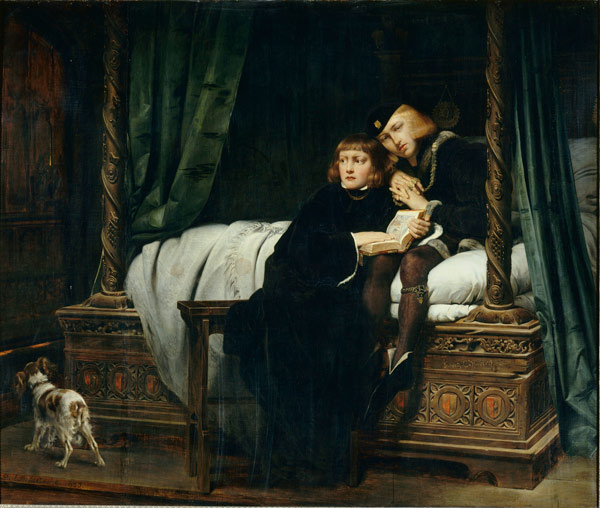
King Edward V and the Duke of York in the Tower of London (1831) Paul Delaroche
 
Two children sit reading in a sumptious chamber, but their attention has strayed.  Edward V, recognisable by his garter, is lost in thought, but his brother and their spaniel are listening to noises coming from the hallway, presumably the approach of their murderers.  The expression of the younger boy is fearful and apprehensive, but the King remains stoical, obviously thinking on higher matters, emphasising his ‘kingly’ character.  I’ve started with Delaroche, a French artist, because he produced this work (and another which we’ll look at later) less than forty years after the executions of the French royal family, so possibly the murder and mayhem of the British past could be seen as a cipher for events within living memory in France.

The Princes in the Tower (1878) J E Millais
 
There is a Doctor Who story called The Kingmaker where the princes in the tower are revealed to be princesses.  You have to wonder looking at the above image if Millais had the same thought.  Damn, I wish my hair was as fabulous as that, that’s almost Farrah Fawcett flicks.  Apparently, Millais used both girls and boys as the models, which comes as no surprise looking at those two.  The Duke of York looks a bit like my daughter, for goodness sake. 

So, gone are the comfy surroundings and we have our two frightened boys on a stairway, possibly hinting at the alleged burial site.  Edward V is again recognisable by his garter, but yet again it is his brother who seems to be alert to the coming danger as he turns towards the light at the top of the steps.  Possibly again, Edward’s mind was on ‘Kingly matters’, like ‘Where’s my spaniel gone?’ 

While it lacks the depth of detail that Delaroche packed into his canvas, Millais nails the audience’s sympathy with the fear on these angelic children’s faces. Look at them, they are just two frightened boys with only each other for protection and some swine is going to come and kill them.  Isn’t history a heartless bitch?

The Princes in the Tower (1861) Henrietta Mary Ada Ward
 
A sort of middle ground between the two pictures come in the form of Henrietta Ward’s The Prince’s in the Tower of 1861.  The two boys are in a richly furnished room, with the light filtering in through the small window, beautifully catching the food on the table in a precious still life.

Again, the King is distracted, but his brother, spaniel-sharp, has sensed some approaching threat. Probably something like this...

The Princes in the Tower James Northcote
So far, the audience has been left to fill in the blanks of the children’s actual murder, but in case you lacked in imagination or just like seeing kids in peril, James Northcote is on hand to help you out.  Two deeply unpleasant characters are seconds away from smothering these again very girly princes.  The grotesque-ness of the men, seemingly grinning or grimacing as they advance the pillow over the sleeping figures is in sharp contrast to the delicate porcelain forms of the princes, bathed in pure light that highlights their Bible and the crucifix on the wall, in case you were in any doubt who were the goodies in this image.  Exactly why the man in armour would chose to smother the children when he has a great big sword is probably not a very wholesome thought on my part.  It does seem a bit of a faff, although, I suppose, cleaner.  Moving on…

The Princes Sleeping in the Tower Augusta Freeman
 
Oh look, I’ve brought a bit of sculpture into the mix.  The first time I saw this I thought, ‘Yuck, sentimental Victorian kiddiewinks all tucked up in bed’.  Then Mr Walker said, in his usual tone, ‘You do realise their dead, don’t you?’ Oh, now it gets interesting…Obviously it plays on the funereal tradition of ‘just sleeping’ rather than dead, but these boys have been murdered, so are we looking at the moment before or after the death?

Then a very unpleasant thought struck me as I looked down at the little cherubic features. 

I am their murderer.

I am stood above these children either about to kill them or having just killed them.  This is not a cute excuse to show chubby little Victorian children, this is audience-as-perpetrator.  The unique thing about the sculpture as opposed to the paintings is that you can physically get in the position necessary to smother the princes.  In none of the canvases is the audience in the right position to be involved in the action, we are merely helpless bystanders, as much use as that damn spaniel.  We can see the light in the passage but we can’t stop the hulking great big men from snuffing out the two boys, we can only watch.  With the sculpture, we are the hulking great big murderers, and that is a powerful thing to realise.

I’m off for a stiff drink and I’ll see you tomorrow.

To join the fun with The Pre-Raphaelite Sisterhood reading project: www.preraphaelitesisterhood.com/?p=1820
To buy The Arrow Chest by Robert Parry: www.amazon.com or www.amazon.co.uk (or an Amazon near you!)

Wednesday, 13 July 2011

Jog On, Guinevere

I’m not going to talk about Guinevere.  She hogs all the limelight and gets to be all romantic and stuff, but really what has she done to deserve all the applauses and bouquets? She swans around Camelot being queen and has it away with Lancelot.  Well, so what? Yes, he has his shiny armour and curly dark hair (sigh), but really, when you are married to King Arthur you ought to be a little more circumspect.  No, I’m not going to talk about her, I’m going to talk about Vivien.

Merlin and Nimue Aubrey Beardsley
 
If I had to be someone from Arthurian legend, I’d be Vivien, or Nimue as she is sometimes known.  Her life starts out tragically, born on a battlefield beside the corpse of her father and her dying mother.  Surely in such a situation, things can only get better.  She wanted revenge against Arthur for the death of her parents so she takes his father-figure from him, Merlin.

The Victorians loved her.  What a woman.  If you think of the average patron of the art, when faced with a picture of an older man being ensnared by a sexy young sorceress, I’m guessing they had mixed feelings.  This shows in the portrayals of her.  Take for example our friend Frederick Sandys…

Vivien (1863) Frederick Sandys
Bocca Baciata (1859) D G Rossetti
This is Sandys at his most Rossetti, but to stunning effect, just look at the peacock ‘tail’ behind her.  Like Burne-Jones’ Morgan Le Fay, Vivien holds a sprig of daphne, but the position of the hands brings to mind Bocca Baciata, apple included.  Nice sneaky boob flash too. No wonder Rossetti accused Sandys of plaguerism.

Speaking of Burne-Jones, his is probably the best known picture of Vivien.

The Beguiling of Merlin (1874-76) Edward Burne-Jones
 He is getting a good beguiling here, lucky devil.  I love the binding in her hair that looks almost like snakes, possibly referencing Medusa again.  Also his clothes and hers seem to be wrapped drapes, possibly hinting at how Merlin is being caught in a web of magic.  The scarf stretching from one shoulder to the other especially seems to restrain him.  I love that Merlin is shown without a beard, as I usually think of him looking somewhat like Getafix in the Astrix books.

 
Yes, that’s more like it, although I’m not sure I think of Merlin carrying a golden sickle and eating wild boar.  Mmmmm, wild boar.  Anyway, back to Burne-Jones.  This wasn’t the only Merlin and Nimue picture he did, he also produced this one…

Merlin and Nimue (1861) Edward Burne-Jones
 The figure of Nimue was allegedly drawn from Fanny Cornforth, and some people choose to interpret this as being proof that the sensitive Burne-Jones found Fanny ugly and evil.  Well, that’s a bit of a stretch, as he also did Hope from her, but I’m on my high horse, so I better dismount.

Thank you Julia Margaret Cameron for giving me a good beard-y Merlin.  Of two images of Merlin and Vivien, I will show you this one first…

The Beguiling of Merlin Julia Margaret Cameron
No, it isn’t your average Victorian wedding photo, nor is it a dodgy Santa’s grotto, but it is Vivien casting a bit of saucy magic on a not-unwilling Merlin. The old wizard takes  the attractive young woman on as his apprentice and teaches her his most dangerous spells.  That can’t possibly end badly…

Damn your sudden yet inevitable betrayal!
 
This is a marvellous photograph of Vivien or Nimue turning Merlin’s magic against him, her posture casual as she destroys him.  Treacherous woman!  Thinking about it, it is a pretty brave character to show.  She is a woman without status who uses her own cunning to trap one of the most powerful wizards, using his own magic, and she does not meet her comeuppance.  She has nothing to lose and so risks everything to get revenge on King Arthur, not by hurting him directly like Morgan Le Fay attempts.  Vivien strikes at Arthur through Merlin, who is at once his father and his power-source.

In Idylls of the King, Tennyson describes Vivien as being the serpent in the garden of Eden, as she ‘writhed towards him’, and embraced him with arms that ‘clung like a snake’.  Now that reminds me of possibly my favourite Arthurian picture…

The Temptation of Sir Percival (1894) Arthur Hacker
Sadly, this isn’t Vivien, but the devil in a floaty dress, sent to tempt the saintly Sir Percival.  A common trait in evil women is apparently the inability to wear shoes, never trust a barefooted woman, she is up to no good.  I love the expression on his face, he seems to be saying ‘Get off, I am not sharing!’

The thing about Vivien is that she doesn’t pay for her crime, she succeeds and that’s the end of her story.  For the most part, Merlin is not shown as deserving his eternity of helplessness, unless you are particularly against wizardry.  I think she is an amazingly liberating anti-heroine, a bad girl who wins.  Thinking about the audience this was playing to, it’s breath-taking to think that some sort of punishment wasn’t written into her story by the Victorians.  Guinevere goes off to die miserably in a nunnery for her adultery but no-one messes with Vivien.  Mind you, she was powerful enough to take Merlin out, so no wonder they left her alone, she wouldn’t go quietly.

I’m off out to beguile someone, I may be some time.  I’ll see you for another three-day weekend, and our theme will be the Victorian response to British History.  See you on Friday!

Monday, 11 July 2011

Le Fay Dismay


How is it possible to make a television series about Arthurian Legend and get it so wrong?  I guess in the same way that they screwed up the Pre-Raphaelites, but surely the stories of King Arthur and the Knights are fool-proof.  Hell, even Excalibur is good for a giggle.   

And they had James Purefoy.

But here we are.  Mr Purefoy got bumped off in the first episode and my interest level dropped like a stone.  Yes, I am shallow, I regret nothing.

However, the real shame is that Eva Green seems to be under the illusion that everyone is working as hard as her, bringing forth a thoroughly barking mad Morgan Le Fay, upstaging everyone else as she swans about in pretty much nothing but a lot of eye-make up.

Eva!
 She is chewing the scenery, well done Eva.  Mind you, I have always like Morgan Le Fay, she is a complicated figure in Arthurian legend, and the source for some fabulous Pre-Raphaelite art.

Morgan Le Fay (1864) Frederick Sandys
 
Take Sandys depiction of Morgan Le Fay, which has to be the best know, if only for the leopard skin.  You can see the Rossetti influence here but I doubt DGR would have taken such a sweeping view of the scene which contains so many bits and bobs you feel she should spend less time in sorcery and more time tidying up. Blimey, I sound like my mother.

Morgan Le Fay represented a wilful, powerful femme fatale, out to seduce and murder her way through Arthurian England, and Sandys depiction of her was described as ‘beauty prostituted to malicious and lustful cruelty’.  Blimey, that’s a bit strong, but hanging around in a leopard skin will get you a bad reputation.

It never used to be like this.  Morgan started life in Geoffrey of Monmouth’s Vita Merlini, where she was a healer and shape-shifter.  Even Chrétien de Troyes, who established her as Arthur’s half-sister and rival, emphasised her healing power.  She was one of nine sisters, all magical, and Morgan is often described as the ruler of Avalon and one of the maidens who travelled with Arthur back to her isle at the end of his life.  Later romances began to elaborate on her more wicked adventures, taking lovers to enable her to kill Arthur and steal Excalibur.

Morgan Le Fay John Raddam Spencer Stanhope
 Spencer Stanhope does quite well at giving us a woman of dubious mental stability and virtue.  Her coils of hair, which seem to have a life of their own, possibly recall Medusa or Lilith, rather than the classical women her pose seems to echo.  Compared to Sandys proactively evil sorceress, Stanhope’s woman is more like a force of nature, or possible the fairy her name suggests.  There is nothing exotic about her, no leopard skins and knick-knacks, just earth coloured clothes and flowers.

Morgan Le Fay (1862) Edward Burne Jones
 A further step along this road is Burne-Jones’ Morgan-le-Fay.  I didn’t even take the image for a femme fatale as she looks so innocent, which only goes to show how long I’d last in Arthurian England.  However innocent she appears, she toys with a sprig of poisonous daphne, hinting at her true nature.

 Luckily for contemporary viewers, we don’t need to be wary of an innocent maiden with a penchant for poisonous herbs.  Camelot alerts us by way of eyeliner misuse and leather, not to mention liberal nudity that this lass is bad to the bone.  Much like the Victorians, it seems that we cannot stand for ambiguity in our female characters, so she is damned to be the ultimate jealous sibling for the rest of her days.  How about The Defence of Morgan, anyone?

Saturday, 9 July 2011

What’s a Nice Girl Like You Doing in a Wood Like This?


As previously covered in my post on Robins of Modern Times, I love a strange child picture. Well, here is a beauty...

The Woodman's Daughter (1850-1) John Everett Millais
Oh yes, I had forgotten how utterly peculiar it was.  Based on a melodramatic poem by Coventry Patmore, the picture shows Old Gerald, the Woodman and his daughter Maud, together the Squire’s Son, who doesn’t seemingly have a name, but does ruin poor Maud and drive her to infanticide and madness.  Good wholesome family stuff.

It was exhibited with the following lines from the poem:

She went merely to think she help'd;
     And, whilst he hack'd and saw'd,
The rich Squire's son, a young boy then,
     Whole mornings, as if awed,
Stood silent by, and gazed in turn
     At Gerald and on Maud.

He sometimes, in a sullen tone
     He offer'd fruits, and she
Received them always with an air
     So unreserved and free,
That shame-faced distance soon became
     Familiarity.

So you get the impression that it isn’t just Maud that attracts the Squire’s Son, but both father and daughter.  Maybe what he was after was a bit of rustic-tourism, which could be levelled at a number of rich, industrial types who bought paintings of the honest, rural workers.  Paintings like this…

The Woodman's Child (1860) Arthur Hughes
Hughes gives us an unthreatening, lovely child, lying on the ground among nature.  There could be nothing dodgy about that, could there…?

Robins of Modern Times (1860) John Roddam Spencer-Stanhope
Yes, alright, but Robins of Modern Times aside, Arthur Hughes’ picture is a traditional scene of a blameless child of nature.  Not so with Maud and the Squire’s Son.  Oh, look, I can’t keep calling him the Squire’s Son, it’s far too much to type, I’ll call him Bob.  Anyway, Maud and Bob are a foreshadowing of things to come, and it won’t be pleasant.

Let’s play my favourite game again – cover up Bob and look at the painting.  Now uncover him and see the difference he makes?  It’s astounding, that red really jumps out at you, while Maud and Old Gerald recede, almost blending with the woods.  It makes me think of the following lines of the poem:

The pool reflects the scarlet West
     With a hot and guilty glow;
The East is changing ashy pale;

Millais seems to be laying the blame firmly at the feet of the ‘scarlet’ one who has a ‘hot and guilty glow’. Does anyone else think he is wearing a very weird outfit?  Maud and Gerald seem to be wearing contemporary clothes, but Bob seems to be playing principal boy in a pantomime.  His tunic and tights come off as a bit medieval, and really, white tights do not flatter anyone’s knees.  I think the ‘medieval-ness’ is heightened by the trees, which remind me of Uccello’s The Hunt in the Forest.

The Hunt in the Forest (1468) Paolo Uccello
In the original sketch, Bob was handing over cherries, which is a little obvious as to what he was after, naughty boy.  Millais changed it to strawberries and that brings to mind possibly the rudest scene in cinema I have ever seen…

Roman Polanski's Tess
When Tess eats the strawberry, you know she is done for.  If you take strawberries off a rich boy, you’re bound to end up disgracing yourself and mad, probably at Stonehenge.  With regard to The Woodman's Daughter, I wonder at the fact that she doesn’t take them off his offered hand, but waits for him to give them to her.  It is a very passive gesture, waiting to see what you are given rather than taking what you want from what is offered.  It strengthens the feeling that Maud is the utterly useless victim in the action, maybe by class, but if she isn’t able to chose a strawberry, what chance has she against illegitimate pregnancy?

Venus Verticordia (1864-8) D G Rossetti
It took me a while to work out what he had hidden behind his back.  In the sketch it’s a riding crop, but in the finished picture it’s a butterfly net.  Butterflies are the symbols of so many things, the soul, the fleetingness of life, lust, nicely rounded up by Venus Verticordia.  All of these things come into play in The Woodman’s Daughter - the purity of Maud’s soul will be compromised, her life is condensed into a few sad stanzas and lust will take her from the little girl in the wood to the baby-drowning madwoman at the end of the poem.  I like the way that Bob is offering her the strawberries while holding the net behind him, it’s very Child-Catcher from Chitty Chitty Bang Bang.  By the way, my father does a great Child-Catcher impression, which I think explains a lot of what’s wrong with me.

The Woodman's Child (1850)
Patmore declared that the figure of the girl looked like ‘a vulgar little slut’, which I think is a bit harsh, but apparently the original figure was less twee and pretty and Millais painted over her, hence the blur around her face.  If you look at how sharp the boy’s face is in comparison it looks like two different painting styles.  Although it is unintentional, I think the effect does give the impression of the young boy’s focus and strength and her uncertainty and weakness in the face of his purpose. Just seeing how prominent he is, you would think that Millais laid the blame for the whole sorry affair squarely at Bob’s feet, but the fact that he changed the figure of Old Gerald from looking on with concern to not paying attention makes me feel that Millais lays some blame at his feet too.  Some people read the oak in the front left to symbolise Gerald’s integrity, but I’m not sure as even in the poem, the father is a bit oblivious to everything except chopping stuff down.

Trust Me (1862)
Bob bothers me.  His gesture is reminiscent of two other paintings by Millais.  Firstly, it’s like the father’s stance in Trust Me (1862), who is also dressed in red and white.  It would be marvellously ironic for The Woodman’s Daughter to be called Trust Me (Have a Strawberry).  That reminds me of a man I used to work with who was known as ‘Mr Peppermint’, who used to tempt young ladies with his bag of peppermint creams.  Damn, they were good.  Sorry, I digress…

The other painting it recalls is obviously Isabella, and Kicky the brother, again wearing those white tights that do nothing for your knees.  I did read an interpretation of the painting that suggests that Bob’s arm is a similarly phallic thrust, but it’s a bit early for language like that.  I’ve only just had breakfast.

Rude.
How about this?  I think of the figure of Christ in Christ in the House of His Parents (1849-50) which he worked on just before this painting.   

Christ in the House of His Parents (1849-50)
 Again we have a small red-haired boy, so possibly Millais was playing with the idea that one is Christ and the other possibly, well, the anti-Christ.  OK, that’s a bit strong, but one is obviously the personification of good and the other is temptation and ruination. 

So what do we learn from this? 
If you take strawberries from rich young men, you’ll end up mad.
Dads enjoy chopping down trees more than anything else in the world.
I’m anyone’s for a peppermint cream.

Salutary lessons for us all, I feel.


Wednesday, 6 July 2011

The Beauty of Berkeley Square


Way back in 1998, the BBC broadcast a costume drama called Berkeley Square, the rolling saga of the lives of three Edwardian nannies and the families they lived with.  I loved it and was disappointed that they made no more, especially as it ended on about three cliff-hangers.  I bought the video and eventually made the redoubtable Mr Walker watch it when we moved in together.  The phrase ‘jigsaw privilege’ has entered the Walker household language*.

Part of the reason I loved the series is the outfits and households, especially the Lamson-Scribener home, but it wasn’t until I bought the DVDs last year that I watched again and noticed all the interiors properly.  For example, look at the frieze around the hallway…

 
I do believe it’s part of the Morris & Co The Forest pattern.  It spreads all around the hallway and so features in many scenes as Lydia, the country-bumpkin nanny comes in and out of the house in a charming, rustic way.

Lydia giving Lord Hugh a good talking to
Detail from The Forest


Not only to they have the good taste to have a Morris hallway, but Lord Lamson-Scribener has the most smashing blue and white room, how very aesthetic.  Get a load of his pots…

The Blue and White China Room - you know what they say about a man with a large pot...
 Nice, and clock the pointy gothic chair in the corner.  Lovely.  Oh, look, he has a matching mirror just outside in the hallway…


Smashing.

Anyway, next door are the troubled St John family, who are embroiled in marital issues and adultery, but do have some rather lovely art on their wall.


OK, so the bottom picture is definitely Dante’s Dream, but I am guessing the top one is a pencil sketch of Jane Morris, but it could easily be a Burne-Jones, I can't quite place it.  There is another picture hung on the wall opposite, but it’s never in shot long enough to screen capture it or see what it is.  Damn them!
                                           
Torrid plot aside, it is worth watching this little gem for the wallpaper alone.


The last one is again in the Lamson-Scribener home and is Morris-tastic, complete with little panels.  For a link to further images and an episode guide, have a look at the entry on Wikipedia.   As it is now available on DVD, I do recommend it to anyone who enjoys a costume drama.  It has everything: a modern-thinking American wife, Hermione Norris being all adulterous, lecherous Lord Hugh who is bent on despoiling the innocent Lydia.  I have rather a soft spot for Lydia, being a rural lass myself, and like to imagine turning up at my new job with a dozen eggs and some clotted cream.  

 I haven’t always been as sophisticated as what I am today, you know…

 * 'Jigsaw Privilege' refers to an incident when one little boy is allowed to see the picture on the box when doing his jigsaw, and he is allowed to finish it instead of it just being dumped into the box when the senior nanny gets bored.  Such luxury! The phrase is used in our house to refer to being allowed to do something straightforward when other people's stupidity has stopped you doing it before.