Wednesday, 18 December 2019

Wednesday 18th December - Never Morning Wore to Evening...

Well here we are, and today is the last day I am going in to work before Christmas.  The rest of the week will be filled with making jam and chocolate things and mince pies for presents.  I also have woken up really wanting sticky gingerbread.  This does not bode well for my waistline this festive season.  Ho hum, on with the abject misery...

'Never Morning Wore to Evening but Some Heart did Break' (1894) Walter Langley
Right, I am pulling out the big guns now as we only have a week to go so here we have one of the supreme masters of misery art.  Good Birmingham lad, Walter Langley is probably best known for his Newlyn work, bringing that crisp Cornish air into scenes of fishermen and women, often highlighting the hard work and hardship they endured.  The scholarships he earned as a young man enabled him to lift himself and his family into the comfortable Victorian middle-class but used his art to highlight the lives of the working class.  There is always that gorgeous clarity of light in his art, that does not detract from the gorgeous levels of despair.  Look at how the light plays on the placid sea behind the women, but something awful has occurred.

This is so serious, she's put down her knitting...
The title is from Tennyson's In Memoriam A.H.H., an entire poem  dedicated to wallowing in grief, that caught the mood of the nation and the Queen after Prince Albert died.  The verse that our title comes from reads thus:

That loss is common would not make
My own less bitter, rather more:
Too common! Never morning wore
To Evening but some heart did break.

The poem continues with a rather pertinent example:

O mother, praying God will save
Thy sailor, - while thy head is bow'd,
His heavy-shotted hammock-shroud
Drops in his vast and wandering grave.

That's the spirit! At first look I thought this was a woman concerned or despairing over her husband, but equally it could be a young son who has gone to sea and is really not coming back.  The section of the poem highlights the awful commonplaceness of grief and how knowing that we are all in this together is absolutely no damn comfort at all.  It is tempting to want to share with someone your own tale of grief when they have been bereaved but Tennyson tells you to shut your face.  It's one of the things I love about Tennyson at his best, he is absolutely as unlike a Victorian as you can imagine.  In In Memoriam he is many things, and selfish and nihilistic is unexpectedly one of them.  For Tennyson, grief is the eternal tension between the personal and the inevitable - what's the point of loving people if they and/or you are just going to die?  In fact, just in the time it took you to read that, someone somewhere has just had their world and heart utterly smashed by losing the person who is essential to them.

For He Will See Them On Tonight (1870) Julia Margaret Cameron
In Memoriam is a hard read as it speaks of the eternal joke of our blissful existence right up to the moment when it all goes horribly wrong.  In For He Will See Them On Tonight, Julia Margaret Cameron gives us an innocent picture of a woman making herself pretty for a lover, but the quote comes from In Memoriam and that woman's husband or lover is already dead and will not be coming home.  He's already drowned in a ford or fallen off his horse or died in yet another pointless Victorian manner and there she is almost trying to summon him home with her preparations. 'Nice try, Sister,' says God, 'But his time was up.  Soz.'

Going back to the painting, the placidity of nature behind the utter devastation of the women I think speaks to the feeling of the poem.  Nature or God or whatever you want to call it doesn't reward  or punish with death, it just is.  There is no comfort in grief, and I think that is what the older woman knows; you just have to endure and get on with it, not least because if we stopped to comfort every bereaved person, no-one would ever get anything done because every second of the day, someone is being bereaved. Saying that, you go ahead and handle your grief in whatever way you want because it is yours and no-one has a say in what or how much you feel.  Grief is a monumental thing because it is that moment that you realise that all that we are stops, sometimes unbelievably abruptly.

This is all unimaginably grim but look, if ever there was a reason to know you are loved and that life, when it doesn't suck, is fabulous, then this is it.  If you wake up and find that you are not the women in this picture today, then celebrate, be kind to yourself and others.  Tickle a puppy.  Eat something amazing.  Have a good laugh because tomorrow we might all perish miserably at sea.

See you tomorrow.  Probably.

Tuesday, 17 December 2019

Tuesday 17th December - A Random Shot

Flipping heck, I've got an awful one for you today, so I'll try and put off the inevitable for as long as I can.  So how are you all?  Well I hope, and not at all stressed by your Christmas shopping.  Personally, I am just trying not to eat too much food so that I still fit into my trousers come January...

Look, it's no good, we have to get on with it.  Brace!

A Random Shot (1848) Edwin Landseer
Rats.  Well, it's all gone wrong for Bambi, hasn't it?  This is all very grim and beautifully painted.  Obviously what we have here is a doe who has been killed and her little fawn trying to work out why Mummy is having a prolonged sit-down.  To be fair, I often have to have a prolonged sit-down and it's not because I've been callously gunned down in the sparkly snow, but because I've found the M&S food hall particularly gruelling. 

The Monarch of the Glen (1851)
Landseer is probably best known for this other massive, scotch-drinking deer who is very much alive and far less tragic.  As an animal painter and sculptor, he is also responsible for the lions in Trafalgar Square.  I find his work difficult as I am so familiar with it, it's easy to not realise how utterly breath-taking it is.  I suppose because we received it, especially post-1960s, as slightly kitsch, biscuit-tin-and-table-mat sort of art that we were bombarded with, especially in our grandparent's houses.  Although it is easy to anthropomorphize the emotions of some of Landseers animals, especially the sad dogs, we forget that Landseer is also responsible for reflecting the unbelievable majesty and borderline threat of nature, for example, these fellows...

Man Proposes, God Disposes (1864)
 I am slightly obsessed with polar bears and how terrifying they are.  I'm currently reading Dark Matter by Michelle Paver which is all polar exploration and terror.  Marvellous for this time of year.  Polar bears will eat you, make no mistake.  Mr Polar Bear thinks you are utterly delicious, which is oddly comforting on the days when you feel that no-one loves you.

Sorry, back to Bambi's Mum.  The title refers to a Walter Scott poem The Lord of the Isles, specifically Canto 5 v.18 

'-O! many a shaft at random sent, 
Finds mark the archer little meant! 
And many a word at random spoken, 
May sooth or wound a heart that's broken!' 

In the poem it refers to Ronald proving comfort to his page Amadine which sort of works but possibly not in the way he meant.  I suppose therefore Landseer is inferring that the hunter of the deer did not intend to kill the doe and in consequent probably kill off her fawn too.  Mind you, as we covered yesterday, hunting for funsies is massively stupid and especially if you want to split hairs about not wanting to kill one lot of animals over another.  In fact, I hope we have a repeat of yesterday's scene and just as the hunter comes over to have a bit of a lament over accidentally killing the wrong sort of deer, Bambi's mum jumps up and wrestles the hunter to the ground, delivering a right good mauling.  She then tag-teams in her friends the polar bears who have a few things to say about hunting for fun.  Bambi's Mum is thenceforth seen wearing a very fetching furry hat and no-one ever messes with her ever again, much like the end of Jon Klassen's marvellous  I Want My Hat Back (2011).  Now that is a damn fine book indeed.

See you tomorrow.

Monday, 16 December 2019

Monday 16th December - J P Inverarity Mauled by a Lioness

Blimey, we really are cracking on with the month as I am now in the last week of term and I still have a lot of Christmas cooking to do.  Mind you, I am never too busy to bring you a truly dismal picture for your entertainment and so here is today's delightful offering...

J P Inverarity Mauled by a Lioness, Somaliland  (1901) George Fiddes Watt
Okay, I have another entry into the 'what on earth were they thinking?' collection.  Do you know what would look great above the mantle piece in the dining room?  Some bloke getting mauled by a lady lion. It seemed a bit of a random thing, especially as the poor chap seemed to be a bit dead - I mean, his pith helmet has fallen off - so it seemed a weird way to embellish a landscape image. 

J P Inverarity (no date) Andrew M Penny
With a bit of digging, I found some very odd accounts of being mauled by a lion, which seemed a bit of a hobby for Victorian gentlemen.  I wondered if this portrait was him as well. Recounted in the delightful tome A Book of Man Eaters by Reginald George Burton, Inverarity's encounter is rather grisly, yet the chap survived.  Apparently 'he felt none of the dreamy stupor described by Livingstone' (p.58), but in fact it felt like a massive lion was biting him.  I'm calling Livingstone out on that one, because if you get mauled by something I bet it bloody hurts, or else they wouldn't call it 'mauling', they would call it 'spirited tickling'.

Charles Jamrach's tiger gives a passing boy a lovely cuddle

In fact, Mr Inverarity escaped by pretending to be dead and the lioness got bored and wandered off after a quick maul.  His arm took most of the mauling, as shown in the painting.  He also goes on to say that lions like eating porcupines, quills and all.  Blimey, I bet they like to catch a nice juicy, soft human - less indigestion.  According to another account in Indian Courts and Character (1931), Inverarity was out hunting and wounded the lioness, but left her to be retrieved by the Somali boys he had taken with him.  The lioness was having none of that and decided to see how much Mr Inverarity liked it, which apparently was not at all.

Honestly, I've never really understood hunting for fun, it seems eminently stupid, but I guess it's part of the whole 'domination of the natural world' thing that the Victorians were into, together with the entitled nonsense of Empire.  I'm glad the lioness gave him a right good mauling but I doubt to taught him anything, sadly.  Mind you, as far as I am concerned, whenever I see this painting I will always think 'Go on, Lady Lion, you bite that idiot's arm off, serves him right!'

See you tomorrow...

Sunday, 15 December 2019

Sunday 15th December - Burial of Lady Jane Swinburne

There are certain paintings that I end up thinking 'well, that's a tad niche', and today's painting is a case in point...

Burial of Lady Jane Swinburne (c.1896) Jane Adye Ram
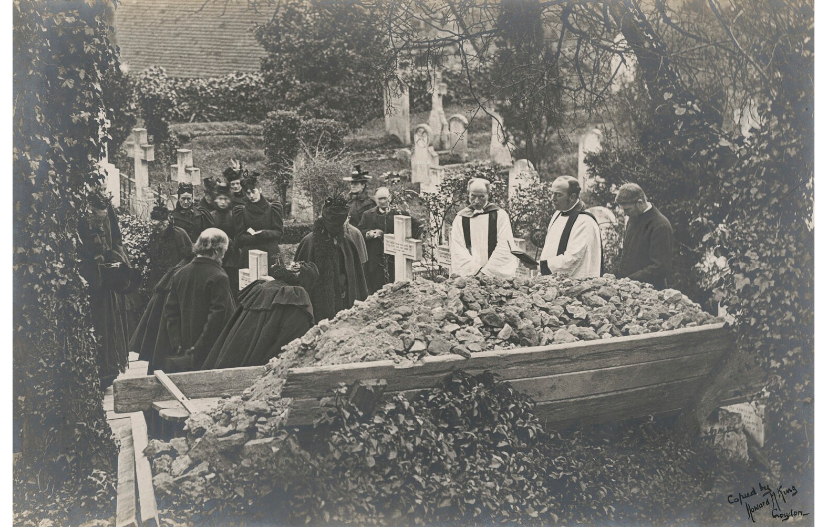
Well, in home decoration I always think that a nice big painting of a funeral is essential.  It's not just any funeral either but that of Lady Jane Swinburne!  Mother of Algernon Swinburne - poet, friend of Rossetti and champion of sliding down banisters nude - and daughter of the 3rd Earl of Ashburnham, she was undoubtedly an important woman, but I'm not sure some people in black and a big pile of dirt make for a charming painting.  That is a massive pile of dirt, and I respect the realism in showing the logistics of getting someone six foot under.  There are the slide-y boards of getting the spoil-heap back in again.  In fact, there is a photograph of the very same scene, if you fancied a closer look...

Burial of Lady Jane Henrietta Swinburne from the National Portrait Gallery
Here we are again and it is very much the same scene, leading me to believe that Ram used this 'official' photograph as the basis of her painting.  I really like the ivy growing around the back of the boards and up the walls on either side. Lady Jane Swinburne was a woman of accomplishment and intelligence, according to various sources, and she seems to have been concerned for the health and wellbeing of her wayward eldest son, Algernon.  According to his Dictionary of National Biography entry, Algernon's removal from society in 1879 for the sake of his health was done with his mother's approval.

Algernon Charles Swinburne (1862) D G Rossetti
Hang on then, are we to infer that the importance of the painting is not that Lady Jane Swinburne was important but that her son is a bit of a celebrity?  Well that's galling, especially if you also consider all the shenanigans he got up to.  I suppose in a way, Lady Jane would have felt she had done a good job in keeping her eldest child not only alive but also that he was so well-respected that a picture of him at a funeral was of interest to the nation.  

Close up on Swinburne and his sisters at the graveside
Mind you, I wonder if that is the reason that the burial itself is not more glamorized - if the dead person is not the point, then there is no reason to make the mechanics of getting a body six foot underground look any less muddy than it is.  What we should be looking at is actually the dignified, mourning figure of Swinburne, pretty much dead centre (if you excuse the expression), without his swirl of red hair (which had dropped out by 1896).  He is the point of the painting and I suppose his celebrity is what made the burial of his mother interesting to people.  I'm sure there were people at the time saying 'I'm a massive Swinburne fan, I even got the painting of him at his Mum's funeral.' Now, is it just me that finds that a bit, well, rude?  The poor woman is dead and it's her funeral, yet we've managed to make it all about Algernon. Isn't that just typical?  It's like the fact that I am 'Lily's Mum' most of the time and people are often quite surprised when they find out I do writing too. As a mum, I absolutely love being Lily's Mum, she's ace, but there are occasions when maybe it should be all about you rather than the person you have given birth to/married/been slightly connected to. Truthfully this painting should therefore be called  Burial of Algernon's Mum, You Know, the Famous Writer Who Did Some Dodgy Stuff, Him, Well, His Mum's Died.  I Know, Very Sad.   

Mind you, that's quite a lot to fit on a painting label...

See you tomorrow.

Saturday, 14 December 2019

Saturday 14th December - The Old Master

Blimey, in ten days it will be Christmas Eve! Where has the month gone?  Time flies when you're, well, obviously not having fun, maybe sobbing so much your face is all slimy?  Anyway, let's crack on with today...

The Old Master (1883) James Hayllar
Here we have a cheery scene of a funeral - the lady in the chair is the widow, her daughter behind her and the men in the room are, presumably, members of staff who have come to pay their respects.  The coffin, in the middle of the room, is open, a sheet covering the body.  There is a quiet dignity to the scene - leading you to believe that the dead man was beloved by all.  Well, I say that but the two men on the far right might be muttering to each other 'I just came to make sure the old sod was dead...'

The Lord is my Shepherd, or in this case, Gary...
No, I'm sure the dead chap was marvellous.  Just look at the shepherd-type person who has come to pay his respects, complete with smock.  That's some top quality, traditional mourning going on there.  It might be a reference to Psalm 23 'The Lord's My Shepherd'.  Is it like chimney sweeps at weddings? Is it lucky to have a shepherd at your funeral?  Well, obviously, at a funeral 'lucky' is a relative term, but I'm sure everyone feel lucky to have seen Gary the Shepherd at a party as he is a hilarious party animal.  Well, obviously not in this case - a time and a place, and all that...

 Plants on windowsills are always interesting in  pictures because they are rife with meaning.  I wonder if that is meant to be a geranium on the ledge?  They symbolize melancholy, which would fit.  Red geranium also symbolize good health, which is a tad ironic, given the circumstances.  Mind you, the departed might have been a man who enjoyed very good health, never happier than when he indulged in his favourite sport, nude hang-gliding.  That was how he died, unfortunately.  It also explains the sheet half way up the coffin.  Nevermind, he died doing what he loved.  Who could ask for more?

See you tomorrow...


Friday, 13 December 2019

Friday 13th December - A Coronach in the Backwoods

Oh Lordy, it's Friday 13th, which does not bode well but might be just what we need for Sobvent.  Nothing like being unlucky and miserable, which leads me to today's offering...

A Coronach in the Backwoods (1859) George W Simson
Well, here we all are then.  For starters, a coronach is a vocal lament at a funeral or wake, or in this case the jolly wail of bagpipes.  It is traditional in the Highlands of Scotland and Ireland, and as is the way in the 19th century, Victorians were both absolutely fascinated with it but also tried to stamp it out.  What a contrary bunch the Victorians were.  That reminds me of the Victorians with all sorts of traditional practices such as country dances, and their attempts to catalogue and record such things, but melodies for the songs had been written down from the 18th century, because when burying someone you don't want to be searching around for a suitable tune.

I completely missed the body in this picture - I thought it was just an image of a man and woman at a graveside.  I then noticed how small the hole was - well, I thought, that's not a very large grave, you could barely fit a baby in there... oh, rats.  The couple have had to dig the little grave, the shovel is behind the man, and now the parents are responsible for burying their child.  I'm not sure if Simson is making a point about the rather 'uncivilized' nature of the people of Ireland and Scotland, that they are uncultured but they are closer to nature and the circle of life, which is grim and magnificently patronising.  Maybe he was just drawing attention to the sort of customs that the English were trying to put a stop to because they didn't understand them.

The jug and letter in front of the woman give me pause for thought.  Why bring a letter and a jug?  Also, in Highlands and Ireland burial tradition (apparently, not sure how reliable this is) a dog or cat at a funeral is really bad luck and beside our piper we have a jolly boarder collie.  So my conclusion is this - the 'grave' is actually symbolic, for someone who has been lost at sea or something, and the woman and her perfectly healthy baby will be burying the letter (which has the details of the death) and the jug (for some reason).  However, the presence of the cursed collie (the Collie of Doom, as I like to think) means they will all be dead before the year is out.

Whatever the truth behind this painting, it's not a jolly scene at all, and suitably unlucky (especially that sheepdog) for Friday 13th...

See you tomorrow.

Thursday, 12 December 2019

Thursday 12th December - The Alarm

If you have read my blog over the years, you will know I have a soft spot for Victorian depictions of the English Civil War, which is why I am delighted to bring you today's image...

The Alarm (1867) Edward Hughes
Lawks! It's all going on here.  Lady Ponsonby was just sitting, listening to her daughter, the Honourable Sharon, belting out Whitesnake hits on her lute when soldiers have erupted into the house, carrying the mortally wounded Lord Ponsonby.  She barely has time to yell 'take your boots off if you are going upstairs, I've just hoovered up there!'  It's all gone a tad 'a pieta' in the lobby with the stricken cavalier being transported up the stairs to what undoubtedly be his death-bed.  The whole shebang is so alarming that the girl has dropped her lute.  The horror.

There is, of course, the chance that our wounded cavalier will survive, but seeing as Lady Ponsonby is already in black, I don't think there is much chance of that.  Also, didn't Lord Ponsonby get the memo that told us all cavaliers die in very beautiful ways?  Take for example this chap...

Spies of the Republic (1909) John Lomax
He is definitely not seeing the morning, but doesn't he look sexy?  Also, obviously, we have this delicious example...

The Wounded Cavalier (1856) William Shakespeare Burton
Good Lord, that's an attractive corpse. Not that today's cavalier is too shabby...

The Victorians, like me, loved the cavaliers because they were both wicked and honorable, regal and naughty, and they lost, so they can be very, very romantic about that too.  They are symptomatic of a system that was very wrong, hence the reason that we got rid of it all, but also had some redeeming features, which is why we brought it all back again. Sort of. 

The English Civil War resonates with us especially at the moment as we as a nation are in danger of being pushed to polar opposites, when in truth most people lurk in the middle, just with tiny nuances of difference.  Today is a day to remember that quite a lot of money is being spent to drive you towards making a decision based on fear - fear of being denied your voice in a political decision, fear of losing our beloved health service, fear of people who appear to hold you in contempt, fear of a bloke with a beard who makes his own jam and wants to take away any money you make.  It is all absolute nonsense and do you know what, they are all absolutely bloody terrified of you with your freedom to place a little cross in a box.  Maybe looking at the English Civil War today of all days is absolutely right, as this is what happens when people are made to feel like they have to side with either black or white when most of us feel like the world is shades of grey.  Whatever you vote today, use that vote to make the world less miserable because there should only be one person making you sob this month and that's me.

See you tomorrow...