Sunday, 5 January 2020

Venus in your Garden

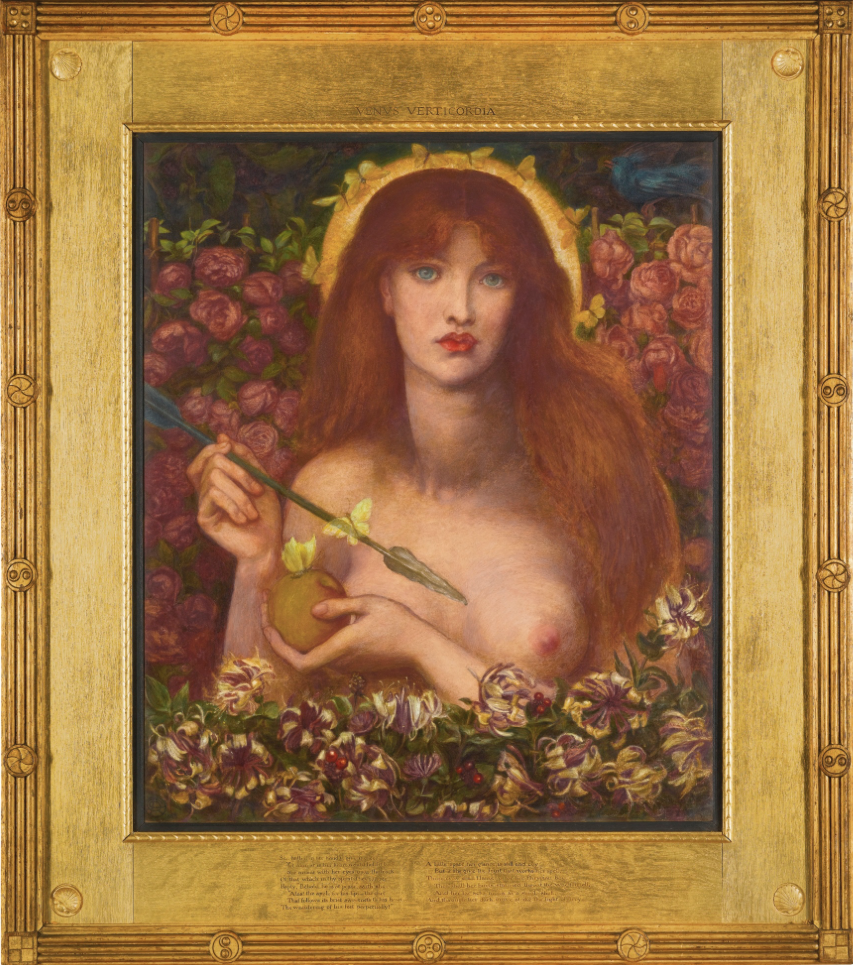
Excuse the brief, rambling nature of this post but it's just a thought that I wanted to write down and as you're here, I'll tell you.  Yesterday, I was having a very lovely look around the Beyond the Brotherhood show in Southampton with some lovely friends, and we found ourselves stood in front of this beauty...

Venus Verticordia (1864-8) Dante Gabriel Rossetti
Yes, yes, all very lovely.  Now, the problem I have with this image, which I liked so much I used it on the front of my novel about Alexa Wilding, is that it is hard to get a decent reproduction of it, and secondly, you just end up looking at Alexa and her assets because she is so very luminous, which means you often don't give a massive amount of thought to all the other bits and pieces in the picture. That might well just be me, because it seems rude not to stare at her boob, especially as she is going to the trouble of pointing at it and everything.  Anyway, I was stood to one side of the painting yesterday, talking about how Rossetti scraped out the face to add Alexa and the suchlike, when I was attracted to the blue bird in the corner.  Now, obviously I had seen the bird before, I'm not that boob-obsessed (not quite) and in fact it is one of my favourite bits as the blue adds a spark of something that contrasts with the pinky-russet of the piece, highlighting her eyes.  Anyway, what I had not really clocked before was what the bird was sitting on. It's a trellis, although, in this reproduction, you'd be hard pressed to see it.  Hang on...

Bird! (Also present but not pictured, boob)
Okay, that is not very helpful, but you can just about see that the blue bird is clinging to the struts of a trellis that the roses are climbing up.  In the chalk version from 1863-8, it has moved...

Weird ghost bird over right shoulder...
But in the watercolour replica of 1868, it is where it should be...

Smashing frame!
And in fact a little bit easier to see...


All this rambling is because the friends we were with asked what the significance of the bird was.  Well, blue birds are a symbol of fertility, renewal, birth, possibly there to contrast with the butterflies that symbolise the fleetingness of life in a whole 'circle of life' thing without having to bother Elton John.  However, something about that bird seemed familiar...

Trellis (1864) William Morris
Hang about, I thought, that reminds me of Trellis!  Why had I never noticed that before?! Trellis is probably my favourite William Morris print (don't tell Strawberry Thief) and his first design.  Legend has it that it was inspired by the trellis work in the gardens at the Red House.  Look at the date, right there at the inception of Venus Verticordia and the little flying insects that look somewhat like tiny butterflies.  A couple of Philip Webb's blue birds (Morris couldn't do birds so got his friend to do them) look awfully like the blue bird in the corner of Venus Verticordia. Hmmm...

So what can we surmise from this? Possibly nothing other than it is a co-incidence, or that Rossetti and Morris discussed the design and Rossetti included it as an homage to his friend.  Or pinched it because it was a nice touch and he was a bit blurry on boundaries when it came to pinching stuff or wives. The fact that both Trellis and Venus concern rose covered trellises, even though Rossetti's is somewhat more overblown (show off) makes me suspect that it isn't a simple co-incidence. The scandalous novelist in me wants to read far more, obviously, and suggest that by 1865 when Venus was in full swing, Rossetti was falling back into love with Morris' wife and by including the Trellis bird in the canvas he was signalling that she had 'turned his heart' like Venus. 

What it probably should tell us is that you should never, ever, let Rossetti anywhere near your trellis, but I think we knew that already...

Tuesday, 24 December 2019

Tuesday 24th December - Frank Holl, obviously

All hail the King of Sobvent!  I really couldn't do a month of misery without the marvellous and miserable art of the wonderful Frank Holl, creator of this...

A Doubtful Hope (1875) Frank Holl
This painting is what started my love of a proper miserable painting and introduced me to Frank Holl, a hero of despair, and the only painter who could really do justice to the finale of Sobvent.  I don't know who the medicine is for in A Doubtful Hope but I think you and I both know that everyone in that shop is doomed.  It's just a matter of time. Probably not much time.

Her First Born, Horsham Churchyard (1876)
Holl is responsible for some of the most depressing images of Victorian life you can possibly imagine.  Little coffins, sobbing mothers, and worthy, elderly country folk all feature in his art.  The grief of mothers is a particularly favourite theme of his.  Both A Doubtful Hope and Her First Born are about the struggle of motherhood, particularly for the working class and poor.  

Hush (1877)

Hushed (1877)
The roughness of the interiors in paintings such as Hush and the inevitable Hushed (I'm guessing that baby hasn't just drifted happily off for a little snooze) shows that the poor have the same lives as the rich but with absolutely no protection from the worst of life.  With a Frank Holl painting we know what is coming, but the protagonists don't - maybe Frank Holl is saying that the art-buying public should be able to spot the perils of being poor and should act on it.  If you have the money for a painting, you could be paying for a decent meal or medical attention for some of these people.

I am the Resurrection and the Life (The Village Funeral) (1872)
Another coffin and another sobbing family, although it is hard to see exactly who the dead body is, with the coffin at such an angle to us - is it the mother this time?  We are seeing a funeral procession led by a chap and a small girl, followed by a sobbing girl and other mourning villagers. I reckon it's the Mum who has popped off, which makes a change, although she might already be dead and it's another child.  Blimey, it's carnage in this village!

No Tidings from the Sea (1870)
Also, don't worry about Holl being overshadowed by such doom-mongers as Walter Langley, as Holl also did a miserable dead fisherman picture with No Tidings from the Sea, although to be honest, this one could be called anything as I'm not getting a strong fishy vibe from this - how about 'I flossed at the Christmas party, the shame!' or 'I posted a rant-y comment on the internet, but misspelled a word!' We all feel your pain, Love, whatever it might be.  Also, cheer up, just because there are no tidings, doesn't mean they are all drowned - the mobile signal might just be really bad where he is.  He's obviously just in the pub and every time you ring he gets his mates to do seagull noises.  

Ordered to the Front (1880)

Sorry, everyone wearing a skirt in this picture will be dead by tomorrow afternoon. Harsh but true.

Hope (1883)
Despair (1881)

Good old Holl, he never disappoints.  So many of the paintings just have no context, they are just moments of personal angst, possibly about stuff that happened ages ago but that is quite Christmas-y.  At this time of year, everything might be going excellently, but you suddenly miss people who just aren't there anymore.  The older I get, the further I get from the magic of childhood, more people are missing and more holes are in the smooth fabric of our happiness.  However, look what Holl did with these last two paintings - like Hush and Hushed, it would be easy to assume the order of these paintings is Hope then Despair but look at the dates.  Holl painted Despair first, then followed it with Hope and that is the message I would leave you with this Sobvent.  No matter how many magpies visit you, lionesses savage you or dogs look at you in a mournful manner, there is always hope.  Sure, the fisherman probably won't return from the sea, but he might. So, whilst Christmas can often be bittersweet, remember if Frank Holl can find hope, it's probably worth giving it a go yourself.

Have a very happy Christmas, my dears, and I will see you all in 2020.

Monday, 23 December 2019

Monday 23rd December - The Last of the Garrison

Well, we are on the penultimate day of Sobvent and what a thoroughly miserable month it has been!  Splendid! I thought today I'd do the wonderfully depressing animal art of Briton Riviere, notably this one...

The Last of the Garrison (1875) Briton Riviere
My Nan would have absolutely loved this as she was a connoisseur of a wretched picture, having two sobbing gypsy children on her kitchen wall.  So, what we have here is the aftermath of a siege or battle in an important house.  The battle has done rather appalling things to the plasterwork and blown a door off its hinges (is that a cannonball hole?), but centre-stage is a lovely dog, having a little nap.  He is having a sleep, right? A nice little snooze on an unfortunate red stain on the floor... Never mind the absolute devastation and loss of life in the battle, someone shot the dog!  That is really going too far.  He was only a day away from retirement too! Sob!

Companions in Misfortune (1883)
Riviere is a repeat offender with his miserable pictures involving animals, especially dogs.  He did do a good dog, I'll give him that.  Out Landseer-ing Landseer in narrative scenes, he brings us treasures such as Companions in Misfortune where a small, miserable terrier is homeless with his worryingly gun-toting owner.  Yes, I think I'd look a bit shifty too with nothing but a massive shotgun to keep you warm.  Not the most comforting of thoughts.

His Only Friend (1871)
'I love you Rover,' says the little boy, 'you're my only friend.'
'I know other people,' thinks the dog, 'and if you tragically snuff it by this milestone, your feet are looking fairly delicious right now.'

The Last of the Crew (1883)
Here we have a fairly rare example of a polar explorer who did not eat the hunting dogs first, which really doesn't seem to have worked out for him, to be honest.  The dogs look fairly unimpressed, and I think they are eating the penultimate of the crew, but really, how did they think it would work out?  How did they think it was going to end when the chap had 'Doomed Polar Explorer' written on his business card?  When he's not paying attention, they will eat him and fashion a raft out of his many fur coats and sail to safety. Hurrah!

Sympathy (c.1878)
I really get the impression that Riviere did not find children cute or appealing, a sort of anti-Carroll, if you will.  He seems almost unable to paint a picture of a child without sneaking a dog into it.  I wonder if proud mothers took their cute little poppets along to Mr Riviere's studio in order to get them painted and he looked at them and frowned. 'Yes, yes, Mrs Ponsomby-Smythe, little Agatha is all very clever, but I'm just going to stick this terrier next to her because it will draw attention away from how homely she is. I'm doing you a favour, Love.'  I think, for Riviere, dogs had a way of expressing emotion very clearly, far more than humans.  I have a bit of a theory, which is completely spurious and fanciful, but I wonder if Riviere was on the autism spectrum.  I wonder if he felt the need for some clarity in the emotion of a piece and that animals are clear and honest in their feelings.  An animal cannot and would not hide or disguise emotion, but humans are tricksy and false.  For Riviere, the truth of the picture does not lay in the human but the animal.  As I said though, he might have just found children unappealing on their own, which is fair enough in a lot of cases.

Requiescat (1888)
Here we have a very noble dog praying for the rest of his dead master.  I wonder if that is the same dog as in the first painting?  Or a relative?  Did Riviere have regular dog models, I wonder, and if so, is this a whole new line in biography?  Maybe 2020 will be the year I become the leading light in animal biography of leading canine models of the 19th century.  It is a shamefully neglected field and I bet they knew loads of scandal...


See you on Christmas Eve for the last installment.

Sunday, 22 December 2019

Sunday 22nd December - The Bride of Death

Today feels a bit like the calm before the storm.  I have biscuits and red cabbage to cook today (separately) but other than that, I'm trying to take it easy so that I don't make my back bad again.  I don't fancy spending Christmas in bed.  Actually, who am I kidding?  That sounds awesome...

The Bride of Death (1839) Thomas Jones Barker
Okay, I think fake-expiring, as we have already covered, is a little extreme, but rather than collapsing on the way to your relatives, do it in the comfort of your own bed, with bedside table and books within handy reach.  The husband is sobbing his heart up because he's realised he's not put his red cabbage on and the guests will be here in less than an hour.  Mrs Death is far too comfy on her prodigious amount of pillows and low-cut nightie to be getting up.  'Oh no, my Love, how will I carry on without you?' he sobs.  She replies 'Gas mark 2, and serve...snacks...(cough)...to...stall...' You know the moment he leaves the room she is picking up her book.  Sadly, I think that probably would be the only way I'd get any serious reading done this time of year.

Death the Bride (c.1894) Thomas Cooper Gotch
There really is a genre of brides who die, or young women who find their ideal bridegrooms in death, from Leonore via Tennyson's 'The May Queen' to any tragic lass who snuffs it while her husband sobs.  I don't know about you but I really get the impression that Victorians almost thought it was preferable for a woman to die rather than have sex.  Mind you, possibly that's what it's all about - Ruskin and Burne-Jones both had rather dubious views concerning the 'damage' all that conjugal unpleasantness had on girls.  I suppose it could be a conflation with the fear of death in child-birth that could claim a young wife just when the couple should be at their happiest.

Till Death Do Us Part (1910) Sigismund Goetze
Far preferable, apparently, is to go as a pair, and a nudey pair at that. In Goetze frankly peculiar image, a man and woman are going off together.  However, I'm not sure everything is well, as the man seems to be reaching into the ether, but the woman's hand has found a hard, unwelcoming surface.  She also has brought a wrap in case it's chilly in heaven.  I don't want to talk out of turn, but I don't think its a buy-one-get-one-free sort of deal.  There are definitely shades of Anna Lea Merritt's Love Locked Out about this.  Sorry Love, your name is not on the list, you're not coming in.

So I think our Bride of Death has the right idea.  She has a very comfy throw on the bed, I'm sure she has a strategically hidden packet of Hobnobs tucked under her pillow and that bedside table has books.  Her weeping husband will have to go and deal with the relatives in a minute, tearfully announcing that his poor wife cannot be disturbed as she is busy expiring.  In the meantime, she'll be getting a decent amount of reading done, and having a good snooze, all ready to make a miraculous recovery on Boxing Day, just after the in-laws leave...

See you tomorrow.

Saturday, 21 December 2019

Saturday 21st December - Telegram

What a busy day!  I was catching up with my good friend and agent today, which was lovely, because there is nothing nicer than hearing the news from friends.  At Christmas, we get to catch up with so many people that we might not get to see throughout the year, via the Christmas card.  Some people however choose to update you in the fullest possible sense, via a round-robin.  Hmmm....

The Telegram (1894) Luisa Max-Ehrlerova
I'm sure the people who send round-robins mean them to be a lovely, life-affirming act of friendship, however, for the recipient, they can be very depressing.  It might be because in this country we are not always comfortable listing our achievements, let alone hearing a massive string of the achievements of others.  Look at the expression of the woman in today's picture - she has just read that her family friend's daughter is now taking grade 8 clarinet as well as competing at Olympic level in gymnastics and has recently won the Nobel prize for at least two things.  Our lass feels her greatest achievement this year is not killing her house plant.  She just reached the end of the first of eight pages of round-robin and that has been enough to make her reach for a pistol.  She hasn't even reached the bit about the Tuscan mini-break yet. I doubt she'll make it that far.

The Message (1890) Henry Scott Tuke
There is a rich artistic history of women getting crappy news by letter.  Mothers being informed of loved ones dying in wars, women being dumped by post.  You get the odd moment of a bloke learning of his wife's infidelity, most famously this one...

Past and Present, No.1 (1858) Augustus Leopold Egg
The letter in this case reads 'I saw your wife in Nandos with Gavin from Accounts.  They are definitely at it. Sincerely, A Friend', causing the wife to completely narf up the hand movements to YMCA, and divorce and destitution inevitably follow.  Of course there are many lovely paintings of love letters being exchanged and people getting thoroughly jolly letters but in art, the majority of news is bad.  Admittedly, not every lucky recipient of a tragic letter goes straight for the pistol - I mean, blimey, what on earth was in that letter?!  Egg's woman has just found out that she will be homeless and cast out to die in an alleyway and she's not reached for the pistol.  Let's not make a scene now, remember you're British.

Memories and Regrets (c.1874) Alfred Emile Stevens
Also, if you shoot yourself (or others) just because you get a sad letter, then you miss the opportunity of keeping that letter and wallowing in it again at a later date.  Just as we have many images of women getting miserable letters, we have even more images of them re-reading that letter at a later date in order to be miserable all over again. As we saw earlier in Sobvent, having a good grizzle over stuff that has already happened is almost a hobby of Victorian women.  Alfred Stevens brings us a reminiscing woman whose letter is so tragic her boobs have almost popped out of her corset.  That's the sign of a properly sad letter.  She has obviously sighed so deeply that her nipples almost got free.  Blimey, if you are going to reminisce, make sure you are wearing the correct underwear or else you leave yourself open to a whole raft of other issues. Get your grieving vest on before you even open that envelope. And before you open your Christmas cards, put all firearms and sharp objects away.  Just in case.

See you tomorrow.

Friday, 20 December 2019

Friday 20th December - Death of a Wombat

Today is the last day of term for a lot of people, so I hope you have a good one because it's not a particularly inspiring morning here.  It's chilly and wet and my sciatica has returned with a vengeance.  I seemed to remember asking Father Christmas for a pony, but instead he seems to have delivered a right good kicking to my lower back, left knee and ankle.  I know a fair number of you are sufferers too and so you have my warmest wishes today that your hot water bottle remains true.  Well, I have strawberry jam to make so I best crack on with today's tear-jerker and it is extremely timely, what with today being Friday...

Death of a Wombat (1869) Dante Gabriel Rossetti
The poem below the drawing reads:

I never reared a young Wombat
To glad me with his pin-hole eye,
But when he most was sweet & fat
And tail-less, he was sure to die!

Goodness me, where to start with Rossetti...? Let's start with Wombat Friday, which it is of course today.  I can't believe it was almost six years ago that I wrote this defense of #WombatFriday and the participation of the National Trust with the shenanigans.  I'm more than delighted to reveal that, come February, there will be more wombat fun-and-games at a certain art gallery by the sea, but I'll tell you more about that next year.  May I wish you a merry Wombat Friday, but for now let's return to the misery.

The marvellous Raine Szramski in wombat action...
Oh Rossetti, you massive mess. It's not hard to see how complicated the whole relationship with the wombat is, not least because he called the wombat Topsy, the nickname of his best friend, whose wife he was also in love with.  It is assumed that Rossetti named the wombat after Morris, and that is more likely than not, however it is the sentiment behind such a naming that is very much open to debate.  Did he do it to mock Morris as Rossetti had it away with his wife?  Unlikely, because firstly Rossetti absolutely loved the wombat and Morris, and also had so many horrible medical complications that he wasn't capable of having it away with anyone, well, not physically.  Undeniably, Rossetti's relationship with Jane was an affair but let's not bring everyone's down-belows into it.

Mrs Morris and Wombat (c.1869) D G Rossetti
I think Rossetti's love for the wombat reflected his love for Morris, but if we know anything about Rossetti, we know he was an extremely complicated man who took drugs, thus making himself even more complicated. There is a moment in the wonderful The Love School where Rossetti is being an absolute treasure to his assembled friends but then Morris recites a poem to much acclaim and you see Rossetti's face change.  Like a petty, jealous sibling you can see him deciding to take the next opportunity to remind everyone who is the most important.  I also don't think he was fool enough to not realise he was like this and spent a good part of his later life trapped in a personal hell of both being appalling to others and knowing how appalling he was, but unable to help it.
The Invalid - Cheyne Walk 1869 (2017) Walton Ford
Also, I read a very interesting interpretation of the wombat death in Poetical Remains: Poet's Graves, Bodies and Books in the Nineteenth Century by Samantha Matthews.  Matthews suggests that Topsy's death, due to Rossetti's neglect and incapability to care properly for it, was reflective of Elizabeth Siddal's demise and so when Rossetti launched into his elaborate and wholehearted grief at the death of Top, who he had only owned for a few months, it was not about the wombat, but about Siddal.  In the poem below the image, a parody of Lalla Rookh (1817) by Thomas Moore, he seems to infer that such a pleasing and delightful creature was certain to die because it knew him. Goodness me, it's all about you, isn't it Rossetti?

I spent some time yesterday talking about how it's a fine balance to like the creations of people who turn out to be disappointing or damn-right loathesome.  I find it hard to loathe Rossetti, despite him not being a particularly wonderful human being, because it is so easy to pity him.  Yes, he was a rubbish husband, a laughable friend, and did absolutely nothing to protect Fanny Cornforth from his family after his death, despite how much care she took of him, but I find him guilty of cowardice and thoughtlessness rather than callousness.  He is the sort of person who takes no responsibility for his mistakes and is just the victim of everything.  If you look at the composition of today's image, it is not the wombat who is dead centre, if you excuse the phrase, it's bloody Rossetti.  The death of the wombat is all about him.  He really is the pinnacle of what I refer to as 'The Theatre of Me' for which he expects us all to be his audience. How exhausting.

Goblin Market illustration (1862) D G Rossetti
Despite being comic and ridiculous, today's picture is really sad because it is typical of the tragedy of one man's life.  Did he learn anything from Top's death? Absolutely not.  He went on to drive William Morris out of the country with his demands on their friendship.  Did he learn anything from Siddal's death?  No, flap all, and in fact this picture is just over a month after he had her dug up for the poems.  Of course, at the time Rossetti's utter disintegration was happening in the privacy of his social circle, but now we pick through it publicly. You could fill a Sobvent with the tragedy of Rossetti, but I'm just giving him one day.

See you tomorrow...

Thursday, 19 December 2019

Thursday 19th December - The Death of Procris

Yesterday got a bit heavy, so I thought we'd have a break today with a straightforward death.  Hurrah!

The Death of Procris (1915) George Owen Wynne Apperley
We'll start with the image, as she looks a bit chilly.  Here we have the lovely Procris, and she has died in a pointless, perky and tragic manner.  She was the daughter of King Thingy of Athens and his lovely wife, Queen Whatsit.  Procris married Cephalus, a tricksy fellow, who goes off for 8 years to test his wife, then comes home in disguise to seduce her.  Well, he knows how to keep a marriage exciting and rather irritating.  None of that is particularly relevant to this image, though.  So Procris is convinced Cephalus is having an affair because he is out "hunting" so much.  One day she follows him and then jumps out of a bush in order to catch him with his lover.  Unfortunately, he really does just love hunting and accidentally shoots her because it is never wise to jump out at someone who is armed.

The Death of Procris by Piero di Cosimo (c.1468-1510)
Despite the difference in style and around 400 years, there are a lot of similarities between the version by Apperley and that by Piero di Cosimo, including the faithful hound, mourning at poor, nudey Procris' feet.   In Piero di Cosimo's version, a faun mourns for her, with his weird goaty legs.  I know, it's rude to stare at his little hoofy feet or fluffy ears, but there you go.  I really like his fluffy legs, they must be lovely and warm.  Anyhow, in Apperley's version, it is the trigger-happy husband who is regretting his life choices.  Now, I have a question - where are everyone's clothes? Do people normally go round hunting in the nude or surprising errant loved ones starkers?  It looks like quite clement weather in the earlier painting but in Apperley's version it looks a little chilly and grey.  I understand that if you want to sneak up on your husband, not having any clothes on might be an advantage because there would be no rustling or clumping shoes, but I feel that the drawbacks from crouching in a bush without your pants on might outweigh the benefits.

Self Portrait (c.1910)
I rather like Apperley's self portrait, it reminds me of Maxwell Armfield's young, fancy painting of himself.  He also makes me think of Aziraphale in Good Omens, and could definitely be played by a young Michael Sheen.  There is a very good page on him, again from a site about a location and the people connected to it.  In Apperley's case, it's Andalucia, and there is actually a statue to him in Granada.  This is all very different from his native Isle of Wight, but I suppose both places are nice and sunny, and popular in the summer with elderly British people who remember the 1950s very fondly.

Enriqueta (1923)

Apperley was expelled from art school, such a rebel, and left his first wife after becoming depressed after being found unfit for service in the First World War.  He left Britain for Spain, never to return.  His work available online is all very 'Sultry Spanish Lady', like the lovely Enriqueta here, which is nice but I actually prefer his fussy, young self portrait, being everso English and probably having crumpets for tea.  I like his scene of classical marital discord, but that landscape looks awfully uncomfortable to be crouching around on. It's okay for Procris, she's dead and can't complain about having all the rocks and twigs under her, but Cephalus has to be feeling that on his knees.  Serves him right, I guess, not least for going hunting naked.  Let that be a lesson to all of us.

See you tomorrow.