Showing posts with label May Prinsep. Show all posts

Friday, 5 August 2022

Who's that Lady? It's Jesus!

This is a bit of a rambling post brought about by a letter I read in an old newspaper. I love reading accounts from the early twentieth century from people who, in old age, are recalling what they know about the Pre-Raphaelites. This is particularly interesting when they are praising the work as by the First World War and the Twenties, when a lot of these accounts appear, they are talking about deeply unfashionable artists.  However, a week or so ago, a rather interesting letter caught my eye. It all started because George Moore published a right old rip-snorter of a Biblical novel called The Brook Kerith. This is 1916, so you'd think people would have other things to worry about, but George had made his Jesus a bit girly and all hell broke loose...

George Moore (1879) Edouard Manet

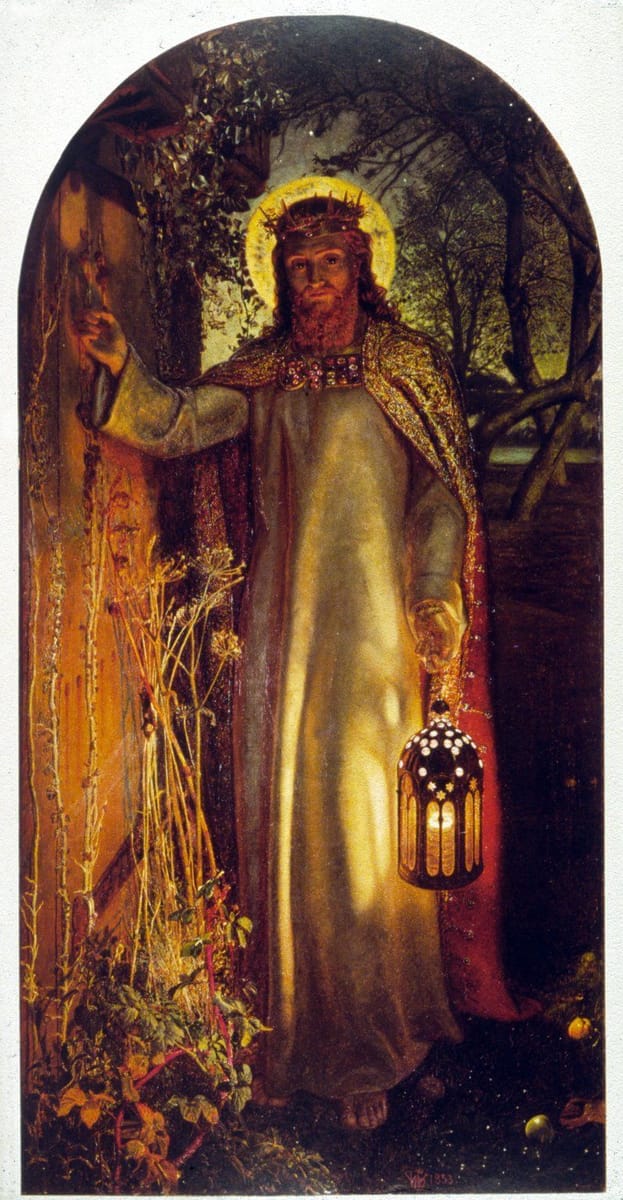
In a piece from the Westminster Gazette on Friday 15th September 1916, the author was forced to defend his depiction of Jesus, and he did so by invoking artistic precedents. When discussing the depiction of Jesus, he pointed out that from the 5th century onward, people had been killing each other over the correct interpretation of the scriptures, but one thing everyone could agree on was that the big JC 'must not be represented as a man.' This is an ecumenical conundrum as I'm guess depicting him as a squirrel would get you dispatched quite quickly, so what to do?  Mercifully, in the 15th century along came Fra Angelico who hit upon the idea of depicting Jesus as a pretty blonde lady and that's apparently fine. George Moore then brought everyone up to date and said Holman Hunt showed us a big girly Jesus knocking on the door, like a Holy Avon Lady. If the Pre-Raphaelites gave their Jesuses (multiple Jesus would be Jesi?) lady-faces then it's fine to have a lady-like Jesus in The Brook Kerith. Actually, having read the criticism of The Brook Kerith most of it is about the fact it's rubbish, and seeing as George had a reputation for writing saucy, scandalous books, I'm guessing the critics were already jumpy every time he published something new. So, George Moore's argument was that the Pre-Raphaelites made their Jesi look like chicks, so what's the big deal? Apparently, even the boy child Jesus in the Millais painting was a girl (according to George)...

Christ in the House of His Parents (1849-50) John Everett Millais

We then enter Round Two of the Big Girly Jesus fight, and on 21st September, Canon Horsley (an actual vicar and everything) weighed in on behalf of the enlightened church and said that if we are going to bring the Pre-Raphaelites into it, only a few people hated the painting and everyone else loved it (apparently). He finishes it up with a quote in Latin, which is always the best way to finish because no-one knows what you're talking about. Finally, and most sensibly, on the 25th September there was a letter from someone who really didn't seem to care if The Brook Kerith was any good but at least everyone could get their facts straight about the Pre-Raphaelites. The author of the letter was Mr Robert Ross, art collector, intimate of Oscar Wilde and all-round excellent chap. For starters, he said that the boy child Jesus in Millais painting was Noel Humphreys, the son of an architect, so George was talking absolute rubbish there but when it came to depictions of adult Jesi, Robbie Ross could give a few examples where it was the case that it was a lady...

The Light of the World (1851-3) William Holman Hunt

As Robbie says - 'Mr Moore remarks on the effeminate concept of Christ in the Pre-Raphaelite pictures, and the circumstance that a woman (Christina Rossetti) acted as the model for Hunt's Light of the World. There are other striking examples: Miss Siddal (Mrs Dante Rossetti) sat for the Christ in Madox Brown's picture of Maundy Thursday or The Washing of the Feet; and in Spencer Stanhope's picture, I Have Trodden the Wine-Press Alone - one of the most singular works of that unequal artist - Miss Ellen Terry posed for the figure of Christ.'

Jesus Washing Peter's Feet (Maundy Thursday) (1852-6) Ford Madox Brown

The Wine Press (1864) John Roddam Spencer Stanhope
In the Illustrated London News  of 1865, it was suggested that The Wine Press was very much after the manner of The Light of the World, an opinion repeated in books since and possibly reflecting that although it was painted in 1864, it was conceived years earlier, possibly nearer the time of Hunt's painting.  Robbie Ross finishes his letter suggesting that George Moore like to consider Henri de Groux painting Christ Aux Outrages (1889) as his frontispiece as it had been on is mind while reading George's book as it features a very feminine Christ.

Christ Aux Outrages (1889) Henri de Groux

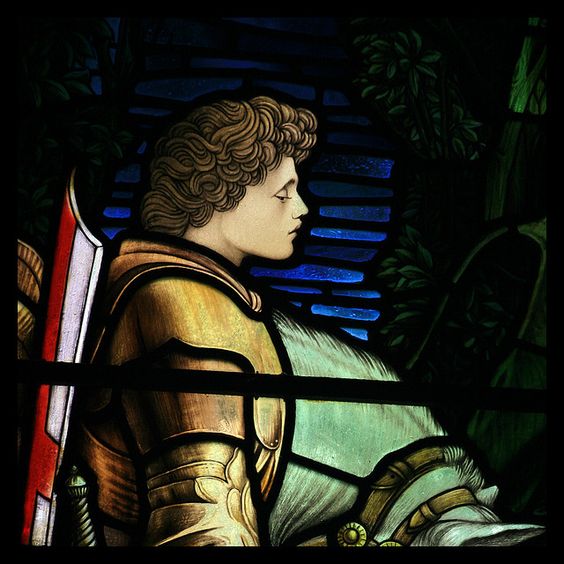
All these feminine figures for Christ left me wondering why no-one had reacted before.  I fully trust Mr Ross in his recollections, but also because we know that Holman Hunt used a few women for his Christ, and also Ellen Terry had form for posing as a chap.  Here she is as Sir Galahad, in a stained glass window from a painting by G F Watts...


...and here she is again, as a knight.  Maybe she just liked wearing the armour...?

Watchman, What of the Night? (1867) G F Watts

The stained glass window is in Freshwater on the Isle of Wight, where Julia Margaret Cameron routinely got girls to dress up as men...

Head of St John (1866) Julia Margaret Cameron

May Prinsep looks rather sombre as the head of John the Baptist (although seemingly very much still attached to the neck of John the Baptist). The place the girl/boy swap happened most often was with the Holy family...

The Holy Family (1864) Julia Margaret Cameron

The Madonna, or Mary Hillier, appears repeatedly in Julia Margaret Cameron's photographs, almost always clutching children of various sizes. Here she is clutching John the Baptist and Jesus, or Kate and Alice Keown as they were better known.  There are the occasional boys, for example Percy Keown, Freddy Gould or Julia's own grandson, Archie, but by and large, it's the Keown girls who are appearing as the various sainted boy-children. Freddy Gould was a very pretty little boy indeed, and he made a popular model, but the other boys are babies and so are fine while asleep but I'm guessing not the best models while awake. 

The Little Foot Page (1905) Eleanor Fortescue Brickdale

I think therefore the answer to why the Pre-Raphaelites used women as men is less to do with artistic tradition and more to do with availability.  As Robbie Ross pointed out, Millais used a boy as Jesus, not a little girl, so there was not an adherence to any ecclesiastical artistic tradition there.  The women brought in to model were friends, wives, sisters and lovers, therefore to hand and with nothing better to do (in the opinion of the artist). The Pre-Raphaelite ideal was to draw from life so if the only life you have to hand is Christina Rossetti then she better strap on a beard because she's going to be Jesus. Also, just because Elizabeth Siddal is washing some grumpy chap's feet as Jesus, it doesn't mean that she looks anything like what appears on the canvas, especially not in the topless version. Just because Walter Crane gave his (male modelled) Venus a six-pack in The Renaissance of Venus (1877) doesn't mean the Siddal Jesus had to have boobs...
Walter Crane, giving us a Venus who is more manly than Jesus...

In conclusion, art is often a combination of opportunity and tradition.  The male figures who are drawn from women are thus because women were to hand. If you asked me to name female artist's models, I could go on for ever but ask me to list male ones and I'd get a bit stuck after the hot Italian who was Julia Margaret Cameron's Iago. Women were to hand in the studios and houses of artists and although the faces (and six packs) of figures might have been finished from male models, preparatory sketches, emergency posing and all that stuff was more than likely done by a woman can yell for. If the tradition for painting Jesus is towards the feminine, then using Christina Rossetti to hold up your lamp is not outrageous as the finished figure has a great big bushy beard.  What surprises me is that Julia Margaret Cameron got away with May Prinsep as John the Baptist, looking completely like a girl and not really different from when she is posing as Zoe of Athens, Beatrice or just a portrait. There is no theatricality to her image (which is a surprise if you consider how Amateur Dramatics some of her Arthurian work is), it is a photograph of a head who also just happens to be a pretty girl. If you consider how devotional and religious Julia Margaret Cameron's work is, I'm surprised that no-one questioned it.  

Maybe they did and people just blamed Fra Angelico...


Thursday, 3 October 2019

National Poetry Day 2019: On a Portrait

Happy National Poetry Day to you all.  I am in the midst of book-writing and so I bring you a poem by Julia Margaret Cameron on the beauty of a portrait...

May Prinsep (1866) Julia Margaret Cameron

On a Portrait
September 1875

Oh, mystery of Beauty! Who can tell
Thy mighty influence? Who can best descry
How secret, swift, and subtle is the spell
Wherein the music of thy voice doth lie?

Here we have eyes so full of fervent love,
That but for lids behind which sorrow’s touch
Doth press and linger, one could almost prove
That Earth had loved her favourite over much.

A mouth where silence seems to gather strength
From lips so gently closed, that almost say,
“Ask not my story, lest you hear at length
Of sorrows where sweet hope has lost its way.”

And yet the head is borne so proudly high,
The soft round cheek so splendidly in its bloom,
True courage rises thro’ the brilliant eye,
And great resolve comes flashing thro’ the gloom.

Oh, noble painter! More than genius goes
To search the key-note of those melodies,
To find the depths of all those tragic woes,
Tune thy song right and paint rare harmonies.

Genius and love have each fulfilled their part,
And both unite with force and equal grace,
Whilst all that we love best in classic art
Is stamped for ever on the immortal face.

Saturday, 2 May 2015

Good Morning May, May You Never Be June

So yesterday we got as far as May Prinsep's marriage to Andrew Hichens in 1874 and the Cameron's move back to Sri Lanka (Ceylon) in 1875.  Andrew wrote to May's brother Harry that he considered the Cameron's move to be 'total madness', but then the family finances were stretched to breaking and they had to make a move.  It is certain that they were greatly missed and sadly never to return, Julia dying in 1879 and her husband in 1880.

The Ulster (1874) G F Watts
Andrew Hichens continued to work in Hichens, Harrison & Co (est. 1803)  in Austinfriars, London's oldest independent brokerage and investment firm.  The couple's London home was 27 Chester Street, Knightsbridge and despite the demolition of Little Holland House in 1871, it seems likely that the new centre for the old Prinsep circle was New Little Holland House on Melbury Road, where Watts had a new house and studio built in 1876.  The land abutted that of Frederic, Lord Leighton's house and it might have been there that May met Leighton, sitting for this portrait in 1885...

Mrs Andrew Hichens (May Prinsep) (1885) Frederic Leighton

The Hichens not only kept a house in London but also Monkshatch in Compton, near Guildford, Surrey.

 Monkshatch, Compton, Surrey (demolished 1950s)
Mary Seton Watts described the house as standing high yet sheltered by a chalk cliff from the north and east winds.  The chalk behind reflected back sunlight into the home and made it an idyllic place to live.  May and Andrew used the house at weekends and holidays, spending most of their time in London, so when G F Watts' health failed, the coupled offered him the use of the house in which to recuperate.  Andrew had become as attached to Watts as his wife, writing in a very emotional letter to the artist that 'you need not be told how entirely dear you are to us, and how very nearly all that concerns you touches us.'  When Watts married for the second time, to Mary Seton in 1886, their first stop after the ceremony was to lunch with May and Andrew in Chester Street.

It is undoubted how deeply May and Andrew cared for Watts, 'the beloved little man' as they referred to him.  When the Watts moved into Monkshatch, they turned the living room into a space Watts could paint in, Andrew remarking 'I told you I built that studio for you'.  The Library was theirs to be alone in, but if they wanted company they could roll back the dividing panel and watch Andrew and May at dinner.  Watts remarked to his wife on one such evening 'I wonder if any other roof in England covers four happier people.' When Mr and Mrs Watts finally moved out, they went only a short distance, building a house in the village, called Limnerslease.

May at the window at Limnerslease (1880s/90s)
 The parental figures in her life slowly vanished as Henry Thoby Prinsep died in 1878, followed by Aunt Sara in 1887.  Watts died in 1904 and two years later Andrew died at Monkshatch on 27th August 1906.  He was cremated and his ashes interred at the beautiful cemetery that surrounds the Watts Chapel.

Two years later May's brother paid a visit from Australia and it was the first time he had seen May since 1866.  Harry Prinsep (1844-1922) had visited his father's estate in Australia (also called Belvedere after the estate in Bengal) whilst on his 'grand Tour' after schooling and fell in love with the land and a woman.  Even on the other side of the world he had run into old friends.  Having met the Tennyson family while staying with family in England, he became firm friends once more with Hallam Tennyson, son of the Poet Laureate, while Hallam was serving as Governor of South Australia (1899-1903), then Governor General of Australia (1903-4).

Hallam Tennyson (1896) Alexander Bassano
In 1918, younger brother Jim Prinsep wrote to Harry : 'It's a profound secret...you'll be able to swagger a bit by referring casually to 'my brother-in-law, who was formerly Governor-General'.  What Jim was alluding to was the marriage of May to Hallam in July of that year.  Both were free to marry but the reason for the secrecy may well have been because of the events which had preceded the marriage. Hallam had been married to Audrey Boyle in 1884, inheriting his father's title on the poet's death in 1892.  They had three sons, Lionel, Alfred and Harold, all of whom served in the First World War. Harold died in 1916, aged 19, when his ship, the Viking, hit a sea-mine in the English Channel. Possibly due to the affect of this tragic loss, Audrey died in December of the same year. In March 1918, Alfred died in action at the Somme.  Even though he had been a widow for two years, it is unsurprising that May and Hallam wished to get married quietly in the midst of such sadness.  They were wed at South Stoneham Church, Southampton, on 27th July 1918.


South Stoneham Church, Swaythling, Southampton
As Lady May Tennyson, she kept Monkshatch in Surrey, but also lived on the Isle of Wight at the Tennyson family home, Farringford. She became a benefactor for local causes, helping to set up a local cottage hospital, a cause dear to Julia Margaret Cameron's heart during her time in Freshwater. In 1925, May donated £800 to purchase an ambulance manned by volunteers and administered by Miss Waistell and Miss Life, members of the Red Cross...

Miss Waistell and Lady May Tennyson 1925
(image from Lincs to the Past website)
In 1928, Hallam died at Farringford.  May moved to the Dower House at Glenbrook St Francis, overlooking Freshwater Bay.  Dower House is the house nearer the sea in the image below.  Here she established a library of improving books.


She died 19th July 1931.  Hallam is buried in the family tomb at St Mary's Church at Freshwater, alongside his mother and first wife.  On the wall of the church is a plaque to May...

Tennyson tomb, overlooking the River Yar, Freshwater
Not far along the row are the graves of Henry and Sara Prinsep

Plaque to May inside St Mary's Church
May was cremated and her ashes returned to Compton where she shares her final resting places with Andrew Hichens...

Ashes interred at Watts Memorial Chapel cemetery, Compton, nr Guildford

Detail of above
So ends the story of a beautiful woman, much loved and remembered by the Tennyson Memorial Ambulance, still running today (they renew the model regularly, its number plate VDL1).  The title of this piece comes from an article by Blanche Warre Cornish in 'Personal Memories of Tennyson' (published in the London Mercury, 1921-22).  Warre-Cornish remembered the poet laureate, walking through Freshwater on a sunny day, a verse or rhyme for each friend or child he passed: 'Good Morning May, / May you never be June for the ever-loved May, once May Prinsep, as she stood in the green porch of Mrs Cameron's door.'

All Her Paths Are Peace (1866) Julia Margaret Cameron
It seems right that a woman who held so much affection for both her family, her adopted family and the people of her community should herself be remembered with love.

To find out more about May's brother Harry, Malcolm Allbrook's Henry Prinsep Empire is free to download here.

May Prinsep, My Princess

Welcome to a weekend of posts about a beautiful woman, which is always a good thing. Hers is the face that gazes out of many of Julia Margaret Cameron's photographs, and her life is like a page out of who's who.   This weekend I will be talking to you about the wonderful May Prinsep...

Elaine (1874) Julia Margaret Cameron
Any of you who have studied Victorian art or society will have come across the name 'Prinsep'.  The family had reach and influence of exciting proportion and anyone who was anyone found their way to their homes and tables. May, born Mary Emily Prinsep, was the daughter of Charles Prinsep, standing counsel to the East India Company and Judge Advocate General of India.  Born in Khidirpur (Kidderpore) in Kolkata (Calcutta) in 1853, she was one of eight children, six of whom survived infanthood.


The Prinsep children: (from left) Annie, May, Harry, Jim and Louisa (Charlie is missing)
(from Henry Prinsep's Empire by Malcolm Allbrook)

Connected closely with the presence of England in India and the growth, spread and success of the East India Company, the family lived in Belvedere House in Kolkata, here shown in a painting by May's uncle William Prinsep...

Belvedere House (1838) William Prinsep
May's mother, Louisa, was the daughter of Lieutenant Colonel Henry Lewis White of the Bengal Army. 1855 saw the birth of youngest Prinsep child, James (also known as Jim), followed by Louisa's death. Probably connected to this, Charles suffered a debilitating stroke, causing the family to return to England.  By the 1861 census, the family are settled in the comfortable town of Walton on Thames in Surrey.  Charles and four of his children lived on Church Road (just near the Aldi, which is handy).  Eldest brother Charles John (Charlie) had returned before his family to attend school in Brighton, then back to India with the 19th Hussars.  Left paralysed  by his stroke, Charles senior's health continued to decline and he died in 1864.  At that point the children went to live with their plentiful relatives, May making the journey to live with her Uncle Henry Thoby Prinsep and Aunt Sara at Little Holland House...

Little Holland House in the 1860s
Home to the Prinseps until its demolition in 1871
Henry Thoby Prinsep, younger brother to Charles, had also been in India, working in the legal system and the East India Company until his return to England in 1843.  By the end of the 1840s, he and his family had moved into Little Holland House, the dower house of Holland House in Kensington, London. Uncle Henry was married to Sara Monckton Pattle (sister to Julia Margaret Cameron) and among their children was the painter Valentine Prinsep. May became a member of the Little Holland Household and became known as 'the vision of beauty' (according to Mary Seton Watts in The Annals of an Artist's Life) as can ably be seen in her cousin's paintings of her...

May Prinsep (1868) Valentine Prinsep
May Prinsep and her Persian Cat Valentine Prinsep
George Frederic Watts had taken up residence at Little Holland House in 1850 as part of the ever-growing Prinsep household, his life dedicated to his art under the maternal care of Sara Prinsep.  Mary Seton Watts recalled that while staying there, Watts worked with 'arduous devotion' to his painting, his only break being a daily ride which he took for his health and his companion was more often than not May.  May's own devotion to Watts began in this time and it is unsurprising that her attachment to him, so soon after the death of her father, took a lifelong paternal slant. He also used her as a model in a handful of works from this period...

May Prinsep (c.1867) G F Watts


Prayer (1869) G F Watts

There will be more of Watts in tomorrow's post...

Being such a large yet close-knit family, it seems almost inevitable that May would find herself in Freshwater Bay, at the home of Julia Margaret Cameron.

The Neopolitan (1866) Julia Margaret Cameron
Spending several of her summers on the Wight, May quickly became part of Cameron's artistic vision, appearing in scores of her pictures for the next ten years.  Alongside the faces of her maids and neighbours, Cameron imagines May as a beauty of historic measure, in photograph after photograph...

Christabel (1866) J M Cameron

Beatrice (1866) J M Cameron
May (1869) J M Cameron
In 1870, Cameron took a series of photos of May one of which was entitled Pre-Raphaelite Study...

Pre-Raphaelite Study (1870) J M Cameron
Whilst it is likely that Cameron was influenced by various artists in the making of her Pre-Raphaelite Study, I agree with Graham Ovenden (amongst many) who suggest that the engraving of William Holman Hunt's Isabella and the Pot of Basil (left) in 1869 seems the most overt influence over the pose held by May in this picture.  It was believed to be a snub for Rossetti in some way as he refused to meet or pose for the photographer, but more likely it was just straightforward praise and inspiration from another artist and a very popular print of the moment. Cameron also knew Hunt, having taken his picture in 1864, dressed in his Eastern garb.

William Holman Hunt (1864) Julia Margaret Cameron
You could track the visits made by May by her occurrence in Cameron's work, all through the beginning of the 1870s. George du Maurier (cartoonist and author) described a visit to the Wight at the beginning of the 1870s when he met a young stockbroker, also on holiday: '...a very good looking chap of 40 with loads of tin - He has hired a yacht of 64 tons and is going to take us cruising about the island'.  That 'good looking chap' was Andrew Kinsman Hichens, who may have been already acquainted with May and her household from London but it was no coincidence that he was in Freshwater at the same time as she was. He was brought in to pose for Julia Margaret Cameron in a suitably romantic fashion for a photograph entitled Gareth and Lynette. This was her aunt's way of heralding a marriage as May and Andrew were married at All Saint's church in Freshwater on 10th November 1874...

Gareth and Lynette (1874)
It is an interesting subject to have as a wedding piece for the couple, taken from Idylls of the King and I wonder how much could be read into the fact that Lynette is quite a difficult character until she realises the true worth of Gareth?  Anyway, the couple were married and less than a year later the Camerons move away from the Isle of Wight, back to Ceylon (modern day Sri Lanka).  Andrew and May lived in London and Compton, a small village outside Guildford in Surrey, but that is not the end of her story by any stretch.

Join me tomorrow for part two...


Sunday, 1 April 2012

The Art of Dressing

Pity me.  I had to go clothes shopping yesterday and I loathe buying clothes.  I can never find what I want, or something that fits me, or makes me look like the supermodel I so patently am (were it not for the ill-fitting clothes.  Oh yes, it is the clothes that are to blame).  Well, eventually I found a top I quite liked and I told Mr Walker that it reminded me of one of the Icelandic blouses worn by Jane Morris.  Apparently, saying that out loud in T K Maxx can attract some funny looks, but then next to us was a man arranging someone's divorce loudly on his mobile phone, so really, he should have attracted funnier looks than me.

Me in new Spring blouse.  Just out of shot are gambling rats and crows.  Ahh, Spring...
As I wandered around, attempting to find an outfit for two parties I am attending, I began to think wistfully of long gowns of rich coloured silk, or possibly velvet.  Sigh, something like this....

Not currently stocked at M&S, apparently. Damn.
I have often voiced the opinion that I would happily wander around dressed like Mrs Nassau Snr, but am usually given the reply that I would 'look like a mental'.  Thinking about it, I wonder if Mrs Nassau Snr ever had a similar worry, because what she was wearing wasn't exactly fashion...

Going back to the beginning, around the middle of the nineteenth century, the position of artists in society changed.  Successful artists enjoyed prosperity and social position, and seemingly more people from prosperity and social position wanted to become artists. The influence of the 'artistic' began to spread, particularly in terms of interior decor and dress.  I have one word for you: Morris.

Mariana D G Rossetti
Jane Morris (1865)


If you weren't sitting on his chair, or hanging his wallpaper, you may well have been considering dressing like his wife.  Jane made her own dresses and the album of photographs owned by Rossetti show her in a sumptuous frock that hangs in a mass of folds and pleats.  In some of the paintings he did of her, Rossetti shows her dress belted, but the waist is a natural one, uncorsetted.

Elizabeth Siddal D G Rossetti
Similarly, Rossetti's plenitude of drawings of his beloved Lizzie show her in simple gowns with pleated bodices and full, loose skirts.  There isn't a corset in sight, even Fanny and Alexa abandoned them.

Alexa (1866)
Fanny (1863)


It's easy to become used to the look of Pre-Raphaelite women when you look at them every day.  My image of 1860s tends to look like the pictures above, rather than what was actually fashionable dress of the time, which was more like this...

Last time I saw a dress like that, the doll on my Granny's loo roll was wearing it...
Heavens to Betsy, look at the frills.  Oh, the horror.  Oh, and when you sit down in a crinoline, the hoop shoots over your head so everyone can see your pants.  Don't ask me how I know that.  Anyway, thinking about it, there must have been some shock that Jane, Lizzie et al actually dressed like the art they appeared in.  I think it's no coincidence that all of Rossetti's models above could sew and did sew their own dresses, or alter ones that he had in his prop box.  They had no more chance of wandering into a shop and buying their dresses as I have.

Choosing G F Watts
Above is a very familiar image of Ellen Terry, the child bride of G F Watts.  What I didn't realise is that she is wearing her wedding dress in the picture, and that dress was designed by Holman Hunt.  Ellen Terry does not seem to have changed her manner of dressed, even when she knew what she wanted to be when she grew up (answer: an actress who wasn't married to G F Watts).

Ellen Terry (1870s)
The influence of one of the most famous actresses of the period must have been felt on the world of fashion, but greater still was G F Watts involvement with the Pattle Sisters, or the households of Prinsep family and Julia Margaret Cameron.

Untitled (c.1870) Julia Margaret Cameron
The above picture, possibly of her niece May Prinsep, shows a young woman in a dress similar to Elizabeth Siddal's, almost a decade before.  This doesn't seem to be a matter of fashion coming around again, but fashion just not changing.  Her dress is also very similar to the gown worn by Alexa Wilding in her photo, above, mid-decade.  Once the fashion for simple gathered frocks reached Little Holland House, home of the Prinseps, its fashion status seemed set.  Once it was adopted by The Souls, it reached saturation.  The Pre-Raphaelite, or Aesthetic style was shorthand for free-thinking, free-flowing, artistic society.

Detail of A Private View at the Royal Academy (1881) W P Frith
The woman in yellow on the left is wearing a dress reminiscent of the Pre-Raphaelite frocks, and  much like Edward Poynter's portrait of Lady Elcho.

Mary Constance Wyndham, Lady Elcho (1886) E J Poynter
I'd love to see the above portrait in real life, but it's still in private hands, hence the only reproduction I could find was on the front of a book.  As things often go, as soon as the anti-fashion of aesthetic dress became fashion, it also drew rather negative attention.  The loose waists were seen as reflecting loose morals, and a sort of ill languor and deluded alienation from reality infused depictions of them by George du Maurier in Punch magazine between 1873-1882.


Patience, where the gentlemen were dressed like Oscar Wilde and the ladies wore gowns of liberty prints.

Oscar, lolling artistically.
Possibly Wilde's arrest in 1895 put a dampener on gentlemen's artistic dress, but 'artistic' dress continued, due to a feeling of rational, liberating movement for ladies, and the endless need for counter-culture.

The Agate (The artist and his wife) 1911 Joseph Southall
Mind you, check out the knee breeches of Joseph Southall, very Oscar Wilde.  Fifty years after Elizabeth Siddal wore a flowing gown without a corset, another artist's wife had donned simple elegance in rejection of the flounces and squeezing of contemporary fashion.

So, I think my path is clear.  As I find myself somewhat more Alexa Wilding than Alexa Chung I must take up my needle and thread and sew myself an artistic wardrobe full of silks and embroidery.  Mind you, Darling Oscar once said 'After all what is fashion? From the artistic point of view, it is usually a form of ugliness so intolerable that we have to alter it every six months...'
M&S might be stocking aesthetic gowns by the end of the summer.  Fingers crossed...