Showing posts with label John Collier. Show all posts

Friday, 30 May 2025

Miss Mab Paul is Too Good at Kissing

 I seem to begin every post at the moment with 'This is going to be a bit ramble-y/cross' but I promise I'm not intentionally in my Grumpy Era.  However, saying that, this one is going to a bit ramble-y and grumpy. Sorry in advance.  I'm also writing this in order to sort out how I feel about the use of young girls in art. Yikes.

Look Out! Teen Knockers Alert! (Allegedly)

I'm sure we all remember the 2018 controversy over the removal of Hylas and the Nymphs (1896) by John William Waterhouse from the walls of Manchester Art Gallery.  Depending on who you believed, it was due to the objectification of women (crikey, there will be nothing left on the walls of most museums that this rate!) or raising awareness of how young the models were (without any actual proof that the models were young or not acting with what agency they had etc etc) or just because they fancied a shufty round of some paintings and a bit of controversy is always fun. Well, while I roll my eyes at most of this because it is a crap way to have a conversation, I was particularly miffed that we can't seemingly have a nuanced conversation about Victorians and woman/girls without imposing what we think we know all over it.  Also, this is not a good painting to use if you want to tak about women/agency/girls stuff etc as it is literally a painting of a bunch of girl-sprites about to murder a bloke because they can, and they suffer absolutely no repercussions at all.  Yay! Girl Power! I do beg your pardon, how very naught of them.  Anyway, I think there is a conversation to be had about how we view art works and more essentially the men who paint them, and possibly a good place to start is Miss Mab Paul...

Mab Paul (c.1905)

As you can see from this postcard of Miss Paul, she was an actress at the turn of the 20th century, hence my interest in her. However, before there was Mab Paul, there was Mabel Hall, artist's model, hence my very great interest in her indeed. Mabel was the third daughter of Richard Hall and Frances Paul (hence the adoption of 'Paul' as her stage name).  Richard and Frances had married in the late 1870s and were comfortably middle class, showing up in the 1881 census living in Kensington, Richard engaged as a Verger. For some reason (no doubt ecclesiastical) by the time Mabel was born in 1882, the family were out in the colonies and little Mabel entered the world in Uttar Pradesh in India. The family had returned by 1887 when Richard jnr was born (in London) and Daddy Hall had moved from the clergy to running a club of some sort. He was also a Chelsea Pensioner, so I'm not entirely sure I can work out his working life at all, but the family all seemed to do okay, and during the 1890s Mabel and her elder sister Edith (b.1878) had become artists' models. I'm going to ease you in slowly, as it gets a bit dodgy. Let's start with John Collier...

The Laboratory (1895) John Collier

Mabel is 13 years old. The painting was fairly well received, although it was felt by some newspapers to be a bit old-fashioned.  Mabel was referred to as the 'fair visitant" purchasing poison (according to The Gentlewoman) or the 'imperious beauty' who wishes to kill her rival (according to the Evening Star).  So, how do we feel about 13 year old Mabel? Hold that thought...

Lady Godiva (1897) John Collier

Have we all done our maths?  Good.  This is 15 year old Mabel (I'm being generous as I'm guessing this was painted when she was 14) naked on a horse. The Coleshill Chronicle called the painting 'frigid and prosaic' which is a bit rude. The London Evening Standard saw that this Lady G was very young, which is something, and they felt that she was charmingly painted, but no-one raised the question whether or not this child should have been naked on a horse in the first place.

The Prodigal Daughter (1903) John Collier

Also, John Collier gives us Mabel in a very dramatic piece.  Aged 21, Mabel is the prodigal daughter, returning to shock her parents in her frankly awesome dress. I wonder if this was a response to the fact that Mabel had indeed taken to the stage by this point, but I'll come back to that as Mr Collier wasn't Mabel's only employer...

Mabel Hall and Ethel Warwick (c.1899) Edward Linley Sambourne

I came across Mabel first when looking at Ethel Warwick's time with Edward Linley Sambourne.  I obviously wanted to know more about this girl that Ethel posed with. Ethel and Mabel were the same age, both 16-17 in this image.  I have chosen my images carefully for this bit, as I will explain.

Mabel Hall (1900) Edward Linley Sambourne

I have such complicated feelings about Sambourne and his photographs.  I must at this point say that the staff at Sambourne's house are amazing and have been no end of help with my investigations into Ethel's time with Sambourne.  I do need to tread very carefully and pick my words.  To start with, Mabel began modelling for Sambourne in January 1899 when, as he wrote in his diary, she was 16 years old, 'very elegant' and 'very tall'.  According to the excellent catalogues Public Artist, Private Passions, Sambourne (born in 1844, so just shy of 40 years older than Mabel) was definitely smitten by his teen models, although he did them no harm that we know of and provided these working class young women with a safe and comfortable living.  I have a lot of questions about the Camera Club in London, founded in 1885, as the majority of Sambourne's naked teen images are taken there.  Also, the above image of Mabel on her own is one of a pair where she is naked in exactly the same pose. I also have questions about why he needed images of the girls naked in the same poses as when they were dressed.  Don't say it is for artistic reasons because we all know it isn't.

Mab(el) in 1902

Like many of Sambourne's girls, Mabel did not remain long in his employ, and like Ethel Warwick, she headed for the stage.  Mabel Hall became Mab Paul, and whilst posing for Sambourne in 1900, she was also treading the boards in Plymouth, selling chocolates at a charity performance at the Theatre Royal. By 1902, Mab had a beautiful full page photograph in The Sketch (above) for her role in Ulysses at Her Majesty's Theatre in London, which also appeared in Tatler. Collier actually painted 'Mab Paul' in 1901 while she was performing in Beau Austin in Henley...

Mab Paul (1901) John Collier, from the Tatler

My favourite review of Mab's acting is from The Stage in June 1902 when she appeared in the comedy Lord of His House.  Whilst the paper liked Mab's performance, they felt that she might 'wisely tone down the kissing...young women may act so, but I think that a gentleman of refinement would want to back out if he found that the young lady who a moment before was "Miss Jones" is permitting him to kiss her décolletée, shoulders and giving hearty busses on the mouth.' Well, that's us told.  Sorry Mab, you are just too good at snogging.

Mab, c.1910

A bit like Ethel Warwick, Mab made her way over to Australia to perform around 1910, and remained there until at least 1916 when she seems to have vanished.  I am currently waiting for a couple of books on Australian theatre of this period, but if anyone has any knowledge about how there was seemingly such an easy transition from the West End to Sydney, I'd be delighted to have a chat.  A few people seem to have her death date in the 1930s but as I don't know if she married, I can't find that out. I hope she had a long and happy life, but knowing my luck probably not. However, what we can say is that her career began at 14 and her experience as an artist's model, no matter how young, enabled her to progress into the theatre.

Mab, in the Sporting and Dramatic News, 1903

So, I think my point is we need to have a nuanced conversation about girls in art. I feel very differently looking at Collier's Lady Godiva and one of Sambourne's nudes, but should I? Especially when you consider that Collier was drawing a literal schoolgirl for his naked lady (she was at Honeywell Road School in 1895) whereas Sambourne does not seem to have employed a girl below 16. Both Collier and Sambourne were much older than Mabel and were producing works that would be consumed by older men, so should we feel protective? Arguably, Collier's art output was entirely for public consumption, but how do we know?  We only know that Sambourne took and kept the nude images independent of his cartoons because there is an archive of them. If we are outraged and remove a painting just because a girl is 14 years old, we are ignoring the fact girls worked in the adult world at 14.  My grandmothers were both working away from home at that age, most probably in jobs that paid less than what Mab was getting from Messrs Collier and Sambourne.  I think my point is that a 14 year old working-class girl had agency to earn money and by hiding paintings, historians are indulging in benevolent sexism, wishing to protect girls who arguably do not need protecting. As far as we know, Sambourne, creepy though I find him, did no-one any harm.  The exploitation that Collier, Sambourne or their ilk indulged in was entirely intellectual - the girls had no say in the way their image was used (or abused) after it was taken, but I very much doubt that either of these men considered what they did to be exploitative.  If Waterhouse (to go back to the ravenous nymphs) really did pay a bevy 14 year old girls to pose naked in a duck pond for his painting, he was paying them.  They could equally be paid possibly less money to work long hours in physically exhausting conditions. At least no-one got an arm ripped off in a loom while posing as Lady Godiva.

Mab in Ulysses, 1902

So, in conclusion, we need to separate our modern sensibilities from the realities of life as a working class person in the nineteenth century when looking at the art of the Pre-Raphaelites and their followers.  To remove a painting off a wall because you feel the subjects are being exploited is negating the work of those girls who received a wage for their time.  Just because you feel squeamish seeing a 14 year old naked, it doesn't mean you get to cover up the agency she had to go out their and earn her money.  Also, branding every male artist that employed a 14 year old model as some sort of predatory animal is also problematic.  We can talk about the power imbalance, we can talk about how uncomfortable it makes us feel, but in the end we should admit that how we feel doesn't have supremacy over historic reality and young female agency. One thing is for certain, shoving it in a cupboard isn't going to help.

Saturday, 25 February 2023

Herself an Artist of Some Repute

 Here we are again with another wife of an artist who was also an artist, my current obsession.  Again, I get to be disappointed in myself as I love this woman's husband so why hadn't I taken more notice of her?  Interestingly, some of what I'm about to talk about I mentioned in this post back in 2015 (when we were all so much younger and gayer etc etc).  That was a post on the smashing John Collier and today we're going to talk a bit more about Marian Huxley Collier, his first wife.  Yes, 'first wife', buckle up...

Marian Huxley Collier (c.1860s)

Luckily for young Marian, she was born a Huxley, her father being Thomas Henry Huxley (1825-1895), President of the Royal Society and massive Darwin fan, so there is quite a bit written about her early life in the biographies of her father and family.  Her nephew was Aldous Huxley, so we're not exactly short on details of her, however I am beginning to feel that we lack nuance in certain descriptions, which leads me to my second current  obsession, but we'll come to that later as it's a bit of a spoiler.  Anyway, Little Marian was the Huxley's third child after Noel, born in 1856 and Jessie Oriana, born in 1858.  Marian was only a baby when the family caught scarlet fever in 1860.  Her mother, Henrietta, was pregnant but managed to get through it, 2 year old Jessie caught it lightly and somehow Marian escaped it altogether.  However, 4 year old Noel died and devastated the family.

Jessie Huxley (c.1880) Marian Collier

Luckily, baby Leonard (Aldous Huxley's Dad) was born safely the same year and was followed by Rachel in 1862, Henrietta (or 'Nettie') in 1863, Henry in 1865 and lastly Ethel in 1866.  That is a lot of children very quickly but then they were a wealthy family.  In the 1861 census, the family are in Folkestone, living at Albion Villas with four servants.  Honestly, when there are more servants that employers in a house, you know there is money, especially early in a marriage.  After the death of Noel, in 1861 the fractured family went to stay with the Darwins at Down House (which is very much worth a visit).  Whilst there, according to Adrian J Desmond's 1997 biography of her Dad, Marian was a favourite of the Darwins, who found two year old Marian to be bright and determined.  They recorded that she 'wins golden opinions, but will not be tempted into any demonstration of affection'.  I find that a very interesting comment which possibly says more about the first years of her life in the shadow of her brother's death, than possibly about the child herself.  Known affectionately as 'Mady' or 'Maidy' (I've found both, but mostly the former) even as a toddler, Marian seemed interested in drawing, holding a pen on the lap of one of the Darwin family, attempting to draw her father and getting frustrated when it didn't come out as well as she'd hoped.

Nettie Huxley (c.1880)

Rachel Huxley (c.1880)

For such a science-y family, it is interesting how artistic society overlapped and the Huxley home welcomed in artists such as Briton Riviere.  I'm guessing that intellectuals of a modern age, no matter their discipline, are happy company together. When Jessie and Marian became interested in pursuing art seriously, they would take the Underground to drawing class at the Slade.  Teenage Marian was discribed as a 'skittish tease', flirting playfully with Frank Darwin, and despite being described as 'frail' seems to have had spirit and an interesting disregard for being absolutely proper.  She is also described as being very much like her father, but we'll come to that in a bit.

Sir Richard Francis Burton (1878) Marian Huxley

Marian's talent is easy to see in her pictures from her teenage years.  Her portraits of Edward Hartpole Lecky, Burton and Darwin are all held by the National Portrait Gallery and were done when she was 17-18 years old, which is impressive. An article in the Sketch from 1895 mentioned her time at the Slade as part of an article on the success of the women artists who had attended, which included not only Marian but also Bertha Newcombe who drew the illustrations and also Dorothy Tennant and Evelyn De Morgan.

The Sculpture Class at the Slade

The Life School at the Slade

Marian did well at Slade, and it is possibly while there that she met John Collier.  Collier was the younger son of Sir Robert Collier, former Attorney General, Lord Justice of the Privy Council and heading toward being Lord Monkswell.  I'm not obsessed with how many servants everyone had, but they had 15! This is not a competition, but that's impressive.  Sorry, I was distracted by the army of maids.  Anyway, again conveniently, John's older brother Robert Collier, future Lord Monkswell married Mary, Lady Monkswell, who kept and published her diary (thank you very much Lady Monkswell).  When Robert and Mary were brought to meet Marian as their prospective sister-in-law, Mary described her as 'quite the artist's wife, her hair comes down, she forgot the band to her dress, she is always wanting pins etc.  She is a dear child full of brightness and life.' John was immediately absorbed into the chaotic Huxley family and beloved by his new parents-in-law, his many new sisters and brothers. When Jessie married in 1878, John was instructed to help with seating the congregation, which he did to their approval.  He was described as being small, fair, with good features and glasses.  He stuttered but not when making a speech or acting in a play.  He was clever, a quality that made him perfect for both Marian and her father.

T H Huxley (1875-85) Marian Huxley

In Mary Collier's diary, she recorded how happy John (known as Jack to his family) and Marian were, and how lovely the Huxleys were - 'Mrs Huxley is about 45, she seems to adore her clever husband & has suffered in a way that made my hair stand on end at the story [presumably about Noel]. Old Huxley is a wonderful looking man, such deep piercing eyes, which peer out from between long hairs in his eyebrows in a manner quite uncanny...What I like about the family is the way they all seem to care so much for each other & they are all so very bright.' The repeated mention of the intelligence of the family will become significant later, but I find it interesting how it is a constant mention.  I've also read passing comments that Marian was extremely pretty but for once the descriptor used is intelligence.  I would be delighted if I didn't know that there is a bit of hindsight at work in a lot of these descriptions and I wonder if Mary Collier's editor had the outcome in mind when presenting Marian in the diary.

Treasures  (c.1878-82) Marian Collier

Anyway, the Huxley and Collier families were joined in marriage - thanks to Mary, we have a bit of a description - 'Marian's rosy face looked extremely happy & the cream coloured satin hung well on her long slim figure.' However, poor old Mary didn't catch much of the wedding because she had to keep her son 'Bino' (known to everyone else as the 3rd Lord Monkswell, Robert Alfred Hardcastle Collier) from shouting the house down, aged 4.  The wedding was a meeting of science and art, with guests such as Joseph Hooker, Herbert Spencer and the Alma Tademas (Mrs Alma-Tadema was wearing a 'most wonderful garment which looked like a cream coloured pillow case').  As the couple departed for honeymoon, Mary noted 'I never saw two happier brighter faces'.

John Collier (1882-3) Marian Collier


Marian Huxley on her Wedding Day (1880) John Collier

The beginning of their married life seems idyllic.  They were wealthy, living in More House which had been designed by Frederick Waller, Marian's cousin, at 52 Tite Street.  Their neighbours over the years included Whistler, Singer Sargent, Wilde, Anna Lea Merritt and all manner of other famous artistic sorts (see Devon Cox's The Street of Wonderful Possibilities for details). In February 1880, they took part in a play written by Jack and Walter Pollock, and Walter joined them in the performance.  Mary's description of the group gives an idea of what you could get away with if you were posh and it was a play - 'We have had several most amusing rehearsing dinners and teas.  Last night I declare it was a perfect orgy, the more Walter embraced Marian in the last scene the more angry Jack became. I roared with laughter. I have a very small part in which I make violent love to Jack so I don't mind.'  For the play, which seemed to centre around an artist and his model (played by Walter Pollock and Marian), John Collier produced a portrait of his wife in a big white hat.  The play had four performances with about 110 people in the audience each time.

Marian's portrait of her sister Nettie was exhibited with her husband's portrait of her in the Grosvenor Gallery in 1880, and her painting The Gambler's Daughter was hung well at the RA beside a multitude of John's paintings. It is interesting to see what pictures of theirs were hung at the same exhibition, for example this one...

The Rehearsal (1882) Marian Collier

...was hung in the same exhibition as this one...

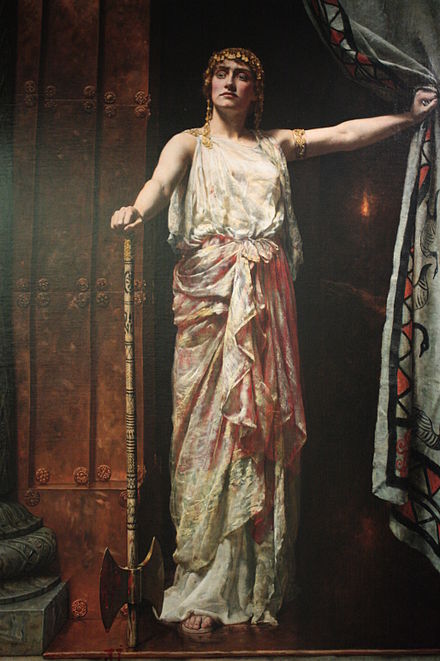
Clytemnestra (1882) John Collier

In the 1881 census, John and Marian, awaiting the completion of their new home in Tite Street, are listed as staying with his father on the Chelsea Embankment with the 15 members of staff (15! sorry).  He is listed as a painter and Marian has no profession, which enrages me no end, especially as they are literally hanging in the same galleries and shared a studio.  In 1882, Marian was included in the Lancashire Ladies Art Society Christmas exhibition, alongside artists like Lady Butler, Florence Claxton, Kate Perugini and Louise Jopling.

Marian's paintings drew very favourable reviews, for example By the Tideless, Dolorous, Midland Sea of 1884 was described as 'one of the most successful' depictions of a nude figure - 'The figure is drawn with surprising skill and obvious knowledge of form and all its varying delicate contours are admirably modelled.' Her portrait 'of a handsome girl' was praised in 1884 in the Freeman's Journal because it would 'haunt many memories this season'.  The paper was quick to point out her connection to John Collier - 'wife of the portrait painter and like Mrs Alma Tadema, painter as well as a painter's wife.'   Blimey, I wonder how Laura Alma Tadema felt about being part of such an illustrious club? Marian's illustrations for Little Songs for Little Voices by Alfred Scott Gatty seems to have come into print in around 1880 and remained reprinted for the rest of the century. The Graphic called the pictures 'excellent, and will charm not only intelligent children, but also their parents and caretakers.'

Illustration for Fairy Bells from Little Songs for Little Voices

In 1884, Marian gave birth to Joyce, the couple's first and only child.  According to biographical accounts, Marian suffered overwhelming post-natal depression, refusing to leave her bed or eat.  John employed 2 attending maids and a nurse who specialised in 'melancholia'.  Her recovery was gradual but eventually she returned to the studio and to exhibiting. I can't find much record of her exhibiting between Joyce's birth and 1887 in the newspapers, in fact one of the few mentions is of her brother Leonard's wedding (to the niece of Victorian poet Matthew Arnold) in 1885.  John and Marian are on the guest list and they gave an opal ring, but unlike Ethel and Nettie Huxley who were bridesmaids and Henry Huxley who was a groomsman, there is no mention of the Colliers actually attending. In one of the biographies of her father, Marian is described as taking 18 months to recover from post-natal depression, possibly explaining why they were absent from Leonard's wedding.

By 1887, Marian's health was not good.  Her father wrote after visiting her that he couldn't bear her unhappiness 'when she knew she was going mad and I knew it too by her look of melancholia.' In desperation, John took Marian to Paris and into the care of Jean-Martin Charcot, a specialist in hysteria (we'll get to my feelings about that in a bit) who seemed encouraging that she could be cured. However, before she could start treatment at his now famous Salpêtriére School, Marian developed pneumonia.  In the Illustrated London News of Autumn 1887, they reported that 'Bronchitis, and its twin brother and usual companion pneumonia or inflammation of the lungs, have been terribly busy during the foggy days that have afflicted Londoners during the last few weeks...These sadly common lung attacks are insidious as they are fatal.'  It isn't known whether Marian was already ill when she left for Paris, but on the 18th November she died, aged 27.

Marian Collier (1882-3) John Collier

Her obituaries were interesting.  Having a famous father and husband slightly overshadowed her own achievements and death, as some of the pieces got carried away talking about John's work (for which, apparently Marian was the constant model, which patently isn't true, thank you Shields Daily News).  The Illustrated London News reported that 'Though her husband's admirable art work no doubt stimulated and encouraged her efforts, yet her style was her own and not a mere copy.' (I wonder if it has ever been said vice versa?)  Marian is described repeated as 'gifted and talented', although the Bristol Mercury calls her 'the wife of the able portrait painter and herself an amateur artist of promise.' Ouch.  The family's response was difficult but honest, with her father writing that 'Rationally we must admit it is best so...although man is not a rational animal - especially in his parental capacity.' He repeats that Marian's death was for the best, although it had broken her mother's heart.  When I first read that I was horrified as I can't imagine ever feeling like that about my child, but God willing I will never be in their place and the understanding of what was going on with Marian's mental health is largely based on fear and misunderstanding when it was called 'hysteria' and 'cured' with hypnotism.  

So, we have my other current obsession - how we speak about people in the past, especially women with mental illness or neurological difference.  If I have taken anything away from Marian it has to be how rubbish we are about talking about mental health in biographies. We need to do better.  I think a large slice of the problem is that it is often women's mental health that is so massively misunderstood and problematic to men and also a bit on the periphery of the main action so it is not looked at in any depth.  It is only when you take that person and make them your focus that it is easy to spot laziness in repeating back past ignorance.  For example in Adrian J Desmond's 1997 biography Huxley, Marian is described as 'talented, unstable' and 'she would die mad in 1887.' That is appalling and inaccurate - she died of pneumonia and 'mad' is not a word we should be just using as a diagnosis these days.  Nor is 18 months worth of post-natal depression an accurate signifier of anything - I had crippling post-natal depression, for which they confined me to hospital for a week after Lily's birth, for 18 months.  Turns out, 18 years later, I can see it was undiagnosed autism having a bit of a moment.  The repeated references to how gifted, unconventional and spirited Marian was are frustratingly not linked to her later depression or mental crisis.  The fact that she is also described as 'just like her Dad' who seems to have the strongest repulsion over her mental distress is also fascinating.  Interestingly, her sister Nettie, who called her daughter Marian, also caused the family some consternation with her 'eccentric' behaviour.  These are wealthy, educated, privileged people and so I wonder if that privilege shields or exposes any sort of neurodivergence?  I'm not saying that Marian was simply neurodivergent and the silly Victorians didn't understand that (although they massively didn't) but that things like autism have comorbidity with other conditions, like anxiety and depression, but if we are not understanding the bottom line of the person's mental state, then it's all just going to be written off as 'madness'. I understand their contemporaries saying that, but come on, it's over a hundred years later, we need to sort that out.

Joyce Collier (1903)

Anyway, I have a couple of postscripts.  In 1889 John Collier married his sister-in-law Ethel Huxley in Norway.  The Huxley family were remarkably stoical about it all - they liked him, they were used to him, why not keep him as a son-in-law?  John's own family were not so forgiving, which reminds me eversomuch of the same position Holman Hunt found himself in when he married the Waugh sisters. The Deceased Wife's Sister bill would still be in effect until 1907 but there was less concern about it and more sympathy in 1889. Lady Monkswell however was never on good terms with her brother-in-law again.  John died in 1934 and Ethel died in 1941. Joyce lived until 1972, having her own career as a miniature artist.

Finally, I'm pleased to say that despite the slightly dismissive obituaries, Marian's reputation as an artist remained strong, at least within the 19th century.  The children's song book seemingly was reprinted many times and in 1897, her works were included in the 'Woman's Section' of the Earl's Court Victorian Era Exhibition.  The section was reported as representing 'the diversity and the excellence of women's pictures' which had been selected and hung by Henrietta Rae, aided by her husband Ernest Normand.  Marian was represented by around 8 works including her portrait of her husband and The Rehersal.  Along with many other women, also now lost in history, she was seen as the pinnacle of women's art in this country, a marker of what it meant to be an artist in 19th century England with the caveat of 'woman'. I have been asked on more than one occasion if women artists were lost in time because they just weren't as good as the men.  Whilst that is simply not true, it is easy to see how someone like Marian, a professional artist, was forgotten if she didn't list herself as a professional artist in census and if, despite having a string of paintings at the RA and other galleries, was still called an 'amateur' in her obituaries and it has to be discussed whether or not she 'copied' her husband's work. It's too simplistic to say we forgot her; her contemporaries did not value her enough to tell us to remember her and all those other female artists filling the walls of the Victorian Era Exhibition. 

We have work to do.

Thursday, 1 December 2022

Thursday 1st December - Clytemnestra

 Welcome to Stabvent, a lovely Christmas-y stroll through murder and mayhem because honestly, what says Christmas like the potential for a murderous rampage? If some of these images were put on Christmas cards, I think it would all be a bit more realistic and might dial back some of the comments and general stresses we all get via this merry festive season.  Happy Christmas, I may snap at any time.  Anyway, let's crack on so we can all have a mince pie and some mulled wine before the red mist descends...

Clytemnestra (1882) John Collier

Oh yes, if this lass was on top of the Christmas tree there would be no comments about whether someone of my stature should be having any Christmas cake.  Here we have Clytemnestra, twin sister of Helen of Troy, obviously fed up of all the Christmas dinner conversation being about her sister and how pretty she is. Actually, here she is having slaughtered her husband Agamemnon with a chuffing big axe-y thing.  He massively deserved it, I don't mean to victim blame, but he is one of those frankly appalling men in history who think it's a jolly fine idea to sacrifice their children for their own benefit.

Murder of Agamemnon (1817) Pierre-Narcisse Guérin


He also went off and kidnapped Cassandra, the seer, as part of his spoils of war, so honestly there was a lot going on in that marriage.  Clytemnestra marries her husband's cousin and then is murdered by her son. The son then gets pursued by the Furies, so that is not a family you'd want to be around at Christmas anyway, in all honesty. There are not enough mince pies for all of that nonsense.

Orestes Pursued by the Furies (1862) William-Adolphe Bouguereau

Collier accompanied his 1882 image with the following lines from the play by Aeschylus - 'Him twice I smote – twice groaning prone he fell, / With limbs relaxed; then, prostrate where he lay, / Him with third blow I dowered, votive gift / To Hades, guardian of the dead below.' Good Lord, Love, have a bit of a sit down, that's all a bit intense.  Collier loved the subject so much he went and painted the murderous Lovely all over again

Clytemnestra (1914) John Collier

Put 'em away, Love. There's always one, isn't there? But then if my twin sister was Helen of Troy, I might end up being a bit of an attention seeker too.  I'm guessing they are not identical twins or else that would have made matters very confusing for poor Paris. Mind you, there is another chap who might have benefitted from meeting the chuffing big axe before he started up a massive war. I also have to say that, despite the dripping sword and off-stage murdering, I rather like Clytemnestra's skirt in the second painting, although it's December and I'll be wearing my cardigan.

Try not to murder anyone and I'll catch you tomorrow...


Friday, 30 January 2015

John Collier, Obviously...

When I'm preparing posts on subjects like femme fatales and naughty women I always look forward to finding a suitable work by John Collier.  He's one of those painters who never fails to deliver something a bit saucy and fabulous, but on the whole his finer details are not really well known so I thought I'd do a post on him because he deserves it.  Plus, obviously, lots of nude-y ladies...

Manaeds (1886)

Born 1850, John Collier is probably remembered these days as a minor Pre-Raphaelite, catching the edges of the movement and occasionally applying it to his works.  In his lifetime he was recognised as a portraitist of tremendous skill and feeling, and produced images of the leading men of the day, many of which we recognise as being their almost 'official' image.

Charles Darwin (1881)
If you search for his work on the National Portrait Gallery website, or on 'Your Paintings', you will see a whole cavalcade of bearded, serious chaps doing serious, bearded, Victorian stuff which no doubt would make them very respectable.  I find the image of Darwin interesting as there is no hint of what he does, why he is famous, just his solemn face and hat in hand, revealing his pink scalp.  The majority of these portraits are just the men in a darkened room, all effort and interest in their faces, their expressions, as a window to their genius.

John Collier (1883) Marian Collier
John Collier married fellow artist Marian Huxley, daughter of the biologist Thomas Henry Huxley, in 1879 after spending time within the Huxley family. After the birth of their daughter, Joyce, Marian was taken to Paris to treat her post-natal depression where she contracted pneumonia and died.  Collier then married his sister-in-law, Ethel, in Norway in 1889 (coming a cropper of the law against marrying your in-laws in this country, like Holman Hunt). In case you were wondering, he was also the uncle of Aldous Huxley, son of his brother-in-law and friend, Leonard Huxley.

An Incantation
It's fascinating reading Collier's obituary from The Times as they regard him as not a great artist but one who was extreme in his accurate presentation of the facts.  They felt he reduced art down to copying a subject without any artistic interpretation. Even when he went nude-tastic, it should not be thought that he was having fun:
'His occasional paintings of the nude show at least an appreciation of line and a pleasure in the surfaces and textures, and some of his landscapes have charm, but the effects were transferred to, not created on the canvas. Beauty for him was a matter of subject and there the matter ended'

Now, I hate to argue but I find tremendous amounts of artistic imagination in works like An Incantation and possibly his best known nude, Lilith...

Lilith (1889)
Look at the contrast between the skin of the snake and blonde loveliness of naughty Lilith, the wonderful tumble of hair. It seems a shame to think that Collier didn't paint these beautiful works with the pleasure that it affords others, and interesting that's the way the critics interpreted it. Unless of course his diary read 'Today I wrapped a python around a naked lady and painted. Had lunch. Stopped python squeezing naked lady to death. Painted. Had tea. Went to Bed.'

Marriage de Covenance (1907)
 As a writer, I adore what is known as his 'problem paintings', a term that the artist loathed.  He grumpily commented that 'They are nothing of the kind. The ones that have been so-termed merely depict the little tragedies of modern life, and I have always endeavoured to make the meanings perfectly plain.' In other words, he wrote stories condensed to a scene.  Take Marriage de Covenance above.  A girl has been told she is to marry for the benefit of her mother who is standing by the fireplace, while the daughter wails and clutches the bedspread. There is no mystery, only details for the viewer to fill in - why does the girl not want to marry the man? Does she love another? Is the man she has to marry a gianty weirdo with a funny beard and a limp and a fondness for eating kippers in bed? What's in it for the mother?

A Fallen Idol (1913)
When A Fallen Idol was exhibited in 1913 he explained the picture thus: The weeping woman is the Fallen Idol. It is a young wife confessing to her middle-aged husband. The husband is a studious man, and has probably neglected her. At any rate the first thing that occurs to him is - is it my fault? I imagine he will forgive his wife.

I love the idea that the woman has done something naughty but Collier blames the husband for neglecting her, it shows a very open mind on the subject of marriage. It also tells of a very straightforward attitude to what art is, which is entertainment, a still movie, a static book. And sometimes they were a thing of scandal...

Clytemnestra (1914)
This lovely lady (a later version of the subject from his 1882 original) was allegedly banned in 'a Northern City' but the reason was not just her boobs but her boobs and big knife combo (come on, it's a pretty decent way to go), explicit female violence, which was too shocking for the public delicate constitution. Maybe as Collier had the reputation for realism in his work, this was too much for anyone to deal with, all too realistic, present and threatening.

The Prodigal Daughter (1903)
I approve of Collier's use of women as the major active protagonist in his works. I've used The Prodigal Daughter before in a post about Prodigal Sons, but look at the magnificence of this woman, back, showy, unrepentant. Her parents look shocked.  She looks pleasingly dramatic.

Sacred and Profane Love (1919)
Being a later Victorian artist, he lived on into the twentieth century and his art changed in terms of costume but not in mode.  In Sacred and Profane Love, the returning soldier is faced with two women, both beautiful but one sedate and the other somewhat lively (in a suspicious, been-at-the-gin kind of way).  Whilst this seems to be straightforwardly about whether you pick the sensible girl or the low-cut-top girl, it might also be about the sort of life the soldier picks on his return - will he return to his pre-War life of sensible duty or does it let it all go with the new, unpredictable hedonism?

The Amber Necklace (1930)
I do love reading how mid 20th century art criticism responded to Victorian art and the Pre-Raphaelites and while we consider Collier a bit Pre-Raphaelish (new, totally legit term I just made up), he doesn't seem to count as a follower at all in criticism at the time of his death.  He is aligned with artists like Frank Holl rather than, for example, Arthur Hughes yet paintings such as The Amber Necklace are as beautifully rich in ornament as something like Dolce Far Niente by Holman Hunt. It also interesting that while noting his adherence to nature, his alleged extreme verisimilitude  is never connected to the Pre-Raphaelite's desire to reproduce reality.  Poor Collier is seen as a mere recorder in paint rather than a creator of imaginary scenes, which seems unfair.

Godiva (1898)
I would love to see an exhibition of his work, and I really must read one of the books he wrote on painting as Collier seems to have taken the role of bridesmaid in Victorian art, never the bride.  He has a healthy showing in regional galleries, so there is a good chance that if you are in this country, you probably aren't that far from a Collier.  What a lovely thought.

Unless it's Clytemnestra, then it's a little bit alarming...

Sunday, 18 May 2014

Public Nudity, But Not Mine

It is certainly hot today.  I have retreated into the front room, onto the sofa with the computer, to wait for it to cool down.  Then I have to do some gardening again.  What I shan't be doing this afternoon is wearing a lot of clothing, rather like this lady...

Lady Godiva (1850) Marshall Claxton
This post came from me finding an image of Lady Godiva and I thought  'I wonder if the Victorians did a lot of pictures of her?' Of course they did!  That should not even be a question because what can be a finer subject for a painting?  You've got boobs, hair and a horse!  What more do you need?  Plus, she was doing it all for the relief in taxation.  What a woman!

Lady Godiva (1897) John Collier
Possibly the best known of all Godiva images has to be Collier's.  I find the modern homages to the Godiva image tend to echo the simplicity of Collier's vision.  Woman, horse, not a lot more.

Modern 'Godiva' with a surprising amount of clothing

Kate Moss in 2001
What I find interesting about Collier's Godiva is that although she has a handful of her hair, it is not obscuring her pink bits in any way at all.  A keynote of the Godiva-look is that she is clothed in her hair.  Collier's lass is not covering anything up.

Lady Godiva (1892) Edmund Blair Leighton
So what's the excuse for all this lady-flesh?  Once upon a time in Coventry, there lived a lady called Godiva who was married to the fabulously named Leofric.  They were a jolly couple, giving lots of money to religious concerns and the suchlike.  However, the legend has it that Leofric was a bit heavy with the taxes.  Lovely Lady Godiva pleaded on behalf of the people of Coventry and her husband said 'I'll lower the taxes when you ride through the town naked!'  I believe that is the very moment that Blair Leighton is showing us.  You can see Godiva thinking 'I do have rather long, thick hair...'

Lady Godiva William Holman Hunt (from the Moxon Tennyson)
So, Lady Godiva, not being easily fobbed off, went to her room and stripped off.  A message was sent around the town that if they fancied having low taxes then everyone ought to go home, shut the curtains and not think about peeking at the nudey lady who was about to trot past.  Obviously.

Lady Godiva Edward Henry Corbould
Godiva Disrobing to Ride Through Coventry (1887) Joseph Henry Sharp
Seemingly a quite popular moment to depict is when Lady G gets her kit off and sneaks off to find a horse.  Sharp shows her modestly covering her right knee (it would be terrible if someone saw that) while tiptoeing off to the stables.  Her lovely white horse is awaiting her with a saddle.  I'm not sure if a saddle is a good thing or not in this situation.  Corbould's Godiva is rather pneumatic, isn't she?  I'm not sure what to make of her jelly-mould boobs, and again, that right knee stays carefully concealed.  Am I missing something?  Is the most erotic part of a lady her right knee?  There is rather a lot of brambles and pointy brickwork in Corbould's scene.  Ouch.

Lady Godiva's Prayer (1865) Edwin Henry Landseer
I notice Landseer's Lady is riding side-saddle on a lovely comfy cloak.  I wonder if her prayer contained lines about not falling off or getting lost or bees.  She's probably hoping that everyone got the message about not peeping too.  I'll come to that...

Lady Godiva (1898) Jules LeFebvre
So here she is, trotting off around Coventry.  In some versions she is being led by a nun which means she can ride around with her hands crossed over her wobbly bits.  I find the images where she is in a cringe of nude-y shame rather irritating.  Come on, if you're going to do it, have a bit of fun with it.  After all no-one is looking and you are getting to ride about the town with no pants on.  That's fun!  If you're really worried, fashion yourself a sort of bikini with your hair because on a health and safety note, you'd be better off holding on to the reins.

There are some rather glorious statues associated with Godiva riding about in Coventry, and I do love a bit of statuary...

Lady Godiva (1861-4) Anne Whitney
Here we have a rather noble lady, getting ready to bare all for tax relief (and who wouldn't?).  If you had to name the subject without the title, I think you would be rather hard-pressed because she really is just a rather thoughtful woman in oldy-worldy dress.  The following one leaves you in no doubt, however...

Lady Godiva Charles Bell Birch
Naked. Hair. Horse.  Could only be that well known woman from Coventry.  It does bring a whole new meaning to being 'sent to Coventry', doesn't it?  Also, can I point out that when I learnt to ride a horse, I wasn't allowed one of those nice boxes to step up into the saddle.  I had to feebly jump up and down until I'd worked up enough momentum to haul myself up.  I guess that is a lot less dignified without jodhpurs on.

Lady Godiva John Thomas

Lady Godiva William Reid Dick
I notice she's side-saddle in both of these.  The Thomas statue is a 19th century vision of the maiden, voluptuous and somewhat ashamed of herself, but the Dick is post Second World War and she is a far more modern looking Miss, athletically stream-lined and looking somewhat not bothered by the whole shenanigans.  I'm riding my horse with my thrups out.  Whatevs.

Lady Godiva (1880) G F Watts
Having won the argument by stripping off, Godiva seems to have trotted back and collapsed in a shame-heap into the arms of her servants, all of whom seem to be getting an eyeful.  Obviously she hadn't been entirely clear in the memo she sent out about not peaking at her while riding.  She should have added 'Also, you are not allowed a gawp while I'm falling off my horse when I get back.'

Hurrah for Godiva, a proper Victorian style heroine - she did something philanthropic but she got her boobs out at the same time so it's okay for us all to have a good old look at her and admire her virtue.  That leads me to wonder about the missing piece of the story:  the legend says that one man ignored the request to not look and he drilled a hole in his shutters so he could have a look at Godiva as she rode past.  Sadly for him, that was the last thing he saw because he was struck blind (according to some stories) or struck dead (according to some others).  That man was called Peeping Tom, from whence we get the phrase.  I had a good old troll around the internet and I couldn't find Victorian images of Tom and I wondered why because that is a fairly dramatic twist in the story.  It also reinforces the punishment of sin and all that malarkey that the Victorians would have loved.  Then I got to wondering if, in fact, we are meant to be Peeping Tom?  Certainly, images of a man being struck blind for looking at the same naked lady as we're all gawping at might give one cause to feel uncomfortable, so it explains why possibly there aren't the same levels of images of him as there are other parts of the Godiva story.  Also, we are indeed the chaps staring at Godiva's rather nice assets, so we should watch ourselves.  It is a handy way of reminding us that we are not the virtuous creatures we might imagine we are.

Godiva (close up) John Thomas
So, hurrah for Godiva and her firm stance on taxation.  I think in these days of austerity, we would all merrily do far worse for a chance of a bit of money back.  In fact, I found this rather fabulous poster for a modern day Godiva and her horse, who has found a novel way of raising money for 'good' causes....


And you get to keep your shoes on! Hurrah for tax relief!