Showing posts with label Ethel Warwick. Show all posts

Saturday, 15 March 2025

Nepo Baby

 In my continuing research around the life, times and connections of Miss Ethel Warwick, I was interested to see how many members of the acting profession were actually children of actors. It seemed so normal that the fact Ethel did not come from a long line of thespians seemed noteworthy to the newspapers.  In recent years, I have heard the term 'Nepo Baby' used against actors (actually, normally actresses) as if to explain how they became famous so promptly. Maya Hawke, Angelina Jolie, Carrie Fisher and the many others could not possibly be talented!  It must be their famous parents! All this leads me to the slightly cautionary tale of Miss Nancy Waller...

Lewis Waller as Lysander (1900)

My adoration of Lewis Waller is well and truly on display in this post, but he and his wife Florence West were a theatrical power couple beyond compare. Despite the fact that she was repeatedly referred to as 'Mrs Lewis Waller' rather than her stage name belays the fact that she was equally as important and respected as he was. I'm trying to think of a modern equivalent - Daniel Craig and Rachel Weisz? Ryan Reynolds and Blake Lively? Kevin Bacon and Kyra Sedgwick? - Anyway, when Oscar Wilde wrote An Ideal Husband in 1895, she was his Mrs Cheveley, which is recommendation enough. Despite the birth of her son Edmund in 1884 and her daughter Nancy twelve years later, Florence didn't seem to break her stride, going off on tour not long after Nancy's birth in 1896. 

Edmund Waller (c.1920)

While Edmund obviously is of interest to me because of his marriage to Ethel Warwick, I noticed that he seemed to try to keep a professional distance from his parents.  In this, he mostly failed because (a) his parents were superstars and (b) I'm not convinced he was a good enough actor to get out from under his father's shadow.  I can definitely see having a father ruling the acting profession you are trying to break into being a massive problem, although arguably Michael Douglas would say otherwise, as would Charlie Sheen and Emilio Estervez.  Maybe because Edmund was born while the couple were building their careers, or because Nancy arrived at the beginning of her parents' superstardom, not to mention the fact that she was incredibly cute, Nancy started appearing in the Wallers' publicity photographs.

Florence West and Daughter (c.1900)

Nancy was only 6 years when she took to the stage. This beat Ellen Terry (aged 9) but was the same age as Drew Barrymore in ET.  The last was particularly illuminating to me as Drew Barrymore as Gertie is so natural and charming that it is easy to see how a child can make a brilliant actress.  The newspaper's were equally charmed, as the Birmingham Mail reported 'This embryo actress rejoices at having arrived at the mature age of six, and is quite convinced that to forbid her playing Toto every night is an injustice for which somebody ought to answer.' The problem came in her mother's production of Zaza in 1901 which featured Nancy as 'Toto', although the Wallers really only wanted their daughter to perform in the matinees.  Nancy was obviously having none of it. She was so praised for her performance that the Empire News wrote a poem 'To a Sweet Child on her First Appearance'...

Baby came and played a part,
Baby won applause.
Baby gained the public's heart;
Why was it? Because - 

Baby was real and Baby was fresh,
Baby remarks she was a 'b'cess'*
Hush-a-bye Baby, on the tree top,
When Baby appears the applause doesn't stop.

(*This is 'baby babble' for 'success')

Ellen Terry and her granddaughter Nelly Gordon (c.1918)

For Edwardian actresses, having children could well trip up your career (for Health and Safety reasons - Juliet isn't usually heavily pregnant during the balcony scene) but it seems Florence didn't seem to slow down and used motherhood in publicity.  Suddenly there were not only pictures of Florence, of Mrs Lewis Waller, but also of Mrs Lewis Waller and Daughter.  In this, she is not unusual, as actresses like Ivy Close and Ellen Terry took a similar stance, feeding the public with carefully curated images of aspirational family. Ellen Terry went as far as to be pictured with her grandchildren, I think in a way displaying an acting dynasty. It almost didn't matter if the child went on the stage in a professional way, the novelty of being the child of a famous actor was a pull to theatre crowds who were already feeling involved in their idols private lives.  Thinking about the private lives of the generation before the Wallers, it was a very sterilised picture that the public were exposed to.  


What I find interesting about Nancy is that she quite quickly becomes her father's sidekick, appearing with him, photographed by him and generally being his shadow. As you will know from my post on Waller, he was absolutely worshipped and so I think this sort of content would have been massively popular with his public. I also notice that there are frustratingly few photographs of his with his wife, which can be read in many ways.  They did not seem to act together after 1900, the period which seems to have sparked the mass producing of picture postcards of actors. Also, she might have wished to keep a bit of a distance from being Waller's wife, being the lesser of the pair if they had been pictured together. This, of course, is not the case with Nancy.


In November 1908, Nancy appeared at the Royal Command performance of The Duke's Motto at Windsor, a play which famously stared her father in one of his popular 'cape and sword' pieces, revived in the autumn of 1908. When they performed for the King, Nancy was included in the cast as a page.  It was apparent that although she had previously appeared in her parent's plays, she was not regarded as anything other than their child.

Stereoscope picture of Lewis and Nancy Waller (c.1902)

Nancy very quickly got into the role of the actress-daughter in the family business, talking to the press about her performances in a grown up manner, although still under 10 years old.  She shared the role of Toto in Zaza with a girl who could play the recorder (which the character required).  Nancy had to have a man behind the curtain playing for her while she mimed and she told the newspapers of an incident when he missed his cue only to start playing when she was not in position making her scramble to her spot and the audience laughed in fond appreciation. She quickly became Lewis' Daughter (TM), a role of its own. When he sailed to New York in 1911, she was reported to have been on the dockside, waving him away.  Partly because her brother was so much older than her, and partly because he was married by 1908 to fellow actress Ethel Warwick, Nancy seemed to act as the 'only child' to her parents, especially her father, a beautiful, slightly melancholic-faced child beside her handsome, noble father.


Florence West's work kept her very busy, touring in Zaza internationally and also making the role of Milady in The Three Musketeers her own, garnering a letter from old friend Oscar Wilde who declared he had heard her 'Miladi' was brilliant. She was generous, encouraging, professional and brilliant, moving audiences to tears on a regular basis and so it was a terrible shock to everyone when she died in November 1912, aged only 53.

Mrs Lewis Waller and Daughter (c.1903)

I was impressed that Florence's obituary in The Era did not mention her children at all, or her husband to any great extent, concentrating solely on her and her accomplishments.  While this sounds appropriate to a modern ear, you can imagine what a leap that was for the Edwardian public. Mentioned in passing in her obituary in the Aberdeen Press and Journal is possibly a reason why Nancy became her father's shadow.  In 1906, after a long run with Zaza, Florence went to Algiers to recover from a nervous breakdown, which was only reported as she was involved in a court case over a motor car and unable to appear in court. After her return, she appeared in music hall rather than grand drama, arranging abbreviated versions of her greatest hits, and delighting audiences with lighter fare than before.  She moved to Flanshaw outside Bognor Regis on the south coast, possibly for her health, while it appears Nancy remained in London at least part of the time, with her father.


It is unsurprising therefore that when Lewis Waller set off on tour to Australia and South Africa in 1913, he took Nancy with him, not to mention his son Edmund as well. The group had a lucky escape when Waller's car collided with a tram, miraculously sparing all the passengers but totally wrecking the car.  The family of actors returned to a country suddenly at war, and Waller was required to give his Henry V speech for recruitment purposes, touring the country, again with Nancy in tow. She was with him in Nottingham in 1915 when he and Madge Titheradge began a tour which was halted in October when he became ill and was taken for rest to the Rufford Hotel. The newspapers were agog for days as Nancy and her uncle, Waller's brother and manager, remained by his bedside.  For a day he seemed to rally, then he died in his sleep from double pneumonia with Nancy still in the chair beside him. He was three days short of his 55th birthday, and 19 year old Nancy was an orphan.

As I have relayed in my post on Ethel Warwick, by 1915 Edmund had divorced her.  The whole affair of the death of Florence, coupled with Edmund's fleeing his wife and child abroad and having to be retrieved, put an large amount of stress on Waller, who acted as far as he could on Ethel's behalf. With both parents dead and (excuse me saying so) a less than ideal brother, Nancy turned seriously to acting.  She made her screen debut in 1916 in The Mill Owner's Daughter (also known as The Little Mayoress) where she played the lead.  Having grown up in the industry I'm sure she was aware that it was uncertain and very competitive, even with the name she had.  The same year as her movie debut, Nancy took the role of 'party guest' in The Boomerang, a hotly anticipated American comedy which required pretty girls as bit-part players.  I find it interesting that she also found a side hussle in costume, becoming friends with fellow actress and theatrical costumer, the amazingly-named Gladys Archbutt...

Gladys and Dog (c.1900)

Gladys was making a great living as an actress but either was a realist or just found her passion lay in costume as I found her through this advert...


In 1919, Gladys and 'E Lewis Waller' (presumably Edmund) opened a theatrical costume shop in Chandos Street which had exhibitions every Friday in the shop on a miniature stage. Both Gladys and Edmund were stakeholders and partners but a matter of months later, Gladys announced in the newspaper that she had other plans. In The Era in February 1920, Gladys reported she had severed all ties with the Chandos Street business and was sailing to New York to go into partnership with Nancy. By this point Nancy had inherited her father's money (payable either on marriage or her 21st birthday) and so with her money and dreams of film stardom, Nancy crossed the Atlantic and there met Horton Edward Pratt.

Horton had arrived from Australia as Horton Pfaff in 1920, changing his name to Pratt along the way. Six foot tall and no doubt handsome, Horton and Nancy fell in love.  She had been acting in films (un-named in the papers) but vowed to give it all up to become the wife of Horton Pratt, a merchant. It was mentioned throughout the newspapers that she had suddenly married this unknown man and cabled her news to home.  Nancy was described as a famous movie actress and her brother Edmund, merely the husband of another famous movie actress, his new wife Marie Blanche (aka Marie Peacock from Scarborough, also a daughter of an actor, William Peacock, who started on the stage as a child). I'm guessing it was entirely respectable and expected that Nancy would give up her acting and live the life of Mrs Pratt, and to be fair the couple travelled a fair amount in the 1920s (thank you to the passenger listings on Ancestry).  Mr and Mrs Pratt, who kept the same address in London as well as New York, travelled across the Atlantic, including a trip to Buenos Aires. In January 1929, on the Cunard ship Mauretania, Horton and Nancy travelled back to New York from Southampton.  However, in July Nancy returned alone.  Well, not quite alone as she had some interesting shipmates...

Yes, he looks like trouble...

Amongst the passengers of the White Star Line ship Adriatic sailing from New York to Liverpool in the summer of 1929 was George Pitt-Rivers.  As I work with archaeologists as my day job, I immediately recognised the name but he's a gitweasel. Good Lord, that's an understatement, as his Wikipedia page involves the phrase 'he always wore his golden swastika badge.' If Nancy had 'accidentally' thrown him overboard it would have been for the best.  Far more conducive to smooth seas was a fellow actor, sailing for one last visit to home before returning to Hollywood.  He's quite obscure, you probably haven't heard of him....

That's young Archibald Leach from Bristol.  I hope he made something of himself...

Poor old Nancy had returned a divorced woman almost a decade after retiring from acting, not the most forgiving of careers to return to as a thirty-something woman.  As actresses like Gabrielle Ray can testify, if you give up your seat at the acting table, there are around a dozen pretty young women ready to take it and it's a devil to get back.  Nancy had her surname, now reclaimed, to aid her, even if it is only to talk about her father. In 1933, a particularly sad report in the Daily News read: 

'Miss Nancy Lewis Waller...the only daughter of the late Mr Lewis Waller, the actor, asks us to state that a man of the same name who was brought from prison to give evidence in a recent High Court case has no connection to her father or her family.'

It is dubious whether or not in 1933 anyone would think of Lewis Waller, or if they did, not be familiar with the particulars of his family. I also think it is interesting that not only did Nancy shed her married name but also brought all her Father's name into hers, as if to keep the flame alive. Her name also appeared in conjunction with a funeral at Stratford Upon Avon, for the autograph-hunting Parish Clerk who had amassed a noteworthy collection that included Nancy, Ellen Terry and the Princess of Schleswig-Holstein.  Nancy slipped into obscurity, travelling again to America and within Europe but finally settling down on the south coast like her mother.  She died in 1972 in Worthing, West Sussex, over 20 years older than either of her parents managed and a decade more than her brother.

Nancy and her Dad (c.1912)

Nancy's life isn't exactly ground-breaking and she has a trajectory opposite to those I normally study.  Miss Waller was born into the limelight, her path to fame fairly well marked out for her.  Reporters hang on her every word aged 6, for goodness sake, but even then neither her or her brother attained the sort of fame either of their parents found. To be the child of a superstar must be incredibly hard in so many ways, even more these days because I could find not one report that implied Nancy got any of her fame merely through her connections. I think for the media Nancy was forever stuck as the little girl clutching the hand of a theatrical god and she never got to change the story.


Friday, 6 December 2024

Friday 6th December - Hydrangeas

Well, we have reached the end of the first week of Catvent and it is my daughter's birthday today, which is exciting.  If you have been with me a while, you will know her birthday always falls in Blogvent and you will be equally horrified to learn she is 19. I refuse to believe it.  She's only about 5 as far as I'm concerned. I feel old and my knees hurt. Let's move on...

Mr Tibbles would later use this photograph as his defence after 'the incident'...

Today's picture is a smashing opportunity for me to have a little look at my current project and a painting she appears in, which handily contains a cat...

Hydrangeas (1901) Philip Wilson Steer

Here we have a pretty young lady in a sun-dappled room, dangling what appear to be pearls in front of a black and white cat.  The sofa she sits on is so plush and huge, we can barely see over or around it, and everything is bright, comfortable and rich. In the left-hand corner are some hydrangeas, after which the painting is named.  The Sketch  reported it thus - 'Mr P Wilson-Steer's "Hydrangeas" at the New English Art Club, Dudley Gallery, is a sparkling arrangement in which violets and pearly greys predominate and harmonise with touches of white and green in the flowers. The subject, a girl playing with a black kitten, is attractive, though the girl's face is scarcely satisfactory and the whole scheme is deficient in focus.'

Starting with the white hydrangeas, in the language of flowers they symbolised purity, grace and abundance which is obviously fitting with the mood of the piece, even if it is unintentional. The girl's white dress is modest and frilly, very decorative indeed, even if she is slightly blending into the soft furnishings. The cat or kitten is dinky and decorative and both the cat and the girl are equally delighted by their game. If it is indeed pearls she is dangling, then I think there might be a hint of rich idleness, playing cat-games with extremely valuable jewellery, but I don't get any judgemental undertone is present. It is all just dolce far niente and verylovely indeed.

Portrait of Miss Ethel Warwick (1901)

The reason for my interest in this picture is the model, Miss Ethel Warwick.  I've talked about her before and I continue to find her of great interest. Ethel was an artist, a model, an actress, a manager and a film star. and she has one of those lives that links Neoclassicist Art and Dad's Army. Probably the most famous painting she appeared in was this one...

The Lament for Icarus (1898) Herbert Draper

...where she is one of the nudey ladies holding the hot chap with wings.  She also appeared in a goodly amount of J W Godward's art, Whistler's paintings and at least two by Steer.  She then made her way onto the stage where she had great success, married the son of the leading actor of his generation and then divorced him, managed her own theatre company and ended up in films.  The Dad's Army connection is that she appeared in a play written by Arnold Ridley, great-uncle to Daisy Ridley so technically I can link Ethel to Star Wars. And I will.

I obviously prefer the shiny smoothness of Draper and Godward (because, as I was once told, I'm the sort of person who buys their art from Woolworths), but I can appreciate the beautiful light in Hydrangeas and the sense of luxury that envelopes the room, girl and cat. By the time Ethel sat for Steer she was already making the transition from model to actress (as so many do) however she never stopped painting, according to the many newspaper articles about her. So here is my Christmas wish - if you know/have a painting by Ethel, please can you give me a shout?  So far I have found a couple that have been on auction sites, but I am having no luck tracking them, or any others, down.  It would make my year to be able to include Ethel's art in my research, so let me know at stonellwalker@googlemail.com if you have any leads for me!

Self portrait (c.1930s) Ethel Warwick

See you tomorrow.

Friday, 4 November 2022

My Scowling Boy!

I warn you now, this is a very cross post.  As you might have heard, I am currently researching and writing a biography on Ethel Warwick, star of this post, but while researching her, I ended up falling in love with Lewis Waller...


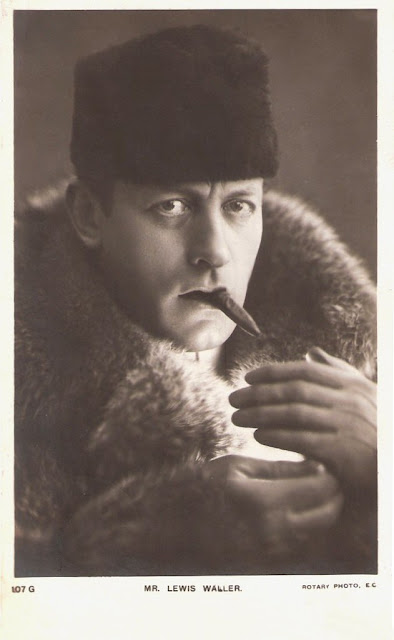
Lawks! Actually, I prefer this one...


If I ever write a biography of my new boyfriend Lewis, this will be the front cover image as he's so dreamy.  Anyway, I digress. The beautiful Mr Waller was actually Ethel's father-in-law, therefore of great interest to me for that reason - The Swanage Times and Directory in September 1928 reported that Ethel visited the Russell-Cotes Art Gallery in Bournemouth to see the painting they have of Lewis Waller by John Collier...
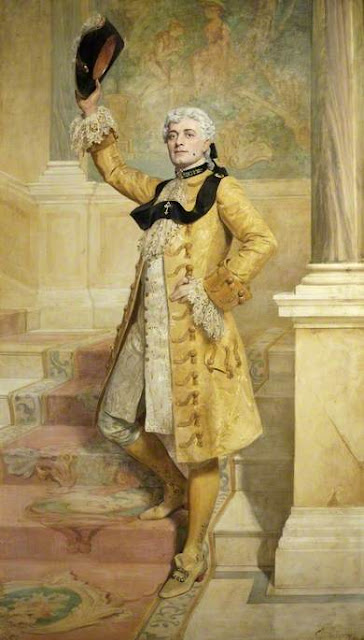
Lewis Waller as Monsieur Beaucaire (1903) John Collier

That gorgeous (and enormous) portrait of Waller can be seen today still displayed in the gallery and it is a stunning sight indeed.  Anyway, the reason for this post was that whilst researching Ethel Warwick, with an eye for images to use in a book, I bought a collection of postcards.  It was a massive bundle of over 100 images in a tatty album and it cost me £20.  Now, I thought that if I used a few of them, it would be cheaper than attempting to find individual ones. I also counted on finding an image of Waller's erstwhile son Edmund, Ethel's first husband, who was also an actor, and Waller's wife, Florence West, who was an actress and company manager, who gave Ethel work (hence how she met Edmund Waller).  However, that wasn't all I found.  I got sucked into the world of Waller-Adoration, a much maligned fan club and an astonishingly criminal vicar. Brace yourself...
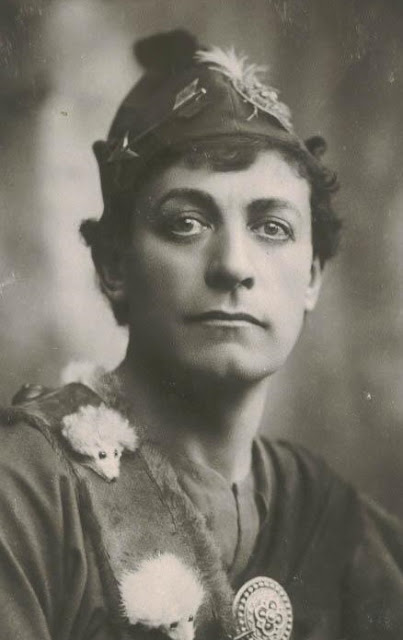
Lewis Waller as Robin Hood (c.1904)

Look at the little mice! Adorable. 

My story begins with the photo album I acquired.  Battered and rather falling apart, it appeared to be the collection of one person, who had inscribed the front endpapers of the album and some of the photographs.  Although it was faded, I could just about make out the inscription...


The inscription reads - 

Audrey M Roper Nunn
Enrolled KOW April 3, 1908
Keen Order of Wallerites
Spes Gregis

As you can imagine, I was keen to find out a bit about Audrey, but I also wanted to know what the KOW were and given that she had collected 100 postcards, I wanted to know Audrey's story with Lewis Waller.  The 'Spes Gregis' comment was also interesting - why was Lewis the 'hope of the flock'? The answers to these questions not only told me a lot about the devotion of women to a talented man, the fate women suffer in the newspaper and why Audrey needed Lewis Waller more than he could ever have known.

Lewis Waller and Madge Titherage in King Henry V (1908)

Lewis Waller (1860-1915) was one of Victorian and Edwardian Britain's most popular stage actors.  Handsome, romantic and accessible, it was unsurprising that Mr Waller would attract a devoted female following who religiously attended his performances in order to worship.  By 1907, he was arguably the biggest star of the stage, starring in and managing some of the most successful performances in London and beyond, touring all over Britain and the world. For his 47th birthday in November of that year, he suddenly received 30 telegrams wishing him well, all signed 'KOW' which utterly puzzled him.  Little did he know that Miss Amy Skelton of Streatham Common had formed a group with other likeminded men and women (mainly women, let's be honest) to meet every Monday to discuss how awesome Lewis Waller was.  They were the Keen Order of Wallerites, or the KOW and they formed the first ever celebrity fan club in existence.
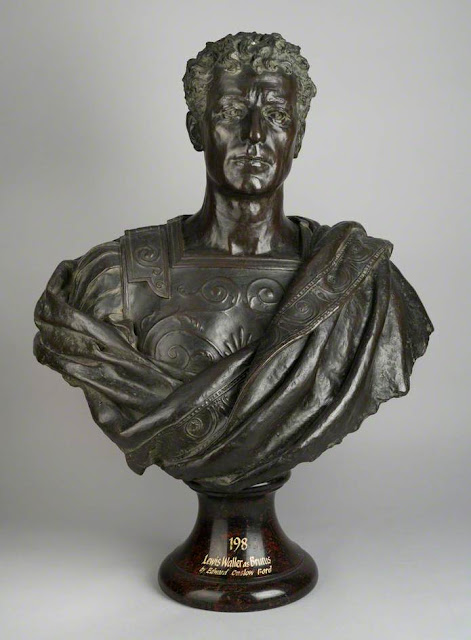
Lewis Waller as Brutus (1900) Edward Onslow Ford

Being a member of the KOW had some pretty strict rules.  As Miss Skelton stated in the Daily Mirror, 'As you can see, we are not silly, giggling school-girls ... we are all old enough to know good acting when we see it, and it is the acting of Mr Waller that we admire... it is the actor rather than the man who holds us together.' Miss Skelton was interviewed in April 1908 about the KOW, interestingly just as Audrey Roper-Nunn joined their ranks and I wonder if she had read the report in the Daily Mirror. By that point, the KOW had been in existence for 6 months and generally not known to those who were not regular attendees of Waller's performances.  The group booked seats for the first and last nights of the shows but otherwise took their chances at the pit door in the queue, often waiting for up to 4 hours for a seat.  Miss Skelton was a practiced hand at this, admitting she had waited in a queue for 12 hours to see Sir Henry Irving and would do the same for Waller. Many of the KOWs had seen Waller's recent plays up to 50 times, which gives you an idea of the economic status of the women (and men) involved.

Lewis Waller in Brigadier Gerard (1906)

The Daily Mirror article was remarkably in-depth and respectful of the group and Miss Skelton was very keen to emphasise that the group were just interested in the performances rather than being groupies.  There was no 'hugging' of the stage door allowed as it was seen as bad form and would annoy Mr Waller. Waller's brother Guy had noticed some of the women who had been frequent attendees at his brother's performances and had been asked for 2 signed photographs of Waller but otherwise had not been bothered by them.  Lewis Waller himself, when informed of the group was gratified that his acting pleased them, no doubt delighted he was guaranteed seat sales. The only way the members of the KOW could be identified was the badge they wore, created by Miss Skelton from designs by her artist brother...
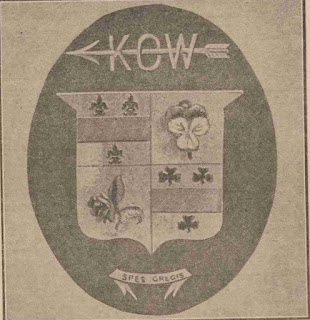

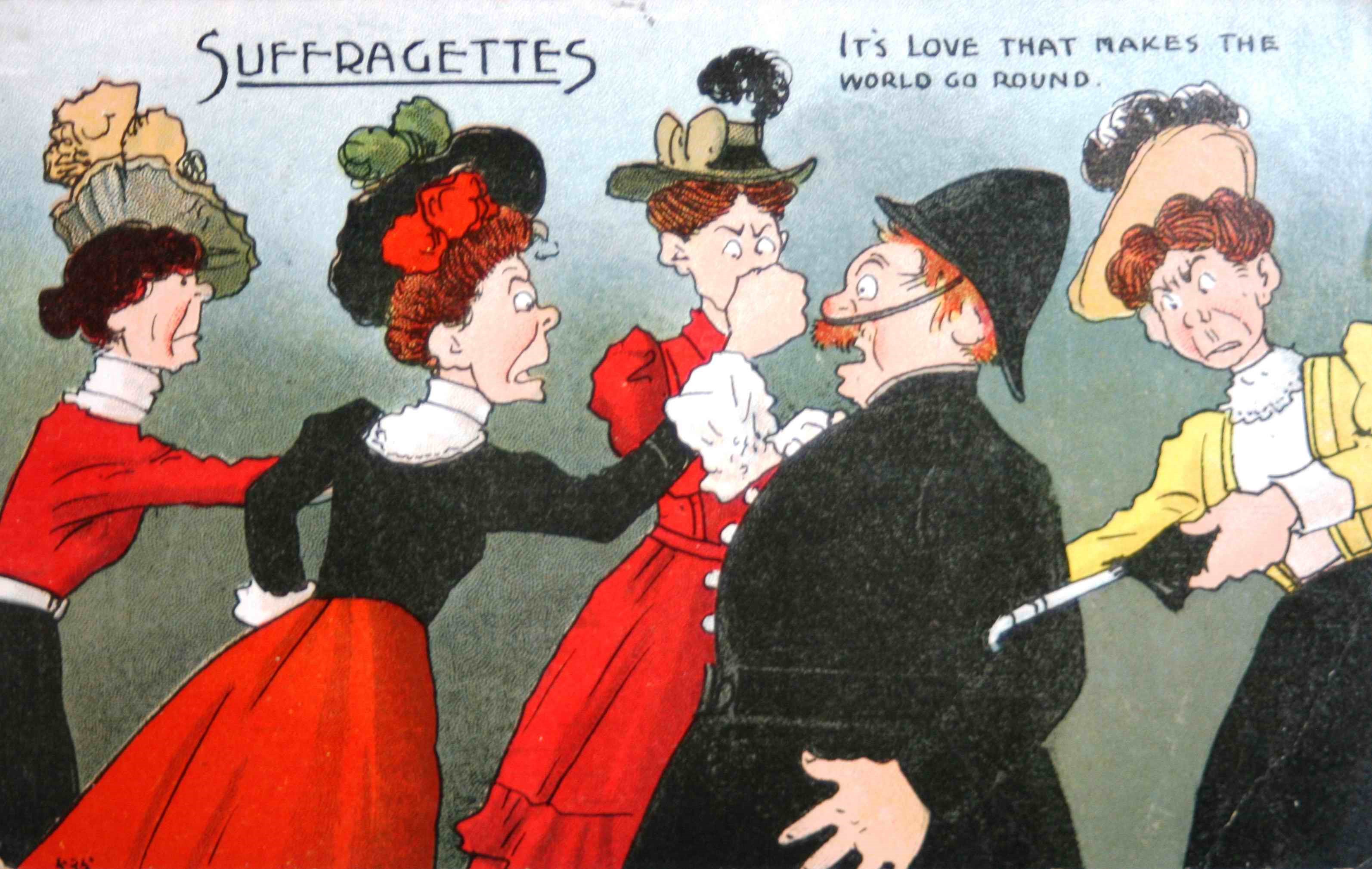
The badge was formed on the back of a photograph of Waller.  The reverse side featured a quartered shield, with a rose, a pansy, a fleur-de-lis and a shamrock in the 4 parts. The pansy was Waller's favourite flower, and the rose, lily and shamrock represented the 3 plays the KOW most admired, Monsieur Beauclaire, Henry V and Clancarty. The arrow across the top was for his performance in Robin Hood. Spes Gregis, written across the bottom, refers to 'the hope of the flock' and how Waller was seen by his followers. Wearing the badge, which was coloured mauve and green resulted in the ladies being mistaken for suffragettes.  Miss Skelton revealed that simply by turning the pin over to reveal Waller's portrait it enabled people to 'understand that we are women of sense and not- (she shrugged her shoulders)'. I wonder if Amy Skelton knew how the suffragettes were treated in the newspapers and therefore wished to distance what they considered quite a harmless fan club from potential ridicule.  Well, Miss Skelton, I admire your optimism but I think we all know what's coming for any woman who says anything in public, especially as the Daily Mirror had been kind enough to print her address in the piece...

Lewis Waller in The White Man (c.1908)

Less than a week later, the Daily Mirror was back for a follow-up interview and the tone had definitely changed from merely reporting something of interest to mocking. Miss Skelton was now described as the 'Grand High Mistress of the Order' and the piece reported on the KOW presence at the 100th performance of The White Man.  Miss Skelton and her friend were seeing the play for the 20th time and 'took up strong positions at the pit door at noon' in order to get tickets.  It was reported that the KOW friends had had lunch together in the line, as the report said 'on the pavement, frugally'.  In the past week, Miss Skelton reported she had received hundreds of letters and telegrams to her house as a result of the previous article.  Some had been very abusive and one weekly illustrated paper had requested a photograph of the chief members of the KOW and a photo of Lewis Waller surrounded by his adoring women, to which Miss Skelton had replied 'certainly not!'  Despite the KOW having some men as members, 6 in a membership of 55, it is the women who entirely get the brunt of the ensuing commentary.  We think that women getting social media abuse is a modern phenomenon, but how comforting to know that women throughout history have been taken to task for existing in public. How dare they!
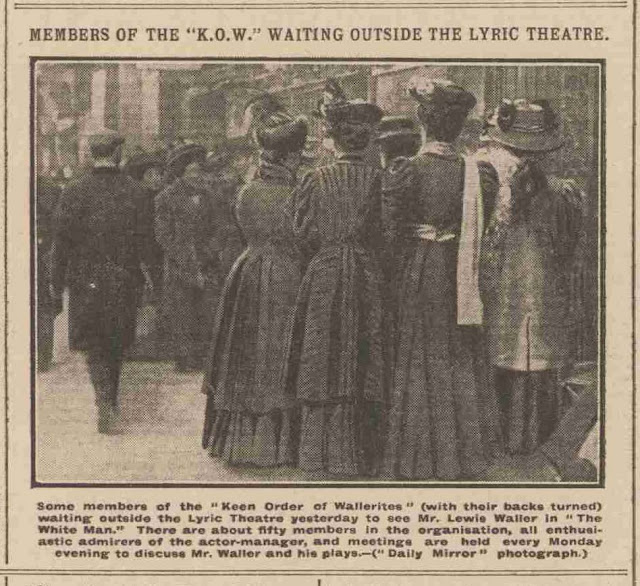

A day later, The Daily Mirror ran a photograph apparently showing the KOW waiting at the Lyric Theatre, incorrectly identifying them as waiting to see Waller.  As reported in their own newspaper, the KOW queued for tickets but did not allow any loitering or bothering of the actors.  Also, Miss Skelton had pointed out there were not formal meetings, they met in the queue or occasionally went out to tea.  It had taken exactly a week for the group to go from enthusiastic theatre goers to groupies who lie in wait for unsuspecting actors.  The use of phrases like 'strong position' de-feminises these mainly unmarried women and gives a very particular impression of the members.  
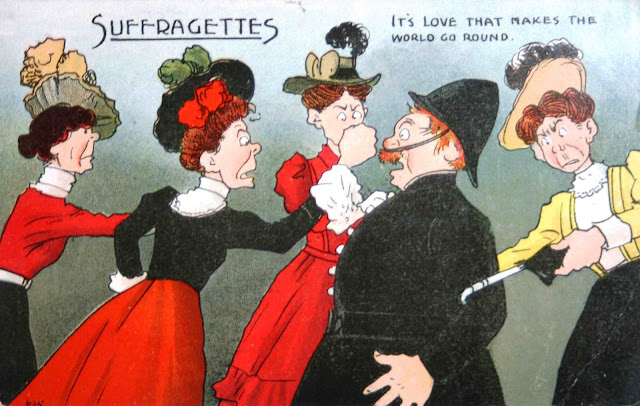
Anti-Suffrage postcard (c.1910s) emphasising strength of unloved women

The same week, Punch magazine congratulated the Daily Mirror for 'unearthing' the KOW because, as they reported, 'if these suburban theatrical cults extend we shall expect to see other symbolic adornments on feminine bosoms in the various pit crowds.' On April 11, nine days after the initial article, Amy Skelton disbanded the KOW under increasing mockery and abuse which continued even in the article about it. Miss Skelton had recalled all the badges she had made, although some members refused to send them back.  An unnamed (and I suspect, fictional) member was approached for comment which ran as follows - 'we are devoted to Mr Lewis Waller - the actor, mind you, not the man - and the members attend on first nights and other occasions and take every possible advantage of applauding him.  We think he is just perfect - the actor, of course, not the man.'

The repetition of Miss Skelton's original assertion that they were interested in the actor, not the man is used here in mocking, patently calling out the women for lusting after Waller.  Also interesting that the claims of disruption start here, that the women applauded Waller's every move and disturbed the play with their clapping and stamping.  These claims are repeated in various books on theatre and reading Amy Skelton's account of their modest fanaticism, it's hard to imagine these middle-class ladies of really letting themselves go with wild abandon in the theatre.  However, these claims affected how others spoke of Waller and the fact he had such a following might have meant he was not taken seriously as an actor.  However, I would argue his good looks and obvious popularity bred jealously.  If you are pretty and popular, you obviously can't be legitimately good at your job, apparently.
Postcard from Audrey Roper Nunn's collection with the below written on the back

'Waller, you darling! Why do you wear striped cuffs?'

So, the KOW was disbanded in 1908, therefore the newspapers would have forgotten all about them, right? Of course not, because much like some sort of mythical creature, the KOW refused to die! Women were still allowed to leave the house and appreciate things and so the newspapers were on hand to ridicule them.  


The Bystander magazine reported on 22 April that Lewis Waller had purchased a Rudge-Whitworth bicycle in order to escape the fanatical grasp of the KOW.  The fact that Rudge-Whitworth had famous clients already, such as Princess Victoria, and that cycling was very fashionable, they had probably given him the bike in order to claim him for the brand, but that is not the point. He was obviously going to use the bike to avoid his fans.  Let's hope the lady in the above advert isn't a KOW...
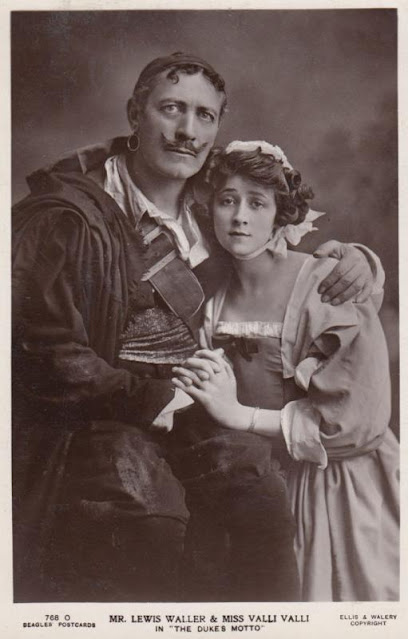
Lewis Waller and Valli Valli (so good they named her twice) in The Duke's Motto

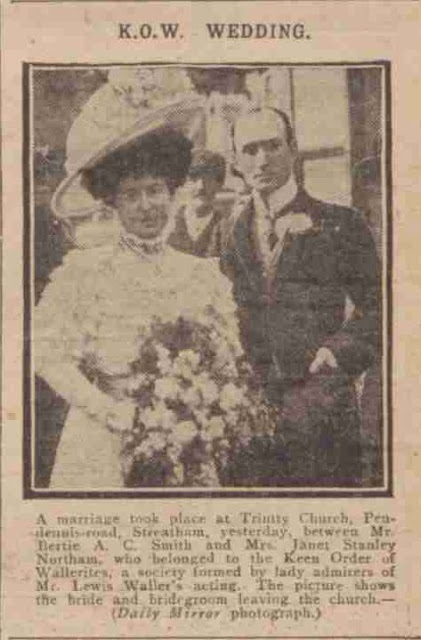
In September of 1908, during the run of The Duke's Motto, The Bystander reported how it was 'a feast for Wallerites' and the Illustrated Sporting and Dramatic News commented that the performance had received an 'enthusiastic Wallerite response'. There was even a report of a KOW wedding between Augustus Camplin Smith and Janet Northam in 1909.  That means there are only 5 KOW men left on the market, ladies! However, the wording is somewhat unclear - do we assume they are both members, hence the KOW wedding headline, or is it just Janet, as the Daily Mirror refers to the KOW as 'lady admirers'.  Part of me suspects that it might just be Janet who was a KOW and the news piece is because one of the appalling lust-fuelled spinsters plaguing Mr Waller has managed to get married, look! I might be extremely pessimistic in my view of newspapers but I suspect that is the case.

Oddly, despite the disbanding of the KOW in 1908, comments in the newspapers continued, increasingly at Waller's expense.  Waller was a handsome actor who played very physical, commercial parts - The Civil and Military Gazette in October 1908 commented of his performance that 'the whole piece is a festival of Waller and swordplay in which the acting of Miss Sybil Carlisle etc goes almost unnoticed.' Sorry Sybil, you just aren't as exciting as Lewis Waller and his sword.
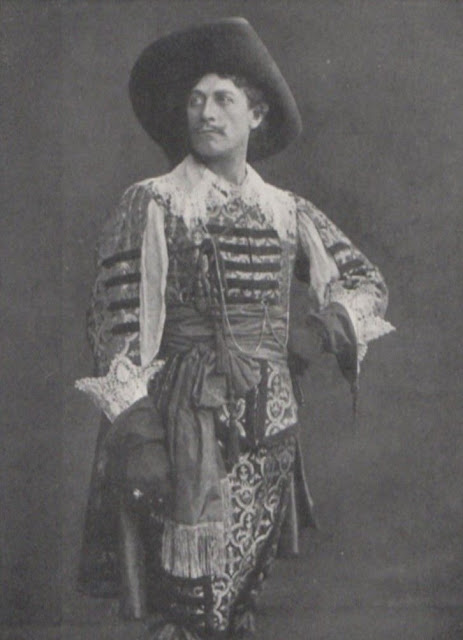
Lewis Waller in Bardeleys the Magnificent (1911)

Having the KOW to blame for when a play was not successful must have actually been a bonus. The Bystander reported that the Wallerites enthusiastically embraced Bardeleys the Magnificent but had not liked the more serious pieces or the contemporary pieces Waller had put on over the year.  His performance as the villain in Butterfly on the Wheel, a divorce drama, in the April of 1911 had not gone down well with audiences who could not believe him as a villain (although probably might believe they would commit adultery with him).  1911 proved to be a very trying year for KOWs (if they even still existed as a group, which is doubtful) as the Daily Mirror reported that Airmen were ousting actors as the new heores.  The opening of a flying ground at Hendon had seen groups of women gather at the gates in order to see their new 'favourite idols', the airmen.  The women were reported as being 'well to do and socially well known' which is very reminiscent of how Amy Skelton and her crew were seen, and in the article it said that several of the women were recognised as KOW - 'Judging by the postbags of the various 'airpilots' at Hendon, it seems that a good many KOWs are now worshipping at the shrine of the airmen.'
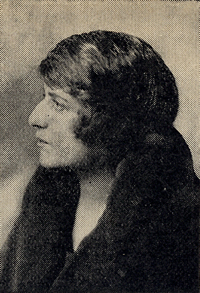
Rachel Ferguson (1892-1957)

A final nail in the coffin of the KOW came in 1923, years after Lewis Waller's premature death in 1914.  The author Rachel Ferguson reported that she was proud never to have been a KOW and 'gorge rose (and rises yet) at the exhibition women of thirty and over made of themselves about Wednesday and Saturday Gods.' There is so much wrong with the sentiment that Rachel Ferguson expresses that I'm not sure where to start.  Women of thirty and over are allowed to lust after people, thank you very much. Well done on doing the work of the patriarchy, Rachel, which is a puzzling stance for someone who is now seen as a feminist hero.  This generalised, cheap-shot journalism made me angry because of the story of the KOW I got to know.  Say hello to Audrey Roper Nunn...
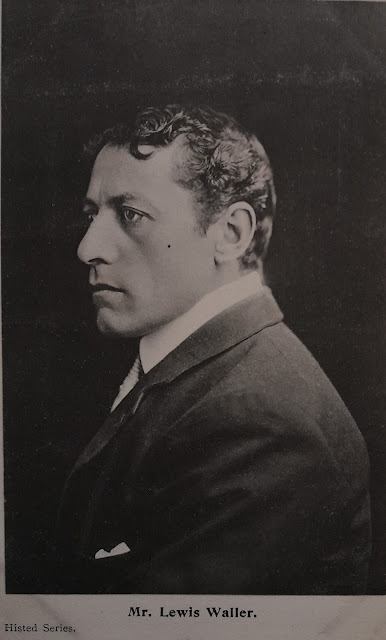
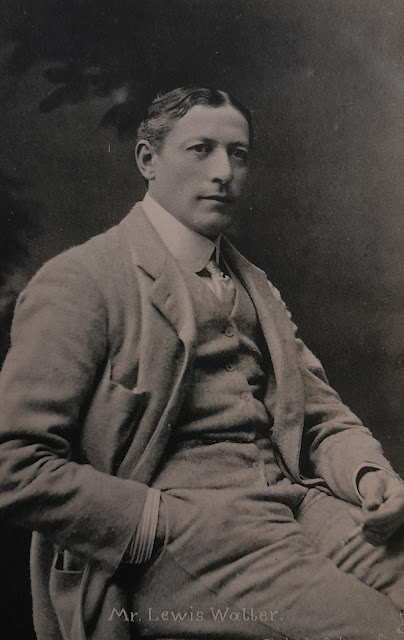
Lewis Waller, from Audrey's collection

Written on the reverse - 'You are a scowling boy here!'

When I received Audrey's collection of Waller postcards, I didn't intend to look into her life, but you know me, of course I did.  I really only expected to find a middle-class lass who enjoyed going to the theatre and in a way, that's what she was. As I said above, I suspect she read the article in the newspaper and became a KOW, either officially or self-diagnosed (both are valid), allowing her long-held adoration of Mr Waller to form the collection of cards.  On the reverse of a lot of them she records when she attends the relevant performances, but my favourite card, above, has the phrase 'you are a scowling boy here!' on it.  It is now common in the Walker household to be referred to as 'my scowling boy!' as a term of affection.  Audrey was born in 1888 in Sutton in Cambridgeshire.  Her father, Douglas, was the son of a very well-regarded JP and was in the church, ordained as a deacon in 1882 and a priest in 1883, so the family moved around a lot. I don't have a photograph of Audrey, which is a great pity. However, I do have a few of her father.  This is not a good sign, I warn you now...
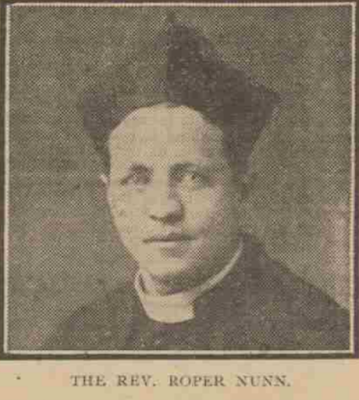

By 1900, the Reverent Roper Nunn was bankrupt and had to auction off his belongings to pay his creditors.  In 1903, he was 'defrocked' for theft, but continued to find work as a priest and continued to steal, getting caught and charged in 1909.  It had been noticed that at each of the churches he had worked (and those in the vicinity) money and belongings would go missing.  Mr Justice Lawrence who tried his case at the Essex Assizes said that he had 'lived a life of disgrace, and it was impossible to imagine a worst offence.' Douglas went to prison for 3 years.  He had been encouraged to reform his life but when he was released, he started stealing once more, getting another year in prison in 1914 and another in 1918. 

Now, I'm not one to gossip, but there was also an incident in 1897, when the Reverend ran over and killed 75 year old Amos Cornish, while on a tricycle (Douglas, not Amos). It had all happened one night after Roper Nunn had been visiting his brother, and he had managed to plough down the elderly gentleman on a straight piece of road - comment was made that the victim must have seen the tricycle coming so should have moved, rather than the vicar shouldn't have run over someone at considerable speed.  Given the events of the following two decades, I wonder if there was more to it, not that I am accusing Roper Nunn of being homicidal, but as he often stole from neighbouring parishes, possibly Cornish saw him and in chasing after the witness, Roper Nunn accidentally ran him over?  Probably it's all a coincidence but I am definitely having that in a book in the future.  Back to Audrey...
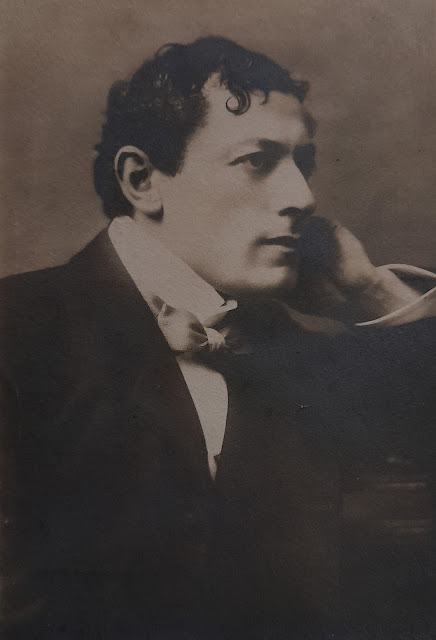
Lewis Waller (c.1890s) from Audrey's collection

In amongst her father's criminal activities, Audrey was finding her way in the world.  As the oldest of the five Roper Nunn children (four of whom survived infancy), she would have witnessed the family's downfall very clearly. From the rather well-to-do young lady from a very good family, by 1911, she was working as a servant for the Tebbitt family in Hampstead while her mother and her three siblings  lived in a small house in Brentford in Essex. I wondered if her move to London for work made it easier to visit the theatre or whether it was financially out of the question? In 1923, Audrey enrolled in training to become a nurse and lived her life that way, dying in Brentwood in Essex in 1972, having never married. I think it is no coincidence that the majority of her collection comes from the years between her father's defrocking and his imprisonments.  Her notes written on the back on the cards not only show that she regularly attended his performances but felt a connection to this strong, handsome hero, who was capable, honest and reliable.  From her late teens to her early twenties, Audrey followed Waller, collecting the cards, swapping with friends who collect other actors and receiving them from her brother Kenneth. I hope it made her happy because I can't imagine her homelife was easy.

Bearing Audrey in mind, reading how the KOW were talked about in newspapers and in books makes me angry.  In Hesketh Pearson's 1921 book Modern Men and Mummers he writes that Waller didn't like 'the clique of maiden ladies who made poor Waller look ridiculous in and out of season' quoting him as allegedly saying 'will no one rid me of these turbulent priestesses?' Furthermore in his memoirs of 1938, Pearson reports how Waller was known for his 'hoards of women' who formed the KOW.  I would hardly call 49 (there were 6 men, remember) a hoard, and the tales of their misbehaviour seem out of character from Amy Skelton's very dignified interview.  Other stories circulated, including one quoted in Ben Iden Payne's A Life in a Wooden O: Memoirs of a Theatre (1977) where Herbert Beerbohm Tree recalled a woman shouting 'How dare he!' at an actor who had wronged Lewis Waller's character in a play.  There is nothing to say that the lady in question (if it even happened) was a KOW but it was assumed she was and therefore one of the hoard of worshipping old maids. 

In varying publications the KOW are described as a band, an army, a hoard of young (and not so young) women whose adoration of Waller makes both parties ridiculous, however wasn't that the point of the parts he played? Waller admitted he adored Shakespeare the most, so in playing the heroes was not the point of the performance to admire him?  In the popular romantic parts he was also famous for, the fact that he was so commercially successful by being the square-jawed, sonorous-voiced manly man meant that they had long runs of performances with the KOW queuing for tickets. There is no contemporary account of the KOW disrupting performances other than applauding loudly for Waller and I have no doubt if they had done any of the other things they are later accused off, like stamping, shouting and generally being uncontrollable, it would have been in the Daily Mirror. Stories breed stories and narratives form to suit the story tellers. In the smug memoirs of the 1920s and beyond, no-one talks about the hate mail received by Miss Skelton because she said she enjoyed seeing Lewis Waller perform. A few actors comment that Waller was a great performer but could be a little overwhelming to the others on stage with him; that must have been galling if you are a co-star, especially if Waller gets rapturous applause for squashing (even inadvertently) your part and career. I read jealousy in accounts of Waller's fan club, the first of its kind and a definite forerunner for film star adoration of the 1920s. Yet again, a talented, popular but possibly flawed man is ridiculed using women (yes, I'm bringing it back to Rossetti and Fanny again, as I always do) - How can he be so great if those ridiculous women love him? And if he is ridiculous, what does that say about the women who love him?

What seems to be mocked here is female desire, especially in women over thirty and unmarried.  It is no coincidence that the mocking of the KOW happens during the years of suffragette action.  The power, desires and actions of educated, middle-class unmarried women terrified the establishment because what is it they want if not to be married? These women do not know their place! I don't know why Amy Skelton formed the KOW, or her life after disbanding the group, but it is easy to see the pleasure Audrey Roper Nunn got from her collection of postcards, during a difficult period of her life. The mocking of Amy and Audrey and the other women who dared to enjoy something designed for their enjoyment is breath-taking.  The fact that the alleged misbehaviour of a few theatre goers is entirely blamed on the KOW, that they become the 'turbulent priestesses' who ruin the life of the very man who they admire is the newspapers once more performing their magic trick of ridiculing successful men by demonising women. The Daily Mirror's astonishing manipulation of the story, the way Amy Skelton was mocked and the general dog-pile of abuse for the next decade and beyond is a sobering lesson in how our society and especially our media can be frighteningly misogynistic. 

The fact that we still trust newspapers proves that we are either ridiculously optimistic or idiots as they have repeated shown they cannot be trusted with the lives of women. As always, my message is to dig deeper, question everything and if you are a woman over thirty, I hope you have a scowling boy (or girl) who makes you happy.

Sunday, 8 November 2020

Straight Outta Hendon...

I hope you are all coping in the current uncertain situation and keeping well and reasonably sane.  I have always been someone who uses the fact I can become absolutely obsessed by a subject to stave off stress.  It's distraction, I know, but when the stressful thing is beyond your control then it probably serves me better to research the heck out of a subject than to worry about whether I have enough bread flour or if I will catch the 'Rona by going to get some more.  Anyway, all that comes to explain how I came to meet and fall in love with Ethel Warwick...

Ethel Warwick (1924) Bassano Ltd

Hang on, what am I doing with a twentieth century muse? Gorgeous as she is, isn't Ethel a bit out of my timeline? Well, normally I'd agree, but you see this is also Ethel...

The Lament for Icarus (1898) Herbert Draper

There she is, lamenting the rather gorgeous Icarus. So, how did that girl go on to be an internationally successful actress, friend of Sarah Bernhardt, twice married, hat designer and a successful artist in her own right? And why don't we remember her now? When I started looking, all I could find was a lovely essay on her by Simon Toll in the British Art Journal, but I wanted more. I read the following exchange in an interview with her:

"It was Whistler who, when Miss Warwick told him that she intended to go on the stage, asked why she chose such a life. "For the honour and glory of it," the girl replied and the great man growled out: "Isn't it honour and glory enough that you have sat for me?" "

Blimey, how could I resist? Let's go back to the beginning...

Ethel Maud Warwick was born in Hendon on 13 October 1880.  She nudged her birthday down by a few years as she got older, which is understandable in her subsequent line of work (if anyone asks, I was born in the late 1990s and not 1973 as my lying birth certificate would have it).  However, some researchers have raised their eyebrows at the difference in a few years if you take into account that she posed nude for artists in her mid to late teens.  Knock four years off 17 and it makes people uncomfortable, but we'll come to that in a minute.  Ethel's father, Francis, was a Railway Station Master, and Ethel was Francis and his wife Emma's third daughter, after Amy and Emma Junior (also known as Emily).  Ethel would be followed by two boys Francis and Herbert.  By the 1891 census, the family had moved further into north London, to Lismore Road in Kentish Town.  As a girl, Ethel recalled later, she was keen on art and her parents sent her to the Polytechnic to study, followed by the Camden School of Art under Francis Black, RBA. Somehow in the mid 1890s, Ethel came to the attention of Herbert Draper.  It is suggested that he saw her in the street, but I think possibly its more likely that they became connected through the art school scene.  Anyway, the upshot was that she posed for this...

The Sea Maiden (1894) Herbert Draper

 Okay, so we have to give Draper a bit of artistic license because that is not a 14 year old nude Ethel (for reasons I'll come to) but you now see why it's important to acknowledge she was 14 and not younger when she posed for this (even though even that gives us pause these days).  Anyway, Draper wasn't the only artist who took a fancy to Ethel as a model.  She also posed for Philip Wilson Steer...

Hydrangeas (1901) Philip Wilson Steer

Not to mention James Abbott McNeill Whistler...

Ethel Warwick Holding an Apple (c.1900) James Abbott McNeill Whistler

But my favourite of her artists, and the reason I met Ethel, was John William Godward...

Ethel (1898) John William Godward

This painting is in the Russell-Cotes Art Gallery and I've always loved it because I have a soft spot for Godward, and this is totally unlike his normal output, which is more like this...

Study of Miss Ethel Warwick (1898) John William Godward

The idea behind the first Godward image is possibly a picture of Ethel as she arrived to pose for Godward, and that he was so fond of her, he painted her like that too. Looking at Ethel in the second image, you can see how her likeness can possibly be seen in an awful lot of Godward's art or at least her dreamy beauty lends itself to Godward's vision of drape-y classical loveliness.  By 1898 Ethel was acting as a model at art school, seemingly as much as she was being a pupil. As well as Steer, Draper, Whistler and Godward, she also appeared at the Camera Club in Charing Cross Road for the Punch cartoonist Edward Linley Sambourne...

Ethel Warwick 1 August 1900 (1900) Edward Linley Sambourne

 Honestly, given a lot of the images taken by Sambourne, this could have been a lot worse, and there are far more naked pictures of Ethel by him. However, it was while posing in a tableau for Solomon J Solomon that Ethel was spotted by Herbert Beerbohm Tree who thought looks like hers should permanently go on the stage. He had arranged a theatrical review, including the tableau (that also involved other famous women such as Elinor Glynn) for a charity performance at the beginning of the Boer War.  By the time she posed for Sambourne in the above image, Ethel was already planning on leaving her modelling behind her.  After 9 months of instruction at Henry Neville's acting school, she debuted on stage on 25 July 1900 at the Grande Theatre Fulham under the management of Neville in The Corsican Brothers. As the curtain rose, Ethel recalled that her nerve failed her, but Neville patted her on the back and whispered 'Remember your first line'.  That first line was 'Courage! Courage!' and so, with courage, Ethel embarked on her new career...

Day and the Dawn Star (1905) Herbert Draper

 That's not to say she didn't combine her professions for a little longer; Steer's Hydrangeas was in 1901 and Draper's Day and the Dawn Star was in 1905, but much to the disappointment of her artists, Ethel had fallen in love with the theatre. Having said that, the theatre had fallen very much in love with Ethel and so the offers of work came in.  The actor-manager Herbert Beerbohm Tree gave her work because he liked the way she walked.  He gave her a bit part in Herod at His  Majesty's Theatre in the Haymarket.  It was just a single line part but she understudied the role of Judith, only to arrive at the theatre one evening to be told she would be on stage in the bigger role with only a quarter of an hour to prepare.

Ethel in Captain Kettle (1902)
 
In 1903, after success in plays such as The Gay Lord Quex and Captain Kettle, she joined Frank Benson's Shakespeare company, playing Portia and Juliet to great acclaim.  However, despite leaving modelling behind, Ethel had not abandoned art, far from it.  It was entirely her intention to be an actress/artist and an interview with her in 1904 pictured her as both a serious artist and actress...

Miss Ethel Warwick at her Canvas (1904)

 Here is where you might be able to help me - does anyone know of any of Ethel's paintings?  I've searched online, and despite her many interviews mentioning how internationally successful she is as an artist, I've yet to find an image by her.  This is not helped by the fact that Ethel Herrick Warwick (1881-1961) was also an artist and so there are paintings which might be Ethel Maud Warwick's work but mis-attributed online subsequently because of Ethel Herrick Warwick's relative fame in comparison.  Anyway, on with the theatre!

Young Ethel, on the brink of Theatrical Superstardom!

The turning point arguably was the offer from Florence West to appear in Vilma.  Florence was married to major acting celebrity Lewis Waller and a star in her own right.  Excuse me while I show you a gratuitous image of the gorgeous Mr Waller...

Good Lord, I should say so...
 
It was through Florence that Ethel met Edmund Lewis Waller, son of the acting family and not a bad looker himself (although not a patch on his father, in my humble opinion)...
 

In 1906, Ethel got the chance to tour South Africa with William Haviland's company, appearing as Ariel in The Tempest.  Edmund Waller was also part of the troop and the couple married while on tour, returning as a golden couple of stage, with Ethel's place ensured within stage royalty.  As a wedding present, Florence West gave her new daughter in law the rights to star in the play Zsazsa, a role that Florence had epitomised and that Ethel had briefly understudied.

Ethel Warwick in 1907 publicity photographs

In June of 1907, the couple had their first and only child, June Belle Florence Waller, but Ethel continued to work and promote herself, as La Giaconda in the play of the same title by D'Annunzio, starring as an artist's model, in 1907, then in The Merry Widow  in 1908. When she appeared in The Volcano in 1908, The Morning Post described it as so exciting it was 'the next best thing to being at the foot of Mount Versuvius during an eruption' which is quite a claim.

Ethel as Milady in The Three Musketeers

In 1911, Ethel appeared to much acclaim in The Three Musketeers as the infamous Milady.  The newspaper reviewers seemed to get themselves in a right lather over one scene where D'Artagnan pulled the shoulder of Ethel's frock down revealing her fleur-de-lys mark on her 'lily white arm'.  The scene was so scandalous that Ethel went out and got publicity cards taken, shoulder out.  Saucy minx. 

Well, quite.

Ethel showed a level of canniness when it came to attention grabbing roles. In 1912 she appeared in the revival of Woman and Wine at the New Prince's Theatre.  Her performance as the villainness of the play was described by one reviewer as 'very beautiful and very, very lurid'.  The climax of the play (if you excuse the phrase) involved Ethel and another actress removing their bodices and fighting to the death with knives.  Lawks, no wonder it was popular.

1912 was a monumental year for Ethel for a number of reasons.  She became manager of her own theatre, the Queen's Theatre, and starred in Zsazsa.  It was also the year that Florence West, Ethel's mother in law who had given her the play as a present, died, aged only 53.  Zsazsa  struggled with reviewers, possibly because it had not been long since the last revival, possibly because of changing tastes in the theatre.  Ethel's performance however was never in question.  Sarah Bernhardt, who was starring in The Loves of Elizabeth, Queen of England at the Colliseum, came and saw Ethel perform and raved about how good it was.  She sent Ethel a present, a copy of her birthday book, inscribed 'To the delicious artist, Ethel Warwick, with my deepest affection.'

From Ben Hur 1912

What should have been a glorious year was actually the beginning of an unlucky spell for Ethel.  In November of 1912, Florence Waller, Ethel's mother-in-law, died aged only 53. Edmund also became ill and was taken to hospital in January 1913. When he was released in March, he left England to join his father in America on the last leg of a tour.  A short piece in the paper reported that Ethel's production of a new play had been postponed due to her own ill health, but in actuality, she had become concerned with the whereabouts of her husband.  When Lewis Waller returned in early April, Edmund was not with him.  He had gone to Australia.  Taking pity on his daughter-in-law, Waller gave Ethel the address and she wrote begging Edmund to return.  He replied thus:

"Dear Ethel,

                    Just a line to say I received your letter, and its extraordinary contents amused me.

I have no intention of returning to you ever and consider you are quite capable of supplying yourself with any amount of homes.

                                Yours truly,

                                                EDMUND WALLER"

Ethel pursued Edmund out in Australia, getting acting jobs in order to plead with her husband to return, going as far as to file for a 'restitution of conjugal rights', but Edmund was having none of it.  On her return, Ethel was left with no other choice but to file for divorce.

The beautiful Gabrielle Ray

Actually, unluckiness in love was nothing unusual for stage actresses in 1913.  This rather splendid article tells of the beautiful Gabrielle Ray who ended her marriage after barely a year in 1913 when her husband strayed.  The hiatus in her career, although brief, was enough to hamper her from achieving the heights she had before her wedding.  Another actress, Maudi Darrell, a girl from the Gaiety Theatre, married Ian Bullough, a mill owner from Scotland.  She died a year later in 1910 from complications after appendicitis.  

Lily Elsie married Ian Bullough

 A year later Bullough married actress Lily Elsie who became ill in the same manner as her predecessor, within a year of marriage, in 1912.  I'm saying nothing...

So, newly divorced or at least separated from her errant husband (the divorce was finalised in 1915) there was no stopping Ethel from kick-starting her career.  She toured the south coast with Cap and Bells and Stolen Fruit and was greeted with far more enthusiasm in the provinces rather than trying to please the jaded Metropolitan elite, who had actually booed her in Sylvia Greer.  Her performance as Josephine in A Royal Divorce was considered a career best and this led to her first appearance in the movies in the 1916 film The Bigamist, with the fabulously named Hayden Coffin.  The plot consisted of a drunkard who abandoned his wife, married a rich girl, took a mistress, stole a legacy and killed his first wife, all in four reels!

Ethel combined stage and screen, gaining both fame and admiration for her performances.  1918 proved a troubling year with both the death of her brother, Francis, in the war and a court case which saw Ethel take a friend to court for stealing one of her fur coats, merrily reported in the gossip columns of the newspapers.  Ethel had become so synonymous with 'bad girl' roles that when one of her dressmakers finally came to see her play, she demanded Ethel pay her outstanding bill on the spot, so convincing was the performances.

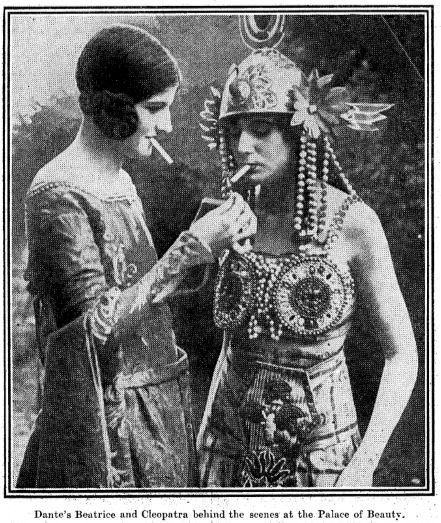
However, post war Ethel continued to star on stage and screen.  Possibly a reflection of Ethel's stardom was her employment in the Pears' Palace of Beauty at the 1924 British Empire Exhibition.  Ethel was Cleopatra in a tableau of some of the most beautiful women in history, which included Dante's Beatrice, Helen of Troy and, puzzlingly, Millais' Bubbles...

Ida Mowbray as 'Bubbles', apparently

The Pears' Beauties worked 7 hour shifts in a 14 hour day, splitting the role with another actress.  It was a very glamorous affair, as can be seen in this image of Cleopatra and Beatrice having a crafty fag between performances...

However, the cost of living an actress's lifestyle and raising a daughter on her own took their toll on Ethel, and in 1924 she was declared bankrupt with debts of £200, which was mostly dressmakers' bills.  She only earned £5 per week as Cleopatra and had a mere £2 in savings.  Still, again she bounced back with what would become her greatest hit and a stage sensation...

The Ghost Train by Arnold Ridley

In 1927, Ethel took to role of Julia Price in Arnold Ridley's The Ghost Train (Arnold Ridley was Godfrey in Dad's Army and the great-uncle of Daisy Ridley, Rey in Star Wars). This was not a new play, having been debuted in 1925 but the special effect of the train rumbling through the theatre was enough to electrify and terrify the audience. One man saw it three times attempting to see how they got a whole train into the theatre.  Once more Ethel was playing a thoroughly bad lot (sorry, spoiler alert) but one of her joys in life was playing a wicked women who managed to win the audience's sympathy by her performance.  The Ghost Train undoubtedly made her a star.  It also saw the debut of June Waller, her daughter, playing one of the minor roles.  

Many plays followed, including The Lonely House in 1930, noteworthy as the cast also included a young actor called Bertram Dix. He was only a couple of years younger than June, but it was Ethel who caught his eye.  While she continued to appear in movies and some stage work, the couple moved to Hendon and there opened a hairdressing salon and hat shop. Yes, that was a twist I was not expecting either. Despite claiming in later interviews that she had taken time away from showbiz to run the salon, Ethel still appeared in films such as The Man Outside in 1933, which can be watched on Amazon Prime...

This classic of cinema must have the poshest criminals in history and some exceptionally wooden acting, but obviously Ethel is marvellous as the spinster Aunt Georgina, complete with monocle...

Ferocious Aunt Georgina, telling off bad actors

I was somewhat surprised by Ethel's hair, properly short from the 1920s and I wonder if that was the work of Bertram Dix.  According to a 1934 newspaper article on the couple's salon, Dix was a hair artist and specialist in waves.  He had brought his experience in theatrical and film hairdressing to the establishment at 7 Greyhound Hill, Hendon.  Joining him in the venture was Ethel, there to give women beauty advice including which hats to wear with their new, beautifully waved hair.  As the report stated 'The hats are marked by impressive distinction and originality yet they are available at exceedingly moderate prices'. I do enjoy a moderately priced hat.

The interior of the salon was decorated with Ethel's paintings and drawings, just too small in the newspaper photograph to be able to see what they were like.  The couple had originally intended to open their place in the West End of London but Hendon was seen to have more charm, and I'm guessing less overheads.  

This business lasted until 1938 when the couple returned to the stage once more in Poison Pen, selling the business.  Then the war came, and the couple hastily wed, buying a cottage in Somerset.  Dix went to fight in North Africa, while Ethel remained at home, becoming patroness of the Ebbor Players, a local theatrical group.  She awaited the return of another husband, but when he returned in 1944, he no longer wanted to be married to her.

Ethel and Dix divorced in 1946, and Ethel carried on touring, starring in The Silver Cord in 1947 as it toured the south coast.  She moved to Sussex, but found that in old age her career began to stall.  In a letter to The Stage magazine in 1950, she reported the plight of older actors - 'The agents, bless them, are far too busy exploiting the youngsters to be bothered with us, and, save for a few exceptions, we're all out of work.'  She suggested that manager should form a company of 'old timers', with no-one under 60 - 'There are many old actresses of petite stature, who, with the help of wigs etc, would give excellent performances as youngsters' she wrote, rather optimistically. She also complained that younger actors didn't talk loudly enough.  Bless her.

Ethel died in the Cavendish Nursing Home, Bognor Regis on 12 September 1951, a couple of months shy of 71.  Her obituary in The Stage listed her art school training, her Shakespearean glory days and her three tours of Australia.  It also shaved a couple of years off her age.  I'm sure she would have been delighted.  I also hope that she would be pleased to know that I'm going to keep researching her because she is absolutely fascinating.  After all, we game old birds should stick together...

If you have any information about possible paintings or drawings by Ethel, please drop me a line at stonellwalker@googlemail.com.