Friday, 10 August 2012

Monks and Marriage

As most of you know by now, I seem to spend a goodly part of my life drifting about the nineteenth century. Well, taste-wise anyhow.  However, it may come as a shock but I happen to quite like some twentieth century artists.  I know.  Who'd have guessed?  Anyway, one of my favourites is Stanley Spencer, who I think shows medieval sensibility with a  wicked twist on modernism.  However, this post is not about Spencer, but the artist I'm going to talk about brought him very much to mind.  One of Spencer's habits was to take the people he knew in Cookham (the village where he lived) and use them as his models, no matter how sacred the scene.  Apparently, there was a Victorian artist who did something very similar.  His name was Walter Denby Sadler.

Friday (1882) Walter Denby Sadler
Born in Dorking in 1824, Sadler was a contemporary of the Pre-Raphaelites, but his art bore more resemblance to latter period Millais than to the depth of feeling of early PRB. Similar to Millais, Sadler was a precocious child artist who chose to pursue painting at the age of 16 and went off to study at Heatherly's School of Art in London and then to study in Germany.  He exhibited from 1872, in the Royal Academy from 1873, and became known as a master of the domestic genre.  Sadler infuses his scenes with a clarity of light that encourages you to think that each of the monks above has his own personality.  I really shouldn't have started with Friday though, I should have started with Thursday...

Thursday (1880)
Thursday is the monks catching the fish they go on to eat in Friday and is one of the first pictures in Henry Tate's rather splendid collection.

No Enthusiast (1877)
Sadler's monks are jolly, pleasant, if foolish fellows, and were very popular as engravings, building up Sadler's reputation.  These images are comic, gently mocking authority, making them out to be stereotypical 'Friar Tuck' types, led by greed and laziness.  But if pleasant if silly monks are not to your taste, Sadler also seemed to run a line in social commentary of a sharper nature.

Married (1880s)
Not a ringing endorsement of married life if you judge by the wife's bored expression, and the husband has popped open a book, with the badminton equipment cast aside.  I could make a tacky comment about discarded shuttlecocks, but I'm better than that.

For Fifty Years
Again, I'm not convinced this is the warmest scene of married life, one description of the painting described the grey haired wife as 'blank faced and bored' after 50 years of marriage to the man offering his arm.  Nice.

Darby and Joan (1889)
That's better.  When I saw this picture it occurred to me that I had no idea of the origin of 'Darby and Joan' which appears to be  a Georgian poetic conceit meaning an old married couple still as devoted as they were when they were young.  In Sadler's work, the early nineteenth century couple are backgrounded by Georgian era portraits that seem to gaze loving at each other, as the old couple at the table do.  Not a discarded shuttlecock in sight.

Played Out (1882)
Sadler chose the Georgian period as a setting for a great number of his works, adding an extra dimension of pale elegance, like in Played Out, where exhausted young dandies relax after a game in the garden, possibly not with a happy outcome, judging by the body language. Again, you won't catch me mentioning neglected balls. This is where the neighbours of Sadler came in, elaborately posed by him for his images. In this way, his figures have a element of realism, a truth to their posture and positioning that the PRB would have been proud of (which also makes me think of George Leslie Dunlop).

A Prisoner of the State (1885)
Not all of his work was Georgian, and this medieval gem is certainly reminiscent of Pre-Raphaelite concerns.  The old man, obviously not a threat to anyone, is a prisoner, an action which is hinted at as folly (in the persona of the fool).  Armed guards watch the old man being assisted on a roof-top walk by presumably his daughter, who also doesn't seem to be too much trouble, but there is something in the presence of the guards that makes you wonder the couple's significance.  The richness of costume is superb in this picture and you get a real feel for the period.

Widow at Home
So here we have Mr Sadler, gentleman artist with a wicked twinkle in his eye.  He is a pleasant blend of romance, cynicism and jolly monks.  Oh, and discarded shuttlecocks.  That's quite a combination.

Monday, 6 August 2012

The Other Brother

Spot Quiz, Hotshots!  Name all the original members of the Pre-Raphaelite Brotherhood....

Well, there's these three....


Yes, well we can name Johnny Millais, Mental Hunt and Rossetti, but what about the others, the rest of the magnificent seven?  Well, there was this bloke...

Not overly prepossessing, but this is a portrait of William Michael Rossetti, brother of the above Rossetti, and he was the non-practising member of the Brotherhood.  He had an actual job and stuff, so did recording, organising, looking after the teafund, that sort of thing.  Oh, and then you had the one that did sculpture...

Thomas Woolner was a sculptor who met with so little success that he emigrated to Australia in 1852 and was the inspiration for the painting The Last of England by Ford Madox Brown.  He came back after a year but had gained enough commissions and inspiration to make a go of it this time and became a very successful sculptor of heroic statues and friezes, including the Manchester Assizes.  Obviously, there's this Brother (fans and smelling salts at the ready, ladies)....


Oh Swoony Fred Stephens, how we love thee....so that makes six, who is number seven?  I always forget him and so in an effort to make myself look less of a fool in front of people, and to pass on the wealth of useless knowledge I accrue in the process I bring you James Collinson, the Other Brother!

Undated Self Portrait
I suddenly realised that I had not the slightest clue what Jimmy Collinson looked like, and I'm not overly convinced this is him, but it was the only picture I could find.  He's somewhat elusive, on the whole.  Born up in Mansfield, Nottinghamshire on 9th May 1825, his father had been a farmer but became a book seller, raising the family up in the world.  James had two siblings, Mary and Charles, James being the youngest child, born when his mother was 40.  Robert Collinson, James father, obviously did well enough to send his young son down to London to the Royal Academy.  James had exhibited his first picture, The Charity Boy's Debut in 1847, which made him the most established painter (if not the most famous, which would arguably be Millais, who was no doubt painting masterpieces in the womb) in the original line-up of the PRB.

The Charity Boy's Debut
James' father died in 1845and his elder brother Charles took over the bookseller's business in Mansfield, while James set about establishing himself in London.  He fell in with a rum lot, Millais, Holman Hunt and Rossetti and together with a couple of other chums they formed the Pre-Raphaelite Brotherhood.

James may have had an ulterior motive for becoming chums with Rossetti.  James Collinson was a devout Catholic, but converted to Anglicanism in order to get closer to a certain young lady...

Christina Rossetti (1849)
17 years old Christina had noticed James at Christ Church in Albany Street and in particular 'his heedful and devout bearing' (obviously what attracted me to Mr Walker, the state of his bearings) and so James not only gained six brothers, he gained a fiancee as well.  Christina went as far as to stay with the Collinson family in Nottinghamshire, spending time with both his widowed mother and sister, learning lacemaking, then with his brother and his wife in the bookshop.  This rather splendid site lists places and people that may have influenced the work of Christina while she visited James' family.  The fact that she travelled and made the effort with his relatives showed that there was a definite intention to marry, but alas Millais managed to break up someone else's relationship, again.

It was all going so well.  Collinson painted possibly his best known Pre-Raphaelite work, The Renunciation of St. Elizabeth of Hungary in 1850.

The Renunciation of St. Elizabeth of Hungary (1850)
That is an exceptionally vibrant pictures, very beautiful, with all those strikingly colourful gowns and ermine.  Well, good old Collinson hit the nail on the Pre-Raphaelite head with this one, sharp, bright and tight, bit medieval, bit religious.  He was getting on well with Christina, repressing his Catholicism nicely, when along comes this....

Christ in the Carpenter's Shop (1849-50) J E Millais

All of a sudden people were questioning these young upstarts: Were they mocking religion?  Were they mocking Mr Jesus and his weird looking mum?  Collinson had a crisis in confidence, manifesting around his latent catholicism and he ended his relationship with all three Rossettis.  Out of the brotherhood and away from Christina, Collinson went out on his own...

In a rash move, he sold all of his paints and brushes and decided to train for the priesthood, but that did not last.  He returned to painting and married a Catholic, ElizaWheeler in 1858.  Eliza was the sister-in-law of John Rogers Herbert, a painter whose work had influenced the Pre-Raphaelites.

Our Saviour Subject to his Parents at Nazareth (1847) John Rogers Herbert
When Collinson returned to his painting career he became known for secular genre pictures, inoffensive and now quite well known.  You'll recognise the next pair from a recent post...


I should really just label these 'Willing for a Shilling, parts one and two'.  These two are probably the best known, but he also did other pictures of an equally crowd-pleasing nature...

Private and Confidential
Such works are light-hearted, prettily painted and convey a moral message without moralising.  He spent some time in his later life in Brittany, where he returned to religious works, such as The Holy Family...

The Holy Family (1878)
He was secretary to the Society of British Artists from 1861-1870, and lived a well-to-do life with his wife and son Robert Vincent Collinson.  James Collinson died in 1881, the year before Rossetti, aged only 55.  His widow lived until 1 January 1894, and left £2259 in her Will to her son, Robert.  Robert never married, doing his parents proud by becoming a Catholic priest, and living until 1930, when he died in St Mary's Convalescent Home in Worthing, leaving his £5000 savings to a fellow priest, Peter Emmanuel Amigo.

So, poor old Collinson.  He died young, he lost his nerve and he's the least memorable of the Magnificent Seven who set up the art movement we all adore.  I bet people think that Walter Deverell or Ford Madox Brown are members of the original line-up, rather than Collinson.  If you had to name people who almost married Christina Rossetti, I bet most people would name John Brett before James Collinson.  However, he was there at the beginning and for that we should be grateful and remember him.  I hope that I have helped anyone who had difficulty in remembering Collinson will remember him now.  Including me.

Friday, 3 August 2012

Marie, Full of Grace...

I have to admit that one of my favourite Rossetti pictures doesn't involve Fanny Cornforth.  Please don't tell her.  In fact, it doesn't even involve Alexa Wilding.  It is this one...


A Vision of Fiammetta (1878) D G Rossetti
It's just so very orange-y.  Okay, I admit that's not a very intellectual reason for loving something, so I'll cover by saying that the apple blossoms are exquisite and their promise of renewal is countered by the fact that Fiammetta is dead and this is a final vision of her.  It is temptation and denial, it is body and spirit, and it is not Alexa Wilding, no matter how much it looks like her.  It's a lovely woman called Marie Spartali Stillman.


Starting out when Marie was merely Spartali, she was a member of the powerful Greek community in London, with people such as Maria Zambaco and Constantine Ionides.  She was the daughter of Michael Spartali, and import-export merchant, who had been born in Greece, and Marie was born in Middlesex in 1843.  She had an equally beautiful sister, Christina, who modeled for Whistler in this rather lovely image...


Christina Spartali
La Princess (1865) J A M Whistler


The family had a house in London, on Clapham Common, called The Shrubbery, with views over Chelsea, and they summered on the Isle of Wight where Daddy Spartali grew grapes.  How marvellous.


From 1864-70 she trained under Ford Madox Brown, developing into an artist of obvious Pre-Raphaelite leanings...


The Lady Prays - Desire (1867)
It was while she was learning her craft that Brown became infatuated by her.  When I first read that, I thought I had read wrong because that is exactly what happened with Maria Zambaco and Ned Burne-Jones, but apparently it was the rules.  You teach a nice Greek girl, you have to become obsessed by her beauty.


Mariana (1867)
Mind you, her pictures are rather lovely.  Her sole female figures in wistful poses are typical of the period, but are reminiscent of Rossetti, with the watercolour romance of his earlier work.  Mind you, where Rossetti's women often just seem to exist to be looked at, there is a more dynamic aesthetic behind some of Marie Spartali's work.  Take the emotional Antigone...


Antigone (1871)
The picture conjures a splendidly bleak feeling, quite isolated and desperate.  When Rossetti heard she was training with Brown, he sent word to his old friend, insisting  "I just hear Miss Spartali is to be your pupil. I hear too that she is one and the same with a marvellous beauty of whom I have heard much talk. So box her up and don’t let fellows see her, as I mean to have first shy at her in the way of sitting."   Gosh, Rossetti, you smoothy.  I think Old Brown actually fancied having a 'shy' at her, but Rossetti used her as one of his regular models from the late 1860s onwards...


The Bower Meadow D G Rossetti
She was used as a bookend for Alexa in not only The Bower Meadow but also the reimagining of Dante's Dream, where she holds the other end of the canopy over the dead Beatrice.


Dante's Dream at the Time of the Death of Beatrice (1871) D G Rossetti
The lovely Miss Spartali is on the left, or is it right?  Hang on....


Chalk Sketch of Marie Spartali (1870) D G Rossetti
Right, she's on the right.  I think.  Ho hum, anyway, also of note in the picture is a certain Mr William Stillman, playing the part of Dante.  It is uncertain whether Miss Spartali and Mr Stillman had met before this picture, but Marie fell in love with William, an American widower.  Her family were against it, but the couple married in 1871.


William Stillman D G Rossetti
Sensible girl that she was, she modelled for other people too, posing for Burne-Jones (The Mill and possibly The Beguiling of Merlin) and countless images by Julia Margaret Cameron...


Marie Spartali (1868) Julia Margaret Cameron
William's job as a foreign correspondent saw the family move to Italy and travel in America, where she painted and exhibited on the east coast.  Despite the unsettled nature of her family life, she was a regular contributor to The Grosvenor Gallery and its successor The New Gallery, but although her work was popular, it didn't seem to sell in the shows.  


Love Sonnets (1894)
When she died, she left a note with her Will that it seemed odd to leave a Will when she had nothing of great interest to leave.  Today, however her works are numbered in some of the great Pre-Raphaelite collections in the world and her body of work is valued at many millions of pounds.  In her obituary in The Times, in 1927, it was written 'With the great triad of those early and now remote days, Mrs Rossetti, Lady Burne-Jones, and Mrs Morris, she was almost a fourth, and of the two latter was a lifelong friend.'  She was known as a talent and a beauty, in fact Swinburne described her thus: 'She is so beautiful that I want to sit down and cry!' which I think counts as a fairly good compliment.  People often want to cry after meeting me, but I think that might be different...


Her work was included in the 1998 Pre-Raphaelite Women Artists exhibition in Manchester, and I have read her described as the best of the female Pre-Raphaelite painters.  It does seem that she was described as such, a true Pre-Raphaelite, from the first, possibly because of her connection to the founders of the brotherhood and the circle as a whole.  


St George (1892)
She continued to paint in the style, producing beautiful works through the turn of the century and beyond, through motherhood, bereavement and endless travel finally settling in London with one of her step-daughters.  Her friendship with Georgie Burne-Jones and Jane Morris shows how she was regarded by the circle, and Samuel Bancroft Jnr wrote to Fanny Cornforth that he had met Marie Stillman (who Fanny claimed to know).


Kelmscott Manor (1905)


Stillman's daughter from his first marriage, Lisa, became an artist, and Marie's own daughter Euphrosyne (Effie) became an artist and sculptress too...
Portrait of Effie (1876)
Arnold Toynbee (1893) Euphrosyne Stillman
Her son Michael was an architect and settled in America, where it seems her art was taken slightly more seriously as retrospectives were held in 1908 and 1982.  Maybe one could be held in this country soon in light of the rather marvellous exhibition of Eleanor Fortescue Brickdale that is exciting us this year.  In any case, it's rather splendid to see her work, which I feel gives a glimpse of what Elizabeth Siddal's work may have been had she lived.  Marie is a Pre-Raphaelite heroine and a powerhouse of art and I look forward to seeing her profile raised when Pre-Raphaelitism becomes all the rage this Autumn...

Sunday, 29 July 2012

Best of British - Part Three: Who's In, Who's Out?

We've reached the end of this long weekend of time travelling merriment, and all that's left is to have a look at the surprise entries and omissions in the construct of 1950s Pre-Raphaelite history.  Yesterday, we were shocked and dismayed by the treatment of poor Ned Burne-Jones under the harsh scrutiny of Carlos Peacock (I do hope his middle name was 'The').  I can't imagine that Ned would be judged so sourly these days, his part in the whole Pre-Raphaelite tapestry is fairly well established, not only in personal terms, but in his contribution towards aestheticism while holding on to his roots in medieval romance.  However, today is not about poor Ned, it's about those artists that Carlos Peacock considered to be Pre-Raphaelite who may not be considered so today, and those we hold dear today, but are missing from the 1950s catalogue.

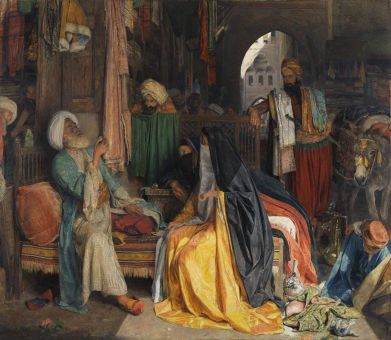
The Doubtful Coin John Frederick Lewis
In amongst Hunt and Millais, at the beginning of the catalogue, is that well known Pre-Raphaelite John Frederick Lewis.  Who?  John Frederick Lewis was an 'Orientalist' painter, as you can tell by The Doubtful Coin, who lived in Cairo in the 1840s and early 1850s before returning to England.  I think you can see a link between the above and Hunt's work done in the Holy Land, but his is certainly not a name I'd place so high on the list.  This is rather a pleasant picture though, and I wouldn't mind find out more...

Mr Heatherley's Holiday (1874) Samuel Butler
Mr Heatherley was the principal of an art school where Butler studied for a while and this picture shows the jumble of objects that were meant to teach the artists to be good little Academy members.  However, as Heatherley mends the much abused skeleton, something tells the viewer that Butler might be somewhat cynical of the system.  Again, I was not familiar with the picture, but I like it and find the over-packed still-life to be exceptionally well executed.

There are also pictures from William Millais and Arthur Houghton, together with James Smetham's Naboth's Vineyard, which resides at the Tate...

Naboth's Vineyard (1856)
None of which I was expecting to see in a Pre-Raphaelite exhibition, especially when other things are omitted, which I'll come to in a second.  I was slightly less surprised to see William Dyce listed, but was surprised when it wasn't Pegwell Bay.

George Herbert at Bemerton (1861) William Dyce
When I first started studying Victorian art, Pegwell Bay was one of those pictures that you are shown and you remember.  This is rather bland, unless you really get excited about Anglican ministers in Wiltshire.  Nice tree.

So that is the 1951 exhibition.  Mostly Hunt, Millais and Rossetti, with a certain amount of representation of others, but who is missing that we would unquestioningly accept as being Pre-Raphaelite today?

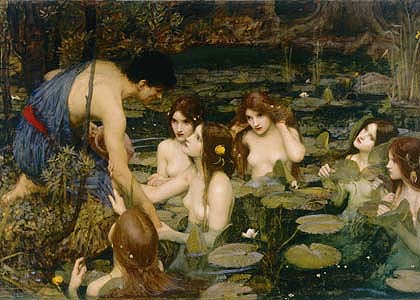
Hylas and the Nymphs J W Waterhouse
If you Google 'Pre-Raphaelite' in images, this is the fourth picture offered, yet where does John William Waterhouse fit in our construct of what it means to be Pre-Raphaelite?  I will be very surprised if The Lady of Shalott doesn't get an outing as it has to be one of the most familiar pictures at the Tate.  In terms of subject, his mixture of Shakespeare, Tennyson and Classics must be enough to assure him a place in the Pre-Raphaelite role call.  Similarly, wouldn't this count as Pre-Raphaelite...?

Cadence of Autumn Evelyn de Morgan
Oh dear, that sound you just heard was Carlos spinning in his grave.  If poor Ned got a slamming, then I can't imagine Evelyne de Morgan would fare any better, but surely we consider her part of the second generation of Pre-Raphaelite painters, trained by Burne-Jones?  Certainly her work is similar to his but the fresh colour palate is enough to mark her out as an individual.

The Boer War (1901) John Liston Byam Shaw 
Look at the riverbank - she might almost be looking at Ophelia floating down past her.  Byam Shaw is such an extraordinary artist, and so under used in exhibitions that it would be a shame if his work did not appear.  This is a classic piece of Pre-Raphaelitism, reminding me of early Millais or Hunt, the understated drama and mood-defining palate of colour.

The Little Foot Page (detail) Eleanor Fortescue Brickdale
Likewise, Byam Shaw's friend, Eleanor Fortescue Brickdale (how excited am I by talk of the exhibition of her work coming down to The Watts Gallery at Compton?) should deserve a mention for continuing the themes and methods of the Pre-Raphaelites into the twentieth century.  In fact, apart from Elizabeth Siddal, no women were in evidence in mid-century appraisals of the movement.  With what we know now, taking into account people like Joanna Boyce, Louise Jopling and Lucy Madox Brown (and a host more) you would hope that women artists would be very much in evidence in the Tate show this year.

When reading about the 1951 exhibition I began to wonder about the reasoning behind holding the exhibition and the choice of artists, and how that would play in the autumn.  Maybe it can be argued that the Pre-Raphaelites were the first and possibly only British art movement (despite where they got their influences) and in a year where we celebrated nationhood, the vision of a group of British artists, following their own passionate vision in revolt of everyone else is the sort of Victorians we need to feel we come from.  Post-War, the nation needed to feel there was a future, even in the vision of their past.  Maybe this year we need a vision of our ancestors, not cosy and chocolate-box-y, but as revolutionaries, men and women who pushed boundaries, because that is what our country feels it does well.  After all, this is the nation whose monarch sky-dives out of a plane with James Bond.  We need our artists to shake the establishment, and that is what our Pre-Raphaelite visionaries did.  Roll on September.  Or 1951.  Whichever comes first.

Saturday, 28 July 2012

The Best of British - Part Two: Defining Pre-Raphaelitism

Welcome to Day Two, as we look at who else was included in the 1951 exhibition of Pre-Raphaelite art, held in Bournemouth as part of the Festival of Britain.  Obviously, the inclusion of Millais, Holman Hunt and Rossetti was given, as was Stephens and Collinson (being founders), but when you start picking 'followers' who do you include?

As you might have guessed from Grace's comment yesterday, there is a bit of a shock, announced loud and proud at the beginning of the catalogue.  Carlos Peacock, what a fabulous name, gave us the fact that 'in the past it has been customary to include paintings by Burne-Jones as examples of Pre-Raphaelite work.'  Well, uh-oh, I feel trouble coming.  Burne-Jones is now unquestionably part of the Pre-Raphaelite story, but in the humble opinion of Mr Peacock, Ned symbolised 'the wan ghost of Pre-Raphaelitism', offering 'necromantic' 'bloodless aestheticism'.  Meow.  However, as he thought Ned was a pretty good draughtsman, he included a couple of his drawings. How kind.

Head of a Girl
Seated Woman Holding a Musical Instrument


These were the pictures Mr Peacock chose, and I am left somewhat underwhelmed.  Where is The Beguiling of Merlin?  Phyllis and Demophon?  Let alone The Depths of the Sea?  Ned is relegated to a mention about the group that painted the Oxford Union Debating Chamber, along with William Morris and Arthur Hughes.  Mind you, Arthur Hughes gets far more page room...

Ophelia (1852) Arthus Hughes
             Fair Rosamund (1854)
The inclusion of the two decent sized Hughes mark him as a man to notice, as does the mention of him in the introduction.  His journey to the Oxford Union, together with his adherence to the Pre-Raphaelite cause make him a worthy inclusion, it seems.  Arthur Hughes is definitely spoken of within the inner circle, and I can imagine that Ophelia, together with the almost certain April Love and The Long Engagement will be in evidence at the Tate.  The latter two, with their clarity of colour and strength of emotion, are things of beauty indeed.

Clerk Saunders (1857) Elizabeth Siddall (sic)
If you remember my ramblings about mid-century Pre-Raphaelite appreciation, then I expressed shame-faced surprised at the inclusion of Elizabeth Siddal in the Pre-Raphaelite role call.  It's not that I don't think she deserves the place, it's just that I was surprised she was allowed it in an otherwise male-dominated scene.  She appears in both the guise of Mrs Rossetti, the artist's wife and Miss Siddall, the artist, having her cover blown by the description of the pencil sketch for Millais' Ophelia which describes her as 'Elizabeth Siddall, afterwards Mrs D G Rossetti'.  It is refreshing to have her presented as just another painter in the movement, rather than 'poor Lizzie'.  There isn't even a mention of her death!  Can you imagine?

I was delighted to see William Windus included, even though it wasn't Too Late...


Study of a Young Woman (1880)
The portrait of Windus' daughter is joined by a rather odd image, entitled The Second Duchess....

The Second Duchess
Neither show Windus to his full potential but go some way to explain how Ruskin might have formed the opinion that his talents were not entirely in art.  Speaking of Ruskin...

Coast Scene near Dunbar (1847)
Ruskin's part in the formation of the Brotherhood and their motivation is given is sensitive detail, outlining Ruskin's love of Turner, and his very specific thoughts on the mystery of art.  Ruskin, like Effie and Lizzie, suffers from our utter obsession with personal grubby details, and his finer qualities are often missed.  How many people think 'Ruskin, he was a marvellous watercolourist, wasn't he?' before 'Ruskin, he never done his wife, did he?'

Rather a surprise entry is Robert Braithwaite Martineau.  I love his romantic images, and his minute detail, in this, possibly his finest picture...

Kit's Writing Lesson (1852)
This was painted in Holman Hunt's studio, and is taken from Dickens' The Old Curiosity Shop.  Although I love Martineau, I always put him firmly in the traditional Victorian art camp, rather than Pre-Raphaelite, but his detail is exquisite and his light is clear.  I hope there is some Martineau in evidence this autumn as I need to know more about Martineau and his connection to Hunt.  Plus any man who can paint a lovely shiny apple like that is okay by me.

Tomorrow we'll talk about the surprises, both of who was included and who wasn't.  Who did they think counted and who do we value now?  I'll give you a clue, Lizzie wouldn't have had to queue for the ladies loo at the 1951 Pre-Raphaelite party....