Friday, 2 December 2011

2nd December – The Mistletoe Bough

I promise I’ll be better today.  I am abstaining from mince pies while I type this, so it should be coherent.  I will also try and be a little more pleasant and Christmas-y, no more temptresses with frosty nipples.  Today, I bring you The Mistletoe Bough by William Loudan.


I need that dress please.  Anyway, this is an illustration for a very popular 1884 poem by Thomas Haynes Bayley, based on a ghost story that is connected to a number of stately homes in Britain (and no doubt elsewhere too).  The story goes that the lovely young lady decides that the best thing to do after her wedding breakfast is to have a game of hide-and-seek, and off she trots to secrete herself inside a giant chest.  Once inside, she finds she is unable to escape.  Years later, they open the chest and find a skeleton.  Happy Christmas!

My problems with this story are as follows:  Apparently they searched for weeks: ‘They sought her that night, they sought her next day,/ They sought her in vain when a week passed away. / In the highest, the lowest, the loneliest spot…’ However, not in the chest about the right size for a person to hide in.  The poem explains that it had ‘long laid hid’ in the attics, so that’s why they didn’t find her.  Hmmm.  It all sounds a little like a public information film from the 1970s.  Also, on my wedding day, it didn’t occur to me to play hide-and-seek, and I got married on HMS Warrior 1860, so it would have been an excellent place to play hide-and-seek.  Mind you, I wore a corset so tight that getting into a chest would have been damn near impossible, let alone getting out.  Maybe that’s what did for The Mistletoe Bough Bride; incapable of bending properly she remained trapped in the chest like a tipped sheep, unable to get up.

Me on my wedding day, but not in any danger of being
suffocated during a game of hide-and-seek.
Honestly, there isn't a chest big enough for me to get trapped in...
If you Google ‘The Mistletoe Bough’ there are a few paintings of the poem, but I must admit this is my favourite because of the lovely rich colours.  Her gorgeous dress is nicely off-set by the deep wood of her soon-to-be coffin, and the peacock-richness of the drapes beyond.  The detail on the chest is splendid, the way the light catches the carving and the little buttons and chess-boards of presumably ivory. 

She is a very pretty girl, who is very pink of cheek.  Possibly this alludes to the fact that she asks her new husband to be the one who finds her first.  Now, you know I’m not one to point out smutty interpretations unnecessarily, but maybe what the poem is about is the dangers of lust.  There is holly also hung around castle, but the poem and its refrain concentrate on the mistletoe, which is commonly associated with kissing, and with youthly passions, possibly bordering on folly.  It could be argued that the poem is more than a ghost story, it’s a warning to young lovers that if you want to arrange some impromptu hanky-panky then it will more than likely result in suffocation and misery.

So remember, by all means kiss your beloved under the mistletoe, but if you want to play naughty hide-and-seek, take a mobile phone or whisper to your lover where you are hiding.  I would hate to lose any of you….

Thursday, 1 December 2011

1st December - Heart of Snow

Welcome to my Blogvent Calendar.  I will post a picture and some overly personal commentary every day until Christmas Eve, when we will all eat too many mince pies, drink one too many sherries, become over-emotional and fall asleep.  I will start as I mean to go on with a semi-naked lady in the snow. 

Heart of Snow Edward Robert Hughes
Now, far be it for me to point out the folly of sprawling around in the snow with your boob out (we’ve all been there), but I’m hoping she is a metaphor, albeit one with a cold arse.  I love the rather cloud-like texture to the snow she is reclining in, and to start with I thought she was an angel.  She appears to exist in some glacial wasteland, dangling her legs over a cliff with only a bird for company.  Is it a dove?  It has awfully big wings and looks a little bit predatory, like a hovering hawk.  Thinking about the title, does Hughes mean that she is a nymph-like personification of snow or that she actually has a cold heart?  She seems self-contained, unbothered by her surroundings, so is it a criticism of the woman, cold and unbothered by her lover’s attention?  Is her heart as unfeeling as the perilous shafts of ice that jut towards the bird in the background, repelling and dissuading?

Happy Christmas!  Sorry, I’m sure she is just a nymph, she is the love and beauty, the ‘heart’, of the cold weather.  Hughes may be saying that when the snow falls and covers the land, it holds the same exquisiteness as a beautiful woman (with her boob out in the snow).

I think I added too much brandy to the mincemeat…see you tomorrow.

Monday, 28 November 2011

Prepare to be Corrupted!

Brace yourself.

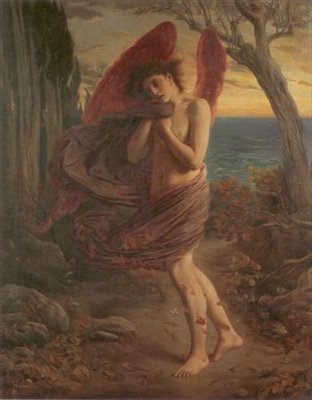
I rarely have the pleasure of reading a contemporary description of a painting without being familiar with it, but today I read an attack on a work I wasn’t overly conversant with, described as ‘one of those allegorical designs which usually suggest something unwholesome in sentiment…’ (The Times, 1872). Unwholesome? Count me in! You know I like a good dose of corruption. Going further, the Athenaeum pointed out the ‘unmanliness’ ruining the sentiment and both papers had suspicions that the central figure was a corrupting deviation on classical form. Hurrah. Let’s have it then!

Autumn Love or Love in Autumn (1866)
Oh. Hang on, I’ll try that again…

AUTUMN LOVE! LOVE IN AUTUMN! by Simeon Solomon
Is it just me, or is everyone else underwhelmingly uncorrupted. I expected to immediately fall on my back and roll naked on an animal fur, at the very least. As it is, it’s just a Simeon Solomon picture. No offence, Simeon, but you’ve not corrupted me. Then again, I wonder if you ever really wanted to.

The Sleepers and the One who Watcheth (1870)
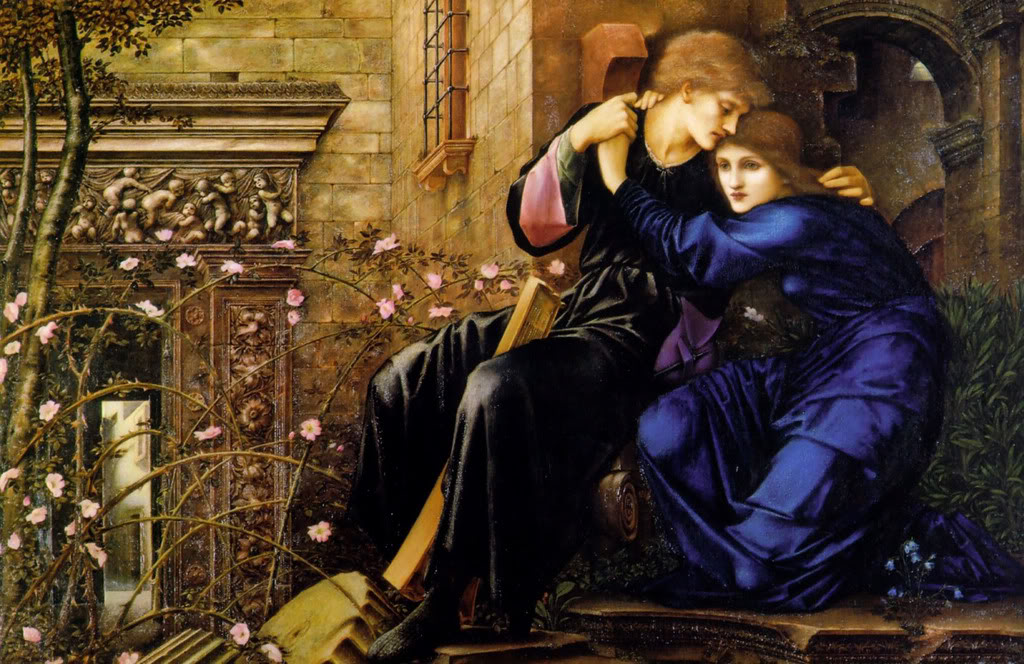
Love Among the Ruins Edward Burne-Jones
I love Simeon Solomon’s work. Recently, Mr Walker hung The Sleepers and the One who Watcheth (1870) in our bedroom, so the first thing I see when I open my eyes in the morning is that gorgeous painting. The painting shows a couple sleeping, while an angel watches over them, their faces all beautiful and peaceful. Although his figures are androgynous (but arguably no more than Burne-Jones), I think the figure in the middle is a woman, the figure on the right is a man, and the figure on the left is an angel, so mind your own business. I also suspect the figure on the right is Gaetano Meo, who modelled for Solomon frequently and was discovered by him playing a harp on the streets of London. He also posed for Burne-Jones’ Love Among the Ruins and Dante’s Dream by Rossetti. If I was less professional I would shout ‘Nom Nom Nom’ and giggle like a schoolgirl, and I wouldn’t be the only one as William Blake Richmond called him ‘the beautiful boy’. So what’s so awful about Love in Autumn?

Self Portrait (1859)
It was fine before 1870. Solomon, youngest of a family of artists, showed unusual and precious talent, devoting considerable time to illustrating religious and classical scenes. As his fame grew, his closeness with artists such as Rossetti and Burne-Jones had considerable influence on his work. I was surprised at how much Rossetti contributed as inspiration, until I saw this painting…

Poetry (1864)
It has a slightly lighter touch, but Poetry of 1864 reminds me of Rossetti’s pictures of Jane Morris, such as The Blue Silk Dress. The young lady has the look of Jane Morris, but it has been suggested that Jane sat for Simeon during this period. Some of his female figures do bear a remarkable resemblance to her, not least his famous images of Sappho. 
Habeat (1865)
Look at the variety of women on show in Habeat! (1865) – the golden-haired, thumbs down woman reminds me of a Sandy’s maiden, especially his women who seem to take sexual pleasure in the misery of others, for example Proud Maisie or Medea.

I think it is a shame that modern critics do not hail Simeon’s female portraits as heartily as his male ones, as they are equally as gorgeous. Take for example the different women in A Prelude by Bach (1868).


The lady in blue reminds me so much of Rossetti's Penelope.  Contemporary critics saw it as a pretty piece, nothing more, but modern readings note the two women embracing in the background as a symbol of the artist’s own same-sex desire. Now, I’m not saying that’s untrue, but plenty of other artists showed girly action without being gay, so I’m a little dubious. What is true is that the critics picked on the languid beauty of the male figures, and began to hint at an ‘unmanly’ quality to his work. Similar criticisms were understandably levelled at Burne-Jones, whose art most closely resembled Solomon’s style, so why did the mud stick to Simeon and not to Ned?

Love Amongst the Schoolboys (1865)
Well, the most obvious answer is that Simeon was gay, and not only that, he gathered patrons who were also gay. His work for Oscar Browning, patron and close friend, was open in its sexuality, such as Love amongst the Schoolboys (1865) and Eton Schoolboys (1867), and determinedly private in their subject, but Solomon’s behaviour had begun to attract attention. His trip to Paris in 1870 was more like a flee, avoiding the trouble that was beginning to follow him. If there were rumours of homosexuality beginning to circulate, his art was seen as proof and the criticism came thick and fast. In 1871, Simeon took a pasting in Robert Buchanan’s Fleshly School of Poetry, along with Rossetti and his other followers. The criticism levelled at Love in Autumn may well have been more knowing than it appeared. A main objection seemed to be that Solomon had chosen a young man to portray Love, rather than a chubby cherub, which Love 'obviously' looks like. There is a sneering hint that Solomon and his patrons would much rather look at the semi-clad young Love (who wouldn’t?) than a fat baby with a bow and arrow, and for that they are obviously ‘unwholesome’. Oddly, the same criticism isn’t levelled at John Roddam Spencer-Stanhope for his painting Love Betrayed where Love is a rather nice looking young man, if a little doomed. Mind your step…


It probably wasn’t a huge surprise when Simeon got arrested with George Roberts doing something naughty in a public loo, although he escaped prison, unlike the unfortunate Mr Roberts. His sentence of 18 months hard labour was reduced to police supervision, but he was ruined and fled London for Devon. The following year, he was caught again, this time in Paris, and this time served three months in prison. He lived another thirty years, but no longer could be openly welcomed by his old friends, plus his behaviour became erratic due to alcohol abuse, however his talent ensures that he is never forgotten or unappreciated, even in his own lifetime. Astonishing, if you consider the weight of prejudice against homosexuality, people continued to trumpet the beauty of Simeon’s work. The Dalziel Brothers used six of his pictures in their Bible Gallery, Five of his paintings appeared in the Royal Jubilee Exhibition of 1887, and Sidney Trefussis Whiteford published an article on Simeon in 1892 entitled ‘A Half-Forgotten Genius’, which led to further offers of work for the artist. Even the inclusion of his paintings among Oscar Wilde’s possessions did not seem to dampen public desire to see his work, and three years after his death, in 1908, Julia Ellsworth Ford published a monograph on his work.

Today, Simeon Solomon is heralded as a gay pioneer, subversively promoting the beauty of men during a period devoted to the female aesthetic. I love the fact that he could infuse a male figure with the same languid beauty as the women, but I worry that his personal circumstances overshadow is genius. By concentrating on his treatment of men, his equally exceptional pictures of women are largely ignored. The way I look at it is this: I think his brilliant portrayal of men isn’t to do with his sexuality as much as it is to do with his talent as an artist. Sometimes I feel that modern biography is often a case of making the story fit the ending. If you didn’t know that Simeon was gay, would you guess from his art? Maybe you’d guess, but look again at Burne-Jones or Leighton and think if the same judgement can be made of them. Maybe we could also celebrate Simeon Solomon for things he had a choice in: his bravery, his uncompromising use of art and his talent for gentle beauty.

Who wouldn’t want to wake up to that every morning?

Thursday, 24 November 2011

Could’ve been Millias

So, there was this artist. He started off all Pre-Raphaelite in the 1850s until he found a groove painting slightly more saccharine pictures of pretty girls and children, one of which became a famous soap advert. Who am I talking about? George Dunlop Leslie, of course, or Almost-Millais Leslie as I like to think of him. He could have been a contender, and in my opinion, on occasions, he was unbeatable…

Now, I’m not going to sit here and tell you George did anything better than Ophelia as that would be blasphemy on a grand scale. When he started out, George Dunlop Leslie had definitely leanings towards the Pre-Raphaelite in his style and subject.

Matilda - Dante, Purgatorio, Canto 28 'For thou, Lord, hast made me glad through thy work; I will triumph in the works of thy hands' - Psalm XCII, 4 (1860)
Oh, you know how I love a catchy title. Although slightly awkward, I think this painting shows a lot of promise and is a bit Arthur Hughes-y. The perspective is beautiful, with the group of figures seen on the other side of the river, and I love the use of colour at once both strong and muted.
He exhibited every year at the Royal Academy from 1859 onwards, becoming an ARA in 1868 and an RA in 1876, and his work changed to more mainstream subjects, as his wish was ‘to paint pictures from the sunny side of English domestic life'. Take for example this…

The Goldfish Seller
When I saw it, I immediately thought of the Millais portrait of the two young girls with the large glass goldfish bowl. Leslie’s use of the water and glass to distort the shape of the fish is gorgeous, look especially at the bowl in the seller’s hand. I find it interesting that the man kneels before them to show the bowls, in an almost ‘courtly’ way, with the lady in the porch viewing him in a cool but benevolent manner. I want her lace sleeves, by the way.

John Ruskin considered Leslie a great painter of gentle domestic scenes (that’ll learn you to run off with his wife, Millais) and thought his pictures displayed the ‘sweet quality of English girlhood’. Let’s not dwell on that too much, but you can see what he means…

The Daughters of Eve (1883)
Yes, it’s a bit sickly and pretty, but look at the little girl in the background, all in white. If she isn’t an aesthetic metaphor waiting to happen, I don’t know what is. Much like Millais, an awful lot of his work featured children, especially girls and often family. Possibly one of his most famous pictures now is this one…

Alice in Wonderland
Here is Alice Leslie, daughter of the artist, with, presumably, her mother, and she is listening to the story of Alice in Wonderland, and she is dressed in traditional 'Alice' clothes and imagining herself in Wonderland. It’s an interesting picture as you would not guess the title from the painting, but once you know the title the different meanings become apparent. Is the Wonderland in her head, the world of imagination, or does it refer to being safe and warm with a loving parent? Or both? I find the doll strange and its position slightly jarring – why is it not with Alice? Why is it cast aside in such a pronouced manner? Does it represent Alice asleep? I could go on like this forever…

Leslie’s capturing of the sweet quality of English girlhood (yes, that gives me the shivers too) made him an obvious candidate to produce a cutesy soap advert. Move over Bubbles….
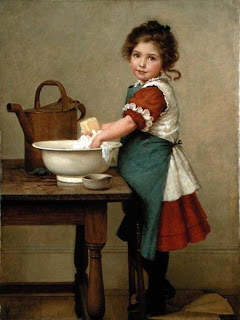
This is the Way We Wash Our Clothes
Oh, Lordy, but ignoring the soapy princess for a moment, look at the still life of the basin on the table. Isn’t it gorgeous? Again the colours are beautiful, the teal apron against the russet dress is deep without looking suspiciously dirt-friendly, and contrast nicely with the clean white of the bowl. I’d buy this soap, look how clean that child is. Lily-Rose is rarely that clean, she usually has chocolate or pen up her face, but don’t we all?

Later in his life, Leslie seems to have had moments of Pre-Raphaelitism again. I was surprised when I found out that the following came from 1904…

In the Wizard's Garden (1904)
This reminds me so much of early Pre-Raphaelite stuff, a bit Burne-Jones in subject, possibly with a bit of Eleanor Fortescue Brickdale thrown in for good measure. Look at her dress - that is a fabulous shade of red. I have no idea what is going on – is she being held prisoner? Is she his daughter? The wizard seems to be a dark figure, not very sympathetic, whereas she is giving us her best bambi-eyes. The garden looks bleak and autumnal, possibly reflecting the wizard, whereas the girl looks out of place, in need of rescue. It is an ambiguous picture, but a beautiful one.

Faith (1858)
The Nut Brown Maid

So what have I learnt from hanging out with George Dunlop Leslie? Well, his work is beautiful, whether or not you like the subject matter. His use of colour in paintings such as Faith or The Nut Brown Maid is exquisite, and he seems to be able to handle different palettes of colour with equal ease. Look at the slap-your-face red and green of Faith as opposed to the muted brown and dark teal of The Nut Brown Maid…

I find a lot of parallels between his work and Millais’. Compare Millais’ Cinderella and Leslie’s Her First Place…

Cinderella J E Millais
Her First Place


It’s tempting to say Leslie was paying homage to the pose of Cinderella with the young maid, to suggest that young girls were used inappropriately in our houses. Obviously my heart belongs to Millais in so many ways (that little red hat!) but Leslie’s light touch with colour and detail lifts this picture from being yet another Victorian domestic interior. Plus she has the sweet quality of English girlhood (God, I can’t stop it now…).

Mollie, 'In silence I stood, your unkindness to hear...' (1882)
Sally in our Alley (1882)


 To sum up, I think there will come a day when Leslie is regarded as highly as Millais, especially Millais’ later work, and rightly so. A part of me wonders if Millais reputation will end up depending solely on his few years of Pre-Raphaelite output, because I think Leslie deserves at least as much regard for his later work. 

Plus, he painted the Queen. Hurrah!

Queen Victoria George Dunlop Leslie and James Hayllar


Tuesday, 22 November 2011

A Tale of Two Illustrations

You must be tired of me saying this, but I'm still hard at work on Stunner 2.0 and this week I managed to get the last of my illustrations sorted.  Two of these have never been published before, so obviously I'm most excited about having them in my book. 

Firstly, I have the pleasure of using this image from the Lyman Allyn Art Museum in New London, Connecticut....


This is a rather glorious pencil, pen and ink sketch of Fanny from the late 1860s, possibly 1867, showing her looking sultry and glorious.  I love the fact that she is wearing her signature earrings, and looks at her 'Stunner' best.  If this does indeed date from after the advent of Alexa and Jane, the picture lends weight to the argument that Rossetti didn't just cast Fanny aside or cease to find her attractive, she remained a part of his art, and for that reason I wanted this little-seen picture to be part of my book.

The second picture is incredibly special.  Many of you will know the work of Raine Szramski and her marvellous pictures of the Pre-Raphaelites, if not take yourself off to Grace Nuth's blog, The Beautiful Necessity immediately! Anyway, I asked the lovely Raine if I could have a Fanny picture for Stunner. Being a classy lass, she didn't take it the wrong way, and she presented me with this....

 I have obviously pledged my undying love to Raine, and will proudly display her gorgeous picture in the upcoming (really, not long now) re-edition of Stunner: The Fall and Rise of Fanny Cornforth (now with added walnuts).

Adding pictures to Stunner, beyond my own photographs, has been a strange experience.  Part of me wants every single picture of Fanny, but in reality I only had £500 to buy a cover illustration and pictures for inside.  Now, I thought that would get me quite a few, but in reality, when certain museums were charging £250+ for a cover image and the average interior picture was £100, I was beginning to despair.  I have to admit that I ended up getting most of my illustrations from America: from Boston, Delaware and Harvard as well as Lyman Allyn, as they gave me such good rates for their gorgeous art.  Thank you to all of them for their fabulous and friendly service and their generosity.

Really, I'm working on it as we speak...I have a visit to a records office on Saturday, then hopefully the manuscript will be ready for proof-reading...

Friday, 18 November 2011

Confessions of a Saucy Blogger

I was lucky enough to deliver a paper at a Victorian Studies conference in Leeds about six years ago, and my session was handled between me and a charming lady from a University in Taiwan. She gave a thoughtful and clever paper on Lady Audley’s Secret. I showed nudie pictures of Kate Winslet while talking about film and Thomas Hardy. I got all the questions and people stayed behind afterwards to ask me things. The lesson we take from this is nudie Kate Winslet rules. Now, this was a damn shame as the lady from Taiwan’s paper was so amazing, but then I adore the book. The idea of a secret ruling you, controlling you, is compelling, and it absolutely defines the Victorian obsession with appearance. The Victorians feared the hidden shame, the skeletons in the cupboard, the secret, but also it was alluring, dangerous and fascinating. Who knows what people hide and what will happen when the beans are spilled….

Abandoned (1881) James Tissot (used by Penguin for their cover)
Well, I’ve read some shocking things in my time, but never felt the need to sprawl on the hearth rug in horror. I wonder if my blog is ever so scandalous that you just collapse in a heap of striped silk and laptop? Honestly, I would have arranged to fall a little further back from the fire, as you know my preoccupation about random sparks setting my dress aflame. I have a fascination with what art works are picked for book covers (more on that in another post) but I wonder why they picked this for Lady Audley? What has she read, what was in the letter, that would make her collapse? Has she been found out, or has she found out someone else’s secret? As the painting is actually entitled Abandoned then I’m guessing she is reading how her lover has left her. Either that or she had too much gin with her afternoon tea and fell out of her chair. Which of us hasn’t done that?

The Letter (1877) Marcus Stone
Oh, talking of unfortunate letters, this young lady seems to have been found out. I love her tense hand, almost claw-like on her paper, contrasting with his casual hand resting on the table as he reads the document that damns her. This is a picture is definitely two halves, the man reading without any outward sign of hostility or anger. The woman is in an ungainly, desperate pose, obviously where she has attempted to retrieve the letter and failed. If you compare it with Past and Present I by Augustus Egg, the woman seems to be almost as desperate as the cheating wife, but Egg’s husband has a look of shocked betrayal completely unlike the cool consideration of the man in Stone’s painting. He has turned his back on the crouching woman literally and presumably metaphorically, and her future does not look good.  Guillotine for her, I suspect...

So that's what happens when you are found out, but how about those that choose to confess their deep, dark secret?

The Confession Frank Dicksee
I think this must be the most famous of the ‘confessing’ pictures, with the shamefaced man hiding in shadow as he spills all to his lady, who couldn’t be more innocent looking if she had a halo. Really, she’s dressed in glowing white, we get it Frank, she’s innocent. She obviously hasn’t smelt the coffee yet. Come on dear, look at him, he’s not about to tell you he’s bought you a pony now is he?

The Confession John Collier
I actually prefer this ‘confessing’ picture as I can’t quite settle on who is confessing what to whom. The man’s face is more visible than the woman’s, she is cloaked in shadow, but neither of them look like the obvious guilty party. The woman is wearing white, but that contrasts with the shadows she leans into. I love the little touch of the poker by the side of the fire. Any moment, one of them is going to sprawl on the hearth rug in shock, I bet. However, I wouldn’t like to put money on which one…

A Confession William Warrener
On the whole, the majority of confessing in Victorian times seems to have been an all female affair, with women spilling the beans wholesale to each other. Sometimes it was a grim affair, like Warrener’s miserable cottage interior. The mother is obviously thinking ‘I should have known she’d be trouble when she painted her clogs red…’

The Secret (1867) James Tissot
Sometimes it seems to be a frilly, giggly affair, like with these two. My goodness there is a lot of accessories involved in confessing a secret. I think the lady in black is saying ‘Yes! I admit it! ‘Twas I that ate the last of the pink macaroons! Oh, and I’m sleeping with your husband.’ Shortly after this was painted, the lady in white gave the other a shove into the river.

A Confession Erik Werenskiold
Oh, Lordy, Granny does not look pleased. Maybe her granddaughter has told her something heartbreaking, something terrible and sad, or possibly Granny’s just thinking ‘I hope she gets to the point quickly as I’m missing Strictly Come Dancing…’

The Confession Alexander Novoskoltsev
This possibly can be filed under ‘Wrong’. I’m not sure what Cherry Ripe is confessing to Rasputin, but the whole scene makes me uncomfortable. Nice frock though.

The Sinner John Collier
Now, that’s better. I like the thought that all her naughtiness has made it hard for her to drag herself into the confessional. In fact, she looks exhausted. Wow, she has been misbehaving...

So, gentle reader, maybe it’s better not to divulge your deep, dark secrets, but then it might not be better to be found out. Actually, it’s probably better not to do the naughty deeds in the first place. Unless you want some nice clothes.

As for me, I have no deep, dark secrets at all.

 
Damn, someecards.com found me out! I am ruined...*faints onto the heath rug*

Wednesday, 16 November 2011

Alas Poor Walter...

Poor Walter Deverell.  Scarcely known or mentioned in Pre-Raphaelite writings and missed entirely in Desperate Bromantics (as I am now calling it), the brief flame of Walter's talent was well and truly snuffed by not only his short life but also his omission from the cannon of Pre-Raphaelite art.  It could have been so different for lovely Walter, so what went wrong?

Walter Deverell (1853) William Holman Hunt

Partly it's due to the fact that Walter never made 'Brother'.  He declined full membership, despite being very close to the other Brothers, due to his appointment as assistant master at the Government School of Design which he felt may be jeopardised by being a member of a revolutionary group.  It was rumoured that he was to have replaced James Collinson in 1850, but it was never to be.  Similar to others who were present at the early days of the Brotherhood, he was both a painter and a model, sitting for figures in the works of Holman Hunt, Millais and Madox Brown.

Claudio and Isabella William Holman Hunt

Walter's face can be seen in the expressive features of Hunt's Claudio, being denied by his sister the key to his freedom, her virginity.  I love the awkwardness of his long legs and pointy shoes (even more pointy in the sketch) and the petulant expression on Claudio's face.  Equally as wicked is Isabella's brother in Millais' Isabella, and Deverell's face can be spied at the back beyond hot Fred Stephens.

Walter Deverell, at the back of the picture.  How apt.
Born in Charlottesville in 1827, his family moved back to England after his Father left his brief post as tutor at the University of Virginia.  He met Rossetti in 1845 at Sass's Drawing School and the two became firm friends, sharing rooms in Red Lion Square in 1851.  Look, there is a plaque commemorating it:

Oh, sorry Walter, they missed you off...
Rather cruelly, I have a book that says his most important contribution to art was his discovery of Lizzie Siddal in a hat shop. Well, now, that's fighting talk.  Anyway, he used Lizzie for his model in Twelfth Night, a painting which says a lot about the situation between Walter, Lizzie and Rossetti...

Twelfth Night (1850) Walter Deverell
On the left, Lizzie as Viola (who is dressed as a boy) looks adoringly at Duke Orsino (looking remarkably like Walter) while Rossetti plays the fool.  I'm sure he didn't mean anything by it...This is the first of Lizzie Siddal's many appearances in paintings, and it seems appropriate that the gentleman who discovered her got to paint her first.  This is certainly his most famous picture, and often the only one of his works shown, mainly due to its overt Pre-Raphaelite pedigree.  It would be easy to see him as a one-trick pony, but I personally love The Grey Parrot of 1852 and A Pet of 1850 far more than Twelfth Night.

The Grey Parrot
A Pet


They both may carry a 'women as caged birds' message but the colours in both are gorgeous, especially the muted tones of The Grey Parrot. The same can be said of Eustatia from 1853.


The woman has an air of mystery, all that is visible is her face and her hand, clutching a handkerchief.  Her expression is vaguely teasing and proud, in conflict with the presence of the hankie, which hints at sadness.  She doesn't look sad, she looks like she will break your heart and stomp on the pieces.

Deverell was by all account a pleasant looking young man, and jolly, flirty company.  For me, the essential portrait of him has to be the figure in Ford Madox Brown's Chaucer at the Court of Edward III:

Deverell and lady-friend....
Poor Walter had a promising start to his career, and his work The Irish Vagrants gained much praise, even though Hunt complained that Walter had fallen for the fashion of 'dwelling on the miseries of the poor, the friendless and the fallen' (which is rich coming from the painter of The Light of the World).

The Irish Vagrants (1853)
All in all, Walter's painting career lasted around five or six years before he died of Brights Disease, a terrible kidney illness, abandoned by his troubled family and fading in a small house in Chelsea.  Apparently, he was working on the cheerily titled The Doctor's Last Visit and Young Children watching a Funeral before his death, which hints at his state of mind.  Had he lived, it has been written that he may have outshined Millais, and achieved mainstream success without diminishing romantic and poetic qualities.  However, poor Walter died and all we know him for now is a handful of paintings and a fortuitous visit to a hatshop.