Yesterday was spent in a grand tour of sites of Fanny Cornforth's life and other Pre-Raphaelite hot-spots for Stunner's second edition. I was ably assisted in this venture by Miss Stephanie 'Stealth' Holman (Resting Ninja who used to wrestle white tigers for diamonds). She collected me from Waterloo and off we went on a whistle-stop, crippling tour of the following places...
1. St John the Evangelist Church, Lambeth
On August 11 1860, Sarah Cox, spinster of the parish, and Timothy Hughes, drunk, gorgeous engineer married, and lived happily ever after. Okay, the last bit isn't true, but this is definitely where they married. It is suggested that Fanny dashed off to the alter with Mr Hughes after Rossetti married Lizzie, and his finer qualities seem to have been lost in the mists of history, so I think it is appropriate to make some up, seeing as all we remember Tim Hughes for is being a drunken incubus, which doesn't seem fair. As part of my 'extensive research', I can categorically say that Mr Timothy Hughes was a world-class lamb-juggler and founder member of the world's first boy band, with Isumbard Kingdom Brunel and Charles Dickens...okay, okay, but what I do know if that he was allegedly the model for the boy David on the left wing of The Seed of David triptych.
So we know he was possibly fine looking. Anyway, the marriage lasted until Hughes' death in 1872, when he was 42, but the couple only seem to have lived together for a short while, with Hughes being discarded as soon as Fanny could leap back into Rossetti's bed. However, what Mr Hughes did give us is Fanny's surname. I think it is more than likely she called herself 'Cornforth' after Timothy's Step-Father, George Cornforth. Anyway, back onto the tube and off to the next location!
2. 81 Drayton Gardens, Kensington
This is a view from the lane behind the property as the front of the building had been messed about with in about 1902 (the date is based on a plaque on the opposite building which had also been converted to flats), but in this rather splendid building Fanny lived with her second husband John Schott and his son Frederick in the 1880s and 1890s. It's a beautiful, leafy area and the house is enormous. Life for Fanny at this point was easy, her money plentiful due to her actions after Rossetti's death, which led us to this rather lovely building...
3. 1a Old Bond Street
Mmmm, Mappin and Webb...Also, home in 1882/3 to Fanny's tribute to Rossetti, 'The Rossetti Gallery', set up after his death, in competition with the Royal Academy and Burlington Fine Arts Club's memorial exhibitions. Incidentally, this building is only just down the road from the Royal Academy, so close you can spit into it from here. And she probably did.
3. 96 Jermyn Street
Mr Schott, a bandleader from Edinburgh, was a gentleman of many talents and one of them was making money. He and Fanny ran the Rose Tavern for many years, which now is Harvie and Hudson, gentleman's outfitter and general shop of couthness. I visited Harvie and Hudson when I published Stunner the first time and they showed me the beautiful tiled hallway, but on my return yesterday I was sad to see the sign had been removed. A picture of the sign appears in Stunner; it was a metal sign with tiny roses on the edges, possibly left from when it was the Rose Tavern. All that remains now are the roses in the plasterwork.
4. 9 Kilmarsh Road, Hammersmith
In 1901, this was home to Emily M Squire, a widowed dressmaker, and her children, and their lodger, Sarah Schott. Fanny (or Sarah Schott) as she was known by this point, had lost not only her husband, but also her stepson Fred, and her money was dwindling. It was from here she was taken by her sister-in-law Rosa Villiers, off to Hove and it has been presumed she died there in 1905, but no proof has been found. Yes, I'm working on that too...
5. The Argyll Room, 8 Great Windmill Street
I really wanted to see the building that was the Argyll Rooms, where Fanny would meet Boyce and Rossetti, but of course it no longer exists. Down a very narrow alley we found the site, just south of Soho, and although a lot of the buildings had been hacked about in various eras, there was a sense of a grand, yet slightly seedy meeting place.
Talking of seedy....
6. 24 Dean Street, Soho
I loved walking through Soho. My favourite bit has to be Walker's Court, which seems to consist of lots of live sex shows and porn shops. Makes me proud. Anyway, when Fanny was being a lady of ill-repute, she lived at 24 Dean Street, which is now part of the very grand and not at all seedy Marx Restaurant. Why 'Marx'? Because....
I think Karl moved out when Fanny moved in. Fancy a bit of company, Comrade? Obviously not.
The only place I couldn't take a picture of was 14 Tenison Street, Lambeth, which doesn't really exist anymore, it's now a whopping great big IMAX.
While I was up in the big smoke, it was too irresistible not to take a few other Pre-Raphaelite images. Partly I wanted some images to work from for my book about Alexa Wilding and partly there was one special place I wanted to visit...
Alexa Wilding Picture 1: 23 Warwick Lane, St Faith-under-St Paul
No, I wasn't expecting to see this exactly, but I really should have put the words 'St Paul's Cathedral' and 'Second World War' together, as this is what Warwick Lane looked like in the 1940s....
So, really I shouldn't have been surprised by the very new buildings lining Warwick Lane. I wasn't expecting that many police though. Blimey. Anyway, sorry Alexa, no joy there. How about your home in Kensington?
Alexa Wilding Picture 2: 33 Redcliffe Road, Kensington
Not far from Fanny's home in Drayton Gardens is the leafy and gorgeous Redcliffe Road. How exactly did Alexa, daughter of a butchery family from Newgate afford to buy a house down here?
Well, how delightful! So, which one is 33? As we walked down the road, we gasped and sighed at the lovely Victorian villas, until we reached 33...
Rats. Stupid bombing, I was beginning to take it personally. To be fair, there was one other house missing from the row, more than likely the victim of sticks of bombs picking off individual houses. However, her place would have looked a little like the one on the opposite side of the road...
Mmmm, pretty, and very posh. Makes you wonder how a lass on a pound a week could afford to buy it...
So Stealth and I rambled all over London, using a combination of map and Miss Holman's ability to know location by where she had been very drunk (she's such a louche influence, which is why I love her) and our final destination was this rather unimpressive house in a Square by Bloomsbury...
Fairly typical of many houses in that area, and quite unremarkable until I tell you that I was stood in Red Lion Square, and that white plaque on the wall? Have a look....
How could I not visit? Astonishing to think that Miss Holman and I were stood outside the house where Rossetti, Morris, and Burne-Jones (and Walter Deverell) lived, back when things weren't utterly messed up for them all, before death, deceit, adultery and other crimes against each other loosened the bonds of brotherhood.
We sat in the garden in the middle of the square and enjoyed the peace, while Miss Holman rubbed her ankle and I rubbed my neck, both of which were agony by this point. We suffered for their art, and for your entertainment, but I wouldn't have missed it for the world.
Fanny Cornforth and Karl Marx, who'd have thought it?
Sunday, 13 November 2011
Thursday, 10 November 2011
Beata Mea Domina!
As you know, I am currently sneakily writing a Pre-Raphaelite novel, and part of the joy of writing it is the chance to animate figures from the artistic world that I know so well. It has been a wicked pleasure, for example, to write Fanny Cornforth’s words and actions, how she appears to me. My novel is set in the late 1860s and 1870s and revolves around Rossetti’s circle. I felt happy and confident until I realised that I would have to tackle Jane Morris.
![]() |
| Pretty much the same facial expression I had when I realised I would have to write for Jane Morris... |
So what’s Jane Morris like?
Ummmmmm………..
See, that’s just it, I suddenly realised I don’t have a clue. Not only that, I think on the whole I actively avoid her.
That’s shocking. I have nothing against Jane Morris, nothing at all. Or so I thought. Considering further, I discovered that of my wall of Pre-Raphaelite postcards and pictures at work, only one is Jane Morris. Lord alive, I have more of Fanny Waugh than Jane. What is my problem with Jane Morris?
Obviously, my attitude is greatly influenced by Fanny. On the face of it, Jane Morris managed to have her cake and Fanny’s cake too, although I doubt she ate either cakes, she most likely just reclined artistically on a couch with the cakes beside her. Jane climbed the social ladder from working-class girl who was a bit funny looking (by contemporary standards) to muse of an art movement, with an independently wealthy husband and Cotswolds shag-pad for her brooding lover. Oh, hang on, I’m getting cross again…
In Nerina Shute’s Victorian Love Story, Fanny and Jane discuss Rossetti and agree that they both want what is best for him, despite not liking each other. Although it is unlikely any such conversation took place (God, can you imagine...?) Jane’s love for Rossetti through some of the most trying years of his life shows that she did genuinely care for him, and tried as much as Fanny to keep him together when he was bent on self-destruction. By taking him off to Kelmscott, you could argue that she delayed his implosion, gave him some happy times before the inevitable. How could I object to that? Her husband didn’t…
Ahhh, William. Another sticking point for me is that it’s all well and good that she looked after Rossetti, but what about her husband? Recently, I heard Franny Moyle refer to William as a hellish husband, impossible to live with, but I’ve never got the impression from anything I’ve read that Morris was a bully or a brute. A bit socially awkward, granted, and a bit like a bull in a china shop, but not awful. As far as we know, his close friendship with Georgie Burne-Jones was as close as he ever came to playing away.
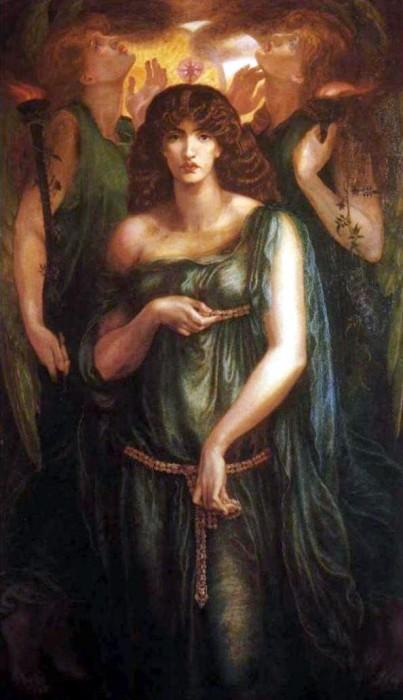
I think it was Bell Scott (correct me if I’m wrong) that actually blamed Jane for Rossetti’s break down after the Fleshly School review. He suggested that it was her presence in Rossetti’s imagination that had worked up something dark and destructive, calling her 'sweet Lucretia Borgia', and it’s easy to see what he meant. Although similar in structure, the pictures of Alexa and Fanny are miles away from the pictures of Jane. Rossetti was capable of glorious, glowing paintings such as Venus Verticordia and also, my favourite of Jane, Astarte Syriaca, which draws you into the darkness in a particularly intense way. I saw Astarte recently at Manchester and it is utterly astonishing and a little bit terrifying. I have read criticism of Rossetti’s work that suggests that all his women look like they are dying. Well, actually I think his depictions of Jane Morris look like she’s coming to kill you.
Now, that’s just it, maybe the problem is the way I ‘consume’ Jane Morris (that just sounds odd, sorry). Possibly if I am relying on Rossetti to tell me about Jane, I’m going to get a bad impression because he’s not talking to me from the Sane Train. When I read The Wayward Muse, I got a distinct impression of a woman who made bad choices but experienced more of life than she expected, both better and worse. I felt sympathy for Jane, a real attachment to her, which I didn’t expect.
![]() |
| Astarte Syriaca (1877) |
Fiction being fiction, obviously I can’t base my opinion of her on a romantic novel, but as she kept her mouth shut, I have very little to go on. Her rather studied silence was taken as proof of her ‘mysterious muse’ nature, and unlike Fanny, Jane strikes me as a woman who understood that it was better to be silent and be suspected of being an idiot, than to flap off your mouth and prove everyone right. I know she denied that her relationship with Rossetti was sexual, which tends to be greeted with snorts of disbelief, but if you take Rossetti’s hydrocele into consideration (ouch) it’s not out of the question. It doesn’t excuse what she did as she still drove her husband to Iceland with her love affair. I’ve been to Iceland and it was lovely but I flew and had a Toblerone on the plane. William Morris got neither a plane ride nor a Toblerone. Poor William.
Maybe I should turn over a new leaf and attempt to understand Jane better. When Rossetti’s madness became too much, she did withdraw from him for the sake of the children (no, I don’t believe for one second that Jane left Rossetti because he lusted after May. Not every Victorian man was a paedophile. Oh, and not every single man was gay, and some gay men got married! Gosh, it’s like they are deliberately refusing to be pigeonholed…naughty Victorian men!). She succumb to the adoration of a man who created a series of stunning art works out of her image, which must have been hard to resist and her husband enabled the dysfunctional relationship as much as she allowed it. What Jane represents is a woman attempting to get as much out of life as the men who surrounded her. I think the images of her as an old lady are very telling. Even then people sought her out to model, because she represented an eternal creature, something almost supernatural in its power and majesty. There are worse things you can be remembered for....
It’s better than being remembered for being an illiterate, nut-flinging whore. Sorry, Fanny...
Monday, 7 November 2011
Getting Sweaty with Etty
Oh, for goodness sake. Recently it's been nothing but decapitation, nudity and self-abuse. I promise I'll be more intellectual this time, I have a masters degree and everything. I know all about theories and stuff, I promise I'll try harder to be serious.
So, I went to see the marvellous Etty exhibition in York last week, 'Art and Controversy', and I thought you'd like to see the intellectual highlights, while I talk all serious and the suchlike, 'cos that's what I do.
I never really went mad for Etty, not in the same way as I do for Pre-Raphaelite paintings, or anything later in the nineteenth century. Poised right at the beginning of the Victorian period, William Etty produced a consistently beautiful body of work, which still has the power to impress and astonish. What I tend to think of when I think of Etty is this...
The whole title is Candaules, King of Lydia, Shews his Wife by Stealth to Gyges, One of his Ministers, as She Goes to Bed, which is fairly impressive. The story goes that Candaules thought his wife Nyssia was the most beautiful woman in the world and wanted to display her perky pinkness to Gyges. Nyssia found out and told Gyges that either he killed Candaules and seize both her and throne or face execution. He thought for about ten seconds and chose the former. When Etty exhibited this picture, people were outraged at the unbridled sensuality, the complicitness of the audience as voyeur and the general unpleasantness of the subject matter. I was surprised at the controversy - haven't we all seen worse? Isn't it a typical artist's standpoint, basically the pimp at a peepshow? I find the composition, the white vertical pillar of female form bisecting the perfidious men, one boastful, one bloodthirsty and controllable, glorious and unsettling. I also think the fabric Nyssia holds looks like the stars and stripes, oddly...
This is also the sort of thing I associate with Etty...
Rachel (the stage name of French actress Eliza Felix) was described as a 'dark brown Queen of Tragedy'. With Manga-big Disney eyes, she looks like she is emoting like crazy and she came to the London stage in 1841, a year after this portrait was done. It has a rough, unfinished look, yet captures the beauty of this young woman, who made a living out of looking on the verge of tears. I really don't like this, it's too sketchy and unfinished for my tastes, yet I am completely in love with this...
This reminds me so strongly of Millais' portraits of Effie, for example...
As Millais produced images like this during the 1850s I would guess that he may have been familiar with Etty's work. It has echoes of Pre-Raphaelite colours, the beautiful juxtaposing of the white, magenta and green and the shiny sweep of hair. Beautiful...
Oh, Miss Elizabeth Potts, aren't you fashionable? She looks like a china doll, so stiff and formal and without the ability to move or else risk dislodging that crown of plaits and curls. Dotted with cameos and dressed in her finery, poor Miss Potts was given a bit of a rough ride when she was exhibited. It was felt that Etty, a renown history painter was not skilled at portraiture as Miss Potts appeared to be sitting in a gloomy wood with a broom handle up her back. Etty may not have won over his critics with this but he was smart enough to get paid by Elizabeth's Dad before he exhibited it.
Oddly, this portrait of Charlotte and Mary Williams-Wynn was heralded as a triumph. Any guess to what costumes the sisters are wearing to the fancy dress ball? I guess they are going as a pair of bath taps.
Part of the reason that the critics hailed Etty's move to portraiture was that he was mostly known for his female nudes. It made a change for him to paint a dress, but when the nudes are as beautiful as the young lady above, then I don't know what the problem is. She was my favourite at the exhibition, I adore her face and her vaguely bored expression. It is a very modern work, reminding me of the work of Freud or Epstein, her expression less simpering that you would expect from 1830.
I suppose when it comes down to it, Etty is best known for his nude studies. There is a lovely bit in the catalogue where they point out that the gentlemen in 'The Wrestlers' would have had to remained locked together for a considerable amount of time, not allowed to move while Etty painted. If I was being less professional I would have something very saucy to say about that, but look how grown up I'm being. Not a word. Is it just me or is the man on the right sporting some elf ears? Possibly this was going to be a picture of Pan wrestling or something., either way there is some astonishing flesh on display. Etty practiced his flesh tones obsessively and liked to paint the entire spectrum of colours and it really shows here. This is a painter who knows flesh.
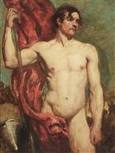
Still being really professional...My word. Apparently there were supports hung from the ceiling of the Royal Academy, enabling an artist to string up his model, so they could hold up-stretched poses without fatigue. There is a fascinating essay in the catalogue about how the picture changes if you rotate it, so that the model is on his back. It becomes so utterly debauched, Mrs Walker is forced to have a sit down and fan herself. Mmm, manflesh. Sorry, where was I? Oh, yes, being all professional...
See how I don't make any remark about lowering standards? There is a discussion ongoing about whether or not Etty was gay, his attention to detail in his beautiful male nudes held up as evidence. I don't know one way or the other, and a little part of me thinks that's his business not mine, but the man knew how to paint a male nude that makes ladies take a serious and professional look. For the record, he also did girls...
Blimey, that is some realistic, gorgeous skin. Interestingly, there is no pretense with Etty that it is about anything else, even her face is in shadow. I'm sure there are far less professional art historians out there who would say that the quality of Etty's flesh paintings makes them want to bite the canvas, but not me, no.
In order to round this piece off before I admit to wanting to nibble parts of the anatomy of Etty nudes, I bring you this portrait. We don't know who she is, but look at her expression. If you were requesting a portrait, would you say 'Oh, and can you make me look like I'm really worried?'. Her Victorian finery, her lace shawl and cap, her brooch, are all very standard, but her forehead is furrowed in a soft frown and her eyes are concerned. Maybe it's a reflection of her black dress - has she lost someone, is she concerned for the future? The fact that we know nothing fuels the feeling that her concerns were legitimate - was she worried that her future was uncertain? For a painter that often paid no attention to the expression, this is such a striking display of emotion. Possibly the glory of Etty can only be appreciated when his nudes are displayed with other pieces of his work. I entered the gallery as a doubter and I left utterly seduced. William Etty, you are a star.
'William Etty: Art & Controversy' is on at York Art Gallery until 22 January 2012. Go and see it, you won't regret it.
So, I went to see the marvellous Etty exhibition in York last week, 'Art and Controversy', and I thought you'd like to see the intellectual highlights, while I talk all serious and the suchlike, 'cos that's what I do.
I never really went mad for Etty, not in the same way as I do for Pre-Raphaelite paintings, or anything later in the nineteenth century. Poised right at the beginning of the Victorian period, William Etty produced a consistently beautiful body of work, which still has the power to impress and astonish. What I tend to think of when I think of Etty is this...
| Candaules, King of Lydia, Shews his Wife by Stealth... (1830) |
This is also the sort of thing I associate with Etty...
![]() |
| Mlle Rachel (1840) |
Rachel (the stage name of French actress Eliza Felix) was described as a 'dark brown Queen of Tragedy'. With Manga-big Disney eyes, she looks like she is emoting like crazy and she came to the London stage in 1841, a year after this portrait was done. It has a rough, unfinished look, yet captures the beauty of this young woman, who made a living out of looking on the verge of tears. I really don't like this, it's too sketchy and unfinished for my tastes, yet I am completely in love with this...
![]() |
| Study for The Crochet Worker (Mary Ann Purdon) (1849) |
As Millais produced images like this during the 1850s I would guess that he may have been familiar with Etty's work. It has echoes of Pre-Raphaelite colours, the beautiful juxtaposing of the white, magenta and green and the shiny sweep of hair. Beautiful...
![]() |
| Elizabeth Potts (1834) |
![]() |
| Preparing for a Fancy Dress Ball (1835) |
![]() |
| Female Nude (1830) |
![]() |
| The Wrestlers (1840) |
![]() |
| Male Nude with Arms Up-Stretched (1828-30) |
![]() | |
| The Standard Bearer (1830s) |
![]() |
| Standing Female Nude (1835) |
![]() |
| Portrait of an Unknown Lady (1840s) |
'William Etty: Art & Controversy' is on at York Art Gallery until 22 January 2012. Go and see it, you won't regret it.
Friday, 4 November 2011
What Doesn't Send You Blind, Does You Good...
The most filthy thing I have ever seen was in a museum. Now, I possibly lead a very sheltered life (imagine that…) but rarely in my day-to-day life do I get to be that close to other people’s very rude goings-on. I blushed, or at least I imagine I did, I was too busy worried if the young lady in question was comfortable. Allow me to explain…
This is really the tale of two exhibitions and a bit of a ponder about what is shocking. It all started when I went to the Victorian Nude exhibition at the Tate, a few years back. Glorious show, all lovely stuff, but for the first time I saw a roped-off area that you had to be over-18 to enter. I could pass for eighteen at the time (cough, cough) and so went and had a look, bracing myself for the corruption that would befall me.
![]() |
| Untitled (1898) Edward Linley Sambourne |
Oh, well, that wasn’t all that corrupting after all, and I liked it so much I now use that postcard as a bookmark. There was a strange section of images of children that were seen as acceptable at the time, but had been placed behind the barrier because of the connotations today. Most of the other pictures were photographs, mainly from various ‘photographic clubs’ (Mmmm, Gentlemen’s Relish…) and were nudie and a bit naughty. The difference between one side of the barrier and the other seemed to be that it was okay to show kids paintings of naked ladies, but photographs of the models were unacceptable. I accept that some of the works had less to do with art and more to do with the novelty of pubic hair, but on the whole it was all just naked people. I found it interesting that the Tate made the distinction but I applaud their guts for including some works which might have proved controversial.
The Walker family found themselves in Sweden at Easter, and having a little time to kill before checking in to our hotel, we wandered over to the National Museum. Outside were giant banners for an exhibition called ‘Lust and Last’ (or Lust and Vice) together with images of gamely plump 18th century ladies. Good-o, we cried as a family and off we trotted. We bought our tickets and went to the glass doors which led to the exhibition. In neat writing there was a little note: ‘Some of these images may be offensive’. Really? Come now! This is art and I can see a party of teenagers with clipboards, surely this is education? Come on, let’s get educated!
Oh.
My.
Giddy.
Aunt.
No over-18s area here, many children milling around with either school groups or families and possibly some of the most astonishing things I have ever seen in a museum. Lily’s favourite was the painting of the Nun…
![]() |
| Nun (1731) Martin von Meytens |
With this on the reverse…
![]() |
| Reverse of above |
‘Nun’s bum!’ she shouted loudly and then cackled all the way round the room. She also thought the sleeping hermaphrodite statue was hilarious. T’uh, everyone’s a critic. As I have mentioned before, Mr Walker works in a museum, and spent the whole exhibition muttering ‘We could not have displayed that! The Daily Mail would have had us raided…’ I don’t know where to begin…clay phalluses with bite marks, a vicious looking chastity belt, a collection of public hair filed on a card index system (Mmm, organised). The Origins of the World by Courbet was present and looked positively tame. (I would show that here, but I don’t want to be condemned by the Daily Mail, so I encourage you to Google it. But not at work. Or in public.)
Then there was the giant film screen showing the lady in the forest enthusiastically pleasuring herself. Oh my.
The art was insanely beautiful and startling in equal amounts and I felt so offended by the whole experience I bought the catalogue. And some postcards.
Part of the exhibition was this staggeringly gorgeous image…
![]() |
| Nymph and Faun (1875) Julius Kronberg |
Oh my heavens, this is a beautiful image, but apparently utterly filthy, as bad as Forest Lady and the Gentleman in the Brown Room (Don't ask - Heavens, you will all go blind! Stop that immediately, or at least wait until I’ve left the gallery). This, in its day was pornography, skilfully painted, but arguably only existing for titillation. The point the marvellous Swedish Museum was making was that one era’s porn is another era’s treasure, that one naked lady in a forest is no better or worse than another. It’s all taste and tolerance. I blushed at Forest Lady but would hang the Victorian painting on my wall.
Here is a very shocking painting from 1865.
![]() |
| Venus Verticordia (but you all knew that) |
Venus was described as ‘a trifle too voluptuous…for a respectable old sinner like me…’ by George Rae, one of Rossetti’s patrons. Condemned by Ruskin and disapproved of by Holman Hunt, the painting was seen as coarse and vulgar, little short of pornography. Now over 150 years old she is the poster girl for the Russell-Cotes Art Gallery in Bournemouth, and you wouldn’t be embarrassed to give your Granny a tea-towel with the painting on.
I suppose what I’m saying is that I appreciated the attitude demonstrated in Sweden that something can be learnt by the comparison of art forms over the ages. It shows us that basically we are all the same, no different from our ancestors. It’s sometimes easy to think of people in the past as strange creatures but I prefer to think that as a group we have changed very little in essentials since we were in the caves. We all contain echoes of our past and some echoes are louder than others. None of them should startle us, because given 150 years we'll be sticking it on a tea towel.
In a forest, really, I ask you….
Wednesday, 2 November 2011
Ford Madox Brown: Pre-Raphaelite Pioneer
The rumours are true, I do get around. This weekend I managed to hit both the Etty in York and the spectacular Ford Madox Brown exhibition in Manchester. I love going to Manchester for two reasons: firstly I get to see Helen and Rob, who are marvellous, and secondly they have some insanely beautiful pieces of Victorian art, like Hylas and the Nipples and Astarte Syriaca. On Sunday, I combined the two best things in Manchester by meeting Helen and Rob at the Art Gallery and it was marvellousness itself.
So, for those unable to go, or just because I like talking about art and no-one has told me to stop yet, here are my highlights from the exhibition:
1. Head of a Girl (c.1840)
I couldn’t believe this was Brown, as the style is so different, but it is such a beautiful picture. It felt quite Rembrant-y in the use of dark and light and I adore how the light catches the curl of hair on the side of her face. The colours are quite muted and the dress is a lovely golden mustard colour. It feels at once much older than Victorian, but if you told me it was painted this year I wouldn’t be surprised as it has a quite modern feel too. Gorgeous.
2. The Hayfield (1855) and Carrying Corn (1854)
I have a photograph somewhere of my grandfather up a hayrick during a harvest in the early years of the twentieth century. I adore the landscape in both pictures and even though there is a moon showing in The Hayfield, I still adore the image. I have a problem with images of the moon, or more specifically when the moon is disproportionately large, as occurs in ‘the moon illusion’ when it appears nearer to the earth. This moon is fine and entirely proportionate. It’s very Thomas Hardy in a rural-idyll kind of way, and I find the golden peace of the images very soothing. I love the way the light plays across Carrying Corn, making the corn bright and gold, while the turnip lady is in shadow. The moonlight of The Hayfield reminds me of being back in Wiltshire, when the moon was so bright it wasn’t dark anymore. I remember running around a field at night as a child, even though I was scared of the dark because it was like a strange daylight and absolutely magical.
3. Stages of Cruelty (1856-90)
Well, you know how I like a strange picture and bar Take your Son, Sir!, this has to be the weirdest one he did. A woman ignores her pleading lover with a smile while a little girl beats a dog with some love-lies-bleeding. It’s a rather sledge-hammered point about punishing loyalty and women’s cruelty with love, but look how splendid the foliage is! Plus I’m a sucker for the meaning of flowers so we have the geraniums pinned to her heart (either ‘deceit’ or ‘preference’, but I like to think deceit), morning glory growing up the handrail meaning ‘love in vain’ and the love-lies-bleeding, which cannot have any good meaning with a name like that. Awful and fascinating in equal measure.
4. Byron’s Dream (1874)
I thought the figure of Mary, the object of Byron’s passion, was reminiscent of Fanny Cornforth. She’s a lovely looking woman with hair and skirts flowing everywhere and she vaguely holds the hand of the smitten but nervous looking Byron, who hides his club foot under the rug. In the distance you can see the small figure of the man Mary pines for and will eventually marry. What I didn’t realise was that Brown and Marie Spartali had been romantically involved and this work was painted around the time she had married William Stillman and may reflect Brown’s sadness and bitterness at being the Byron figure in the romance. Mainly I just want to flounce around in a big red skirt and break men’s hearts, but I digress...
5. The Irish Girl (1860)
Gorgeous, no wonder she is the poster girl for the exhibition. The simplicity of the image, the use of red and brown, highlighted with that vivid blue is utterly beguiling. She reminds me of Rossetti’s later works, particularly something like Regina Cordium. I love her distracted gaze, her little hand and her shawl. Just gorgeousness itself.
6. Thinking (1869)
I have a weakness for coloured chalk, and this is a lovely pastel of Emma Madox Brown, not least because she’s not showing her teeth which always seems to make her look a bit like a bulldog. It’s nice to see Emma in almost a straight portrait, rather than the many, many images of her as all the different characters she played for her husband. Emma is 40 in this picture and I wish I looked this good. My favourite bit is the way the orange ribbon just seen in her hair matches the burnt colour of her dress.
Obviously, in this exhibition you get to see the well-known works too. It was staggering to see Work up close, and see the preparatory sketches, and also Last of England and Pretty Baa Lambs. Part of the joy of Pretty Baa Lambs has to be spotting the enormous sheep in the background. That is one huge sheep...
So, my friends, if you are able, make your way to Manchester before 29th January 2012 and enjoy what is a unique experience. I was only moaning about the lack of retrospective for Brown recently and here one is. Perhaps I should moan more often if the results are this stunning....
Subscribe to:
Posts (Atom)